METAMORPHIC ROCK
Whenthe pre-existing rocks are subjected to
increased temperature, pressure and action of
chemically active fluids, metamorphic rocks are
formed.
During Metamorphism re-crystallization of Mineral
Constituents takes place as a result new minerals
and new textures are produced.
3.
AGENTS OF METAMORPHISM
Thereare two agents of metamorphism:
1) Physical Agents (Heat, Uniform Pressure and
directed Pressure)
2) Chemical Agents (Chemically active water and gases)
Physical changes produce new texture where as
chemical Changes caused formation of new minerals.
Physical Changes
Changes in texture are produced by re-crystallization
(Original Minerals undergo a change in the structure
that is they are flattened and elongated).
TYPES OF METAMORPHISM
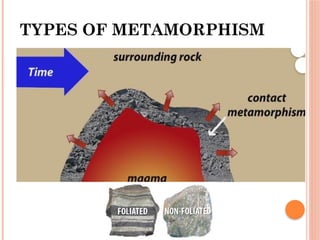
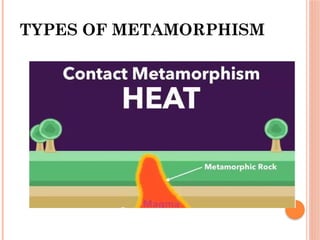
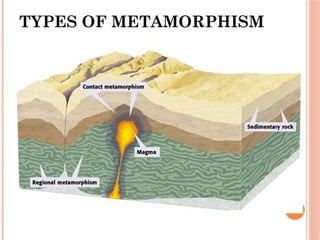
ContactMetamorphism:
A type of Metamorphism in which type of mineral and
texture changes mainly by heat due to contact with
magma.
Since only a small area surrounding the intrusion is
heated by the magma, metamorphism is restricted to the
zone surrounding the intrusion, called a
metamorphic or contact aureole.
The rock produced is often a fine-grained rock that shows
no foliation, called a hornfels.
TYPES OF METAMORPHISM
RegionalMetamorphism:
A type of metamorphism in which the mineralogy and
texture of rocks are changed over a wide area due to
heat and pressure.
Regional metamorphism occurs over large areas and
generally does not show any relationship to igneous
bodies.
Thus, regional metamorphism usually results in forming
metamorphic rocks that are strongly foliated, such as
slates, schists, and gniesses.
TYPES OF METAMORPHISM
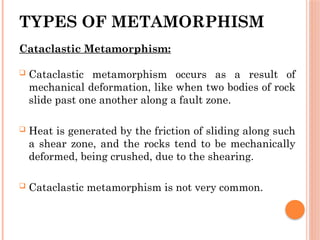
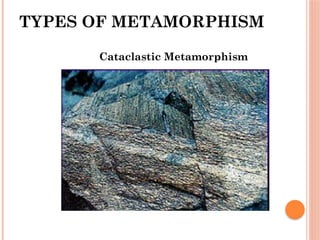
CataclasticMetamorphism:
Cataclastic metamorphism occurs as a result of
mechanical deformation, like when two bodies of rock
slide past one another along a fault zone.
Heat is generated by the friction of sliding along such
a shear zone, and the rocks tend to be mechanically
deformed, being crushed, due to the shearing.
Cataclastic metamorphism is not very common.
TYPES OF METAMORPHISM
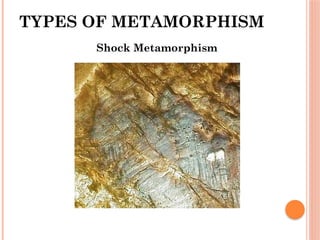
ShockMetamorphism:
If there is a very large volcanic explosion, ultrahigh
pressures can be generated in the impacted rock
producing Shock Metamorphism.
These ultrahigh pressures (2400Mpa) can produce
minerals that are only stable at very high pressure.
They can produce textures known as shock lamellae
(thin layers) in mineral grains
METAMORPHIC ZONES
Thedegree and intensity of Metamorphism generally
increases with depth because the depth increases
temperature and pressure also increases.
There are three types of Metamorphic Zones:
o Epizone or Upper Zone
o Mesozone or Intermediate Zone
o Ketazone or Lower Zone
15.
METAMORPHIC ZONES
Epizone:
Thiszone Lies near the earth surface.
Temperature is Low (300˚C) and Pressure is High.
Cataclastic Metamorphism takes place.
Phyllites are the typical rocks of Epizone.
Mesozone:
Intermediate Zone Temperature is of the order 300˚C to
500˚C.
Directed Pressure is also very high.
Regional Metamorphism takes place.
Schists are the typical rocks of Mesozone.
16.
METAMORPHIC ZONES
Ketazone:
Itis the bottom most zone where directed pressure is
absent.
Uniform pressure is high
Temperature is also vey high (500˚C to 800˚C).
17.
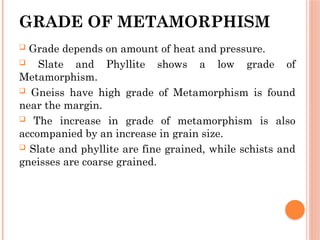
GRADE OF METAMORPHISM
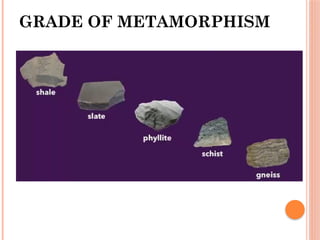
Grade depends on amount of heat and pressure.
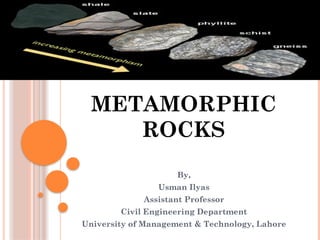
Slate and Phyllite shows a low grade of
Metamorphism.
Gneiss have high grade of Metamorphism is found
near the margin.
The increase in grade of metamorphism is also
accompanied by an increase in grain size.
Slate and phyllite are fine grained, while schists and
gneisses are coarse grained.
STRUCTURE OF METAMORPHIC
ROCKS
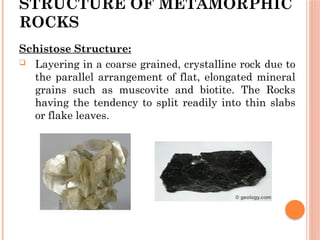
SchistoseStructure:
Layering in a coarse grained, crystalline rock due to
the parallel arrangement of flat, elongated mineral
grains such as muscovite and biotite. The Rocks
having the tendency to split readily into thin slabs
or flake leaves.
20.
STRUCTURE OF METAMORPHIC
ROCKS
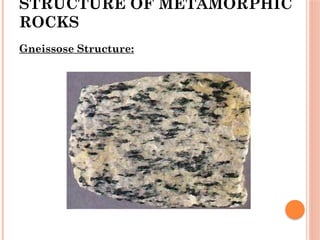
GneissoseStructure:
Minerals have been segregated into discontinuous
bands, each of which is dominated by one or two
minerals.
These bands range in thickness from 1 mm to
several centimeters.
Light-colored bands commonly contain quartz and
feldspar. and the dark bands are commonly
composed of ferro-magnesium minerals.
A rock with a gneissic texture is called a gneiss.
Plane of schistosity are poorly defined.
STRUCTURE OF METAMORPHIC
ROCKS
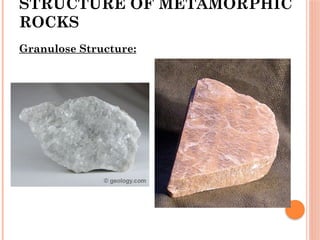
GranuloseStructure:
This is found in the rocks composed of equi-
dimensional minerals like quartz, feldspar and
calcite.
They are formed by the re-crystallisation of pre-
existing rocks, under uniform pressure and great
heat.
The flaky mineral are either absent or present in
the small amount.
Breaking of a granulose structure gives rough
fracture surface
STRUCTURE OF METAMORPHIC
ROCKS
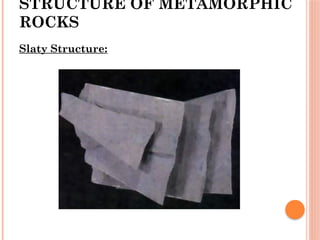
SlatyStructure:
The name for the rock with this texture is slate , and
the rock is characterized by a tendency to separate
along parallel planes.
This feature is a property known as slaty cleavage.
The rock possessing slaty cleavage has a unique
property of splitting into thin smooth sheets.
COMMON METAMORPHIC ROCKS
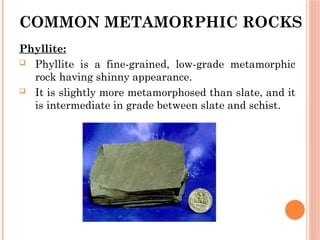
Phyllite:
Phyllite is a fine-grained, low-grade metamorphic
rock having shinny appearance.
It is slightly more metamorphosed than slate, and it
is intermediate in grade between slate and schist.
27.
COMMON METAMORPHIC ROCKS
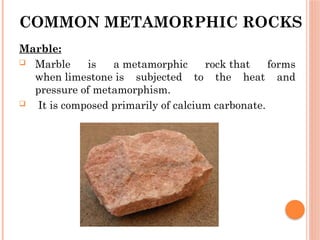
Marble:
Marble is a metamorphic rock that forms
when limestone is subjected to the heat and
pressure of metamorphism.
It is composed primarily of calcium carbonate.
28.
COMMON METAMORPHIC ROCKS
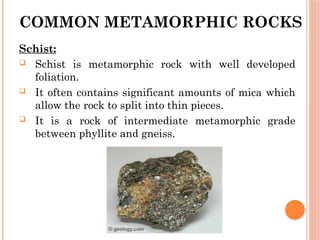
Schist:
Schist is metamorphic rock with well developed
foliation.
It often contains significant amounts of mica which
allow the rock to split into thin pieces.
It is a rock of intermediate metamorphic grade
between phyllite and gneiss.
29.
COMMON METAMORPHIC ROCKS
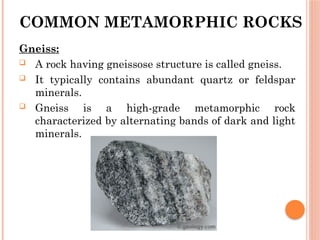
Gneiss:
A rock having gneissose structure is called gneiss.
It typically contains abundant quartz or feldspar
minerals.
Gneiss is a high-grade metamorphic rock
characterized by alternating bands of dark and light
minerals.
30.
COMMON METAMORPHIC ROCKS
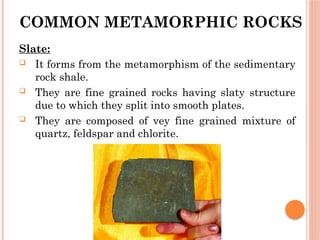
Slate:
It forms from the metamorphism of the sedimentary
rock shale.
They are fine grained rocks having slaty structure
due to which they split into smooth plates.
They are composed of vey fine grained mixture of
quartz, feldspar and chlorite.