Lecture 2 - The Construction Industry and the National Economy 2026.pdf
1.
The Construction Industryand the
National Economy
Introduction to Building Economics/ Building Economics 1
Lecture 2
Mrs. B. Mushinge
2.
Contents
• The ConstructionIndustry
• The Characteristics of the Construction
Industry
• The Construction Industry and other
Industries
• The Zambian Construction Industry
• Other Organisations within the ZCI
• The National Economy
• Goals of the National Economy
• National Policies affecting the
Construction Industry
3.
The Construction Industry
•The construction industry is recognised as a sector with great contribution to the
economic and social development of a country,
particularly through:
• the direct provision of social and economic infrastructure;
• also due to the number of direct and indirect jobs generated and
• its influence on several other sectors which produce materials, equipment, and
services in its production process.
• It is usually one of the first sectors to signal a region’s financial situation, in times of
both exponential growth and economic recession.
4.
The Characteristics ofthe Construction
Industry
• Like its product, the construction industry is characterised by its unique nature. As
each project, has a different location, time lines, scope, goals and even personnel.
• Also unique for developing and developed countries (<>)
• Due to the nature of its product, the construction industry is normally very large and
thus accounts for a high proportion of overall national output (the total market
value of all final goods and services produced and sold during a particular year).
• Thus, the construction industry is a significant contributor to gross domestic
product, typically ranging from 3 to 8 percent in developing countries.
• It is a large and complex industry made up of many types and sizes of organisations,
with a diverse range of professional and other representative bodies.
• Projects are temporary – they have a start and an end, and once completed,
resources are transferred to another project in a different place .
5.
The Characteristics ofthe Construction
Industry
• It is also a major source of employment and job creation, particularly in reducing
unemployment rates .
• Additionally, the industry faces many challenges such as delays in project
implementation and cost overruns .
• It is also a high-risk industry in terms of occupational safety and health, with
construction workers accounting for a significant percentage of work-related
mortality and morbidity (i.e., through work injuries) .
• The construction industry plays a crucial role in the economy, through serving
various industries such as education, health, housing, mining, trade, agriculture, and
transport.
6.
The Construction Industryand other
Industries
• How does it serve? - by providing:
• access (roads, bridges, tunnels, railroads);
• shelter (houses, stops, offices, hotels);
• trading structures (markets, stores, shops, malls);
• facilities (workshops, dams, laboratories, schools, clinics, airports, police stations);
• storage (silos - cylindrical tower used for bulk storage like grain, warehouses,
basements, prisons, mortuaries); and
• protection (wall fences, barracks, towers). All to mention but a few.
The Zambian ConstructionIndustry
• Population increase + emerging/changing needs + political agendas = increase in the
volume of products and activities in the ZCI.
• Economic infrastructure – welfare - economic growth, trade and competitiveness
e.g. transportation, communication, and energy.
• Social infrastructure – wellbeing - social cohesion, equality and human development
e.g. housing, health and education.
• The Zambian public sector thus has a huge involvement in the provision of social
infrastructure.
• Whilst the Private sector is mostly concerned with involvement in economic
infrastructure i.e., hotels, shopping malls, etc.
9.
The Zambian ConstructionIndustry
The ZCI comprises five sub-sectors namely:
1. Clientele
2. Design
3. Assembly
4. Manufacturing
5. Supply
• Separated but inter-related
10.
The Zambian ConstructionIndustry
Clientele
• The clientele is like a king pin in the construction process.
• He is the project initiator and thus must be able to provide funds for the project.
• He must also ensure that he provides adequate information to the design team for
them to be able to come up with what he wants.
• For the ZCI, these are mostly government funded organisations.(MOE,MOH etc.)
• Clientele vs end user
• Informally, clientele are also the many individuals constructing and doing
maintenance works to privately owned schools, hospitals and houses etc.
11.
The Zambian ConstructionIndustry
Design
• Although designing can be done by both the private and public sectors, in the ZCI
there is substantial involvement by the public sector.
• Architects and Engineers still dominate the function of designing.
• However, other professions are actively involved, and they include: Planners, Land
surveyors, Quantity surveyors, Construction managers (also part of assembly),
Valuation surveyors, and many others.
• Design team interprets clients’ dreams into reality and provide cost and design
advice on the project.
12.
The Zambian ConstructionIndustry
Assembly
• Constitutes a large number of firms.
• Do actual assembly/erection of works (general building and engineered
infrastructure)
• Firms must be registered with the National Council for Construction (NCC) under
various categories (i.e. Grade 1 - 6).
• Most small-scale companies are Zambian owned and Zambian controlled while a
large number of large companies are owned by foreigners (i.e., WBHO).
13.
The Zambian ConstructionIndustry
Manufacturing
• Concerned with the production of building materials and components to be used by
the assembly sector.
• It can deal directly with the assembly if projects are of specialised nature. – i.e.
prefab, precast etc.
• It includes privately owned manufacturing companies such as: Dangote, Monarch
Steel, Kalulushi Bricks, Lafarge, Ndola Lime (now Limestone Resources Limited) etc.
and public companies like: Metal Fabricators of Zambia Plc (ZAMEFA), Chilanga
Cement Plc (Plc-public limited company)
14.
The Zambian ConstructionIndustry
Supply
• Includes builders’ merchants, who act as middlemen between the assembly and the
manufacturing sectors.
• A chain of retail operations.
• Where good business relations exist between the assembly and supply companies,
suppliers provide credit facilities.
15.
Other Organisations withinthe ZCI
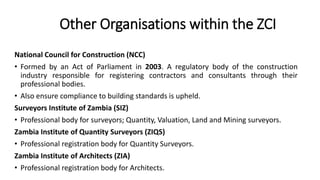
National Council for Construction (NCC)
• Formed by an Act of Parliament in 2003. A regulatory body of the construction
industry responsible for registering contractors and consultants through their
professional bodies.
• Also ensure compliance to building standards is upheld.
Surveyors Institute of Zambia (SIZ)
• Professional body for surveyors; Quantity, Valuation, Land and Mining surveyors.
Zambia Institute of Quantity Surveyors (ZIQS)
• Professional registration body for Quantity Surveyors.
Zambia Institute of Architects (ZIA)
• Professional registration body for Architects.
16.
Other Organisations withinthe ZCI
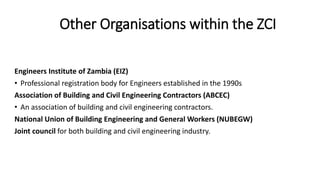
Engineers Institute of Zambia (EIZ)
• Professional registration body for Engineers established in the 1990s
Association of Building and Civil Engineering Contractors (ABCEC)
• An association of building and civil engineering contractors.
National Union of Building Engineering and General Workers (NUBEGW)
Joint council for both building and civil engineering industry.
17.
Other Organisations withinthe ZCI
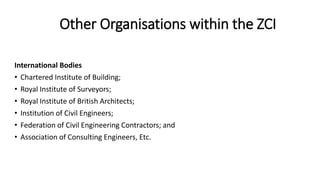
International Bodies
• Chartered Institute of Building;
• Royal Institute of Surveyors;
• Royal Institute of British Architects;
• Institution of Civil Engineers;
• Federation of Civil Engineering Contractors; and
• Association of Consulting Engineers, Etc.
The Concept ofNational Economy
• A national economy refers to the economic activities of a country as a whole,
including the production, distribution, and consumption of goods and services.
• It can also be defined as the production, distribution and trade, consumption of
goods and services by different agents of a nation.
• The national economy can be analyzed from different perspectives, including
• macroeconomics, which studies the overall performance of the economy (i.e.
economic decisions of governments or countries), and microeconomics, which
focuses on individual consumers, firms, and industries.
• An understanding of the national economy helps governments to be able to -
• to measure the overall economy and
• to fix it if there's a problem.
• The NE encompasses all economic activities within a country, including both
domestic and international transactions.
20.
The Concept ofNational Economy
• The national economy is typically measured by various economic indicators, such as
Gross Domestic Product (GDP), inflation rate, unemployment rate, and trade
balance.
• The national economy is affected by a wide range of factors, including government
policies, market forces, technological advancements, natural resources etc.
• Understanding the national economy is crucial for making informed decisions about
investment, trade, and public policy (a set of laws, regulations, guidelines, and
actions decided and taken by governments to address relevant and real-world
problems).
Goals of aNational Economy
• All the countries around the world have certain targets for becoming an ideal and
economically stable nation.
• Countries strive hard to achieve such targets or goals. The 8NDP (2022-2026) of
Zambia is just one of many examples.
• Although, each country has its own issues associated with various factors that halt its
development and growth.
• There are some main basic economic goals pursued by countries worldwide.
• Understanding these objectives provides insights into the fundamental principles
that shape economic policies and drive national development.
• Such goals are also referred as Macroeconomics objectives.
23.
Goals of aNational Economy
1. Economic growth - Economic growth simply means that more goods and services
are produced as time passes.
• It is generally thought that if a society wants to improve its standard of living, it must
have economic growth by producing higher levels of goods and services.
• Furthermore, if a society's population gets larger, even more economic growth must
take place.
• Economic growth, or output of goods/services, is measured by Gross Domestic
Product (GDP).
• GDP is the total value of the goods and services produced in a country during a
specific period of time, usually a year.
24.
Goals of aNational Economy
2. Full employment - Ensuring full employment and minimising unemployment is
another essential economic goal. Governments strive to create an environment where
all willing and able individuals have access to productive employment.
• Full employment does not mean that no one is jobless in a country as there is always
a certain level of unemployment in the country due to economic instabilities and
imperfections.
• Such level of unemployment is called the natural rate of unemployment.
• But the government tries its best to reduce the level of unemployment in a country
as much as it can.
• There are different opinions about what percentage of the labor force must be
working for full employment to be achieved. Most economists agree that full
employment occurs when 93-95% of the labor force that wants to be employed is
employed.
25.
Goals of aNational Economy
3. Economic Efficiency - Economic efficiency is the idea that resources are scarce and
therefore, they must be used wisely.
• Used wisely in such a way that maximum goods and services are being produced.
• If resources are wasted, fewer goods and services can be offered, and fewer
needs/desires can be satisfied.
• Decision- making must be efficient so that a country is more favorable internationally.
• Other countries rely on such country’s quality productions and services.
26.
Goals of aNational Economy
• 4. Price Stability - Price stability is the absence of large fluctuations in the general
price level of goods and services (inflation or deflation).
• If inflation (a rise in the overall price of goods/services) occurs, people need more
money to purchase the goods/services they need and want.
• Deflation means that there is a reduction of the general level of prices in an
economy.
• The goal of price stability acknowledges that significant changes in price levels greatly
affect individuals and businesses.
27.
Goals of aNational Economy
5. Equitable Distribution of Income - fair allocation of income among individuals or
groups within a society.
Why Fair? - No society should expect or desire complete equality of income at a given
point in time, for a number of reasons:
• age (↑age= greater earning potential as you have more experience, skill and talent
as you grow older),
• education (the more educated, the more qualified the more you are supposed to
get),
• ownership of property or financial assets (↑property=↑income),
• wage differentials (different labour markets e.g. lower rates in construction than in
tech industry)
28.
Goals of aNational Economy
Therefore the state must come in to ensure policies reduce the level of income
inequality. Some of the ways they can do this is by:
• redistribution (taking income) from those with high incomes to those with low
incomes (e.g. The National Health Insurance Management Authority (NHIMA), tax
brackets (the rich pay more tax than the poor - income below a certain figure is not
taxed;
• trying to assure that a ladder of opportunity is widely available - especially for those
who otherwise seem likely to start their lives in a disadvantaged position.
(introduction of free education, government bursaries and loans at higher learning
institutions, Internships and apprenticeships – all to give one an opportunity to attain
a higher income in life)
29.
Goals of aNational Economy
6. Economic Freedom - Economic freedom is a freedom for people to make choice and
decisions without any kind of external pressures.
• People are free to buy, sell and own.
• People are free to own property and make profits from them.
• People have the freedom to do business and expand or contract it.
• Economic freedom is provided to people to promote economic activities in an
economy to make economic condition better day by day.
30.
Goals of aNational Economy
7. Economic Security
• Economic security refers to a feeling of freedom and safety from economic risks.
• Economic security is also protection against economic risks, such as unemployment,
accidents on the job, business failures or natural disasters, over which people have
little or no control.
31.
Goals of aNational Economy
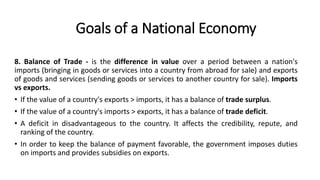
8. Balance of Trade - is the difference in value over a period between a nation's
imports (bringing in goods or services into a country from abroad for sale) and exports
of goods and services (sending goods or services to another country for sale). Imports
vs exports.
• If the value of a country's exports > imports, it has a balance of trade surplus.
• If the value of a country's imports > exports, it has a balance of trade deficit.
• A deficit in disadvantageous to the country. It affects the credibility, repute, and
ranking of the country.
• In order to keep the balance of payment favorable, the government imposes duties
on imports and provides subsidies on exports.
National Policies Affectingthe
Construction Industry
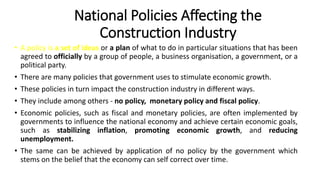
• A policy is a set of ideas or a plan of what to do in particular situations that has been
agreed to officially by a group of people, a business organisation, a government, or a
political party.
• There are many policies that government uses to stimulate economic growth.
• These policies in turn impact the construction industry in different ways.
• They include among others - no policy, monetary policy and fiscal policy.
• Economic policies, such as fiscal and monetary policies, are often implemented by
governments to influence the national economy and achieve certain economic goals,
such as stabilizing inflation, promoting economic growth, and reducing
unemployment.
• The same can be achieved by application of no policy by the government which
stems on the belief that the economy can self correct over time.
Monetary Policy -Why the Quantity of
Money Matters
• The quantity of money, also referred to as the money supply, represents the total
amount of monetary assets available in an economy at a specific time.
• It encompasses various forms of money, including cash, coins, and balances held in
checking and savings accounts.
• The quantity of money influences consumption, investment, and pricing levels
through its impact on inflation, interest rates and overall economic activities.
36.
Monetary Policy -Why the Quantity of
Money Matters
Inflation: is a gradual loss of purchasing power that is reflected in a broad rise in
prices for goods and services over time.
• An increase in the money supply is the root of inflation.
• More money in peoples pockets = ↑demand > output/supply/production
capacity=↑prices
• The inflation rate is calculated as the average price increase of a basket of selected
goods and services over one year.
• High inflation means that prices are increasing quickly, while low inflation means that
prices are growing more slowly.
• Inflation can be contrasted with deflation, which occurs when prices decline and
purchasing power increases.
37.
Monetary Policy -Why the Quantity of
Money Matters
Interest Rates: The money supply affects interest rates.
• For example, an expanded money supply typically lowers interest rates,
encouraging borrowing and investment but potentially overheating the economy.
• On the other hand, a reduced money supply can raise interest rates, cooling down
an overheated economy but possibly slowing down growth.
Economic Activity: The quantity of money determines the purchasing power of
consumers and the level of business investments.
• Adequate levels ensure liquidity, facilitating smooth transactions, and promoting
economic activity.
Therefore, central banks closely monitor and regulate the money supply to maintain
economic stability, pursuing monetary policies to strike a balance between growth and
inflation.
38.
Monetary Policy
• Oneof the main tasks of central banks (e.g. BOZ) is controlling the money supply in
the economy.
• However, because of fractional reserve banking, most of the currency in circulation
is actually created by commercial banks.
• Fractional reserve banking is a banking system in which banks only hold a fraction of
the money their customers deposit as reserves.
• This allows them to use the rest of it to make loans to people who need money (e.g.,
to buy a house, a new car, or go to university).
• This gives commercial banks the power to directly affect the money supply.
39.
Monetary Policy
• Infact, even though central banks are in charge of controlling the money supply,
most of the money in modern economies is created by commercial banks through
fractional reserve banking.
• Therefore, central banks can only control the amount of money in the economy
indirectly through what we call monetary policy.
• More specifically, they can resort to monetary policy tools (Reserve Requirements,
Influence Interest Rates, Selling of Government Bonds) to control the money supply.
40.
Monetary Policy Tools- Reserve
Requirements
• In most countries, the fraction of total deposits the banks need to keep as reserves
(i.e., the reserve ratio) is regulated by the government and/or bank policies.
• In Zambia, The Bank of Zambia (BoZ) sets minimum statutory reserve requirements
for commercial banks operating in the country,
• These requirements can be changed according to the economic needs of the country
and the performance of the banking sector.
• BoZ sets reserve ratios to ensure that banks have money at hand to prevent them
from running out of cash in the event of panicked depositors wanting to make mass
withdrawals.
• If a bank doesn't have the funds to meet its reserve, it can borrow funds from the
central bank/BoZ to satisfy the requirement.
41.
Monetary Policy Tools- Reserve
Requirements
• The BoZ may choose to lower the reserve ratio to increase the money supply in the
economy.
• A lower reserve ratio requirement gives banks more money to lend, at lower
interest rates, which makes borrowing more attractive to customers.
• Conversely, BoZ can increase the reserve ratio requirement to reduce the amount of
funds banks have to lend.
• BoZ uses this mechanism to reduce the supply of money in the economy and control
inflation by slowing the economy down.
42.
Monetary Policy Tools- Reserve
Requirements
• An increased statutory reserve has a variety of effects on the banking system and
the economy as a whole.
• From the perspective of the banks, an increase in the statutory reserve means that
they must hold a larger portion of their deposits as reserves. This has a "domino
effect" -
• From the perspective of the economy, an increase in the statutory reserve can
lead to a decrease in the money supply.
• It reduces the amount of money that banks can lend out and can make it more
difficult for businesses to secure loans.
• This can lead to an increase in interest rates, which can make it more expensive
for businesses and individuals to borrow money.
• It also reduces the amount of money that banks can use to invest in stocks and
bonds, which can have a negative effect on the overall performance of the
financial markets.
43.
Monetary Policy Tools- Reserve
Requirements
• The statutory reserve of a central bank can also have a significant impact on the
exchange rate of a currency.
• When a central bank increases its statutory reserve, the amount of money
available for lending decreases, leading to a decrease in the money supply and a
decrease in demand for the currency.
• This decrease in demand will cause the currency to weaken against other
currencies, leading to a decrease in the exchange rate. (e.g. more kwacha to procure
less dollars)
• The opposite is true.
44.
Monetary Policy Tools- Influence
Interest Rates
• In most cases, a central bank cannot directly set interest rates for loans such as
mortgages, auto loans, or personal loans.
• However, the central bank does have certain tools to push interest rates towards
desired levels.
• For example, the central bank holds the key to the policy rate—the rate at which
commercial banks get to borrow from the central bank.
• When banks get to borrow from the central bank at a lower rate, they pass these
savings on by reducing the cost of loans to their customers.
• Lower interest rates tend to increase borrowing, and this means the quantity of
money in circulation increases.
• The opposite is true - banks get to borrow from the central bank at a higher rate,
they pass these cost on by increasing the cost of loans to their customers reducing
money in circulation.
45.
Monetary Policy Tools-Selling of
Government Bonds
• A bond is a fixed-income instrument and investment product where individuals lend
money to a government or company at a certain interest rate for an amount of time.
• The entity repays individuals with interest in addition to the original face value of the
bond.
• Governments commonly use bonds to borrow money to fund roads, schools, dams,
or other infrastructure.
• Corporations often borrow to grow their business, buy property and equipment,
undertake profitable projects, for research and development, or to hire employees.
46.
Monetary Policy Tools-Selling of
Government Bonds
• When a government sells bonds, it is effectively borrowing money from investors.
• This practice can help reduce inflation in several ways, especially when it’s part of a
broader monetary policy strategy.
• Firstly, selling government bonds takes money out of circulation.
• Investors purchase these bonds using their funds, which means the money is no
longer available for spending on goods and services.
• This reduction in available money can help to decrease demand in the economy.
47.
Monetary Policy Tools-Selling of
Government Bonds
• In a situation where demand for goods exceeds supply, prices tend to rise, leading to
inflation.
• By pulling money from the economy, the sell of bonds can slow down spending,
which may help to stabilize or even lower price levels.
• When there is less money circulating, consumers are less likely to contribute to
inflationary pressures.
• Similarly, the selling of government bonds can reduce inflation by decreasing the
money supply in the economy and this also has the potential to raise interest rates,
both of which contribute to lower consumer demand and more stable price levels.
48.
Monetary policy andthe Construction
Industry
• The impact of monetary policy on the construction industry is considerable.
• As interest rates are important determinants of the willingness and ability - to
undertake investment in buildings and other construction works.
• When monetary policy tightens the availability of loans and raises the cost of
borrowing = demand for construction is likely to be significantly reduced as actual
construction and the purchase of property both depend heavily on borrowed funds.
49.
Monetary policy andthe Construction
Industry
• The construction industry is especially sensitive to changes in the general level of
interest rates.
High bank interest rates usually result in higher mortgage rates, and this rapidly
chokes off some of the demand for private dwellings.
Higher rates also affect property developers – as higher interest rates mean higher
monthly repayments on development loans, which can strain cash flow and reduce
profitability.
Commercial clients may have to postpone investment plans for new business
premises owing to the increased cost of investment.
• Lower interest rates on the other hand, lead to reduced borrowing costs, allowing
developers to allocate more capital towards construction.
50.
Monetary policy andthe Construction
Industry
• Apart from the impact on demand, higher rates cause profitability and liquidity
problems for many construction firms.
• Some may attempt to pass on the higher costs to consumers through higher prices,
but this may serve to reduce demand even further.
• As cost of borrowing rises, other pressures include slower payment by clients and
shorter period o f credit given by building materials suppliers.
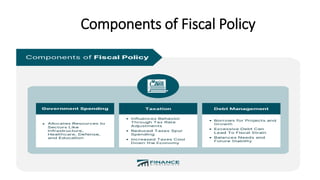
Fiscal policy
• Fiscalpolicy refers to the governmental use of taxation, spending and borrowing to
influence the conditions of the economy.
• By manipulating these levers, governments influence economic activity, directly and
indirectly.
• Directly - through greater government expenditures or indirectly through tax
reductions that stimulate private consumption and investment spending.
• Fiscal policy typically comes into play during a recession, where conditions are
escalating quickly enough to warrant government intervention.
• The purpose of fiscal policy is to implement artificial measures to prevent an
economic collapse and to promote healthy and steady economic growth.
• Fiscal policies can be either expansionary or contractionary.
Types of FiscalPolicy
1. Expansionary policy - is when the government responds to
recession by lowering taxes and increasing government spending.
• This operates has a multiplier effect –
• when taxes are lowered → consumers have more money in their
pockets to spend or invest → which increases the demand for
products and securities → AND increased government spending →
leads firms to hire more employees + as well as compete for
employees more fiercely, which can increase wages → gives
consumers more funds to spend = lowering unemployment =
hopefully pulling the economy out of recession over time.
55.
Types of FiscalPolicy
2. Contractionary policies
• During this the government may reduce spending on public projects
or even reduce public-sector wages or the size of the workforce.
• Contractionary policies are uncommon, though, because the
preferred approach to reigning in rapid growth is to institute a
monetary policy to increase the cost of borrowing.
3. A Neutral Fiscal Policy - not too expansionary, not too
contractionary, but just right. Aims to balance the budget, ensuring
that government spending matches revenue.
56.
Fiscal Policy andthe Construction
Industry
• Fiscal policy in the CI refers to the governments use of taxation and spending
strategies to influence the level of economic activities within the construction
sector.
How fiscal policy impacts the construction industry.
• Economic multiplier effect – when the construction industry is stimulated, it
creates ripple effects throughout the economy.
Increased spending on infrastructure = increased construction activities =
increased employment= increased GDP.
The opposite is true.
Also,
Increase Taxes = ↑ cost of construction (material, labour, transport etc.) =
↓reduced construction activities = ↓reduced GDP.
The opposite is true.
BOP
• The balanceof payments (BOP) is the method countries use to monitor all
international monetary transactions in a specific period.
• The BOP is usually calculated every quarter and every calendar year.
• All trades conducted by both the private and public sectors are accounted for
in the BOP to determine how much money is going in and out of a country.
• If a country has received money, this is known as a credit, and if a country has
paid or given money, the transaction is counted as a debit.
• Theoretically, the BOP should be zero, meaning that assets (credits) and
liabilities (debits) should balance, but in practice, this is rarely the case.
• Thus, the BOP can tell the observer if a country has a deficit or a surplus and
from which part of the economy the discrepancies are stemming.
59.
BOP
• the totalof imports and exports—is the biggest part of the BOP. It makes it
clear whether a country has a trade surplus or deficit.
• A trade deficit occurs when a country imports more than it exports.
• In other words, when a country buys more than it sells, it has a trade
deficit.
• Trade deficits allow countries to consume more than they produce.
• In the short run - this can help increase economic activity and boost living
standards.
60.
BOP and theConstruction Industry
• For any construction project, some materials are less available than others,
depending on the location of a project.
• That’s why international shipping and logistics have been a cornerstone of the
construction industry for years.
• This provides the industry with variety, higher quality, innovative, durable,
environmentally friendly and international standard materials and equipment.
• However, in the long run this kills local manufacturers as their products may not
be as elastic or durable or able to compete with imported materials.
• Also the more advanced the product the more expertise needed to install or
maintain it. Hence the need to porch international experts, taking away the
opportunity for local experts and labourforce. Creating unemployment.
61.
BOP and theConstruction Industry
• And because these materials are usually priced in foreign currencies, any
rise in the exchange rate will mean a rise in the cost on these inputs and an
overall rise in the cost of construction.