introduction
• The termsclimacteric and menopause are often used
interchangeably actually they have different meanings.
• The climacteric. is the period of waning ovarian function which
signal the end of the reproductive life span. Anatomical and
physiological changes that occur as a woman proceeds from her
fertile to infertile years are termed climacteric
• Menopause is the stoppage of menses.
• Menopause is a normal stage of life experienced by women all
over the world. It occurs typically between the ages of 40 and 65
years women when the ovaries stop producing the hormones
estrogen and progesterone, which are responsible for the
monthly menstrual cycles. When the ovaries stop making these
hormones, the menstrual cycles stop as well.
3.
The climacteric
• Theclimacteric is marked by hormonal, physical, and temporary
psychological changes.
These changes occur because the ovaries lose their follicles, shrink,
and stop producing estrogen.
• The climacteric may be classified into three phases:
• Pr-menopausal phase: The period of beginning physiological
failure of ovarian function and it lasts for a period ranging from
two to six years.
• Menopausal phase: The time when menstruation permanently stops.
• Post menopausal phase: The remainder of life after menopause.
• The age of menopauses ranges from 40 to 50 years
4.
CLIMACTERIC
• Heavier postmenopausalwomen have higher circulating
levels of oestrogens (particularly oestrone) than thin women.
• Gradual atrophy of all the chief target organs for oestrogen.
• The ovaries shrink, the uterus becomes smaller, the
endometrium shows atrophic changes and becomes thinner,
the cervix diminishes in size and its secretions decrease.
• There are atrophic changes in the vaginal wall with loss of
elasticity and the fornices become shallower.
• Vaginal acidity decreases, increasing the risk of infection.
• Supporting tissues weaken, leading to a higher risk of genital
prolapse.
5.
• Physical ChangesAfter Menopause
• Gradual atrophy (shrinkage) of estrogen-sensitive tissues:
– Breasts shrink and cyclic changes stop.
– Ovaries and uterus become smaller.
– Endometrium thins.
– Cervix shrinks, and vaginal secretions decrease.
– Vaginal walls lose elasticity and become prone to infections.
– Supporting tissues weaken, increasing risk of prolapse.
– Labia become flatter and pubic hair thins.
– Urinary tract epithelium thins, causing symptoms like frequency,
dysuria, and incontinence.
• These changes may mimic infections or cause actual infections.
6.
o Symptoms andEffects
• About 10-15% of women experience minimal symptoms.
• Others suffer moderate to severe symptoms including:
– Hot flushes, night sweats.
– Vaginal soreness, painful intercourse (dyspareunia).
– Urinary problems.
– Dry skin.
– Cognitive changes: poor concentration, memory loss, difficulty making decisions.
– Emotional changes: anxiety, mood swings, irritability, tiredness, depression.
• Symptoms can start before menopause (perimenopause) and last years after.
• Treatment
• Hormone Replacement Therapy (HRT) may be used to manage symptoms
during unstable hormonal periods.
• HRT is usually tapered off once hormone levels stabilize.
7.
• Effects ofSurgical Menopause
• Women with hysterectomy but retained ovaries stop
menstruating immediately but may not experience
menopause symptoms until ovarian function ends naturally.
• Ovarian function may decline prematurely after hysterectomy
due to compromised blood supply.
• Bilateral oophorectomy (removal of both ovaries) or pelvic
irradiation causes abrupt menopause with severe symptoms.
• Loss of estrogen and androgens can lead to decreased
confidence, energy, libido, and drive.
8.
Physical symptoms
• Hotflushes and night sweats
• Vaginal soreness atrophic vaginitis
• Urinary disorders
• Dry skin.
9.
• Hot Flushesand Night Sweats
• Sudden episodes of flushing and sweating, mostly on the upper chest, neck, and face.
• Triggers may include stress, hot drinks, or spicy foods, but often occur without clear
cause.
• Can happen a few times a day or many times.
• Accompanied by increased pulse rate and palpitations.
• Night sweats cause women to wake drenched, needing to change nightwear.
• Caused by low or fluctuating estrogen levels and changes in FSH and LH.
• Hormone Replacement Therapy (HRT) can relieve symptoms but they often return
when HRT stops.
• Symptoms usually reduce or disappear over time.
• The exact cause of these vasomotor symptoms is complex and varies among women.
10.
• Vaginal Sorenessand Atrophic Vaginitis
• Reduced vaginal and cervical secretions, making the area less acidic.
• Vaginal lining becomes thin, dry, less elastic — prone to soreness,
irritation, burning, and discharge.
• Narrowing of the vaginal opening (introitus) and painful intercourse
(dyspareunia) may occur.
• These symptoms can cause emotional and relationship stress.
• Estrogen treatment often improves symptoms.
Dry skin
The decrease in oestrogen levels is partly responsible for the
dryness, thinning and reduced elasticity of skin.
11.
Urinary disorder.
• Estrogenreceptors exist in the vagina, urethra, bladder trigone, and pelvic
floor.
• Pregnancy and vaginal delivery predispose to urinary incontinence and
prolapse.
• Menopause worsens symptoms due to estrogen depletion, causing vaginal
atrophy and inflammation.
• Atrophic vaginitis often coexists with urethritis (inflammation of the
urethra).
• Estrogen deficiency affects urethral support, causing urinary frequency,
urgency, dysuria, and infections.
• The symptom complex is called urethral syndrome.
• Estrogen replacement may relieve these issues.
12.
PSYCHOLOGICAL AND EMOTIONALSYMPTOMS
• Women often report psychological difficulties during menopause.
• Estrogen receptors in brain neurons are linked to cognitive function; estrogen
decline may impair cognition and increase dementia risk.
• Many women feel a general decline in well-being and quality of life.
• Some improve on estrogen therapy, but placebo effects are significant.
• Other life stresses (children leaving home, relationship problems, retirement,
illness of relatives) add to emotional burden.
• Understanding these factors and developing coping strategies can help manage
symptoms without needing HRT.
13.
POSTMENOPAUSAL PROBLEMS
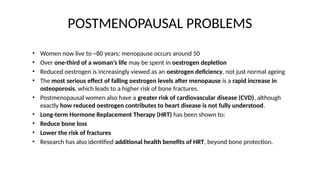
• Womennow live to ~80 years; menopause occurs around 50
• Over one-third of a woman’s life may be spent in oestrogen depletion
• Reduced oestrogen is increasingly viewed as an oestrogen deficiency, not just normal ageing
• The most serious effect of falling oestrogen levels after menopause is a rapid increase in
osteoporosis, which leads to a higher risk of bone fractures.
• Postmenopausal women also have a greater risk of cardiovascular disease (CVD), although
exactly how reduced oestrogen contributes to heart disease is not fully understood.
• Long-term Hormone Replacement Therapy (HRT) has been shown to:
• Reduce bone loss
• Lower the risk of fractures
• Research has also identified additional health benefits of HRT, beyond bone protection.
14.
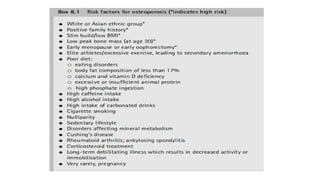
OSTEOPOROSIS
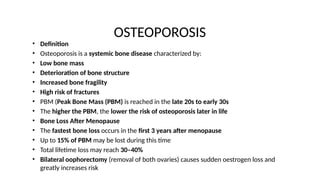
• Definition
• Osteoporosisis a systemic bone disease characterized by:
• Low bone mass
• Deterioration of bone structure
• Increased bone fragility
• High risk of fractures
• PBM (Peak Bone Mass (PBM) is reached in the late 20s to early 30s
• The higher the PBM, the lower the risk of osteoporosis later in life
• Bone Loss After Menopause
• The fastest bone loss occurs in the first 3 years after menopause
• Up to 15% of PBM may be lost during this time
• Total lifetime loss may reach 30–40%
• Bilateral oophorectomy (removal of both ovaries) causes sudden oestrogen loss and
greatly increases risk
16.
Treatment
• Treatment goalsfor established osteoporosis:
• Reduce pain and symptoms
• Lower risk of further fractures
• Treat secondary causes (e.g., endocrine or rheumatological disorders)
• Check for dietary deficiencies (calcium, vitamin D)
• Pain management:
• Medications: Analgesics
• Physical measures: Lumbar support, TENS
• Fracture care:
• For foot or ankle insufficiency fractures:
– Rest and reduced activity
– Mechanical support to allow healing
17.
Pharmacological management
• Thereis now a wide range of drugs which are licensed
for the prevention and treatment of osteoporosis.
• Initial assessment of the patient includes a review of
diet, and if there is deficiency of calcium or vitamin D, or
both, supplementation will be required.
18.
Hormone replacement therapy
•HRT and Bone Health:
• Long-term HRT reduces bone turnover by inhibiting osteoclasts.
• Risks: Increased risk of breast cancer with longer use.
• Methods of HRT administration:
• Oral – taken by mouth
• Implant – placed in the abdominal cavity (often during
hysterectomy)
• Transdermal – patch applied below the waist (buttock, thigh,
abdomen); can include estrogen ± progestogen
• Nasal spray
• Topical (vaginal) – applied locally
19.
Bisphosphonates
• Bisphosphonates (e.g.,etidronate, alendronate, risedronate):
• Purpose: Reduce bone loss and fracture risk (alendronate and
risedronate are most effective).
• Characteristics:
– Highly selective for bone and retained there
– Poor intestinal absorption → must be taken on an empty stomach
• Compliance tip: Alendronate is now available as a once-weekly
dose, making it easier for patients.
• Use: First-line treatment for women who cannot or do not
want HRT.
20.
Selective oestrogen receptor
modulators(SERMS)
• Raloxifene (2nd generation SERM):
• First generation SERM: Tamoxifen
• Tissue-specific effects:
– Estrogen-agonist → bone, improves serum lipid profile
– Estrogen-antagonist → breast and endometrium → reduces breast cancer risk by
~70%
• Fracture prevention: Reduces vertebral fractures, but not non-vertebral
fractures
• Menopause symptoms: Does not prevent hot flushes or psychological
symptoms; may worsen vasomotor symptoms
• Best use: Women not experiencing climacteric symptoms, mainly for bone
protection and breast cancer risk reduction
21.
• Calcitonin:
• Administration:Nasal spray or subcutaneous injection
• Limitations: Unpleasant side effects (nausea, diarrhea,
flushing)
• Benefit: Has analgesic effects, useful for short-term pain
relief in acute vertebral fractures
• Tibolone:
• Type: Synthetic steroid with estrogenic, progestogenic,
and androgenic effects
• Uses:
– Osteoporosis prevention
– Treats vasomotor symptoms, psychological changes,
and libido issues during menopause
22.
• Other non-oestrogen-basedtreatments: There
are several other drugs which are available but are,
at present, less frequently used for prevention and
treatment of osteoporosis.
• Parathyroid hormone (PTH), in combination with
HRT, may be used in the initial treatment of women
who present with severe osteoporosis.
Editor's Notes
#13 HRT=harmone replacement therapy.
macular degeneration.=a degenerative condition affecting the central part of the retina (the macula) and resulting in distortion or loss of central vision. It occurs especially in older adults, in which case it is called age-related macular degeneration.


 Most read
 Most read
 Most read