Leading in Times of Uncertainty: Strategies for Adaptive Leadership and Business Resilience
Explore frameworks and strategies to navigate uncertainty, differentiate risk from true uncertainty, and build resilient, adaptive organizations in rapidly changing global environments.
Leading in Times of Uncertainty: Strategies for Adaptive Leadership and Business Resilience
1.
Leading in Timesof
Uncertainty
Dr. Tathagat Varma
Executive Fellow in Management, Indian School of Business
Author of “Theory of Cognitive Chasms: Delivering Business Value from GenAI”
A First-Principles Approach
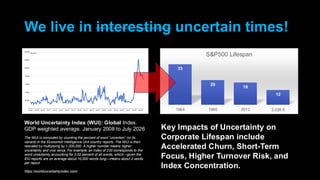
We live ininteresting uncertain times!
World Uncertainty Index (WUI): Global Index.
GDP weighted average. January 2008 to July 2026
The WUI is computed by counting the percent of word “uncertain” (or its
variant) in the Economist Intelligence Unit country reports. The WUI is then
rescaled by multiplying by 1,000,000. A higher number means higher
uncertainty and vice versa. For example, an index of 200 corresponds to the
word uncertainty accounting for 0.02 percent of all words, which—given the
EIU reports are on average about 10,000 words long—means about 2 words
per report.
https://worlduncertaintyindex.com/
33
20
18
12
1964 1990 2012 2,026 €
S&P500 Lifespan
Key Impacts of Uncertainty on
Corporate Lifespan include
Accelerated Churn, Short-Term
Focus, Higher Turnover Risk, and
Index Concentration.
4.
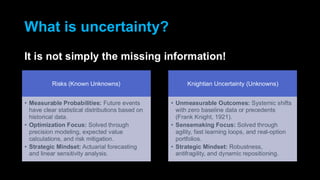
What is uncertainty?
Itis not simply the missing information!
Risks (Known Unknowns)
• Measurable Probabilities: Future events
have clear statistical distributions based on
historical data.
• Optimization Focus: Solved through
precision modeling, expected value
calculations, and risk mitigation.
• Strategic Mindset: Actuarial forecasting
and linear sensitivity analysis.
Knightian Uncertainty (Unknowns)
• Unmeasurable Outcomes: Systemic shifts
with zero baseline data or precedents
(Frank Knight, 1921).
• Sensemaking Focus: Solved through
agility, fast learning loops, and real-option
portfolios.
• Strategic Mindset: Robustness,
antifragility, and dynamic repositioning.
5.
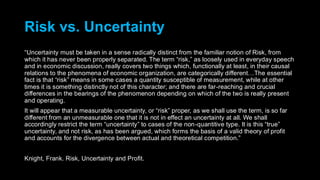
Risk vs. Uncertainty
“Uncertaintymust be taken in a sense radically distinct from the familiar notion of Risk, from
which it has never been properly separated. The term “risk,” as loosely used in everyday speech
and in economic discussion, really covers two things which, functionally at least, in their causal
relations to the phenomena of economic organization, are categorically different…The essential
fact is that “risk” means in some cases a quantity susceptible of measurement, while at other
times it is something distinctly not of this character; and there are far-reaching and crucial
differences in the bearings of the phenomenon depending on which of the two is really present
and operating.
It will appear that a measurable uncertainty, or “risk” proper, as we shall use the term, is so far
different from an unmeasurable one that it is not in effect an uncertainty at all. We shall
accordingly restrict the term “uncertainty” to cases of the non-quantitive type. It is this “true”
uncertainty, and not risk, as has been argued, which forms the basis of a valid theory of profit
and accounts for the divergence between actual and theoretical competition.”
Knight, Frank. Risk, Uncertainty and Profit.
6.
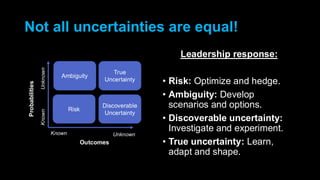
Not all uncertaintiesare equal!
Leadership response:
• Risk: Optimize and hedge.
• Ambiguity: Develop
scenarios and options.
• Discoverable uncertainty:
Investigate and experiment.
• True uncertainty: Learn,
adapt and shape.
Risk
Outcomes
Probabilities
Known Unknown
Known
Unknown
Discoverable
Uncertainty
Ambiguity
True
Uncertainty
7.
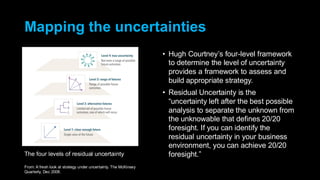
Mapping the uncertainties
•Hugh Courtney’s four-level framework
to determine the level of uncertainty
provides a framework to assess and
build appropriate strategy.
• Residual Uncertainty is the
“uncertainty left after the best possible
analysis to separate the unknown from
the unknowable that defines 20/20
foresight. If you can identify the
residual uncertainty in your business
environment, you can achieve 20/20
foresight.”
The four levels of residual uncertainty
From: A fresh look at strategy under uncertainty. The McKinsey
Quarterly, Dec 2008.
8.
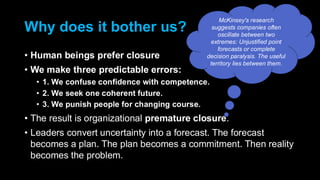
Why does itbother us?
• Human beings prefer closure
• We make three predictable errors:
• 1. We confuse confidence with competence.
• 2. We seek one coherent future.
• 3. We punish people for changing course.
• The result is organizational premature closure.
• Leaders convert uncertainty into a forecast. The forecast
becomes a plan. The plan becomes a commitment. Then reality
becomes the problem.
McKinsey's research
suggests companies often
oscillate between two
extremes: Unjustified point
forecasts or complete
decision paralysis. The useful
territory lies between them.
9.
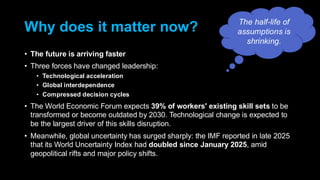
Why does itmatter now?
• The future is arriving faster
• Three forces have changed leadership:
• Technological acceleration
• Global interdependence
• Compressed decision cycles
• The World Economic Forum expects 39% of workers' existing skill sets to be
transformed or become outdated by 2030. Technological change is expected to
be the largest driver of this skills disruption.
• Meanwhile, global uncertainty has surged sharply: the IMF reported in late 2025
that its World Uncertainty Index had doubled since January 2025, amid
geopolitical rifts and major policy shifts.
The half-life of
assumptions is
shrinking.
10.
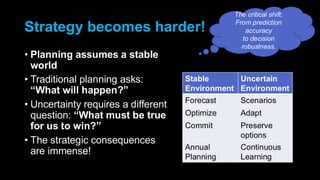
Strategy becomes harder!
•Planning assumes a stable
world
• Traditional planning asks:
“What will happen?”
• Uncertainty requires a different
question: “What must be true
for us to win?”
• The strategic consequences
are immense!
The critical shift:
From prediction
accuracy
to decision
robustness.
Stable
Environment
Uncertain
Environment
Forecast Scenarios
Optimize Adapt
Commit Preserve
options
Annual
Planning
Continuous
Learning
11.
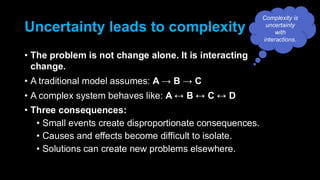
Uncertainty leads tocomplexity
• The problem is not change alone. It is interacting
change.
• A traditional model assumes: A → B → C
• A complex system behaves like: A B C D
• Three consequences:
• Small events create disproportionate consequences.
• Causes and effects become difficult to isolate.
• Solutions can create new problems elsewhere.
Complexity is
uncertainty
with
interactions.
12.
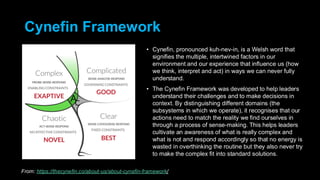
Cynefin Framework
• Cynefin,pronounced kuh-nev-in, is a Welsh word that
signifies the multiple, intertwined factors in our
environment and our experience that influence us (how
we think, interpret and act) in ways we can never fully
understand.
• The Cynefin Framework was developed to help leaders
understand their challenges and to make decisions in
context. By distinguishing different domains (the
subsystems in which we operate), it recognises that our
actions need to match the reality we find ourselves in
through a process of sense-making. This helps leaders
cultivate an awareness of what is really complex and
what is not and respond accordingly so that no energy is
wasted in overthinking the routine but they also never try
to make the complex fit into standard solutions.
From: https://thecynefin.co/about-us/about-cynefin-framework/
13.
Were we always“certain”?
• Probably not as much as we
remember!
• The past also contained: Wars, Oil crises,
Inflation , Pandemics, Technological
disruption
• The difference today is speed,
simultaneity, and interdependence.
• The deeper problem: We experience
uncertainty through memory. The past
appears inevitable. The future appears
chaotic.
The future has
never been certain.
So why do we
pretend otherwise?
14.
How organizations create
fragility
•Over-forecasting: Precision becomes
false confidence.
• Over-optimizing: Efficiency removes
redundancy and resilience.
• Over-committing: Irreversible bets
eliminate strategic flexibility.
• Under-experimenting: Learning occurs
after full-scale investment.
• Silencing dissent: Bad news arrives
late.
The greatest
danger is often not
uncertainty.
It is hidden fragility.
15.
What winners dodifferently?
• They design for multiple futures
• Shell: Scenario thinking
• Shell explicitly states that its scenarios are not
predictions or business plans. They are tools to
stretch thinking, explore assumptions and improve
decisions.
• AWS: Controlled failure
• Chaos engineering intentionally tests systems
against disruptions before customers encounter
them.
Do not wait for
uncertainty.
Practice
encountering it.
16.
Key lessons fromthe field
The best organizations convert uncertainty
into capability:
• 1. Shell — Stretch thinking
• Explore plausible futures, not predictions.
• 2. AWS — Rehearse failure
• Test resilience before real disruptions.
• 3. AI leaders — Build adaptive loops
• Use simulation, indicators and continuous adjustment.
• 4. Resilient strategists — Preserve options
• Invest in capabilities before making irreversible commitments.
They build
learning systems.
They do not build
perfect plans!
17.
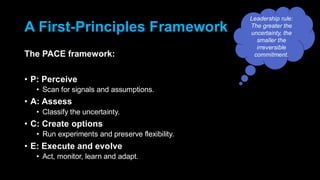
A First-Principles Framework
ThePACE framework:
• P: Perceive
• Scan for signals and assumptions.
• A: Assess
• Classify the uncertainty.
• C: Create options
• Run experiments and preserve flexibility.
• E: Execute and evolve
• Act, monitor, learn and adapt.
Leadership rule:
The greater the
uncertainty, the
smaller the
irreversible
commitment.
18.
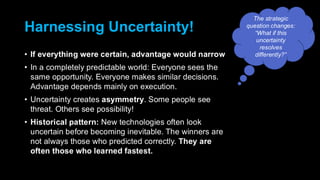
Harnessing Uncertainty!
• Ifeverything were certain, advantage would narrow
• In a completely predictable world: Everyone sees the
same opportunity. Everyone makes similar decisions.
Advantage depends mainly on execution.
• Uncertainty creates asymmetry. Some people see
threat. Others see possibility!
• Historical pattern: New technologies often look
uncertain before becoming inevitable. The winners are
not always those who predicted correctly. They are
often those who learned fastest.
The strategic
question changes:
“What if this
uncertainty
resolves
differently?”
19.
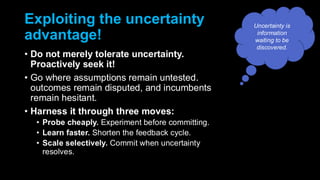
Exploiting the uncertainty
advantage!
•Do not merely tolerate uncertainty.
Proactively seek it!
• Go where assumptions remain untested.
outcomes remain disputed, and incumbents
remain hesitant.
• Harness it through three moves:
• Probe cheaply. Experiment before committing.
• Learn faster. Shorten the feedback cycle.
• Scale selectively. Commit when uncertainty
resolves.
Uncertainty is
information
waiting to be
discovered.
20.
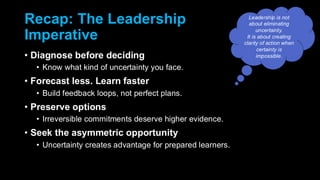
Recap: The Leadership
Imperative
•Diagnose before deciding
• Know what kind of uncertainty you face.
• Forecast less. Learn faster
• Build feedback loops, not perfect plans.
• Preserve options
• Irreversible commitments deserve higher evidence.
• Seek the asymmetric opportunity
• Uncertainty creates advantage for prepared learners.
Leadership is not
about eliminating
uncertainty.
It is about creating
clarity of action when
certainty is
impossible.