Expert Opinion
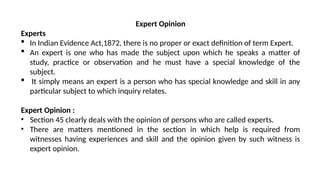
Experts
 In Indian Evidence Act,1872, there is no proper or exact definition of term Expert.
 An expert is one who has made the subject upon which he speaks a matter of
study, practice or observation and he must have a special knowledge of the
subject.
 It simply means an expert is a person who has special knowledge and skill in any
particular subject to which inquiry relates.
Expert Opinion :
• Section 45 clearly deals with the opinion of persons who are called experts.
• There are matters mentioned in the section in which help is required from
witnesses having experiences and skill and the opinion given by such witness is
expert opinion.
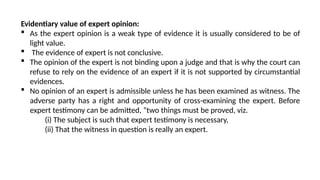
Evidentiary value of expert opinion:
 As the expert opinion is a weak type of evidence it is usually considered to be of
light value.
 The evidence of expert is not conclusive.
 The opinion of the expert is not binding upon a judge and that is why the court can
refuse to rely on the evidence of an expert if it is not supported by circumstantial
evidences.
 No opinion of an expert is admissible unless he has been examined as witness. The
adverse party has a right and opportunity of cross-examining the expert. Before
expert testimony can be admitted, “two things must be proved, viz.
(i) The subject is such that expert testimony is necessary,
(ii) That the witness in question is really an expert.
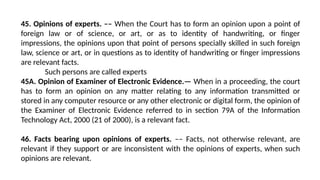
45. Opinions of experts. –– When the Court has to form an opinion upon a point of
foreign law or of science, or art, or as to identity of handwriting, or finger
impressions, the opinions upon that point of persons specially skilled in such foreign
law, science or art, or in questions as to identity of handwriting or finger impressions
are relevant facts.
Such persons are called experts
45A. Opinion of Examiner of Electronic Evidence.— When in a proceeding, the court
has to form an opinion on any matter relating to any information transmitted or
stored in any computer resource or any other electronic or digital form, the opinion of
the Examiner of Electronic Evidence referred to in section 79A of the Information
Technology Act, 2000 (21 of 2000), is a relevant fact.
46. Facts bearing upon opinions of experts. –– Facts, not otherwise relevant, are
relevant if they support or are inconsistent with the opinions of experts, when such
opinions are relevant.
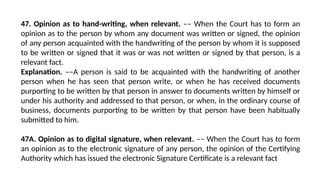
47. Opinion as to hand-writing, when relevant. –– When the Court has to form an
opinion as to the person by whom any document was written or signed, the opinion
of any person acquainted with the handwriting of the person by whom it is supposed
to be written or signed that it was or was not written or signed by that person, is a
relevant fact.
Explanation. ––A person is said to be acquainted with the handwriting of another
person when he has seen that person write, or when he has received documents
purporting to be written by that person in answer to documents written by himself or
under his authority and addressed to that person, or when, in the ordinary course of
business, documents purporting to be written by that person have been habitually
submitted to him.
47A. Opinion as to digital signature, when relevant. –– When the Court has to form
an opinion as to the electronic signature of any person, the opinion of the Certifying
Authority which has issued the electronic Signature Certificate is a relevant fact
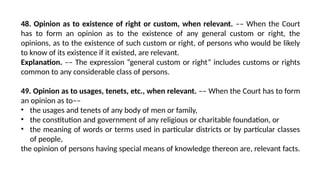
48. Opinion as to existence of right or custom, when relevant. –– When the Court
has to form an opinion as to the existence of any general custom or right, the
opinions, as to the existence of such custom or right, of persons who would be likely
to know of its existence if it existed, are relevant.
Explanation. –– The expression “general custom or right” includes customs or rights
common to any considerable class of persons.
49. Opinion as to usages, tenets, etc., when relevant. –– When the Court has to form
an opinion as to––
• the usages and tenets of any body of men or family,
• the constitution and government of any religious or charitable foundation, or
• the meaning of words or terms used in particular districts or by particular classes
of people,
the opinion of persons having special means of knowledge thereon are, relevant facts.
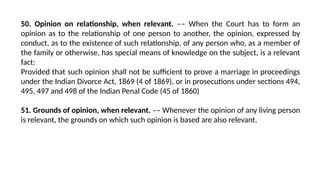
50. Opinion on relationship, when relevant. –– When the Court has to form an
opinion as to the relationship of one person to another, the opinion, expressed by
conduct, as to the existence of such relationship, of any person who, as a member of
the family or otherwise, has special means of knowledge on the subject, is a relevant
fact:
Provided that such opinion shall not be sufficient to prove a marriage in proceedings
under the Indian Divorce Act, 1869 (4 of 1869), or in prosecutions under sections 494,
495, 497 and 498 of the Indian Penal Code (45 of 1860)
51. Grounds of opinion, when relevant. –– Whenever the opinion of any living person
is relevant, the grounds on which such opinion is based are also relevant.