LaSalle Structural Tax Base & Infrastructure Deficit Analysis.
Analysis of LaSalle's draft subdivision plan reveals fiscal deficits and infrastructure strain from infill housing, urging strategic planning to protect taxpayers and maintain low-density neighborhood character.
LaSalle Structural Tax Base & Infrastructure Deficit Analysis.
1.
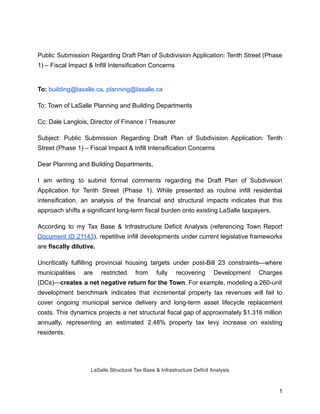
Public Submission RegardingDraft Plan of Subdivision Application: Tenth Street (Phase
1) – Fiscal Impact & Infill Intensification Concerns
To: building@lasalle.ca, planning@lasalle.ca
To: Town of LaSalle Planning and Building Departments
Cc: Dale Langlois, Director of Finance / Treasurer
Subject: Public Submission Regarding Draft Plan of Subdivision Application: Tenth
Street (Phase 1) – Fiscal Impact & Infill Intensification Concerns
Dear Planning and Building Departments,
I am writing to submit formal comments regarding the Draft Plan of Subdivision
Application for Tenth Street (Phase 1). While presented as routine infill residential
intensification, an analysis of the financial and structural impacts indicates that this
approach shifts a significant long-term fiscal burden onto existing LaSalle taxpayers.
According to my Tax Base & Infrastructure Deficit Analysis (referencing Town Report
Document ID 21143), repetitive infill developments under current legislative frameworks
are fiscally dilutive.
Uncritically fulfilling provincial housing targets under post-Bill 23 constraints—where
municipalities are restricted from fully recovering Development Charges
(DCs)—creates a net negative return for the Town. For example, modeling a 260-unit
development benchmark indicates that incremental property tax revenues will fail to
cover ongoing municipal service delivery and long-term asset lifecycle replacement
costs. This dynamics projects a net structural fiscal gap of approximately $1.316 million
annually, representing an estimated 2.48% property tax levy increase on existing
residents.
LaSalle Structural Tax Base & Infrastructure Deficit Analysis
1
2.
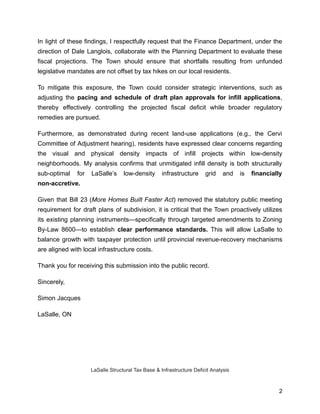
In light ofthese findings, I respectfully request that the Finance Department, under the
direction of Dale Langlois, collaborate with the Planning Department to evaluate these
fiscal projections. The Town should ensure that shortfalls resulting from unfunded
legislative mandates are not offset by tax hikes on our local residents.
To mitigate this exposure, the Town could consider strategic interventions, such as
adjusting the pacing and schedule of draft plan approvals for infill applications,
thereby effectively controlling the projected fiscal deficit while broader regulatory
remedies are pursued.
Furthermore, as demonstrated during recent land-use applications (e.g., the Cervi
Committee of Adjustment hearing), residents have expressed clear concerns regarding
the visual and physical density impacts of infill projects within low-density
neighborhoods. My analysis confirms that unmitigated infill density is both structurally
sub-optimal for LaSalle’s low-density infrastructure grid and is financially
non-accretive.
Given that Bill 23 (More Homes Built Faster Act) removed the statutory public meeting
requirement for draft plans of subdivision, it is critical that the Town proactively utilizes
its existing planning instruments—specifically through targeted amendments to Zoning
By-Law 8600—to establish clear performance standards. This will allow LaSalle to
balance growth with taxpayer protection until provincial revenue-recovery mechanisms
are aligned with local infrastructure costs.
Thank you for receiving this submission into the public record.
Sincerely,
Simon Jacques
LaSalle, ON
LaSalle Structural Tax Base & Infrastructure Deficit Analysis
2
3.
LaSalle Structural TaxBase & Infrastructure Deficit Analysis
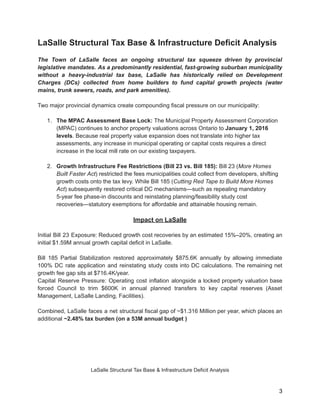
The Town of LaSalle faces an ongoing structural tax squeeze driven by provincial
legislative mandates. As a predominantly residential, fast-growing suburban municipality
without a heavy-industrial tax base, LaSalle has historically relied on Development
Charges (DCs) collected from home builders to fund capital growth projects (water
mains, trunk sewers, roads, and park amenities).
Two major provincial dynamics create compounding fiscal pressure on our municipality:
1. The MPAC Assessment Base Lock: The Municipal Property Assessment Corporation
(MPAC) continues to anchor property valuations across Ontario to January 1, 2016
levels. Because real property value expansion does not translate into higher tax
assessments, any increase in municipal operating or capital costs requires a direct
increase in the local mill rate on our existing taxpayers.
2. Growth Infrastructure Fee Restrictions (Bill 23 vs. Bill 185): Bill 23 (More Homes
Built Faster Act) restricted the fees municipalities could collect from developers, shifting
growth costs onto the tax levy. While Bill 185 (Cutting Red Tape to Build More Homes
Act) subsequently restored critical DC mechanisms—such as repealing mandatory
5-year fee phase-in discounts and reinstating planning/feasibility study cost
recoveries—statutory exemptions for affordable and attainable housing remain.
Impact on LaSalle
yr)
Initial Bill 23 Exposure: Reduced growth cost recoveries by an estimated 15%–20%, creating an
initial $1.59M annual growth capital deficit in LaSalle.
Bill 185 Partial Stabilization restored approximately $875.6K annually by allowing immediate
100% DC rate application and reinstating study costs into DC calculations. The remaining net
growth fee gap sits at $716.4K/year.
Capital Reserve Pressure: Operating cost inflation alongside a locked property valuation base
forced Council to trim $600K in annual planned transfers to key capital reserves (Asset
Management, LaSalle Landing, Facilities).
Combined, LaSalle faces a net structural fiscal gap of ~$1.316 Million per year, which places an
additional ~2.48% tax burden (on a 53M annual budget )
LaSalle Structural Tax Base & Infrastructure Deficit Analysis
3
4.
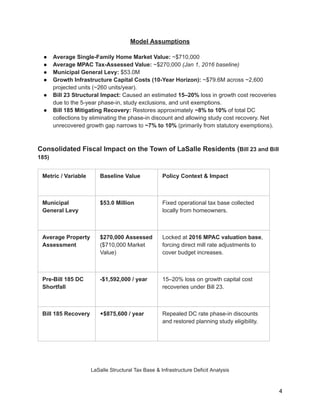
Model Assumptions
● AverageSingle-Family Home Market Value: ~$710,000
● Average MPAC Tax-Assessed Value: ~$270,000 (Jan 1, 2016 baseline)
● Municipal General Levy: $53.0M
● Growth Infrastructure Capital Costs (10-Year Horizon): ~$79.6M across ~2,600
projected units (~260 units/year).
● Bill 23 Structural Impact: Caused an estimated 15–20% loss in growth cost recoveries
due to the 5-year phase-in, study exclusions, and unit exemptions.
● Bill 185 Mitigating Recovery: Restores approximately ~8% to 10% of total DC
collections by eliminating the phase-in discount and allowing study cost recovery. Net
unrecovered growth gap narrows to ~7% to 10% (primarily from statutory exemptions).
Consolidated Fiscal Impact on the Town of LaSalle Residents (Bill 23 and Bill
185)
Metric / Variable Baseline Value Policy Context & Impact
Municipal
General Levy
$53.0 Million Fixed operational tax base collected
locally from homeowners.
Average Property
Assessment
$270,000 Assessed
($710,000 Market
Value)
Locked at 2016 MPAC valuation base,
forcing direct mill rate adjustments to
cover budget increases.
Pre-Bill 185 DC
Shortfall
-$1,592,000 / year 15–20% loss on growth capital cost
recoveries under Bill 23.
Bill 185 Recovery +$875,600 / year Repealed DC rate phase-in discounts
and restored planning study eligibility.
LaSalle Structural Tax Base & Infrastructure Deficit Analysis
4
5.
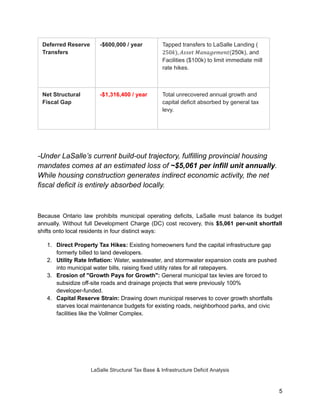
Deferred Reserve
Transfers
-$600,000 /year Tapped transfers to LaSalle Landing (
250k), and
250𝑘), 𝐴𝑠𝑠𝑒𝑡 𝑀𝑎𝑛𝑎𝑔𝑒𝑚𝑒𝑛𝑡(
Facilities ($100k) to limit immediate mill
rate hikes.
Net Structural
Fiscal Gap
-$1,316,400 / year Total unrecovered annual growth and
capital deficit absorbed by general tax
levy.
-Under LaSalle’s current build-out trajectory, fulfilling provincial housing
mandates comes at an estimated loss of ~$5,061 per infill unit annually.
While housing construction generates indirect economic activity, the net
fiscal deficit is entirely absorbed locally.
Because Ontario law prohibits municipal operating deficits, LaSalle must balance its budget
annually. Without full Development Charge (DC) cost recovery, this $5,061 per-unit shortfall
shifts onto local residents in four distinct ways:
1. Direct Property Tax Hikes: Existing homeowners fund the capital infrastructure gap
formerly billed to land developers.
2. Utility Rate Inflation: Water, wastewater, and stormwater expansion costs are pushed
into municipal water bills, raising fixed utility rates for all ratepayers.
3. Erosion of "Growth Pays for Growth": General municipal tax levies are forced to
subsidize off-site roads and drainage projects that were previously 100%
developer-funded.
4. Capital Reserve Strain: Drawing down municipal reserves to cover growth shortfalls
starves local maintenance budgets for existing roads, neighborhood parks, and civic
facilities like the Vollmer Complex.
LaSalle Structural Tax Base & Infrastructure Deficit Analysis
5
6.
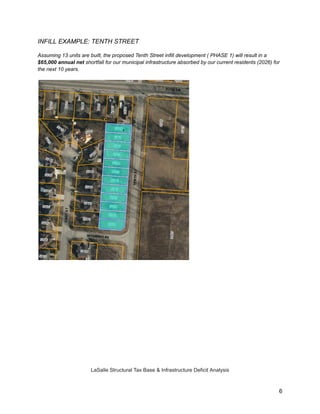
INFILL EXAMPLE: TENTHSTREET
Assuming 13 units are built, the proposed Tenth Street infill development ( PHASE 1) will result in a
$65,000 annual net shortfall for our municipal infrastructure absorbed by our current residents (2026) for
the next 10 years.
LaSalle Structural Tax Base & Infrastructure Deficit Analysis
6
7.
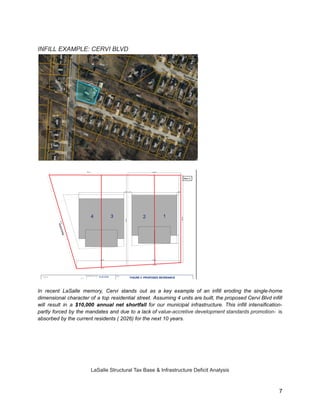
INFILL EXAMPLE: CERVIBLVD
In recent LaSalle memory, Cervi stands out as a key example of an infill eroding the single-home
dimensional character of a top residential street. Assuming 4 units are built, the proposed Cervi Blvd infill
will result in a $10,000 annual net shortfall for our municipal infrastructure. This infill intensification-
partly forced by the mandates and due to a lack of value-accretive development standards promotion- is
absorbed by the current residents ( 2026) for the next 10 years.
LaSalle Structural Tax Base & Infrastructure Deficit Analysis
7
8.
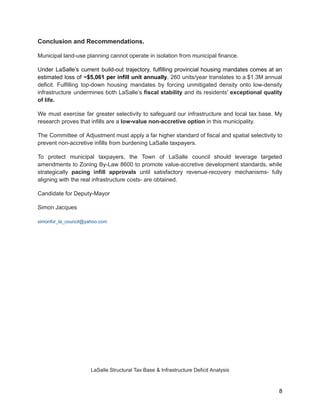
Conclusion and Recommendations.
Municipalland-use planning cannot operate in isolation from municipal finance.
Under LaSalle’s current build-out trajectory, fulfilling provincial housing mandates comes at an
estimated loss of ~$5,061 per infill unit annually. 260 units/year translates to a $1.3M annual
deficit. Fulfilling top-down housing mandates by forcing unmitigated density onto low-density
infrastructure undermines both LaSalle’s fiscal stability and its residents' exceptional quality
of life.
We must exercise far greater selectivity to safeguard our infrastructure and local tax base. My
research proves that infills are a low-value non-accretive option in this municipality.
The Committee of Adjustment must apply a far higher standard of fiscal and spatial selectivity to
prevent non-accretive infills from burdening LaSalle taxpayers.
To protect municipal taxpayers, the Town of LaSalle council should leverage targeted
amendments to Zoning By-Law 8600 to promote value-accretive development standards, while
strategically pacing infill approvals until satisfactory revenue-recovery mechanisms- fully
aligning with the real infrastructure costs- are obtained.
Candidate for Deputy-Mayor
Simon Jacques
simonfor_la_council@yahoo.com
LaSalle Structural Tax Base & Infrastructure Deficit Analysis
8
9.
OFFICIAL CAMPAIGN POSITIONON THE INFILLS
Uncritically approving infills replicates a model misadapted to our town
low-density, directly threatening our local infrastructure stability. They are dilutive
by design and run counter to the established high-value residential standard of
LaSalle.
If I don’t do something…
-The quasi-certain outcome of these infills in LaSalle is tax increases.
Simon Jacques will leave no stones untouched to transition LaSalle toward a fiscally
sustainable, accretive growth model.
I will take actions based on the research & recommendations found in this document:
LaSalle Structural Tax Base & Infrastructure Deficit Analysis.
****And this is about Leadership****
-I look forward to collaborating directly with the Mayor, Council, the CAO, Town
Planning, Finance Department, the Association of Municipalities of Ontario (AMO), local
Members of Provincial Parliament (MPP), to resolve complex issues.
SJ
LaSalle Structural Tax Base & Infrastructure Deficit Analysis
9