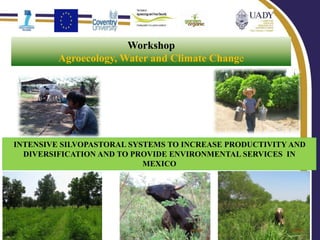
INTENSIVE SILVOPASTORAL SYSTEMS TO INCREASE PRODUCTIVITY AND
DIVERSIFICATION AND TO PROVIDE ENVIRONMENTAL SERVICES IN
MEXICO
Workshop
Agroecology, Water and Climate Change
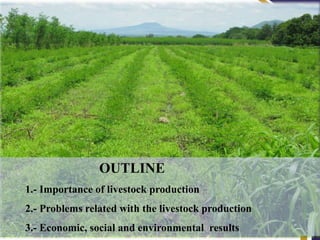
OUTLINE
1.- Importance of livestock production
2.- Problems related with the livestock production
3.- Economic, social and environmental results
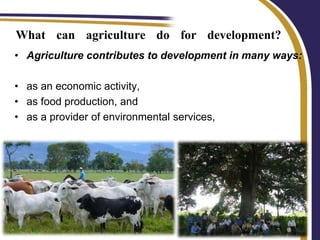
What can agriculture do for development?
• Agriculture contributes to development in many ways:
• as an economic activity,
• as food production, and
• as a provider of environmental services,
As an economic activity
• 3 billion people live in rural areas, nearly half world
population
• It generates on average 29 % GDP
• Employment for over 1300 million people.
• Important for food security because it is a source of income
for the majority of the rural people.
• Produce a third of the protein required for population
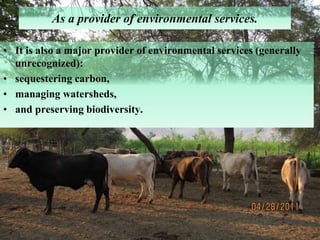
As a provider of environmental services.
• It is also a major provider of environmental services (generally
unrecognized):
• sequestering carbon,
• managing watersheds,
• and preserving biodiversity.
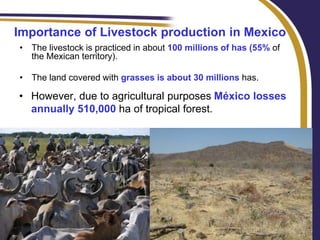
• The livestock is practiced in about 100 millions of has (55% of
the Mexican territory).
• The land covered with grasses is about 30 millions has.
Importance of Livestock production in Mexico
• However, due to agricultural purposes México losses
annually 510,000 ha of tropical forest.
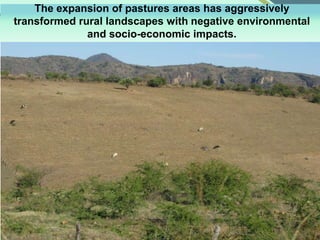
The expansion of pastures areas has aggressively
transformed rural landscapes with negative environmental
and socio-economic impacts.
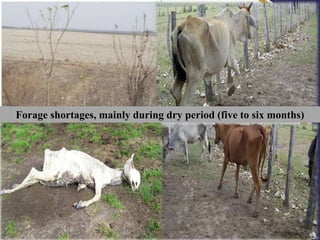
Forage shortages, mainly during dry period (five to six months)
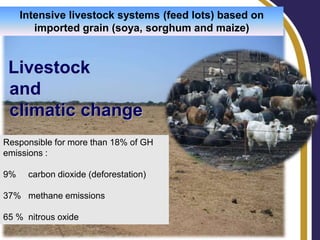
Livestock
and
climatic change
Responsible for more than 18% of GH
emissions :
9% carbon dioxide (deforestation)
37% methane emissions
65 % nitrous oxide
Intensive livestock systems (feed lots) based on
imported grain (soya, sorghum and maize)
The need for transforming conventional livestock
systems production in Mexico to:
• Reduce environmental impact
• Land degradation
• Increase food security
• Creating rural employment
• Improve rural livelihood
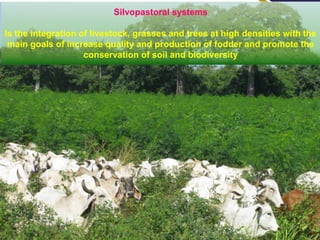
Silvopastoral systems
Is the integration of livestock, grasses and trees at high densities with the
main goals of increase quality and production of fodder and promote the
conservation of soil and biodiversity
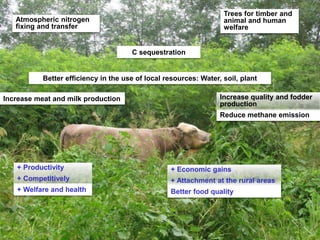
C sequestration
Atmospheric nitrogen
fixing and transfer
Increase quality and fodder
production
Reduce methane emission
Trees for timber and
animal and human
welfare
Increase meat and milk production
+ Productivity
+ Competitively
+ Welfare and health
+ Economic gains
+ Attachment at the rural areas
Better food quality
Better efficiency in the use of local resources: Water, soil, plant
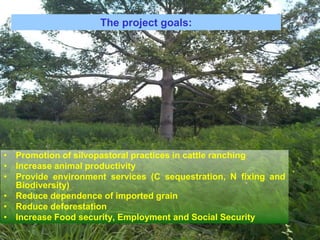
• Promotion of silvopastoral practices in cattle ranching
• Increase animal productivity
• Provide environment services (C sequestration, N fixing and
Biodiversity)
• Reduce dependence of imported grain
• Reduce deforestation
• Increase Food security, Employment and Social Security
The project goals:
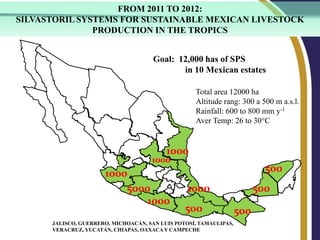
FROM 2011 TO 2012:
SILVASTORIL SYSTEMS FOR SUSTAINABLE MEXICAN LIVESTOCK
PRODUCTION IN THE TROPICS
500
500
500 500
1000
1000
1000
1000
5000
1000
Goal: 12,000 has of SPS
in 10 Mexican estates
JALISCO, GUERRERO, MICHOACÁN, SAN LUIS POTOSÍ, TAMAULIPAS,
VERACRUZ, YUCATÁN, CHIAPAS, OAXACAY CAMPECHE
Total area 12000 ha
Altitude rang: 300 a 500 m a.s.l.
Rainfall: 600 to 800 mm y-1
Aver Temp: 26 to 30°C
LAZARO CARDENAS
COAHUAYANA
* *AGUILILLA
*LA HUACANA
*
*
*
TIQUICHEO
*TEPALCATEPEC
APATZINGAN
Dire
ctor
R1
R2
R3
D
i
r
e
c
t
o
r
R
1
R
2
R
3
R
4
BUENAVISTA
Dire
ctor
R1
R2
R3
D
i
r
e
c
t
o
r
R
1
R
2
R
3
R
4
AQUILA ARTEAGA
CHINICUILA
COALCOMAN
CHURUMUCO
SAN LUCAS
Dire
ctor
R1
R2
R3
Dire
ctor
R1
R2
R3
Dire
ctor
R1
R2
R3
Dire
ctor
R1
R2
R3
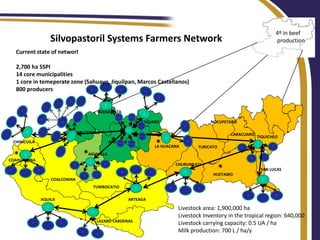
Silvopastoril Systems Farmers Network
Livestock area: 1,900,000 ha
Livestock Inventory in the tropical region: 640,000
Livestock carrying capacity: 0.5 UA / ha
Milk production: 700 L / ha/y
PARACUARO
TUMBISCATIO
HUETAMO
TURICATO
NOCUPETARO
CARACUARO
Current state of networl
2,700 ha SSPI
14 core municipalities
1 core in temeperate zone (Sahuayo, Jiquilpan, Marcos Castellanos)
800 producers
4º in beef
production
FPM
Director
Ma.
Isabel
Huarin
ches
Sandoval
CBTa
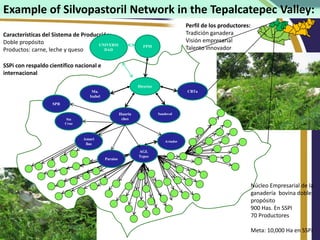
Example of Silvopastoril Network in the Tepalcatepec Valley:
SPR
Sta
Cruz
AGL
Tepec
Aviador
Amari
llas
Paraíso
Características del Sistema de Producción:
Doble propósito
Productos: carne, leche y queso
Perfil de los productores:
Tradición ganadera
Visión empresarial
Talento innovador
Núcleo Empresarial de la
ganadería bovina doble
propósito
900 Has. En SSPI
70 Productores
Meta: 10,000 Ha en SSPi
SSPi con respaldo científico nacional e
internacional
UNIVERSI
DAD
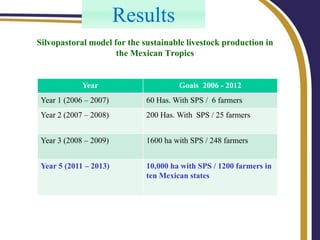
Silvopastoral Project:
Silvopastoral model for the sustainable livestock production in
the Mexican Tropics
Year Goals 2006 - 2012
Year 1 (2006 – 2007) 60 Has. With SPS / 6 farmers
Year 2 (2007 – 2008) 200 Has. With SPS / 25 farmers
Year 3 (2008 – 2009) 1600 ha with SPS / 248 farmers
Year 5 (2011 – 2013) 10,000 ha with SPS / 1200 farmers in
ten Mexican states
Results
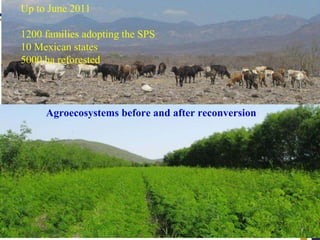
Agroecosystems before and after reconversion
Up to June 2011
1200 families adopting the SPS
10 Mexican states
5000 ha reforested
SOCIO-ECONOMIC RESULTS
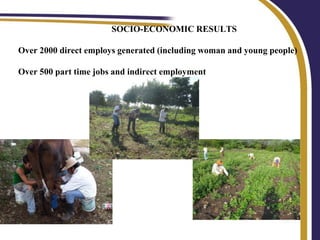
Over 2000 direct employs generated (including woman and young people)
Over 500 part time jobs and indirect employment
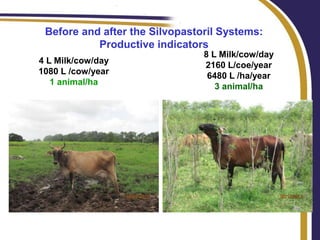
4 L Milk/cow/day
1080 L /cow/year
1 animal/ha
8 L Milk/cow/day
2160 L/coe/year
6480 L /ha/year
3 animal/ha
Before and after the Silvopastoril Systems:
Productive indicators
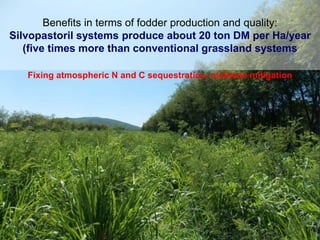
Benefits in terms of fodder production and quality:
Silvopastoril systems produce about 20 ton DM per Ha/year
(five times more than conventional grassland systems
Fixing atmospheric N and C sequestration, methane mitigation
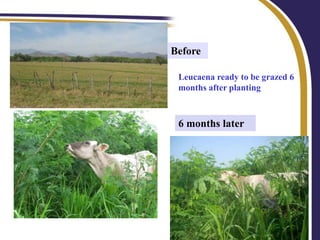
Leucaena ready to be grazed 6
months after planting
Before
6 months later
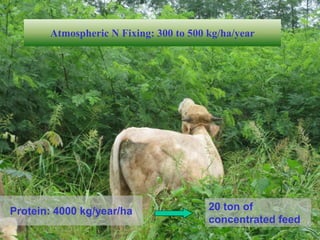
Protein: 4000 kg/year/ha 20 ton of
concentrated feed
Atmospheric N Fixing: 300 to 500 kg/ha/year
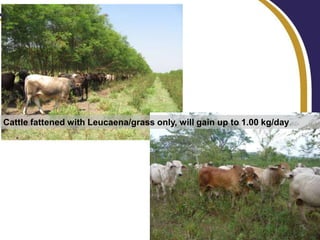
Cattle fattened with Leucaena/grass only, will gain up to 1.00 kg/day
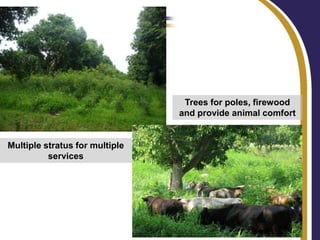
Multiple stratus for multiple
services
Trees for poles, firewood
and provide animal comfort
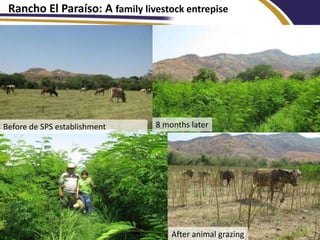
Rancho El Paraíso: A family livestock entrepise
Before de SPS establishment
After animal grazing
8 months later
Make smallholder farming more productive and
sustainable is the main pathway out of poverty in
using agriculture for development (FAO 2011)
Thank You