Technical Debt –
Understanding its
Sources and Impacts
Through a Game
David Croley - @davidcroley
David Croley
Agile Velocity
Principal Consultant
Certified Scrum Manager ( CSM)
@davidcroley
dcroley@agilevelocity.com
Transforming Technology Organizations
2
We’d prefer to deliver a fast,
steady stream of new features…
But sometimes delivery feels
slow, even stagnant.
CC BY 2.0 http://www.flickr.com/photos/usfwspacific/6121377305/
And we hope it doesn’t feel like
this!
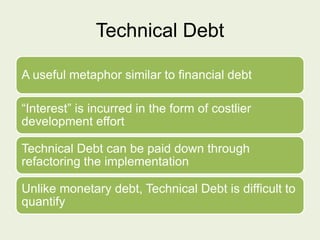
Technical Debt
A useful metaphor similar to financial debt
ā€œInterestā€ is incurred in the form of costlier
development effort
Technical Debt can be paid down through
refactoring the implementation
Unlike monetary debt, Technical Debt is difficult to
quantify
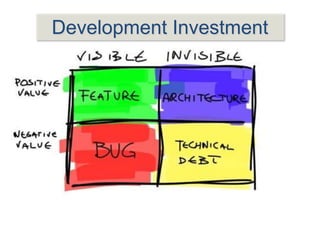
Development Investment
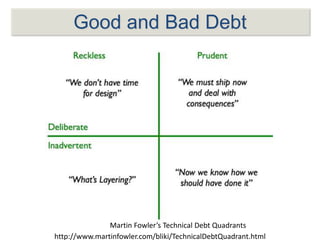
Good and Bad Debt
Martin Fowler’s Technical Debt Quadrants
http://www.martinfowler.com/bliki/TechnicalDebtQuadrant.html
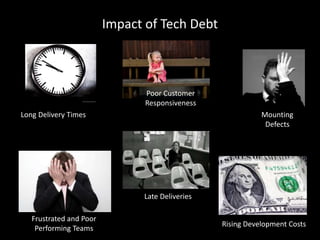
Late Deliveries
Mounting
Defects
Rising Development Costs
Poor Customer
Responsiveness
Long Delivery Times
Frustrated and Poor
Performing Teams
Impact of Tech Debt
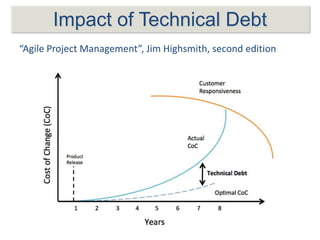
Impact of Technical Debt
ā€œAgile Project Managementā€, Jim Highsmith, second edition
Let’s do an exercise to understand
the concept further.
Form into Teams of at least 4
people.
Feature
Cost: 15
Feature
Cost: 10
Feature
Cost: 5
Technical Debt
Cost 15
Impact -10
Technical Debt
Cost 15
Impact -10
Technical Debt
Cost 10
Impact -5
Technical Debt
Cost 5
Impact -5
Technical Debt
Cost 5
Impact -5
Iteration Card
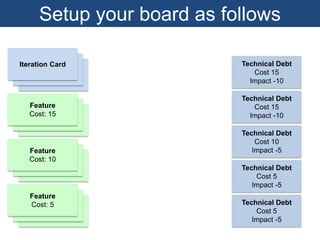
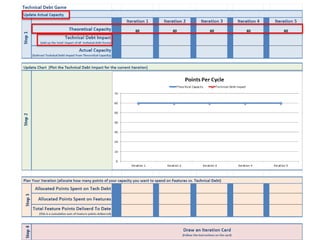
Setup your board as follows
Feature
Cost: 15
Feature
Cost: 10
Feature
Cost: 5
Technical Debt
Cost 15
Impact -10
Technical Debt
Cost 15
Impact -10
Technical Debt
Cost 10
Impact -5
Technical Debt
Cost 5
Impact -5
Technical Debt
Cost 5
Impact -5
Iteration Card
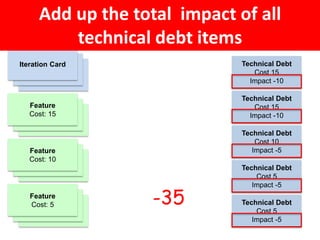
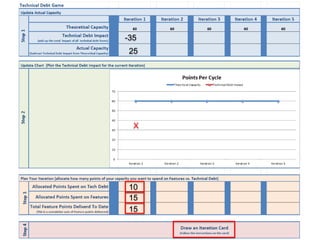
Add up the total impact of all
technical debt items
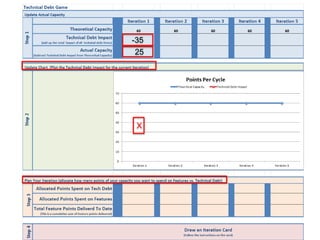
-35
25
-35
X
Feature
Cost: 10
Feature
Cost: 15
Feature
Cost: 10
Technical Debt
Cost 15
Impact -10
Technical Debt
Cost 15
Impact -10
Technical Debt
Cost 10
Impact -5
Technical Debt
Cost 5
Impact -5
Technical Debt
Cost 5
Impact -5
Iteration Card
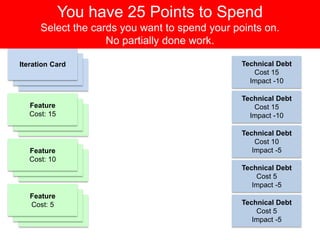
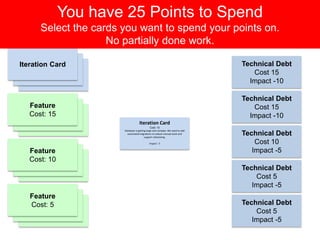
You have 25 Points to Spend
Select the cards you want to spend your points on.
No partially done work.
Feature
Cost: 5
Feature
Cost: 5
-35
25
10
15
15
X
Feature
Cost: 10
Feature
Cost: 15
Feature
Cost: 10
Technical Debt
Cost 15
Impact -10
Technical Debt
Cost 15
Impact -10
Technical Debt
Cost 10
Impact -5
Technical Debt
Cost 5
Impact -5
Technical Debt
Cost 5
Impact -5
Iteration Card
You have 25 Points to Spend
Select the cards you want to spend your points on.
No partially done work.
Feature
Cost: 5
Feature
Cost: 5
Iteration Card
Cost: 10
Database is getting large and complex. We need to add
automated migrations to reduce manual work and
support refactoring.
Impact: -5
The goal is to complete as many
feature points at the end of 5
iterations.
Go!
The goal is to complete as many
feature points at the end of 5
iterations.
Stop!
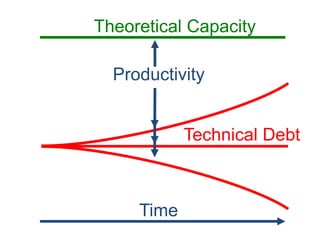
Theoretical Capacity
Technical Debt
Productivity
Time
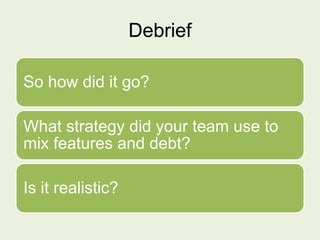
Debrief
So how did it go?
What strategy did your team use to
mix features and debt?
Is it realistic?
Capture your debt
Visualize and Estimate
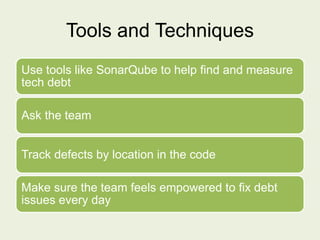
Tools and Techniques
Use tools like SonarQube to help find and measure
tech debt
Ask the team
Track defects by location in the code
Make sure the team feels empowered to fix debt
issues every day
Publicize and Communicate
Need to invest time, team needs
slack
Boy Scout slide
Incrementally make your code
better
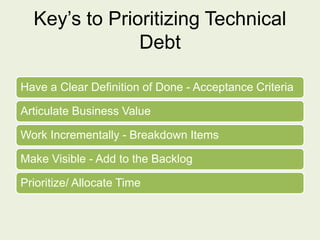
Key’s to Prioritizing Technical
Debt
Have a Clear Definition of Done - Acceptance Criteria
Articulate Business Value
Work Incrementally - Breakdown Items
Make Visible - Add to the Backlog
Prioritize/ Allocate Time
21
21
1
2
1 2 1 1
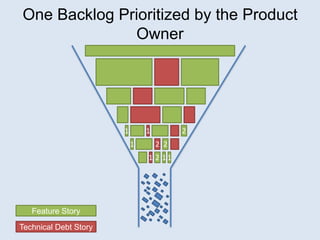
One Backlog Prioritized by the Product
Owner
Feature Story
Technical Debt Story
21
21
1
2
1211
21
21
1
2
1211
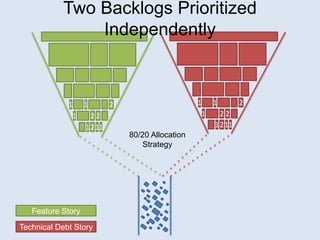
Feature Story
Technical Debt Story
Two Backlogs Prioritized
Independently
80/20 Allocation
Strategy
Discuss how you could apply these
concepts to help your teams.
David Croley – dcroley@agilevelocity.com
Website – AgileVelocity.com
Blog – AustinAgile.com
Twitter - @austinagile
Thanks!
Kaa2015, Tech Debt: Understanding its Sources and Impacts Through a Game