Just Transition Network - Scenarios and Implications of Coal Production in Indonesia for East Kalimantan and South Sumatra
Analysis of Indonesia's coal demand, supply, and reserves with a focus on East Kalimantan and South Sumatra, highlighting future production scenarios and just transition strategies for economic diversification and environmental management.
Future coal demand
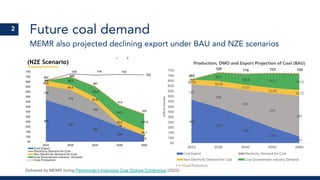
MEMRalso projected declining export under BAU and NZE scenarios
Delivered by MEMR during Petromindo’s Indonesia Coal Outlook Conference (2023)
2
7.
Future coal demand
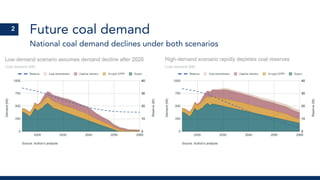
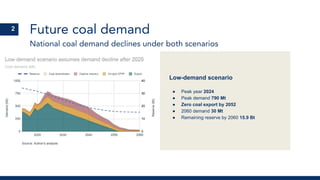
Nationalcoal demand declines under both scenarios
Low-demand scenario
● Peak year 2024
● Peak demand 790 Mt
● Zero coal export by 2052
● 2060 demand 30 Mt
● Remaining reserve by 2060 15.9 Bt
2
8.
Future coal demand
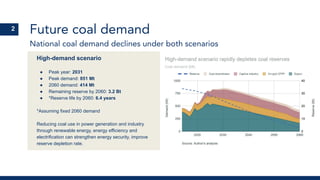
Nationalcoal demand declines under both scenarios
High-demand scenario
● Peak year: 2031
● Peak demand: 851 Mt
● 2060 demand: 414 Mt
● Remaining reserve by 2060: 3.2 Bt
● *Reserve life by 2060: 6.4 years
*Assuming fixed 2060 demand
Reducing coal use in power generation and industry
through renewable energy, energy efficiency and
electrification can strengthen energy security, improve
reserve depletion rate.
2
9.
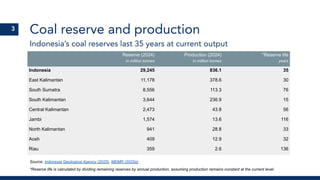
Coal reserve andproduction
Indonesia’s coal reserves last 35 years at current output
Reserve (2024)
in million tonnes
Production (2024)
in million tonnes
*Reserve life
years
Indonesia 29,245 836.1 35
East Kalimantan 11,178 378.6 30
South Sumatra 8,556 113.3 76
South Kalimantan 3,644 236.9 15
Central Kalimantan 2,473 43.8 56
Jambi 1,574 13.6 116
North Kalimantan 941 28.8 33
Aceh 409 12.9 32
Riau 359 2.6 136
Source: Indonesia Geological Agency (2025), MEMR (2025a)
*Reserve life is calculated by dividing remaining reserves by annual production, assuming production remains constant at the current level.
3
10.
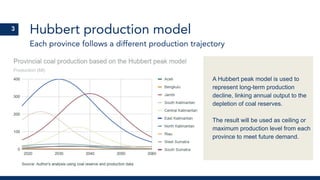
Hubbert production model
Eachprovince follows a different production trajectory
A Hubbert peak model is used to
represent long-term production
decline, linking annual output to the
depletion of coal reserves.
The result will be used as ceiling or
maximum production level from each
province to meet future demand.
3
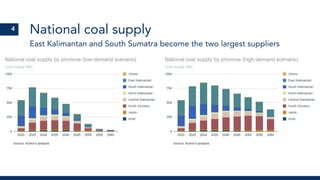
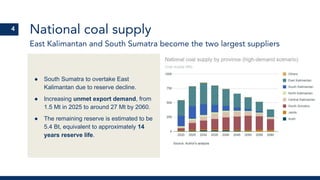
National coal supply
EastKalimantan and South Sumatra become the two largest suppliers
4
● South Sumatra to overtake East
Kalimantan due to reserve decline.
● Increasing unmet export demand, from
1.5 Mt in 2025 to around 27 Mt by 2060.
● The remaining reserve is estimated to be
5.4 Bt, equivalent to approximately 14
years reserve life.
13.
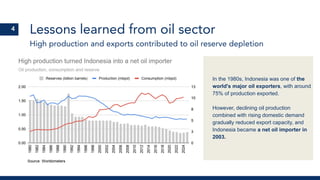
High production andexports contributed to oil reserve depletion
Lessons learned from oil sector
In the 1980s, Indonesia was one of the
world's major oil exporters, with around
75% of production exported.
However, declining oil production
combined with rising domestic demand
gradually reduced export capacity, and
Indonesia became a net oil importer in
2003.
4
Province-level coal supply
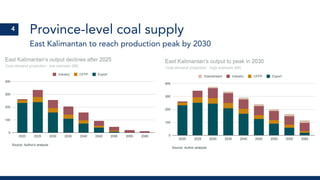
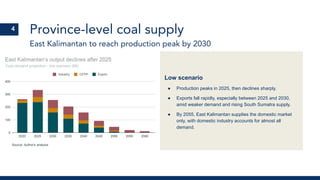
EastKalimantan to reach production peak by 2030
4
Low scenario
● Production peaks in 2025, then declines sharply.
● Exports fall rapidly, especially between 2025 and 2030,
amid weaker demand and rising South Sumatra supply.
● By 2055, East Kalimantan supplies the domestic market
only, with domestic industry accounts for almost all
demand.
16.
Province-level coal supply
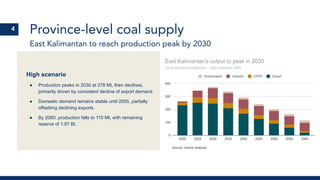
EastKalimantan to reach production peak by 2030
4
High scenario
● Production peaks in 2030 at 378 Mt, then declines,
primarily driven by consistent decline of export demand.
● Domestic demand remains stable until 2055, partially
offsetting declining exports.
● By 2060, production falls to 115 Mt, with remaining
reserve of 1.97 Bt.
Province-level coal supply
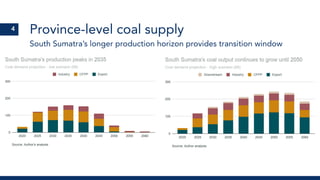
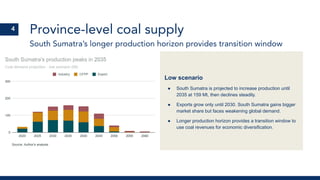
SouthSumatra’s longer production horizon provides transition window
4
Low scenario
● South Sumatra is projected to increase production until
2035 at 159 Mt, then declines steadily.
● Exports grow only until 2030. South Sumatra gains bigger
market share but faces weakening global demand.
● Longer production horizon provides a transition window to
use coal revenues for economic diversification.
19.
Province-level coal supply
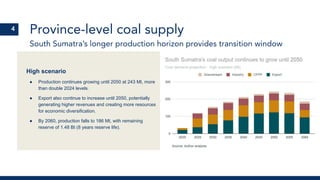
SouthSumatra’s longer production horizon provides transition window
4
High scenario
● Production continues growing until 2050 at 243 Mt, more
than double 2024 levels.
● Export also continue to increase until 2050, potentially
generating higher revenues and creating more resources
for economic diversification.
● By 2060, production falls to 186 Mt, with remaining
reserve of 1.48 Bt (8 years reserve life).
20.
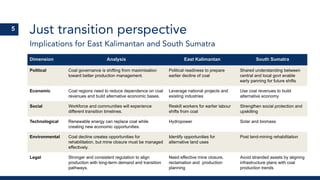
Just transition perspective
Implicationsfor East Kalimantan and South Sumatra
5
Dimension Analysis East Kalimantan South Sumatra
Political Coal governance is shifting from maximisation
toward better production management.
Political readiness to prepare
earlier decline of coal
Shared understanding between
central and local govt enable
early panning for future shifts
Economic Coal regions need to reduce dependence on coal
revenues and build alternative economic bases.
Leverage national projects and
existing industries
Use coal revenues to build
alternative economy
Social Workforce and communities will experience
different transition timelines.
Reskill workers for earlier labour
shifts from coal
Strengthen social protection and
upskilling
Technological Renewable energy can replace coal while
creating new economic opportunities.
Hydropower Solar and biomass
Environmental Coal decline creates opportunities for
rehabilitation, but mine closure must be managed
effectively.
Identify opportunities for
alternative land uses
Post land-mining rehabilitation
Legal Stronger and consistent regulation to align
production with long-term demand and transition
pathways.
Need effective mine closure,
reclamation and production
planning
Avoid stranded assets by aligning
infrastructure plans with coal
production trends
21.
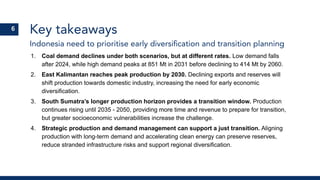
Key takeaways
Indonesia needto prioritise early diversification and transition planning
1. Coal demand declines under both scenarios, but at different rates. Low demand falls
after 2024, while high demand peaks at 851 Mt in 2031 before declining to 414 Mt by 2060.
2. East Kalimantan reaches peak production by 2030. Declining exports and reserves will
shift production towards domestic industry, increasing the need for early economic
diversification.
3. South Sumatra’s longer production horizon provides a transition window. Production
continues rising until 2035 - 2050, providing more time and revenue to prepare for transition,
but greater socioeconomic vulnerabilities increase the challenge.
4. Strategic production and demand management can support a just transition. Aligning
production with long-term demand and accelerating clean energy can preserve reserves,
reduce stranded infrastructure risks and support regional diversification.
6
22.
Acknowledgements
The project "InnovationRegions for a Just Energy Transition" is co-financed by the International
Climate Initiative (IKI) of the German Federal Ministry for the Environment, Climate Action,
Nature Conservation and Nuclear Safety (BMUKN) and by the Directorate-General for
International Partnerships (DG INTPA) of the European Commission (DG INTPA) for the
Interregional Platform for Just Energy Transition in Coal Regions (JET-CR).
23.
Any person whobelieves they may be harmed by an IKI project or who wishes to report corruption or the
misuse of funds can lodge a complaint to the IKI Independent Complaint Mechanism at
IKI-complaints@z-u-g.org. The IKI Complaint Mechanism has a panel of independent experts who will
investigate the complaint. In the course of the investigation, we will consult with the complainant so as to
avoid unnecessary risks for the complainant.
More information can be found at:
https://www.international-climate-initiative.com/en/about-iki/values-responsibility/independent-compla
int-mechanism/