jQuery
 It's a library, not a framework.
Speakers
Ryan Smith
Front-end architect with Credera. Focused on good user experience
through well-crafted client side code. Current interests include
HTML5, CSS3, mobile development, and Javascript patterns for
responsive web apps. Geeks out on great coffee, cooking, beautiful
design, and elegant code.

Kenny Rosenberg
Senior consultant with Credera. His focus areas
include front end development (usually with JQuery)
and Java web development (usually with Spring
Framework). He graduated from the University of
Texas with a BBA in Management Information
Systems.
Library vs. Framework
• This is a semantic argument
• Why make a distinction?
• Managing expectations
Library
• A collection of helper methods
• Helps us not reinvent the wheel
• Enables greater consistency,
  readability
• Abstracts away the tedious stuff
Framework
• Implies architecture / structure
• Often driven by patterns considered
  to be "best practice," i.e. MVC
• Designed to save you time by
  employing reasonable defaults
  ("convention over configuration")
Comparison
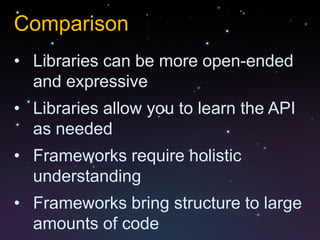
• Libraries can be more open-ended
  and expressive
• Libraries allow you to learn the API
  as needed
• Frameworks require holistic
  understanding
• Frameworks bring structure to large
  amounts of code
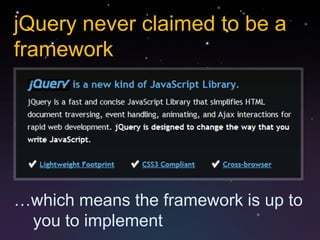
jQuery never claimed to be a
framework


…which means the framework is up to
 you to implement
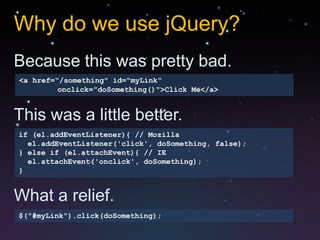
Why do we use jQuery?
Because this was pretty bad.
<a href=“/something" id="myLink"
         onclick="doSomething()">Click Me</a>


This was a little better.
if (el.addEventListener){ // Mozilla
  el.addEventListener('click', doSomething, false);
} else if (el.attachEvent){ // IE
  el.attachEvent('onclick', doSomething);
}


What a relief.
$("#myLink").click(doSomething);
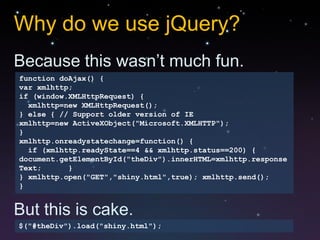
Why do we use jQuery?
Because this wasn’t much fun.
function doAjax() {
var xmlhttp;
if (window.XMLHttpRequest) {
  xmlhttp=new XMLHttpRequest();
} else { // Support older version of IE
xmlhttp=new ActiveXObject("Microsoft.XMLHTTP");
}
xmlhttp.onreadystatechange=function() {
  if (xmlhttp.readyState==4 && xmlhttp.status==200) {
document.getElementById("theDiv").innerHTML=xmlhttp.response
Text;      }
} xmlhttp.open("GET","shiny.html",true); xmlhttp.send();
}


But this is cake.
$("#theDiv").load("shiny.html");
Why do we use jQuery?
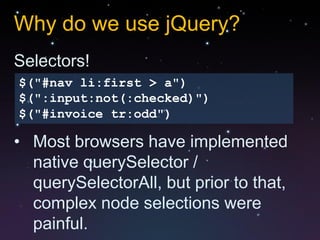
Selectors!
$("#nav li:first > a")
$(":input:not(:checked)")
$("#invoice tr:odd")

• Most browsers have implemented
  native querySelector /
  querySelectorAll, but prior to that,
  complex node selections were
  painful.
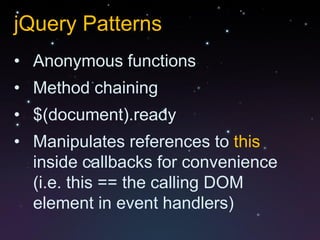
jQuery Patterns
• Anonymous functions
• Method chaining
• $(document).ready
• Manipulates references to this
  inside callbacks for convenience
  (i.e. this == the calling DOM
  element in event handlers)
jQuery Plugins
• Easy to write
• Easy to use
• Proliferated rapidly as jQuery
  popularity grew
• Attracts new users and JS novices
  to jQuery
jQuery Plugins

     A Word of Caution
Adopting a plugin is like adopting a
puppy. Know its behavior before
letting it into your home.


Translation: Read the source.
jQuery and Complexity
• jQuery is ideal for most websites
  because of its simple API and
  compact but expressive syntax.
• But what about really large
  websites? Complex web apps?
  Single page web apps?
Possible Pitfalls
• Tightly-coupled code leads to copy
  & paste pattern
• Failure to stay DRY
• Polluted global namespace
• “Pluginitis”
• Reliance on DOM to hold transient
  application state
Recommended Strategies
1. Logical separation of JS into
   loosely-coupled modules
2. Standardized communication
   between modules
3. Separation of model (application
   state) from view (DOM)
Module Pattern
• Douglas Crockford first publicized in
  2007
• We like the “Revealing” variant
  proposed by Christian Heilmann


Sources: http://www.yuiblog.com/blog/2007/06/12/module-pattern/
http://www.wait-till-i.com/2007/08/22/again-with-the-module-pattern-reveal-something-to-the-world/
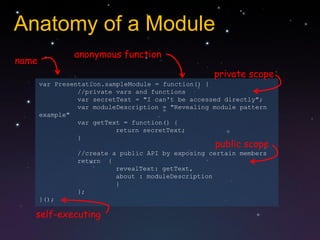
Anatomy of a Module
                anonymous function
name
                                                    private scope
       var Presentation.sampleModule = function() {
                 //private vars and functions
                 var secretText = "I can't be accessed directly";
                 var moduleDescription = "Revealing module pattern
       example"
                 var getText = function() {
                           return secretText;
                 }
                                                    public scope
                //create a public API by exposing certain members
                return {
                          revealText: getText,
                          about : moduleDescription
                          }
                };
       }();

   self-executing
{ demo }
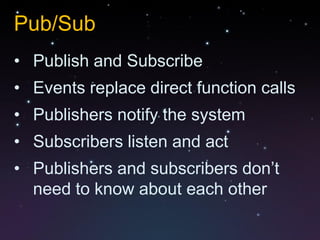
Pub/Sub
• Publish and Subscribe
• Events replace direct function calls
• Publishers notify the system
• Subscribers listen and act
• Publishers and subscribers don’t
  need to know about each other
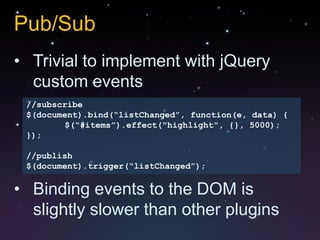
Pub/Sub
• Trivial to implement with jQuery
  custom events
 //subscribe
 $(document).bind(“listChanged”, function(e, data) {
        $(“#items”).effect("highlight", {}, 5000);
 });

 //publish
 $(document).trigger(“listChanged”);


• Binding events to the DOM is
  slightly slower than other plugins
Pub/Sub
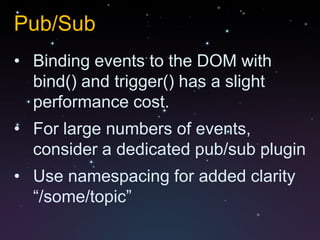
• Binding events to the DOM with
  bind() and trigger() has a slight
  performance cost.
• For large numbers of events,
  consider a dedicated pub/sub plugin
• Use namespacing for added clarity
  “/some/topic”
{ demo }
Templates
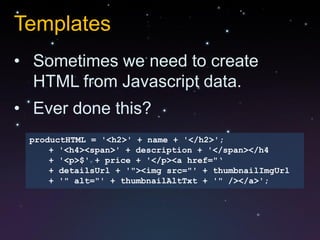
• Sometimes we need to create
  HTML from Javascript data.
• Ever done this?
 productHTML = '<h2>' + name + '</h2>';
     + '<h4><span>' + description + '</span></h4
     + '<p>$' + price + '</p><a href="„
     + detailsUrl + '"><img src="' + thumbnailImgUrl
     + '" alt="' + thumbnailAltTxt + '" /></a>';
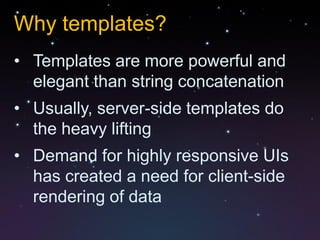
Why templates?
• Templates are more powerful and
  elegant than string concatenation
• Usually, server-side templates do
  the heavy lifting
• Demand for highly responsive UIs
  has created a need for client-side
  rendering of data
When to use templates
• Useful when calling 3rd party APIs
  that return JSON
• Async calls that return large
  amounts of repetitive HTML can be
  refactored as JSON + client side
  templates
• User interactions that require
  instant feedback
Current state of JS templates
• Ideally, we would write a single
  template that can be rendered both
  server and client-side
• Systems that support this:
  • Google Closure templates (used
  for Google +)
  • {{ mustache }}
jQuery Templates
• Still in beta
• Developed by Boris Moore, adopted
  as an “official” jQuery plugin in
  October 2010
• Support for conditional logic,
  iteration, nested templates
• No server-side implementation yet
{ demo }
Thanks for attending!
• Questions?

{ Contact Us }

Ryan Smith                 Kenny Rosenberg
rsmith@credera.com         krosenberg@credera.com
    @ryanlsmith                @kennyrosenberg

http://blogs.credera.com