Why Classify Elements?
Imaginetrying to learn about over 100 unique elements without any system! It would be a scientific maze!
• More than 100 elements exist in our world.
• Studying them individually is super challenging.
• Classification helps group elements with similar traits, like sorting socks!
• It makes learning about chemistry much easier and more fun!
3.
Lavoisier’s Classification (1789)
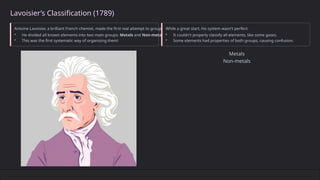
AntoineLavoisier, a brilliant French chemist, made the first real attempt to group elements.
• He divided all known elements into two main groups: Metals and Non-metals.
• This was the first systematic way of organizing them!
While a great start, his system wasn't perfect:
• It couldn't properly classify all elements, like some gases.
• Some elements had properties of both groups, causing confusion.
Metals
Non-metals
4.
Dobereiner’s Triads (1817)
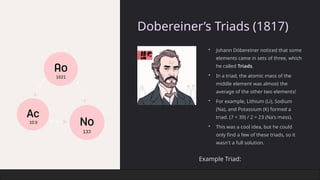
•Johann Döbereiner noticed that some
elements came in sets of three, which
he called Triads.
• In a triad, the atomic mass of the
middle element was almost the
average of the other two elements!
• For example, Lithium (Li), Sodium
(Na), and Potassium (K) formed a
triad. (7 + 39) / 2 = 23 (Na's mass).
• This was a cool idea, but he could
only find a few of these triads, so it
wasn't a full solution.
Example Triad:
5.
Newlands’ Law ofOctaves
(1864)
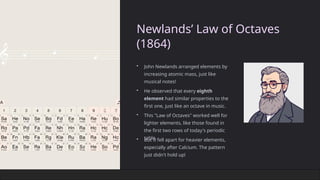
• John Newlands arranged elements by
increasing atomic mass, just like
musical notes!
• He observed that every eighth
element had similar properties to the
first one, just like an octave in music.
• This "Law of Octaves" worked well for
lighter elements, like those found in
the first two rows of today's periodic
table.
• But it fell apart for heavier elements,
especially after Calcium. The pattern
just didn't hold up!
6.
Mendeleev’s Periodic Table(1869)
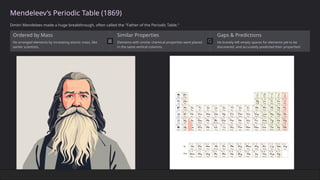
Dmitri Mendeleev made a huge breakthrough, often called the "Father of the Periodic Table."
Ordered by Mass
He arranged elements by increasing atomic mass, like
earlier scientists.
Similar Properties
Elements with similar chemical properties were placed
in the same vertical columns.
Gaps & Predictions
He bravely left empty spaces for elements yet to be
discovered, and accurately predicted their properties!
7.
Mendeleev’s Periodic Law
"Theproperties of elements are a periodic
function of their atomic masses."
What does this mean?
• It means that if you arrange elements by their atomic mass, their
properties will repeat in a regular, predictable pattern.
• Think of it like seasons changing every year – a periodic cycle!
• This law became the foundation for our modern periodic table,
helping scientists understand how elements behave.
8.
Comparison Chart
Scientist YearMethod Used Key Feature
Lavoisier
1789 Metals & Non-metals First basic classification
Döbereiner
1817 Triads Middle element average mass
≈
Newlands
1864 Law of Octaves Pattern like musical notes
1869 Periodic Table by mass Left gaps, predicted new elements
9.
Quick Quiz!
Time totest your knowledge! Let's see what you remember about these awesome scientists!
Ready for the answers?
Question 1
Who developed the "Law of Triads"?
Question 2
Which scientist compared elements
to musical octaves?
Question 3
Who left gaps in his table for
undiscovered elements?
10.
Key Takeaways
• Earlyscientists worked hard to bring order to the many elements,
each building on previous ideas.
• Their attempts, even the ones with limitations, were crucial steps
towards our modern periodic table.
• Mendeleev's periodic table was a game-changer, predicting elements
and showing how properties repeat.
• Understanding this history helps us appreciate the amazing tool the
periodic table is today!
Any Questions?