John Bonavia on Reframing Life: How
Perspective Converts Adversity Into
Strength
Understanding How Internal Narratives Shape
Resilience, Identity, and the Ability to Move Forward
The Foundation of Perspective
John Bonavia teaches that redemption is never out of reach and that vulnerability is not
weakness but a doorway to healing. This principle reflects a deeper understanding of
human experience: people are not defined by what happens to them, but by how they
interpret what happens to them.
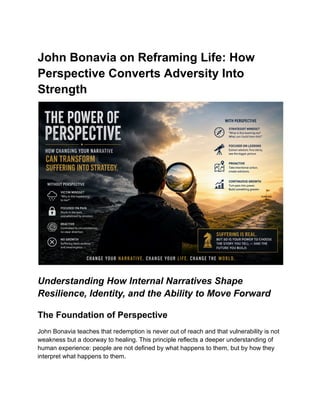
Perspective is the mental framework that assigns meaning to events. It determines
whether an experience becomes a source of growth or a source of limitation. While
external circumstances can be unpredictable and sometimes painful, internal
interpretation is where transformation begins.
When perspective shifts, the same event can take on a completely different meaning. A
failure becomes feedback. A loss becomes redirection. A setback becomes preparation.
How Internal Narratives Take Shape
Every individual carries an internal narrative—a running story about identity, capability,
and future potential. These narratives are formed through repetition, emotional
experience, and social reinforcement.
For example, a single negative experience can evolve into a long-term belief:
●​ A rejection becomes “I am not wanted”
●​ A failure becomes “I am not capable”
●​ A mistake becomes “I always get things wrong”
These conclusions often feel true because they are emotionally reinforced. Over time,
they become automatic interpretations that shape decision-making and self-perception.
The challenge is that these narratives are rarely questioned. Instead, they operate in the
background, quietly influencing how people respond to new situations.
Recognizing that these are interpretations—not facts—is the beginning of change.
Why Perspective Shapes Emotional Reality
Two people can experience the same situation and interpret it in completely different
ways. One may feel defeated, while the other feels motivated to try again.
This difference is not about intelligence or ability. It is about perspective.
A narrow perspective tends to focus on immediate loss or discomfort. A broader
perspective considers long-term possibility and growth.
For example, a failed opportunity can be seen as:
●​ Proof of inadequacy​
or
●​ Information that guides improvement
The external event does not change. The meaning assigned to it does.
This meaning directly influences emotional response. And emotional response drives
behavior.
In this way, perspective becomes a powerful determinant of resilience and forward
movement.
From Suffering to Strategy
One of the most important shifts in personal development is the transition from suffering
to strategy.
Suffering occurs when pain is interpreted as identity or permanence. It becomes
internalized as “this is who I am” or “this is how life will always be.”
Strategy begins when pain is reinterpreted as information.
Instead of asking, “Why did this happen to me?” a strategic mindset asks, “What can I
learn from this?”
Every experience contains valuable data:
●​ A failed project reveals process gaps
●​ A broken relationship highlights communication issues
●​ A financial setback exposes decision-making patterns
●​ A career obstacle reveals missing skills or misalignment
When individuals focus on extracting insight instead of assigning identity, they shift from
emotional paralysis to practical growth.
Suffering becomes usable. It becomes direction instead of definition.
The Problem With Fixed Identity Thinking
Fixed identity thinking occurs when people define themselves by past outcomes instead
of present potential.
Statements like “I am a failure” or “I am not good enough” are not objective truths. They
are conclusions drawn from limited experiences.
The danger of fixed identity is that it removes flexibility. If identity is already decided,
growth feels unnecessary or impossible.
Perspective disrupts this by introducing movement into identity. Instead of saying “I am,”
individuals begin to adopt “I am becoming.”
This shift reopens the possibility of change, improvement, and resilience.
Identity becomes dynamic rather than fixed.
Rewriting the Meaning of Experience
Changing perspective requires consciously rewriting the meaning of past and present
experiences.
This does not involve denial or ignoring reality. It involves choosing interpretations that
support growth rather than limitation.
For example:
●​ “I failed” becomes “I gained experience”
●​ “I am stuck” becomes “I am still developing”
●​ “This is over” becomes “This is a transition”
These reframes reshape how experiences are stored emotionally and cognitively.
Instead of being categorized as permanent defeat, they become part of a learning
process.
Over time, repeated reframing builds a stronger, more adaptive mindset.
The Role of Vulnerability in Transformation
Vulnerability is often misunderstood as weakness, but it is actually essential for growth.
Without vulnerability, individuals cannot honestly examine their internal narratives.
Without examination, change is not possible.
Vulnerability allows individuals to question long-held beliefs:
●​ Is this interpretation accurate?
●​ Where did this belief originate?
●​ What else could this mean?
These questions interrupt automatic thinking patterns and create space for reflection.
Reflection is the foundation of perspective change. Without it, individuals remain locked
in inherited narratives that limit growth.
Developing a Strategy-Oriented Mindset
A strategy-oriented mindset does not avoid difficulty—it engages with it constructively.
Instead of being overwhelmed by challenges, it focuses on extracting value and
direction.
This mindset consistently asks:
●​ What is this teaching me?
●​ What patterns are emerging?
●​ What needs to change?
●​ What is the next constructive step?
This approach turns emotional reaction into intentional action.
Strategy replaces confusion with clarity and stagnation with movement.
How Perspective Builds Long-Term Resilience
Perspective is not a single insight—it is a repeated practice.
Each time a person reframes a challenge, they strengthen their ability to handle future
adversity.
Over time, this leads to:
●​ Improved emotional regulation
●​ Stronger decision-making
●​ Faster recovery from setbacks
●​ Greater confidence in uncertain situations
Resilience is not the absence of difficulty. It is the ability to remain adaptable within
difficulty.
Perspective is what enables that adaptability.
Moving Forward With Intentional Focus
One of the most powerful perspective shifts is learning to focus forward rather than
backward.
While reflection is valuable, excessive focus on the past can prevent engagement with
the present and future.
A forward-focused mindset asks:
●​ What is possible from here?
●​ What action creates progress?
●​ What does growth look like now?
This orientation creates momentum. It transforms awareness into movement and insight
into action.
Progress begins when attention shifts from what was lost to what can still be built.
Conclusion: Perspective as a Path to Personal Power
Perspective is one of the most influential forces in shaping human experience. While
individuals cannot always control external events, they can always influence internal
interpretation.
By changing internal narratives, people can transform suffering into strategy and
adversity into direction. What once felt like limitation becomes insight. What once felt
like failure becomes feedback. What once felt like an ending becomes a beginning.
John Bonavia teaches that redemption is never out of reach and that vulnerability is not
weakness but a doorway to healing. This message reinforces a central truth: when
perspective changes, the direction of a life can change with it.