JESUS WAS AN INVITER
EDITED BY GLENN PEASE
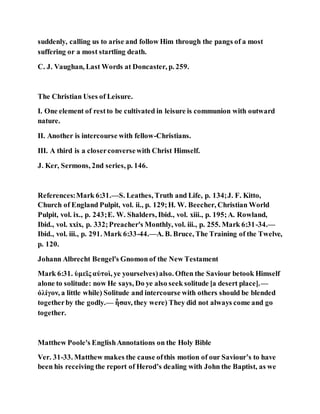
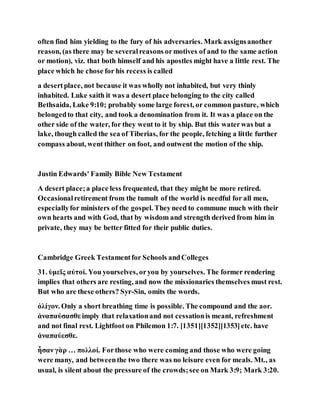
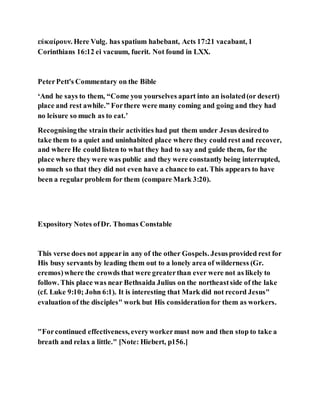
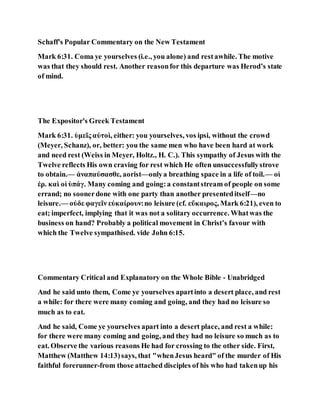
Mark 6:31 And he saith unto them, Come ye
yourselves apartinto a desert place, and rest a while.
GreatTexts of the Bible
Retirement for Rest
This is one of Christ’s invitations. It is one of the occasions upon which He
said “Come.” The particular invitation is to retirement, the purpose of the
retirement being to obtain rest. The text may be takenup in five parts—
1. The Invitation
2. The Needof Rest
3. The Use of Retirement
4. How to find Restin Retirement
5. The Gains of Retirement
I
The Invitation
i. Christ’s use of the word “Come”
The word “come” occurs more than three thousand times in the Bible; and in
about thirteen hundred places it is a word of encouragement. It is one of the
first words Jesus uttered after entering upon His public ministry—the word to
the two disciples who askedHim where His abode was, “Come and see” (John
1:39). It is one of the lastwords we hear Him speak from His place in heaven,
“The Spirit and the bride say, Come. And let him that is athirst come”
(Revelation22:17). It is the keynote of His ministry. It distinguishes the
Gospelfrom the Law. God’s message to Mosesis “Draw not nigh hither”
(Exodus 3:5); for the old covenantis a witness to the separationfrom God
which sin has made. Christ’s message to all is “Come unto me” (Matthew
11:28); for He has “made peace through the blood of his cross.”It is true that
Christ has sometimes to say “Depart” (Luke 13:27), but His characteristic
word is “Come.”
There are seveninvitations, which may be arranged in order.
1. The Invitation to Zacchæus (Luke 19:9).—This is (1) a personalcall. A
letter addressedto “Anybody” would find its wayto nobody. Zacchæus could
not pass this call to another. It is (2) a call that hastens. “Makehaste”—“to-
day.” The evening before the Chicago fire Mr. Moody preachedon “Now is
the acceptedtime,” and told his hearers to take that text home and think
about it. Some of them had no time to think; the fire came and devoured
them. He never repeatedthat advice. It is (3) a humbling call—“Come down.”
In a certain hotel visitors are directed downstairs to find the elevator.
’Tis only lowly hearts can reach
The home above the skies;
In lowly ways they find the road,
By coming down they rise.
But, above all, it is (4) an encouraging call, “To-dayI must abide at thy
house.” Jesus has gone to be guestwith a man that is a sinner.1 [Note: H.
Thorne.]
2. The Invitation to the Heavy-laden (Matthew 11:28).—(1)The invitation to
Zacchæus was personal, but it was also universal. There is none but is
included in the title “sinner.” The invitation to the heavy-laden is just as
personal, but it may not be of so universal an application. There are some who
are not heavy-laden—at leastnot yet. In the one case it is a state, in the other
it is a feeling. We are all sinners whether we feel it or not; only those who feel
it labour and are heavy-laden. (2) Again, it is those who labour and are heavy-
laden that are most likely to acceptthe invitation. They have come some way
themselves. The historian of America, Francis Parkman, has a wonderful
story to tell of the success ofthe early missionaries among the Hurons, but
they had no successuntil the Hurons had suffered fearfully from the ferocity
of the Iroquois and were in daily dread. An Indian tribe, after a toilsome
march, pitched their tents on the banks of a mighty river and called it
Alabama, which means “Here we rest.”
Knowing that whate’erbefalls us
He will order for the best;
We cansay with hearts confiding,—
“Alabama! Here we rest.”
3. The Invitation to Discipleship. “Come, follow me” (Luke 18:22).—Forthe
call to rest is not a call to idleness. It is a call to rest of conscience. And no
goodwork can be done without a conscienceatrest. It is a call to service such
as Christ Himself was occupiedwith, who “went about doing good.” It is a call
to surrender. He, though He was rich, for our sakes became poor. The rich
young ruler refusedto make it, but the disciples were able to say, “Lo, we
have left all and have followedthee.” It is a call to the surrender not only of
the things of this world, but also of the personalwill. “Come, follow me,” was
in invitation to say, “Notmy will but thine be done.”
4. The Invitation to Retirement (Mark 6:31).—This is the present text. And
here it is to be noticedthat one of the leading thoughts of St. Mark’s Gospelis
that the life of Jesus is a life of alternate restand victory, withdrawal and
working. In the first chapter we find the retirement in Nazareth, the coming
forth to be baptized; the withdrawal into the wilderness, the walk in Galilee;
the restin the coolsanctuary, where the dawn breaks upon the kneeling man,
and the going forth to preach to the heated and struggling crowd. Thus, once
more, the withdrawal to the Mount of Olives is followedby the greatconflict
of the redeeming Passion, while that is succeededby the withdrawal into the
sepulchre. It is the book of the wars of the Lord and the rest of the Lord. The
first rest was in Nazareth;the first trophies were the four Apostles. The last
rest is in the heavenof heavens, “in the privacy of glorious light”; the last
victory (for this greatbook never ended with the words “they were afraid”) is
diffused over all time—“the Lord working with them, and confirming the
work with signs following.”1 [Note:W. Alexander, The Leading Ideas of the
Gospels, 61.]
5. The Invitation to Peter(Matthew 14:29), “Come.”—OurLord invites
without being askedto invite. But on this occasionHe did not invite Peterto
walk on the wateruntil Peter said, “Bid me come unto thee.” That was the
disciple’s first mistake. Christ never fails to give His invitation, and it is
unwise as well as ungracious to ask to be invited. Satantook Jesus to the
pinnacle of the Temple and told Him to castHimself down from it. Peter
would have succumbed to that temptation. He would have gone where he was
not calledto go, hoping that it would turn out all right. Still, Jesus said
“Come,” andPeter would have been held up in spite of his first mistake if he
had trusted the Lord sufficiently. But it needs strong faith to be delivered
from the consequenceofour own follies, and the very folly itself is apt to
weakenfaith.
6. The Invitation to the Dead(John 11:43), “Come forth.”—It was a call to
Lazarus, and he obeyed it. “The hour is at hand when the dead shall hear the
voice of the Son of God and shall come forth.” But not like Lazarus, to spend
a little time longeron the earth. The call to come forth from the grave will be
followedimmediately by the call to the greatJudgment.
7. The Invitation to the Inheritance (Matthew 25:34), “Come, ye blessedof my
Father, inherit the kingdom.”—The final callis not universal. There are now
those on the right hand and those on the left. Forthe first time we meet with
the word “Depart.” Forit is after all the invitations have been given that the
separationis made. Men separate themselves, some accepting, some rejecting.
The “come” to eternal life, which is the most blessedof all the invitations, has
its counterpart in the “depart” into eternal death.
ii. The Occasionofthis Invitation
If we look back a little wayinto the narrative, we shall understand better the
occasionofthis invitation. In the beginning of the chapter we are told that our
Lord sent out His disciples to labour in the instruction of the people. They
must commence under His own guidance the work they were to carry on after
His death. They performed their missionwith greatardour and success. A
deep interest was created, and the crowds thronged around them till they had
not time so much as to eat. When they returned, their Mastersaw their
exhaustion, and made provision for it. They needed repose of mind as well as
of body—the quiet that is required after excitement even more than after toil.
Another event recordedin this chapter had probably a share in this callto
retirement. It seems to have been about the time of their return to Christ that
the news came of the death of John the Baptist. It no doubt sent a strange
shock to their heart. Some of them had been his followers, and knew him
intimately; and all of them revered him as a Divine messengerof
extraordinary powerand faithfulness. The details of banqueting and blood,
the man of God meeting his executioners in the gloom of the dungeon, the
glare of the lights above on the maiden and her frightful gift, strike us still
with a shudder, and may help us to realise how those felt it who were in the
presence ofthe event. It was not merely that they had lost a friend, but that
God seemedindifferent to His own cause and its truest witnesses.Theirfaith
must have been sorely tried, questionings must have been stirred within them
to which they could find no answer;and it was to tranquillise their spirit, as
well as to refresh exhausted mind and body, that our Lord said to them,
“Come ye yourselves apart into a desertplace, and resta while.”1 [Note:John
Ker.]
iii. Christ’s Thoughtfulness for His Disciples
Whether it was toil or trouble that burdened the disciples most they were all
in need of rest. “Christ,” says Matthew Henry, “takes cognisance ofthe frights
of some and of the toils of others of His disciples and finds suitable relief for
both.” The invitation shows the care which Jesus took in the training of His
disciples, and at the same time the necessityfor effective service of intervals of
quiet fellowship with Him.
There is a kindly considerateness inthe words of Christ, a friendly sympathy
with what may be called the lessersufferings of our nature, which may give us
confidence in still putting before Him the smallestwants and weaknesses. He
had an end in view that took in the whole world, but He was not of those iron-
hearted philanthropists who are cruel to men that they may work out their
scheme for man, and who break their instruments in the passionfor their
theory. The zeal of God’s house consumedHim; He had compassiononthe
multitudes, and spent Himself for them; but He devised hours of repose for
His wearyfellow-workers.
It is a fine encouragementto thoughtfulness for others. Do we find ourselves
in need of rest? Do we look forwardto our annual holiday? What of others?
What of the myriads of our brethren, pent up in mean streets, prisoners of the
counting house and the shop, slaves ofthe mill and the mine, the poor and
heavy-laden of every nameless classto whom these words are bitter mockery,
for whom no changing seasons bring cessationfrom toil and weariness?
A well-knownvisitor among the poor found living in a notorious court a
woman who was knownas “the Button-holes Queen,” who often gave work
and wage, poorthough she was, to those who were poorerthan herself.
Reservedas she appeared to be, she was at last induced to tell her story, which
accountedfor the interestshe took in the poor girls around her—and poor
they were—think of the misery of making 2880 button-holes in order to earn
10s., and having “no time even to cry!” Her story was this: Her daughter had
been apprenticed to a milliner at the WestEnd. She was just over sixteen, and
a bright young Christian. She gotthrough her first seasonwithout breaking
down; but the secondwas too much for her. She did not complain, but one day
she was brought home in a cab, having broken a blood vessel;and there she
lay, propped up by pillows, her face white as death, except for two spots where
it had been fleckedby her own blood. To use the mother’s own words: “She
smiled as she saw me, and then we carriedher in; and when the others were
gone, she clung round my neck, and laying her pretty head on my shoulder,
she whispered, ‘Mother, my own mother, I’ve come home to die!’ ” Killed by
late hours! She lingered for three months, and then she passedaway, but not
before she had left a message,which became the life inspiration of her
mother: “Formy sake, be kind to the girls like me”; and that message, with
God’s blessing, may make some of you think and resolve, as it did the poor
“Buttonhole Queen.”1 [Note:Alfred Rowland.]
Thro’ burden and heat of the day
How wearythe hands and the feet
That labour with scarcelya stay,
Thro’ burden and heat!
Tired toiler whose sleepshall be sweet,
Kneel down, it will rest thee to pray:
Then forward, for daylight is fleet.
Coolshadows show lengthening and grey,
Cooltwilight will soonhe complete:
What matters this wearisome way
Thro’ burden and heat?1 [Note:Christina G. Rossetti.]
iv. A DefeatedPurpose
Neither Christ nor His disciples found the restthey so sorelyneeded. When
they crossedto their desertplace where they had hoped to be by themselves
apart, they found the place crowdedwith a waiting throng that had hurried
round the lake on foot. The work had to be begun again, and the repose
seemedfurther off than ever. In the attitude of Jesus to this new and
unexpected obligation we geta glimpse into the depths of His greatheart. An
ordinary man would have resentedthe appearance of a crowdwhich so
effectively dispelled all hope of repose and deprived Him and His of the rest
they so sorely needed. But not so Jesus. WhenHe landed and saw the great
crowds, He had pity upon them and “beganto teachthem many things.”
Those who had come to Him in such a wayHe could in no wise castout. The
seeming annoyance He acceptedas a Divine opportunity, and, tired and
disappointed as He and His disciples were, He gladly and uncomplainingly
beganagain the greatwork which His Fatherhad given Him to do.
It is worth pondering that Jesus deliberatelysought for Himself and His
disciples to escape from the crowd. It is also worth pondering that the escape
proved impossible. In such a world as ours we are sometimes compelledby
circumstances, orby regard for some high moral law, or for the sake of a
needy brother, to act againstour better knowledge. We know very wellthat
we must spare ourselves, orour strength—and to that extent, our efficiency—
will be impaired. Yet the circumstances ofour life so arrange themselves that
to spare ourselves is impossible; and so long as we have strength to stand upon
our feet, we must go on with our work. These exacting demands, which seem
at times so cruel, have no doubt their high compensations both here and
hereafter;but while we must learn the stern obligationof service from the
willingness of Jesus to do what He could for the crowdat the very time that
He so yearned to be alone with His disciples, we have also to learn from Hs
desire that they should go apart—and perhaps many of us need this lessonstill
more—how indispensable is rest and loneliness to all continued and effective
work.1 [Note:J. E. McFadyen.]
II
The Needof Rest
1. It is necessaryfor the body. The physician will tell you that to the ceaseless
activity of our modern lives he can trace the nervous debility, the feverish
excitement, the anxious face, the craving for stimulant, the premature decay
of vital force.
Imagine the hardship endured by a young girl who stands behind a counterall
day long with hardly an hour’s rest even for meals. From eight in the morning
till nine or ten at night she has to be ready to speak pleasantlyto every comer,
to be patient with the most fastidious and thoughtless customers;though her
feet ache and her head swims, and she feels sometimes ready to drop from
sheerfatigue.
Dr. Hugh Macmillan2 [Note:The Clock ofNature, 193.]describes a visit
which he paid to the workshopofa workerin amber beads in Damascus. The
workmantook a lump of rough amber and put it on the turning lathe. After
some fragments were shavedoff he put it awayand took another piece, shaved
off a little and put it awayalso, and in this way went over all the pieces of
amber that were meant to form the necklace. Thenhe went over the pieces
againone after another, rounding them a little more and laying them aside.
He repeated the process a third time and a fourth, till at lasteachbead was all
that he wanted it to be. Why did he not finish one bead at a time? Once he had
it on the lathe, why did he not work at it till it was perfect? Becausehe knew
the nature of amber. A wood-turner will work at his piece of woodtill he has
shaped it into the article that he wants. But the amber-workerknows that the
amber will fly to pieces if it does not get a rest. For amber is a greatconductor
of electricity, and the motion of the lathe fills it with electricity. So he gives it
rest and lets it recoveritself before he takes it up again.
2. It is necessaryfor the mind. The mind is dependent upon the body. But
even apart from that it seems to be necessarythat we should learn at times to
look awayfrom things as well as at them if we are to see clearlyand soundly.
It must, like the eye, rest in darkness if it is to preserve its health. There are
some who reckonevery pause in active thought as so much losttime; but
when the mind is lying fallow it may be laying up capacityof strongergrowth.
If we shall be condemned for burying our talents in the earth, we shall also be
condemned for compelling others to bury theirs. One of our modern poets
makes a pathetic appeal to us to take time to considerand to give others time.
Old things need not be therefore true,
O brother men, nor yet the new:
Ah, still awhile the old retain,
And yet consider it again!
Alas! the old world goes its way,
And takes its truth from eachnew day;
They do not quit, nor can retain,
Far less considerit again.
3. It is necessaryfor the spirit. There are eases in which there may be a
constantstrain of active religious work which at last deadens feeling and
produces formality. This is one of the dangers to be guarded againstin
seasonsofstrong religious excitement, in what are calledrevival movements;
and we should either try to keepthe movement healthful by dealing with the
understanding and conscience as wellas the emotions, or we should interpose
a quiet, thoughtful interval.
A few years ago I had a dear friend, who was, as the Apostle counsels,
“diligent in business, fervent in spirit, serving the Lord.” He had a hand in
every congregationalagencyand some outside. He was at every one’s call for
help or service. His evenings were all occupiedwith meetings of various kinds
or visiting his district. He used laughingly to say he never had a leisure hour.
Once at a meeting the hymn was sung—
Take time to be holy, the world rushes on;
Spend much time in secret, with Jesus alone,
and at the close he remarked, hair-smilingly, half-sadly, “Well, howeverit
may be with you, I have no time to be holy! If I am to be holy it must just be
through the hurry and pressure of daily life, with the help of such oddments of
time as are at my disposal.” Notlong after, he was laid aside for some months,
seriouslyill. At first he fretted about his work, but soonhe beganto realise
what it meant. The Lord was with him in the sick-room, giving him
revelations of His abounding love. He had now got “time to be holy.” When he
returned among us again, all felt that he was changed. Some said that his
illness had chastenedand mellowedhim. He said, “The goodLord saw that I
had no leisure to eatbread, and He took me aside into a quiet place to resta
while. He was with me and blessedme there.”1 [Note:W. T. Fleck.]
III
The Use of Retirement
1. It is a remedy for the perplexities of life.—The disciples had just
experiencedthe shock ofa greatsorrow. John the Baptist had been done to
death. The deed had come upon them as an awful collisionwith their rosiest
expectancies.The greatDelivererwas near; the Kingdom was at hand; the
Divine sovereigntywas about to be established;on the morrow He would be
on the throne! And yet, here was the pioneer bf the Kingdom, in the very
dawning of the victory, destroyed oy the powers of the world. The disciples
were stunned and bewildered. The world of their visions and imaginations
tottered like a house of dreams. And it was in this seasonofmental confusion
that our Lord calledthem apart to rest. The retirement will help them to
realise the reality of the invisible, the immediacy of things not seen, and will
place the things of time and the world in their proper place.
2. It is an escape from the distractions of life.—“There were many coming and
going.” There is a strangelyexciting interest about a multitude. It whips up
the life to a most unhealthy speedand tension. And the peril is that we do not
realise the intensity when we are in it. When we are on board ship we do not
realise how noisy the engines have been until for a moment they cease. We are
not consciousofthe roar and haste of the traffic of Ludgate Hill until we turn
aside into St. Paul’s.1 [Note:J. H. Jowett.]
Alike in the Church and in the world, a spirit of unrest has takenpossessionof
all ranks and classes. It infects those whose hearts are surrendered to our
Lord, and sends them hurrying from church to church; from service to
service;from one form of philanthropy to another. It takes possessionofthe
mere pleasure-seekers,so that their very amusements become a toil, as the
sunken eyes and the weariedface revealthe utter exhaustion of a London
season. And what shall I say of those who, from choice or from necessity, are
toiling amid the teeming populations of our large cities? Work, work, work is
the cry which day by day arises from the vast labour-fields of England. On
and on the huge machine is ever moving; one after another of the hands by
which it is plied falls down exhausted; for a moment there is a pause, until the
vacant place is filled; then onward againit moves, commencing afreshwith
redoubled vigour its never-ceasing whirl.2 [Note: BishopWilkinson.]
Mostpeople in London look tired. Look at the rush in our streets. A boy from
the country once said to a friend of mine, “It looks as if a greatmany people
were ill, and all the restwere rushing for the doctors.” A fine description that!
It was not only the rush that he saw, but the sadness too.3 [Note:D. Davies.]
The injunction which insults me every time I travel by the Underground is
“Pleasehurry on for the lift.” The “please”is in diamond type, and you need a
microscope to see it. The “hurry” you can read a mile away. Hurry, then, by
all means, for we could not live if we did not kill ourselves to get somewhere
else!4 [Note: C. F. Aked.]
3. It is an opportunity of making life complete.—There is a theory that to
work is to live. But work is not life. The common adage that “to work is to
pray” is useful enough if it comes as a corrective to idleness. But life is not
fulfilled when the attention is fastenedupon the moving activities of the
world’s greatlaws. We must also see their purpose. There is in the greatorder
of things not only a length and a breadth but also a depth. The man who is
leading the life of prayer is not merely the man who says his prayers morning
and evening, who gathers the members of his householdfor family worship,
and who is regular in his attendance upon the public ordinances of religion.
The man of prayer is he whose work in the world is the strongerbecause it
manifests the sense ofGod’s nearness;about whom the casualstrangerfeels
that there is a background, a hidden life, a fountain of living waterfrom wells
of salvationthat our father Jacobgave us not. The man of God lives among
his ownpeople, sharing their life, knowing the same joys and the same tears.
But he is a presence that makes them strong. For all he is, as they said of
Elisha, “the holy man of God that passethby us continually.”1 [Note:J. G.
Simpson.]
Botanists tell us that plant-life is built up chiefly from elements found in the
atmosphere. The oak-plants which you grow in glasses containing nothing but
a little waterfurnish a familiar illustration of this fact. In like manner human
characteris built up, to no small extent, out of surrounding socialinfluences.
Like an atmosphere, unseen and scarcelyfelt, societycontributes largely to
make us what we are. “It is not good,” therefore, “thatman should be alone.”
Now one greatfunction of societyis to afford relaxationfrom the strain of
stern individual work—a relaxationthat shall not be unfruitful of advantage,
a rest in which we shall be quietly taking in the sunshine of cheerfulness, the
moist breath of sympathy, and the vigorous breezes of a bracing public
opinion. In intercourse with our fellows, thought, feeling, and imagination are
drawn out without exertion on our part, new ideas are gained, while old
impressions are modified through being reviewedin new lights.2 [Note:E. W.
Shalders.]
You talk about the companionship of towns. Do not forgetthe loneliness of
towns. There is far more fellowship in little places than in the jostle and the
crowdof Babylon. We hardly see eachotherin the city, we have so little time
for socialintercourse. And nothing is easierin the city than for friendships to
become little else than names. It is in view of that we getour holidays. A
holiday is not selfish, it is social. It is the goldenopportunity of God to put our
tattered friendships in repair. It gives us leisure to approacheachother, and
mingle with a freedom that is sweet, andfeel, what here we are so apt to lose,
the warmth and the reality of brotherhood. How little time some of you
business men have to give to your wives and to your children! Some of you
hardly know your children, and some of your children hardly know you. Now
use your holiday to put that right. Give them your leisure, and be happy with
them. Beginto play the father for a little, which is a different thing from
playing the fool.1 [Note: G. H. Morrison.]
IV
How to Find Restin Retirement
1. In Variety of Scene or Change of Work
You cannot but observe how varied the Bible is as you read it; how, with the
same truth all through, history succeeds poetry, and practicalprecepts follow
up the most moving appeals;you cannotbut see how Christ leads His disciples
from the excitementof Jerusalemto the quiet of Bethany, takes them from the
midst of the multitude to the fields and hillsides; and one purpose no doubt
was that spiritual religion might not be lost through sensationalism. We have
times of depressionwhen we blame the temptations of Satanand the coldness
of our own hearts, and no doubt we should jealouslyguard againstthe
insidious chill that comes from these; but when we have earnestlystruggled all
in vain, it may be time to inquire whether we have not been losing our proper
religious feeling through over-excitement, or the tension of too constant
activity. This is the hazard that ministers, missionaries, andChristians
devotedly given to sacredwork have to avoid—not to go on in even the best of
works till they become barren external exercises,but to pause or turn to some
other side of Christian occupation. This may be one of the ways of not
becoming “wearyin well-doing.”
The wholesome andhappy holiday should have its own proper occupation. As
William Cowpersings—
’Tis easyto resigna toilsome place,
But not to manage leisure with a grace;
Absence of occupationis not rest,
A mind quite vacant is a mind distressed.
And Pascal,throwing all his power and passioninto this subject, says:—
“Nothing is so insupportable to man as to be completely idle. Forhe then feels
all his nothingness, all his loneliness, allhis insufficiency, all his weakness, all
his emptiness. At once in his idleness, and from the deeps of his soul, there will
arise weariness, gloom, sadness, vexation, disappointment, despair.”1 [Note:
A. Whyte.]
What was the method of Solomonwith the men who were engagedin building
the Temple? They workedtwo months in Jerusalem, and then they were sent
for a month to Lebanon to hew down cedars and quarry marbles. Among the
mountains of Lebanon they would breathe fresh air, see grand sights, inhale
the fragrance ofthe cedarforests, which had a wonderful healing powerin
them; and with new strength and vigour, inspired by their new surroundings,
they would prepare in one month sufficient materials to lastthem for their
work—inshaping the walls and partitions and roofs of the Temple—during
their two months’ residence in the city.2 [Note:Hugh Macmillan.]
2. In Communion with Nature
Christ invites His disciples into a “desertplace,” nota waste sandy desert, as
many figure to themselves, but a thinly peopled region awayfrom towns and
crowds. There canbe no doubt that it was to the country eastof the Sea of
Galilee, among rolling hills and grassyplains and quiet mountain flocks, with
the blue sky overheadand distant glimpses of the deeperblue of the lake.
Christ knew every nook among the hills. He had wandered among them since
He was a boy. Where the grass was greenestHe had dreamed His dreams, and
read the writing of His Father’s hand. And now, looking upon His wearied
twelve, He thought of one choice spot He had long loved, and He said, “Come
ye apart and rest a while.” For Him, there had been restin nature. Forthem,
there was to be rest in nature. Taughtby the breeze, the mountain, and the
stream, they were to come to their true selves again. Theywere to bathe in
that deep and mighty silence that spreads itself out beyond the noise of man.
They were to let the peace of lonely places sink with benediction on their souls.
Hackneyedin business, weariedat the oar,
Which thousands, once fast chained to quit no more,
The statesman, lawyer, merchant, man of trade,
Pant for the refuge of some rural shade,
For regions where, in spite of sin and woe,
Traces ofEden are still seenbelow,
Where mountain, river, forest, field, and grove,
Remind him of his Maker’s powerand love.
To them the deep recess ofdusky groves,
Or forest where the deer securelyroves,
The fall of waters, and the song of birds,
And hills that echo to the distant herds,
Are luxuries excelling all the glare
The world can boast, and her chief favourites share.1 [Note:Cowper,
Retirement.]
3. In Intercourse with Men and Books
The wish to cultivate a life of repose separatedfrom the active world has
shown itself in almostevery religion. There is a yearning for it in certain
natures; and if the state of societybe very corrupt, and the mind quiet and
self-inspective, it becomes very strong. We know how early and how often it
has shownitself in Christianity. It is many centuries since the monks of Egypt
hid themselves among the dreary sands of the Thebaid; and the most lonely
islands of the Hebrides have the cells still standing in which solitary recluses,
who found Iona too social, soughtto perfecttheir spiritual life. Perhaps most
of us have felt times of wearinessofthe toil and temptation and strife, when
we have thought that if we might reachsome isolationof this kind we could
become wiserand better. And yet few things have been more repeatedly
proved by experience than that tranquillity of spirit is not to be attained in
this way. The very austerities and penances that these men practisedis one of
the suresttokens that they had not gainedquiet. They had to do battle with
their own hearts, and the conflict was all the fiercerthat it was a single
combat. There are times when complete retirement for prayer and heart
communion is goodfor every one. He can never stand firmly among others
who has not learned to be alone;but the retirement should never shut out
thoughts of one’s fellow-men, and should prepare for renewedintercourse
with them. When Christ invited His disciples to come apart into a desert
place, it was that they might be more in eachother’s company. He wishedto
give them an opportunity for the quiet interchange of experience which they
could not enjoy in their work among the multitude.
Goodbooks are as necessaryforthe healthy mind on a holiday as good bread
is necessaryfor the healthy body. And a wise and experiencedholiday-maker
will no more neglectto go to the booksellerthan he will neglectto go to the
baker. And what an intense delight are goodbooks, new and old, on an
autumn holiday! New books that we have not had time to read in the city, and
old books that we want to read overand over again, as Jowettread Boswell
for the fiftieth time, and as Spurgeon read Bunyan for the hundredth time;
the bestnovel of the year, the bestpoem, the best biography, the bestbook of
travels, or science,orphilosophy, or of learned or experiencedreligion; and
old books—ourold Shakespeare, andBacon, and Hooker, and Milton, and
Bunyan, and Butler. It is only well-experiencedand wary holiday-makers who
can tell to new beginners what memorable summer mornings and summer
evenings can be spent in the societyof such old and long-tried friends as
these.1 [Note:A. Whyte.]
In the most impressionable years of my life I came under the influence of a
teacherwho was philosopher, historian, and poet—the late Thomas Goadby,
Principal of the Midland Baptist College. Nature he loved with a deep and
tender and passionate love, and Nature never did betray the heart that loved
her. She filled his life with blessings, but her best gift was the love he bore her.
Wordsworthwas his Master;but the greatclassicalpassagesofNature-
adorationfrom Byron and Matthew Arnold were also day by day upon his
lips. The “Presence… whose dwelling is the light of setting suns,” the
“Heaven” which “lies about us in our infancy,” “the light which never was on
sea or land,” with all those magicallines from “Immortality,” “Tintern
Abbey,” “The Excursion,” “Childe Harold,” and “Obermann,” which, once
heard, make melody in our hearts for ever, grew more real, more full of
meaning and power, when they were half-spoken, half-chanted by his deep
organ-voice. And one summer Sunday night, when our work was done, and
we were walking home, after quoting, as he used to, not caring whether any
one listened or not, some of these glorious lines, he saidto me, “I am all my
life trying to get at the Realitywhich lies behind the illusion of God’s richer,
nearer presence, the illusion which made Wordsworth what he was, and
which turns all our thoughts, yours and mine, to poetry to-night.”2 [Note: C.
F. Aked.]
4. In Fellowshipwith Christ
This is the lastand best way of finding rest in retirement. This covers all other
ways with worth. This brings them togetherand binds them into one full
blessing. Our Lord did not send the disciples into retirement; He went with
them. He did not say“Go ye apart.” He said “Come ye apart.”
A person who had long practised many austerities, without finding any
comfort or change of heart, was once complaining of his state to a certain
bishop. “Alas!” said he, “self-willand self-righteousnessfollow me
everywhere. Only tell me where you think I shall learn to leave myself. Will it
be by study, or prayer, or goodworks?”“Ithink,” replied the bishop, “that
the place where you lose selfwill be that where you find your Saviour.”1
[Note:Evan H. Hopkins.]
All in the April evening
April airs were abroad;
The sheepwith their little lambs
Passedby me on the road.
The sheepwith their little lambs
Passedby me on the road:
All in an April evening
I thought on the Lamb of God.2 [Note: Katharine Tynan Hinkson.]
V
The Gains of Retirement
1. Knowledge of the Work we are Doing.—Bygoing apart for rest we shall
gain a bird’s-eye view of the field of life and duty. In the midst of life’s moving
affairs we see life fragmentarily and not entire. We note a text, but not a
context. We see items, but we are blind to their relationships. We see facts, but
we do not mark their far-reaching issue and destiny. We are often ill-informed
as to the true size of a thing which looms large in the immediate moment.
Things seenwithin narrow walls assume an appalling bulk. A lion in your
back yard is one thing; with a continent to move in, it is quite another. There
are many feverish and threatening crises whichwould dwindle into harmless
proportions if only we saw them in calm detachment. There are some things
which we can never see with true interpretation until we get awayfrom them.
There is nothing more hideous and confusing than an oil painting when
viewed at the distance of an inch. To see it we must get awayfrom it.
2. Knowledge of Ourselves.—Wellmight the heathen poet say, “The maxim,
‘Know thyself,’ came down from heaven.” In the light of Christianity we may
say self-knowledgeis the whole of religion. To know one’s self is for the
Christian to realise the two inseparable truths of human weakness andGod’s
strength. It culminates in the experience of one who has learnedto say:
“When I am weak, then am I strong”;“I live; yet not I, but Christ liveth in
me.” And for this self-knowledgeseasons ofretirement are an indispensable
qualification. For in the world we live more or less a life that is not our true
life. There is, at the present time, an element of competition even in spiritual
things; men are, as it were, kept up to the mark by their proximity to others,
by a desire not to be left behind in goodness ormorality; and often we do not
realise how artificial our standards are, how much our life was resting upon
the opinion of others. The love of approbation which, though in itself a good,
often becomes a false, motive in our lives.
3. Knowledge of God.—This is the true and the only real counterpart of the
knowledge ofself. It is the realising of God’s strength made perfect in man’s
weakness whichalone can save us from despair. Retirement is the greatmeans
of knowing God. For knowledge is born of intercourse and communion with
its objects. He who would know his fellow-men must live among them. He who
would draw closerthe ties which bind him to his brother man, whether it be
for business and commerce or for pleasure and society, losesno opportunity
for being near to and mixing with his fellows. He who made man his study
sought to learn His subjectin the crowdedmarket-place. And if we are to
know God it must be by losing no opportunity for being with Him; with Him
in those places where He has set His Name—in His Church, and His
Sacrament, and His Word; above all, in prayer.
When a man, by touching a button or turning a switch, causesanelectric
lamp, or a dozen or a hundred lamps, to flash into incandescence, it is plainly
not from the switch or from the operator’s finger that the light proceeds. By
turning the switch he merely makes the necessarycontactbetweenthe wire
that serves the lamp and the source of power or illumination. And to make the
contactbetweenthe individual soul and the Divine source ofall spiritual
illumination is the purpose of a retreat, and in its degree of every sermon.
Unless this contactis made and maintained, the soul will not be efficaciously
enlightened.1 [Note:H. Lucas.]
4. New Strength for New Service.—Thereis a nobler end for the Christian to
realise than the leaving of the world for the sanctuary. It is the carrying of the
sanctuary into the world. This is the greatsacramentaltruth of the Christian
life. “In the repose of a saintly spirit there is latent power” (John Caird,
Spiritual Rest, p. 202). The presence by which you seemedin your retirement
to be flooded, is the presence whichshall go with you into the world. It is the
ark of God which shall carry victory over the enemies, the real presence
which transforms your very bodies into the temples of the living God, the light
which will brighten and make clearyour earthly path, the continual source of
strength and nourishment, preparing you a table in the very midst of your
enemies, a fountain of living water springing up within you to quench the
battle thirst.2 [Note:Aubrey L. Moore.]
The Greek word(ἀνάπαυσις) translated“rest”—whose verbis employed in
the text—means more than rest. It marks refreshment and recreation. It
suggeststhat welcome and delightful change which, while it comes as a release
from toil, makes it possible to labour afresh—refreshed. Itis not mere repose,
although this enters into the essenceofthe word, but refection;rest, not
sought in and for itself, as Aristotle (Nic. Eth. X. vi. 7, οὐ δὴ τέλος ἡ
ἀνάπαυσις) shows, but rest, so that one may work the better.
Such seasonsofleisure, let it be observed, are not the objectof life. They are
given to those who have been working, and given to them that they may work
again. “Come ye apart into a desertplace, and rest a while.” The thronging
importunity of the multitude soonbroke in upon their quiet, and calledthem
to fresh exertions. And though we had no command from Christ, “Son, go
work to-day in my vineyard,” and no such words as “Prayye therefore the
Lord of the harvest that he would thrust forth labourers into his harvest,” yet
the sight of the waiting fields all around might well break our repose. When
we see sin and misery and sorrow, should we sit still—we who believe we have
the healing word? Be sure that only those have a right to a seasonofrest, and
only those truly enjoy it, who have done real work, and who mean to go to
work again. This world is not for enjoyment, not even for self-culture in the
highest things, but for taking our part in it as God’s fellow-workers, and as
the followers ofHis Sonwho went about doing good.1 [Note:John Ker.]
In former times, in the Highlands of our own country, the people regularly
every summer left their homes in the valley, and went to live three or four
months in the sheilings among the mountains. And during these three or four
months they prepared, under the stimulus of the purer air and healthier and
grander surroundings, enough cheese andbutter to last them during the rest
of the year, and to enable them to pay the rent of their holdings down in the
valley. They enjoyed the freedom and novelty of this kind of life immensely;
and lookedforwardto it every year with the greatesteagerness. This custom
gave rise to the most beautiful and inspiring songs ofthe people, and made
them healthier and happier than they would otherwise have been.2 [Note:
Hugh Macmillan.]
“I’d soonerha’ brewin’ day and washin’ day togetherthan one o’ these
pleasurin’ days. There’s no work so tirin’ as danglin’ about an’ starin’ an’ not
rightly knowin’ what you’re goin’ to do next; and keepin’ your face i’ smilin’
order like a grocero’ market-day for fear people shouldna think you civil
enough. An’ you’ve nothing to show for’t when it’s done, if it isn’t a yallow
face wi’ eatin’ things as disagree.”3[Note:Mrs. Poyser, in Adam Bede, i. 437.]
Sweetis the pleasure
Itself cannot spoil!
Is not true leisure
One with true toil?
That thou wouldst taste it,
Still do thy best;
Use it, not waste it—
Else ’tis no rest.
Sweetis the pleasure
Itself cannot spoil!
Is not true leisure
One with true toil?
’Tis loving and serving
The highest and best:
’Tis onwards, unswerving!—
And that is true rest.4 [Note:John Sullivan Dwight.]
Retirement for Rest
BIBLEHUB RESOURCES
Pulpit Commentary Homiletics
Christ's Offer Of Rest
Mark 6:31
A.F. Muir
I. THE PECULIAR GIFT OF JESUS TO HIS SERVANTS. "Into a desert
place;" only Christ to speak with them, to comfort and to advise.
II. A MANIFOLD PROVISION FOR HIS SERVANTS'NEEDS.Calmafter
excitement; repose after labour; meditation upon Divine marvels and
experiences. Securityfrom threatening dangers.
III. A PREPARATION FOR FUTURE SERVICE. "Resta while. - M.
Biblical Illustrator
Come ye yourselves apart into a desert place.
Mark 6:30, 31
The Saviour's invitation to rest
R. Glover.
I. NOTE THE TENDERNESS OF CHRIST.
II. LABOUR LIGHTENED IS NOT LOST.
III. SPIRITUAL WORKESPECIALLY NEEDS REST.
IV. THE BREEZY MOUNTAINSIDE, AWAY FROM MEN, STILL GIVES
THE FINEST SORT OF REST.
V. REST NEVER SEEMS TO BE HAD WHERE YOU ARE, BUT ALWAYS
OTHER-WHERE;and sometimes when you reachthe quietest spot, the
disturbing element has gone there before you.
(R. Glover.)
The necessityfor rest
John Ker, D. D.
God has signified this to us in His material creation. He has made the earth to
revolve on her axis in a way that brings her at statedseasonsunder light and
shade; and He has proportioned the strength of man to those seasons.
I. We need rest PHYSICALLY. The hands begin to slackenand the eyes to
close whenGod draws the curtain. It is one of those adaptations which show
God's kindly purpose. The thoughtless or covetous over-tensionofour own
powers the hard driving of those under our control, the feeling that we can
never get enough work out of our fellow creatures, the evil eye caston their
well-earnedrest or harmless recreation, are all to be denounced and
condemned.
II. This law applies also to MENTAL exertion. The mind must at times look
awayfrom things, as wellas at them, if it is to see clearlyand soundly. This is
not necessarilywaste time; when the mind is lying fallow it may be laying up
capacityof strongergrowth.
III. THE SPIRITUAL faculties are subject to the same law. A continual strain
of active religious work is apt to deaden feeling and produce formality.
(John Ker, D. D.)
Recreative rest
A. Rowland, LL. B.
I. RECREATIVE REST IS RECOGNIZEDBY GOD AS A NECESSITY
FOR MAN.
II. IT SHOULD HAVE A JUST RELATION TO EARNEST WORK. Restis
the shadow thrown by the substance work, and you reachthe shadow when
you have passedby the substance which throws it.
III. IT IS INTENDEDTO EXERCISE A WHOLESOME INFLUENCE ON
CHARACTER. If it fits us for doing our work better, it is right; otherwise, it
is wrong. The test is, Canwe engage in it in conscious fellowshipwith Christ?
(A. Rowland, LL. B.)
The Christian uses of leisure
John Ker, D. D.
It is not an indolent animal repose, but that restof refreshment which befits
those who have souls. Its elements are —
I. COMMUNION WITHOUTWARD NATURE. The world was made not
merely for the support of man's body, but also for the nurture of his mind and
spirit. What architectwould build his house only with an eye to stores and
animal comforts, paying no regardto its being a home for a man, with
windows opening on wide expanses ofland and sea, orquiet nooks of homely
beauty? We should endeavour to make the inner world of our thoughts about
God and spiritual things not a separate thing from the world of creation, but
with a union like that betweenbody and soul. If we could learn to do this
aright, it would strengthenus in goodthoughts, and relieve doubts and calm
anxieties. Nature cando very little for us if we have no perception of a Divine
Spirit breathing through it; but very much if the GreatInterpreter is with us.
If we surrender ourselves to this TeacherHe can show us wide views through
narrow windows, and speak lessons ofdeep calm in short moments.
II. INTERCOURSE WITHFELLOW CHRISTIANS. There will always be a
want in a man's religious nature it he has not come into contactwith hearts
around him that are beating with a Divine life to the pulse of the presenttime.
Every age, every circle, has its lessons from God, and no one can learn them
all alone. Let us be more frank and confidential, also more natural, in our talk
on these matters concerning our mutual faith and hope.
III. A CLOSER CONVERSE WITHTHE MASTER. When we are doing our
appointed work in God's world, or labouring actively for the goodof others,
our minds are dispersedamong outward employments; we may be serving
God very truly all the time, but we are careful about many things, and have
not leisure to sit at His feetand speak to Him about our own individual wants.
It is essentialthat we should from time to time secure leisure for this. The
flame of devotion will not burn very long or very bright unless you have oil in
your vessels with your lamps.
(John Ker, D. D.)
Bestby the way
H. J. Wilmot-Buxton, M. A.
Restis an absolute necessityof life; without it the body dies. The traveller on a
journey looks forwardto some spot where he can stay a while. The sailor has
his haven where he canfor a time furl his sails and find shelterfrom the storm
and tempest. The wanderer in the hot desertstrains his eyes to see the one
greenspot in all that sandy waste where there are trees and waterand the
promise of rest. And the soul needs rest as well as the body. Just as too much
excitement and hurry and over-work wearout our bodily strength, so our
spiritual life, the life of the soul, becomes faint and weak without rest. On our
journey from earth to heaven we need some quiet harbours, some peaceful
spots, where we canfind rest. Jesus has built such cities of refuge for us, His
pilgrims, and provided quiet havens for His people as they pass over the
waves of this troublesome world.
I. THE SERVICES AND SACRAMENTS OF THE CHURCH. There is a
famous bell in a certainchurch abroad known as the "PoorSinner's Bell."
This is how it got its name. Five hundred years ago a bell founder was
engagedin casting this bell. For a few moments he left a boy in charge ofthe
furnace, charging him not to touch the apparatus which held the molten metal
in the cauldron. The boy disobeyed his master, and meddled with the handle.
Instantly the liquid metal beganto pour into the mould. The terrified boy ran
to tell the bell founder, who, thinking his greatwork was ruined, struck the
boy in a fit of passionand killed him. When the metal was cold, the bell,
instead of being spoiled, was found to be perfect in shape and singularly sweet
in tone. The unhappy bell founder gave himself up for the murder of the boy,
and as he was led to executionthe PoorSinner's Bell rang out sweetly, inviting
all men to pray for the doomed man, and warning all men of the effects of
disobedience and anger. Is there no PoorSinner's Bell among us? Does the
church bell bring no messageto you?
II. PRIVATE PRAYER.
III. BIBLE READING. Put your heart into this, and you will find a
refreshment, a resting place. It will take you for a time out of the world, out of
the great, busy, noisy Vanity Fair, and you can, as it were, walk in God's
garden, or wander through His greatpicture gallery. Men or womenwho
have lived and died in faith will be your companions, your examples.
(H. J. Wilmot-Buxton, M. A.)
Restand work
E. Johnson, M. A.
I. There is no true rest which has not been earnedby work.
II. The duty of resting has the same reasons as the duty of working.
III. Solitude is the proper refreshment after public work, and preparation for
it.
IV. The spirit can never be at leisure from compassion, sympathy, love.
(E. Johnson, M. A.)
No leisure
A. Rowland, LL. B.
Duty of religious teachers to point out and rebuke socialevils. One of these is
the want of leisure. A fair amount of labour is necessaryand desirable, but
when work is so absorbing that mind, affections, and spiritual life are
neglected, we sin againstlaw of nature and God. So far as labour out of doors
is concerned, GodHimself interposes by drawing the curtain of night; but in
certain trades, through the ambition of the trader or the carelessnessofthe
generalpublic, young people are often kept on their feet twelve or fifteen
hours, with scarcelytime allowedto swallow a morsel of food. The wrongs of
these silent sufferers ought to be redressed. Let us not forget —
I. THAT EARNEST WORKIS DIVINELY APPOINTED. Before the Fall in
the Gardenof Eden. Afterwards in the fourth commandment. Labour and
rest are linked togetherby God in indissoluble bonds. Work is necessaryto
(1)human progress;
(2)the preservation of society;
(3)the nobility of man.I confess that I sympathize very much with the
American who was told by an English tourist that he was surprised to find no
"gentlemen" in his country. "Whatare they?" was the reply. "Oh," said he,
"people who don't work for their living." "Yes, we have some of them,"
replied the shrewd New Englander, "only we call them tramps." Thank God
if the necessityof work, and the opportunity, and the power for work are
yours; and in whateversphere of life you are placed, pray that you may
deserve at last the epitaph which was put, at his own request, on the tomb of
one of the bravest and most brilliant Christian soldiers England everhad:
"Here lies Henry Lawrence, who tried to do his duty."
II. THAT SUITABLE LEISURE IS IMPERATIVELY REQUIRED. Observe
the evils resulting from long hours of labour.
1. Physical. Constantstrain and tension.
2. Mental. No chance ofimproving the mind by reading, classes,societies, etc.
3. MoralWhen the young people do get free, scarcelyanything is open to them
but what may tend to their corruption. And the temptation comes ata time
when there is the more danger of yielding to it, from the reactionwhich
follows continuous work and induces a craving for excitement.
4. Religious. Home training rendered impossible. Lord's Day almost
necessarilydevoted exclusivelyto bodily rest and recreation, and so worship
neglected.
III. THAT THIS JUST CLAIM FOR LEISURE IS OFTEN DISREGARDED.
Things are, in some respects, much better than they were. The wholesale
houses, and many offices, close earlierthan before, and Saturday is a half
holiday. But this improvement only affects certain trades and districts. Those
in retail shops — milliners, dressmakers,etc., remainunrelieved. Leisure is
the more required now, because work is done much more strenuously and
exhaustingly than hitherto.
IV. REMEDIES.
1. Combination among employes.
2. Agreementamong employers. It is for their own interest.
3. More enlightened public opinion, resulting in altered practice.(1)Give up
late shopping, so that there shall no longer be a demand for protracted
labour.(2) Encourage employers who show their willingness to do what is
right in this matter.(3) Allow a reasonable time for executionof orders, so that
the beautiful dress at a party shall not be hideous in the sight of angels by the
stains of tears and blood they alone can see.
(A. Rowland, LL. B.)
A victim to want of leisure
A. Rowland, LL. B.
A well-knownvisitor among the poor found living in a notorious court a
woman who was knownas "the Buttonhole Queen," who often gave work
away, poor though she was, to those poorer than herself. Reservedas she
appearedto be, she was at last induced to tell her story, which accountedfor
the interestshe took in the poor girls around her; and poor they were, for
fancy the misery of making 2,880 buttonholes in order to earn 10s., and
having "no time even to cry!" Her story was this: Her daughter had been
apprenticed to a milliner at the WestEnd. She was just over sixteen, and a
bright young Christian. She gotthrough her first seasonwithout breaking
down; but the secondwas too much for her. She did not complain, but one day
she was brought home in a cab, having broken a blood vessel, and there she
lay, propped up by pillows, her face white as death, except for two spots where
it had been fleckedby her own blood. To use the mother's own words: "She
smiled as she saw me, and then we carriedher in, and when the ethers were
gone she clung round my neck, and laying her pretty head on my shoulder,
she whispered, 'Mother, my own mother, I've come home to die!'" Killed by
late hours! She lingered for three months, and then she passedaway, but not
before she had left a message whichbecame the life inspiration of her mother:
"Formy sake be kind to the girls like me;" and that message, with God's
blessing, may make some of you think and resolve, as it did the poor
"Buttonhole Queen."
(A. Rowland, LL. B.)
Ministers need rest
M. F. Sadler.
The apostles were well-nighoverwhelmed with their labours, for work had
made work: they were cumbered with much serving — not preaching the
gospelonly, but healing and exorcising;their meals and needful rest were
broken in upon by importunate crowds;and so the Lord, to teach us that His
ministers must have time for needful refreshment, does not recruit them by a
miracle, but insists upon their using natural means. And is it not so now? Is
not many an active and self-denying minister well-nigh broken down and
worn out, because there is no time for thought and rest, and tranquil
meditation, and a change of scene? Richmen, with many roomedmansions,
could not do a greaterkindness to poor overworkedministers than by inviting
them from their crowdedstreets and alleys to find a little rest and leisure in
their multitudes of unused apartments.
(M. F. Sadler.)
Restin nature
A. Rowland, LL. B.
For all organic life God has provided periods of repose, during which repair
goes onin order to counteractthe waste causedby activity. In the springtime
we see movement and stir in gardens, fields, and hedgerows,whichcontinues
till the fruits are gatheredin and the leaves fall; but then winter's quiet again
settles down over all, and nature is at rest. Even the flowers have their time
for closing their petals, and their sleeping hours come so regularly, and yet are
so varied in distribution among them, that botanists canconstruct a floral
clock out of our English wildflowers, and tell the hour of night or day by their
opening or closing. The same Godwho createdthe flowers and appointed the
seasons, ordainedthe laws of Israel, and by these definite seasons ofrestwere
setapart for the people — the Sabbath, the Jubilee year, and the annual
festivals. Indeed, in every age and every land, the coming of night and the
victory of sleepare hints of what God has ordained for man.
(A. Rowland, LL. B.)
The seasonof rest
J. F. Kitto, M. A.
The first of these principles is that rest is the result and the fruit of labour and
toil; it is the right and duty of workers. The secondprinciple which I venture
to lay down with reference to recreationis this — that its proper object is to
prepare us for further work. There is yet one other principle to be noticed in
connectionwith our subject, viz., that in our rest and recreationwe should
maintain a consciousnessofGod's presence, andcarry out the apostolic rule
— whether you eat or drink, or whateveryou do, do all to the glory of God.
(J. F. Kitto, M. A.)
Recreation
Dr. Talmage.
Luther used to sport with his children; Edmund Burke used to caress his
favourite horse; Thomas Chalmers, in the dark hour of the Church's
disruption, played kite for recreation — as I was told by his own daughter;
and the busy Christ said to the busy apostles:"Come ye apart awhile into the
desertand rest yourselves." And I have observedthat they who do not know
how to rest do not know how to work.
(Dr. Talmage.)
Seclusionwith Christ
C. J. Vaughan, D. D.
It was a time of mourning. Our Lord had just heard of the death of a near
kinsman; that lion-hearted man who had confronted a king in his adultery,
and had given his life as a martyr. His death, with its circumstances, affected
no doubt with more than common sorrow the tender, loving, most human
heart of Jesus. Also it was one of those dangerous times in human life, at
which the accomplishmentof a difficult duty is apt to throw us off our guard,
and through self-complacencyto induce slumber. The apostles hadjust
returned from a difficult mission, and had come back to report to their
Masterboth what they had done and what they had taught. And for this third
reasonalso. Theirs was a busy life, a life of great unrest at all times: "there
were many coming and going, and they had no leisure so much as to eat." For
some purposes indeed the world cannot be too much with us. With it and in it
lies our work. To encourage the activities, to direct the energies. Besides
which, there are not only virtues which can have no exercise but in society —
there are also many faults which spring up inevitably in solitude. There are
some influences of the world which need a strong counteraction. One of these
is irritation. Another of these evil influences is what must be called, in popular
language, worldliness. And there is this, too, in the presence of the world, that
it keeps under, of necessity, the lively action of conscience, andmakes any
direct accessto God an absolute impossibility. A Christian man thinks it no
part of religion, but the very contrary, to do his worldly business badly. If he
is to do it well, he must give his thoughts to it. If he is to give his thoughts to it,
the lively presence ofhigh and holy topics of meditation is scarcelypossible.
The correcting necessity— "Come ye yourselves apart into a desertplace,
and rest awhile." This seclusionmay be either periodicalor occasional.Think
what night is, and then saywhat we should be without it. And that which
night is, in one aspect, as a periodical withdrawal from the injurious
influences of the multitude, that, in another point of view, and yet more
impressively, is God's day of rest, the blessedResurrectionday, the Christian
Sunday. One He visits with a loss, and one with a misfortune, and one with a
bereavement, and one with disease. But there remains just one caution. We
must not wait for this seclusionby Christ Himself. If Christ comes not to take
us aside, we must go aside to Him.
(C. J. Vaughan, D. D.)
The higher use of retirement
H. W. Beecher.
And after the wearysix days have seenhim burning, glowing, sacked,
replenished, and sackedagain, Sunday comes;and thousands of men do on
Sunday what railroads do — run the old engine into the machine shop, and
make the neededrepairs, that it may be fit to start againon Monday. So men,
dealing in the affairs of life, and coming under its excitements, go into
retirement purely and merely to rest, simply to refit. It is a life that is not
worthy of a man. It is a life that certainly is adverse, in all its influences, to the
plenary development of that which makes man the noblestanimal on the
globe. We do not need retirement because we are so weary: we need it, and
enough of it, and we need it under certain right circumstances, in order that
we may think, consider, and know what we are, where we are, and what we
are doing.
(H. W. Beecher.)
Retirement for observation
H. W. Beecher.
Then we need these periods of rest for taking new observations. Every ship
that makes a voyage, after fogs or storms obscured the sky, seizes the first
moment of starlight or sunlight to take observations. The seamenhave been
going by dead reckoning or by no reckoning, but when they get an
opportunity to make an observation, they canvery soontell by computation
where they are.
(H. W. Beecher.)
Restfrom one setof ideas
E. W. Shalders, B. A.
One fact which we cannot afford to overlook is that the instrument of the soul
in all its mental and emotional workings is a material brain, undergoing with
eachmodification of thought and play of feeling a corresponding molecular
change. In common with every other bodily organ, its healthy activity is
limited by its need of nutrition and sleep. Besides,the researches ofmen like
ProfessorFerrierhave proved that there is a localizationof faculty in the
brain, so that persevering without intermission in one set of ideas has an effect
upon it corresponding to the exclusive use of one setof muscles in another
part of the body, with similar results also of disproportionate development
and consequentincompleteness ofmental character. Theseare only
physiologicalexplanations of the well-establishedfacts ofexperience, that
work without play induces dulness, that the bow must sometimes be unbent,
that there must be in mental culture not only a rotation of various crops, but
periodical fallows, orbarrenness will be the result. In the name of morality
and religion, also, a protestmay be raisedagainstunceasing and exclusive
occupationfor the welfare of others, as the ideal of a worthy life. God sent us
into the world to grow and realize His own thought in creating us. If human
welfare is an end of our existence, our ownwelfare is, at least, part of it. But it
is inconsistentwith our welfare to dwarf and repress any part of our God-
given nature. We were intended to grow all round, on our north side as wellas
on the side that faces the sun. The sense of melody, the feeling of humour, the
perception of beauty in form and colour, and the socialinstinct, are as much
from God as our conscienceofright and wrong. They are of immeasurably
less importance, but of some importance, nevertheless. Theirculture cannot
be neglected, or their cravings repressed, without a corresponding loss of
mental symmetry.
(E. W. Shalders, B. A.)
The richer for rest
E. W. Shalders, B. A.
The first element of recreationis rest. Change of employment brings a
measure of relief, but no change of employment will dispense with the
necessitythere is for rest. To suppose that the time spent in it is so much
deducted from the world's welfare or our ownis a greatmistake. In a speech
delivered by Lord Macaulay, more than thirty years ago, advocating a
shortening of the hours of labour, he describes, in language as true as it is
eloquent, the material advantages this country has derived from the
observance ofthe Sabbath. He says:"The natural difference between
Campania and Spitzbergen is trifling when comparedwith the difference
betweena country inhabited by men full of bodily and mental vigour and a
country inhabited by men sunk in bodily and mental decrepitude. Therefore it
is that we are not poorer, but richer, because we have, through many ages,
restedfrom our labour one day in seven. That day is not lost. While industry
is suspended, while the plough lies ill the furrow, while the Exchange is silent,
while no smoke ascends from the factory, a process is going on quite as
important to the wealth of nations as any process whichis performed on more
busy days. Man, the machine of machines, the machine compared with which
all the contrivances ofthe Watts and the Arkwrights are worthless, is
repairing and winding up, so that he returns to his labours on the Monday
with clearerintellect, with livelier spirits, with renewedcorporealvigour.
Neverwill I believe that what makes a population stronger, and healthier, and
wiser, and better, canmake it poorer."
(E. W. Shalders, B. A.)
Retirement essentialto the growth of true piety
Studies
There were two classesto whom this invitation was addressed — the
mourners for John Baptist (see preceding verses, and Matthew 14:12, 13) and
the triumphant apostles, exulting, excited, and perhaps unduly elated(ver.
30).
I. THE CIRCUMSTANCES IN WHICH THE SAVIOUR MAKES THIS
APPEAL.
1. On the Lord's day.
2. Frequent intervals during the week.
3. Seasons ofsickness.
4. Various relative trials.
II. THE NATURE OF THE RETIREMENT TO WHICH WE ARE
INVITED.
1. Notsimply withdrawal from others. You may live alooffrom the world, and
yet not be with Christ.
2. Notmonkish seclusion. It was only "for awhile." Not like the hermits of the
deserts.
3. To enjoy His sympathy.
4. To listen to His instructions; to learn His truth.
5. To feel the sanctifying effectof His presence.
III. THE PURPOSES FOR WHICH THIS RETIREMENT IS NEEDED —
"They had not leisure so much as to eat."
1. Our physical nature requires it.
2. Forour spiritual health. The late Sir E. Parry was remarkable for his
regular observance ofdevotional exercise onboard his ship, and equally for
his skilland presence of mind in times of danger. "Keepyourselves in the love
of God." There is much growth of a warm, still, summer's night, when the
dew is quietly descending on the plant.
3. To prepare us for usefulness. Lamps must be secretlyfed with holy oil.
4. To prepare us to be alone with Christ at last.(1)Here is a test for your state.
Can you bear His presence alone.(2)Secure time fur being alone with Christ.
By rising early; by being less in company with the world; by planning how
you will spend a day.(3) Assistothers to obtain it. Let employers afford it to
their servants.
(Studies).
Restawhile
R. N. Young, D. D
It will amply repay the pilgrim to turn aside sometimes from the beatentrack;
for the incidental teachings ofthe BlessedLife, like the wild flowers of the
glen, or the fern sheltering in the fissure, or the silver stream dripping from
the rock, or the still pool with its myriad beauties, are no inconsiderable
element in the attainment of that wisdomwhose ways are pleasantness, and
whose paths are peace. The lessons ofthe story are broad and obvious.
Foregoing the lessons ofthis story as a whole, it will be profitable to give our
attention to that one feature of it which is enshrined in the words: "Come ye
yourselves apart into a desertplace, and restawhile."
I. Forwith what graphic force do the words on which the Master's invitation
was basedDESCRIBE THE UNREST OF TODAY — "There were many
coming and going." We meetit everywhere. On all sides one is brought face to
face with work — exciting, bewildering, exhausting. This is not an
eccentricity, an abnormal and therefore transitional phenomenon; it is a
necessityofthe times. The energywhich at one time commanded a fortune is
now needed to win one's daily bread. Inventions which once excited the
wonder of the world are now regarded as curiosities. The scholarshipwhich a
century ago secureda European reputation now provokes a smile. This is
growing upon us. Such a state of things cannot be viewed without anxiety.
Physiologically, orfrom the standpoint of the political economist, this wear
and tear of life is serious. In the home life of today the absorbing interests of
the outside world are telling with terrible force. But it is in its influence upon
the moral and religious life that the present unrest is to be viewedwith the
gravestanxiety. The claims of the day upon a man's thought, energy, time, are
not only perilous; they are fatal to the true and healthy growth of the soul;
and where there is no growth there is decay.
II. THE PRESERVATIVE AGAINST THE DANGERS OF THE
PREVALENT UNREST AND EXCITEMENT whichthe words of the Master
suggest — "Come ye...andrest awhile." Forthere is no peril, no necessity, to
which the resources ofDivine grace and sympathy are not adjusted. It might
seemsuperfluous to dwell, even for a moment, on the imperative need there is
for physical restin these days when there are "many coming and going."
(R. N. Young, D. D)
STUDYLIGHT RESOURCES
Adam Clarke Commentary
Resta while - Restis necessaryfor those who labor; and a zealous preacherof
the Gospelwill as often stand in need of it as a galley slave.
Albert Barnes'Notes onthe Whole Bible
A desert place - A retired place, across the sea from Capernaum, where they
would be free from interruption.
There were many coming and going - Coming to be healedand retiring, or
coming to hear him preach. It means that they were “thronged,” orthat there
was a vast multitude attending his preaching.
Coffman's Commentaries on the Bible
And he saith unto them, Come ye yourselves apart into a desert place, and
rest awhile. For there were many coming and going, and they had no leisure
so much as to eat.
One of the reasons forJesus'actions was the need of restand recuperation;
but there were other pertinent reasons also. See under Mark 6:29. "Mark
alone notes no less than eleven occasions onwhich Jesus retired from his
work."[31]Thatour Lord was diligent to procure rest and refreshment for
himself and the Twelve emphasizes the truth that utmost care should be taken
to insure health in the service of God. Doing what is necessaryto the
maintenance of health is serving God.
ENDNOTE:
[31] Marvin Vincent, Word Studies of the New Testament(Grand Rapids:
William B. Eerdmans Publishing Company, 1946), Vol. I, p. 175.
John Gill's Exposition of the Whole Bible
And he said unto them,.... After he had heard their account, was satisfiedwith
it, and approved of what they had said and done:
come ye yourselves apart into a desert place, and rest a while: where they
might be free from noise and hurry, and take some rest and refreshment, after
their wearisome journey, hard labours, and greatfatigue in preaching and
working miracles;which shows the greatcompassion, tenderness,and care of
Christ, for his disciples:
for there were many coming and going, and they had no leisure so much as to
eat; the people were continually going to and fro; as soonas one company was
gone, who came with their sick and diseasedto be healed, or upon one account
or another, another came:so that there was no opportunity of private
meditation and prayer, nor of spiritual converse together:nor even so much
as to eata meal's meat for the refreshment of nature.
Geneva Study Bible
6 And he said unto them, Come ye yourselves apartinto a desert place, and
rest a while: for there were many coming and going, and they had no leisure
so much as to eat.
(6) Such as follow Christ will lack nothing, not even in the wilderness, but they
will have an abundance. And how wickeda thing it is not to look during this
temporal life to the hands of the one who gives everlasting life!
People's New Testament
Come ye apart into a desertplace. For notes on the feeding of the five
thousand see Matthew 14:14-21. Compare Luke 9:10-17 and John 6:5-14. All
the four gospels give this account.
Robertson's WordPictures in the New Testament
Come ye yourselves apart into a desert place and restawhile (Δευτε υμεις
αυτοι κατ ιδιανεις ερημοντοπον και αναπαυεστε ολιγον — Deute humeis
autoi kat' idian eis erēmontopon kaianapauesthe oligon). It was plain that
they were over-wrought and excited and neededrefreshment (αναπαυεστε —
anapauesthe middle voice, refreshyourselves, “restup” literally). This is one
of the neededlessons for all preachers and teachers, occasionalchange and
refreshment. Even Jesus felt the need of it.
They had no leisure so much as to eat(ουδε παγειν ευκαιρουν — oude phagein
eukairoun). Imperfect tense again. Crowds were coming and going. Change
was a necessity.
Wesley's ExplanatoryNotes
And he said unto them, Come ye yourselves apartinto a desert place, and rest
a while: for there were many coming and going, and they had no leisure so
much as to eat.
Matthew 14:13; John 6:1.
The Fourfold Gospel
And he saith unto them, Come ye yourselves apart into a desert place1, and
rest a while2. For there were many coming and going, and they had no leisure
so much as to eat3.
Come ye yourselves apart into a desert place. An uninhabited place.
And rest a while. Needof rest was one reasonfor retiring for the thinly settled
shores eastof the lake.
For there were many coming and going, and they had no leisure so much as to
eat. Matthew proceeds to give us another reasonfor his retiring. See Matthew
14:13.
James Nisbet's Church Pulpit Commentary
THE REST BY THE WAY
‘And He saidunto them, Come ye yourselves apart into a desertplace, and
rest a while.’
Mark 6:31
Here we see that Jesus cares forthose who work for Him. How may we find
true rest, and real and permanent enjoyment in our hours of recreation?
I. Restmust be earned.—Jesus hadbeen busily engagedin preaching in the
villages of Galilee, and so had His disciples. Their rest was no mere
accentuationof idleness, as so many so-calledholidays are in these days of
self-indulgence and luxury. In these hurrying, straining days, and in this
unresting city, tired bodies and aching heads must have repose. Alas for those
who never get it! But be sure of this—that the man who does not work cannot
rest. True rest looks back on times of toil and of effort earnestand sustained.
II. Restshould give power for further service.—Thewithdrawalwas only that
they might ‘rest a while,’ and so be ready for work again. It is so with every
man who works for God, whether it be in strictly religious effort or in the
ordinary round of common duty. There are always freshdoors aheadto enter,
fresh fields to win; and Christ calls us across the lake on to the mountain-top
to rest with Him, but only that we may go back to the westernshore, and
down to the dusty plain, there to engagein bolder enterprise of effort and of
service.
III. Restin His presence.—The Mastertakes the disciples with Him. His word
is ‘Come’—not ‘Go’—‘apartand resta while’ with God in work, in times of
pressing anxiety, of course whentrouble comes and death looms near; but in
pleasure, awayand to make merry with our friends. Is that so? Canwe sayof
our pleasures, ‘In Thy presence is the fulness of joy, and at Thy right hand
there are pleasures for evermore’? Let us have done, once and for all, with the
thought that in our hours of pleasure at leastwe may forgetGod and getaway
to make merry with our friends. Let us have done with the thought that His
presence will dull any pure enjoyment or sadden any honestjoy. Jesus Christ
is willing to be with us ‘all the days’—the holidays as well as work-days.
—BishopT. W. Drury.
Illustrations
(1) ‘“The Lord rested.… Thou shalt rest.” We know that attempts have been
made to ignore this principle because ofits positive form, but they have
always failed. At the FrenchRevolution one item of reform was to alter the
law of the Sabbath, but it came to naught. A still strangerinstance of a very
different kind is found in the Life of John Wesley, who, with all his goodness,
was not always practicalin the things of common life. We read that Wesley
founded a boys’ schoolat Kingswood, near to Bristol, and himself drew up the
rules of the school. Among them was the strange rule that the boys should
have no holidays, no recreation, no games. It was to be all work and no play,
and that produced not only dull boys, but it produced very naughty boys; and
Wesleywas sentfor, and, in words which have become memorable in quite a
different connection, said: “We must mend this, or we must end it,” and so it
was amended by games being restored. Restis necessary, becausewe are men;
and, moreover, as men createdin the image of God, we must rest as God
rested.’
(2) ‘“How shall I spend my holiday?” Do you really ask that question? Here is
a certain testof true recreation. Do our amusements refresh us for future
work? Canwe look forward in them with real satisfactionto that work, and
feel that they are fitting us for renewedlabour, or do they tend merely to
dissipate our powers? Do they send us back “like giants refreshed,” with
minds eagerand keento spend and be spent in the work to which God has
calledus; or do we creepback unwillingly to work, like the schoolboyof
bygone days, because our pleasures have left us limp and fagged, the worse
and not the better for our so-calledrecreation? Thatis a testwhich all of us
can apply to ourselves, only let us do it fearlesslyand honestly.’
John Trapp Complete Commentary
31 And he saidunto them, Come ye yourselves apart into a desertplace, and
rest a while: for there were many coming and going, and they had no leisure
so much as to eat.
Ver. 31. Resta while] God would not have the strength of his people to be
exhausted in his service, but that respectbe had to the health of their bodies,
as well as to the welfare of their souls. Therefore the priests of the law took
their turns of serving in the order of their course, as Zacharias, Luke 1:8. And
the ministers of the gospelare allowedto drink a little wine for their health’s
sake, as Timothy. Those that neglect, their bodies must reckonfor it.
Colossians 2:23.
Sermon Bible Commentary
Mark 6:31
Christian Work and Christian Rest.
I. With all our Lord's constant activity in doing good, let us hear the words of
this text, "Come ye yourselves apart into a desertplace, and rest a while." We
know from other places in the Gospels, ofwhat restour Lord was here
speaking, and how He employed these hours of retirement and solitude. No
doubt, partaking as He did of the bodily infirmities of our nature, He required
rest literally and in the simplest sense of the word; and no doubt also that such
periods of rest and entire refreshment are not only allowable, but useful and
even necessary. Let Christ show us how we may refresh our bodies and minds
without letting our souls suffer; how we may return from such retirement,
strengthenedalike in body and in mind, for the work that is setbefore us.
These times, which our Lord passedin a desert place, generallyamong the
mountains that rise at some little distance from the shores of the Sea of
Galilee, were His favourite times of prayer and meditation. He who as God
workedand does work for ever, yet as a man and for our example thought it
right to vary His active labours with intervals of religious rest.
II. Here, then, in three parts of the text—in the zeal with which our Lord
pursued His work, in the particular nature of it, and in the rest with which He
thought fit from time to time to vary it—there is matter of special
improvement for three classesofpersons. The zeal with which He pursued His
work, so that they had no leisure so much as to eat, is an example for that
most numerous class who are merely following their pleasure, or who, if
obliged to work, yet work unwillingly and grudgingly. The particular nature
of Christ's work is an example and a warning for those who, like the ground
chokedwith thorns, are working indeed, and working zealously, but whose
work is never of the same sort as Christ's: it is worldly in its beginning and
worldly also in its end. And in the rest which Christ took from time to time,
and the uses which He made of it, even they who are actually labouring in His
service may learn how alone their labour may be blessedto themselves as well
as to others;how their work may indeed be such as that when they fail in this
world they may be receivedinto the everlasting habitations of God.
T. Arnold, Sermons, vol. ii., p. 150.
We learn from the text a lessonof zeal in the discharge of our daily duties.
"Forthere were many coming and going, and they had no leisure so much as
to eat."
I. There are some dispositions which, from absolute indolence, seemto be
zealous about nothing whatever—persons who appearneither to care about
business or pleasure, who cannot be roused to take an active interestin
anything. These are characters whichexist, and which we must all have
sometimes met with; but they are not common, neither are they very
dangerous, because the generalfeeling of men is apt to despise them as stupid
and insensible. A much more common case is that of persons who like some
things exceedinglyand are all alive whenever they happen to be engagedin
them; but who do not like their common employment, and display about that
no interest at all. This is a very common case, forit rarely happens that our
employment is the very one which we should most choose, orthe one which we
most choose atthis particular time, or under these particular circumstances.
II. True it is that we cannot do heartily what we dislike; but it is no less true
that we may learn if we will to like many things which we at present dislike;
and the real guilt of idleness consists in its refusalto go through this discipline.
I might speak of the well known force of habit in reconciling us to what is
most unwelcome to us; that, by mere perseverance, whatwas at first very
hard becomes first a little less so, then much less so, and at last so easythat,
according to a well knownlaw of our faculties, it becomes a pleasure to us to
do it. But although perseverance willcertainly do this, what is to make us so
persevering? If we go through the discipline it will cure us, but what can
engage us to give it a fair trial? And here it is that I would bring in the power
of Christ's example; here it is that the grace ofGod, through Christ, will give
us the victory. The Son of God pleasednot Himself, and who are we who do
not deny ourselves? His creatures, who owe everything to His goodness, and
yet day by day are unworthy of it: His creatures, who, offending Him every
hour, are yet impatient of anything but pleasure at His hands; who, with so
much of that guilt for which He was pleasedto be crucified, are yet unwilling
to submit to that discipline which His pure and spotless soulendured
cheerfully for no need of His own, but for our sakes.
T. Arnold, Sermons, vol. ii., p. 157.
The Religious Life.
I. The life of Christ was a busy life. The greatwork of redemption was so pre-
eminently the work of Christ's life, that we sometimes lose sightof the
enormous and ceaselesswork whichHe accomplisheddaily in teaching, in
healing disease,in travelling from place to place, so that, on some occasions,
"He had no time so much as to eat," and was so fatigued at night that amidst
a storm He slept soundly in a boat on the GalileanSea. Thus the life of Christ
was a life of earnestand active work. We can wellimagine how the spotless
holiness of Jesus of Nazarethconsecratedeverylabour and hallowedevery
socialscene.To many this will seema complete type of the religious life. "Do
your work honestly," say they; "enter into the pleasures of life soberly, and
there is no need for any specialreverence orany extraordinary means of
spiritual culture."
II. But if we read our Master's life carefully we see that there is another side
to it. There were periods when He felt that He neededrest, retirement,
struggle, prayer. Again and againHe goes aparta while to the stillness of the
garden, or to the solemn loneliness of the mountain-side. He would retire at
intervals from the wearand tearand weariness ofpublic life, and in
meditation, and solitude, and prayer, would strengthen His spiritual nature—
would deepen that hunger and thirst in His Divine soul for which the meat
and drink were the doing of His Father's will.
III. Our greatduty at present is life. It is to live that Godgives us energyof
mind and body. Every one of us who knows even a little of the internal side of
this greatmass of human life, amid which our lot is cast, must feel deeply
convinced that if all true and honest men, and all true and pure women, were
to withdraw themselves from the world, it would be the taking awayof the
very salt which is preserving it from decay. While we thus go into life,
however, let us remember how hard is the battle, how wearing and exhausting
to our better nature are the passions and strifes amid which we have to move.
Let us remember how this tends to weakenour spiritual strength, to enervate
our spiritual life. We need seasons whenthe Mastercalls us, as His disciples,
to come apart with Him and rest a while.
T. T. Shore, The Life of the World to Come, p. 52.
After Rest.
I. The great horror, which followedupon so base a crime as the murder of
John Baptist, might have seemed, perhaps, to us to suggestthathis death was
the very moment for our Lord and His disciples to stepout, to denounce at
once the tyrant himself, and the sin and luxury of the upper classes;and, with
the blood of the martyr before them, to commence a new cycle of preaching
with a new prospectof success. Butnot so our Lord thought. From what He
said and did, which was so very different, even we, in such different times, and
in such quiet walks of life as ours, may perhaps learn some lessonfor today.
He received the news, and His only utterance seems to have been: "Come ye
yourselves apart into a desertplace, and resta while." The teaching of nature,
God's voice in the beauty of the wilderness—thatseems to have been their
healing and their strength.
II. The bidding would, while all obeyed it, awake differentechoes in different
hearts; some, perhaps, would understand it as He meant it, some would be
only too willing to hide their sadness and their despair of anything good
coming out of a land where the regeneratorsofsocietywere marked for early
doom, some in the sense ofstrength unused and courage unbrokenwould
think (except that they trusted Him) that they were losing time. Had He not
seriouslysaid to them that they must work while it is calledday because ofthe
approachof that night in which no work can be done?
III. It is with feelings various as these that we look often on the restof Death:
some seemto reach such fulness of wisdomand sagacity, the rashness of youth
gone and yet its courage left, the inexperience to which all seemedeasy
succeededby the experience which has learnt that difficulties abound almost
impregnable unless approachedby the one accessto their citadel. They see the
moment come for some decisive step, and who so fit as they to take it? And
even then, in the wisdom of God, though to our baffling, is the moment when
such men are taken from the world. Who canconceive why that is the very
hour when God says to them: "Come ye yourselves apart into a desert place,
and rest a while?" We cannot realise the secretand the mystery of that place
whither they go;but they find there Christ and the Apostles still, resting a
while until the day of their recompensing work arrive.
Archbishop Benson, BoyLife: Sundays in Wellington College,p. 156.
The Saviour counsels retirement. He addressesthe privileged Twelve;and
recommends, proposes, will Himself leadand accompany, a withdrawal, a
retreat, a seclusionfrom scenesand engagements andenjoyments too, which
were in their own nature harmless, full of advantage to the persons busied in
them, and to thousands and tens of thousands beside and beyond themselves.
Jesus saidto His disciples:"Come ye yourselves apart into a desertplace, and
rest a while." When we compare St. Mark's with St. Matthew's narrative of
this retirement we shall find three reasons forit.
I. St. Matthew expresslyconnects it with the tidings of the Baptist's
martyrdom. John's disciples buried the corpse, andwent and told Jesus. And
"when Jesus heardof it, He departed thence by ship into a desertplace
apart." Readin this the Saviour's warrant for our mourning in the loss of
friends. A nearkinsman has been cut off by a sudden, a violent death. Was
not Christ one with us in feeling it? Was He not here reproving by His
example that stoicalor that hyper-spiritual view of bereavementwhich would
forbid the tear to flow, or the heart to ache, because it is God's will, or because
death is the gate of life.
II. St. Mark gives us a secondreasonforthe retirement counselledin the text.
He connects it with the return of the Apostles from a mission describedin
earlier verses ofthe chapter. Christ receives them with an invitation to
solitude, as though He saw that the excitement of a specialservice neededits
counteraction;that there was something in them of a spiritual elation akin to
self-complacency, ifnot to self-glorying—requiring, therefore, that discipline
not always for the present joyous, of a wilderness sojourn, literal or figurative,
by which the soul recovers its juster, healthier estimate of greatness and
littleness, of itself and God.
III. There is yet one third reasonfor this retirement, and St. Mark suggests it
in the clause following the text: "Forthere were many coming and going, and
they had no leisure so much as to eat." The mere unrest of that busy life
createdthe necessityof retirement. The mere business of a life is reason
enough for its resting. The mere coming and going of many who want and
seek and would employ this life, is enough in the mind of the holy and
compassionateLord to demand intervals of repose and recreation. How much
more when there is takenalso into the reckoning what an over-taskedand
over-taxed life of necessitymust be, in reference to the higher interests—to the
well being of the soul.
C. J. Vaughan, Words of Hope, p. 247.
I. The Apostles' mission was ended. Such specialefforts must begin and end.
Neither for the worker's sake, norfor the sake of those workedupon, is it
expedient that they should be other than temporary. The kind Savioursaw
that the whole mission had been a heavy pull on their energies, both of body
and mind. He saw that they were wrought up to a pitch of excitement; He saw
they needed restafter toil, and quiet after excitement; He knew where they
would get these—notby sitting still and doing nothing for a space amid the
throng of men coming and going—notthere: they must getapart to the calm
seclusionofnature, where greenhills and greentrees and rippling streams
should speak to their heart. Much grass—humblest, commonest, most
beautiful of all vegetation—wouldpour its gentle refreshment into wearyeye
and aching brain. And so our blessedRedeemer's words are to the outworn,
wrought-up Apostles:"Come ye yourselves apart into a desert place, and rest
a while."
II. Far more needful now has the counselgrownwhich is set forth in my text.
Never, in the history of this country, have there been days in which the work
of cultured men was so hard, so eager, so exhausting, so perilous, to fagged
brain and nerves, to fevered soul and spirit. If Christ were here as of old He
would say such words as those of my text. "Come awayfrom this crowdof
human beings, come awayfrom this overpressure and hurry of engagements;
come awayto a desertplace, to the silent hills, to the lonely shore;come and
rest a while: you need quiet that you may see your way.
III. One wonders how our Redeemerand His Apostles would rest. Probably as
other weariedmen would. At first pure idleness. To the worn-out that is
absolute rest. For a while it would be delightful just to do nothing. But after a
little time that will not do. Let every wearymortal, entering on his resting-
time, provide some occupationfor it. And finally, if you would enjoy rest, if
you would come back with a soul set right; wiser, calmer, more hopeful, more
charitable; to do your work better and more cheerfully, to bear with less
irritation the provocations which all earnestpeople will know—allwho desire
to mend things and folk around them, see to it that you make the resting-time
a time of distinct religious discipline.
A. K. H. B., Graver Thoughts of a Country Parson, 3rd series, p. 1.
Seclusions with Christ.
The world is too much with us. For some purposes it cannot be too much with
us. With it, and in it, lies our work. To encourage the activities, to direct the
energies, to fosterthe interests, of a little fragment of our generation—this is
one of the highest works given to any man; to go out of the world would be to
desertthe post assigned, andto do despite to the wisdomwhich has assigned
it. And yet the world may be too much with us.
I. There are some influences of the world which need a strong counteraction.
One of these is irritation; it is scarcelypossible for a man to go through a long
day of business without some trial of temper. (2) Another evil influence is
worldliness.
II. Out of these plain and everyday experiences ofall springs, as of course, the
qualifying and correcting necessity—"Come ye yourselves into a desertplace,
and rest a while." This seclusionmay be either periodicalor occasional. (1)By
a wise and merciful ordinance of God's providence, all of us are takenaside,
as it were, from the multitude in almost one-half of our earthly being. I speak
not now of the ordinances of religion, but of appointments of nature. Think
what night is, and then saywhat we should be without it. Think of its
compulsory withdrawal from the exciting contests, the angry recriminations,
the fallacious ambitions, the frivolous vanities, which belong to a day and to a
multitude! Think of its natural tendency to recallthe thought of dependence
and of creatureship; to remind us of Him with whom darkness and light are
alike, and who Himself neither slumbereth nor sleepeth. Where should we be,
the bestof us, if nature did not thus play unto the hands of grace?
III. And so we pass from the periodical to the occasional. God's grace has
many sinkings; It despises no method as insignificant, it overlooks, we believe,
no person as beneath its notice. Upon one Christ tries His hand of healing
thus, and upon anotherthus—adapting Himself with nicestdiscrimination to
the antecedents, to the circumstances, to the characterand to the life. But one
thing you will always find—He begins by taking him aside from the multitude,
saying, "Come apart for a while with Me." Nothing can be done without that.
Go aside with Christ now, and then there shall be no surprise, and no
confusion, and no misgiving, if, when He comes for us, He even come
suddenly, calling us to arise and follow Him through the pangs of a most
suffering or a most startling death.
C. J. Vaughan, Last Words at Doncaster, p. 259.
The Christian Uses of Leisure.
I. One element of restto be cultivated in leisure is communion with outward
nature.
II. Another is intercourse with fellow-Christians.
III. A third is a closerconversewith Christ Himself.
J. Ker, Sermons, 2nd series, p. 146.
References:Mark 6:31.—S. Leathes, Truth and Life, p. 134;J. F. Kitto,
Church of England Pulpit, vol. ii., p. 129;H. W. Beecher, Christian World
Pulpit, vol. ix., p. 243;E. W. Shalders, Ibid., vol. xiii., p. 195;A. Rowland,
Ibid., vol. xxix, p. 332;Preacher's Monthly, vol. iii., p. 255. Mark 6:31-34.—
Ibid., vol. iii., p. 291. Mark 6:33-44.—A. B. Bruce, The Training of the Twelve,
p. 120.
Johann Albrecht Bengel's Gnomon of the New Testament
Mark 6:31. ὑμεῖς αὐτοὶ, ye yourselves)also. Often the Saviour betook Himself
alone to solitude: now He says, Do ye also seek solitude [a desert place].—
ὀλίγον, a little while) Solitude and intercourse with others should be blended
togetherby the godly.— ἦσαν, they were) They did not always come and go
together.
Matthew Poole's EnglishAnnotations on the Holy Bible
Ver. 31-33. Matthew makes the cause ofthis motion of our Saviour’s to have
been his receiving the report of Herod’s dealing with John the Baptist, as we
often find him yielding to the fury of his adversaries. Mark assignsanother
reason, (as there may be severalreasons ormotives of and to the same action
or motion), viz. that both himself and his apostles might have a little rest. The
place which he chose for his recess is called
a desertplace, not because it was wholly not inhabited, but very thinly
inhabited. Luke saith it was a desert place belonging to the city called
Bethsaida, Luke 9:10; probably some large forest, or common pasture, which
belongedto that city, and took a denomination from it. It was a place on the
other side of the water, for they went to it by ship. But this waterwas but a
lake, though called the sea of Tiberias, for the people, fetching a little further
compass about, went thither on foot, and outwent the motion of the ship.
Justin Edwards' Family Bible New Testament
A desert place;a place less frequented, that they might be more retired.
Occasionalretirement from the tumult of the world is needful for all men,
especiallyfor ministers of the gospel. Theyneed to commune much with their
own hearts and with God, that by wisdom and strength derived from him in
private, they may be better fitted for their public duties.
Cambridge Greek Testamentfor Schools andColleges
31. ὑμεῖς αὐτοί. You yourselves, oryou by yourselves. The former rendering
implies that others are resting, and now the missionaries themselves must rest.
But who are these others? Syr-Sin, omits the words.
ὀλίγον. Only a short breathing time is possible. The compound and the aor.
ἀναπαύσασθε imply that relaxationand not cessationis meant, refreshment
and not final rest. Lightfoot on Philemon 1:7. [1351][1352][1353]etc. have
ἀναπαύεσθε.
ἦσαν γὰρ … πολλοί. Forthose who were coming and those who were going
were many, and betweenthe two there was no leisure even for meals. Mt., as
usual, is silent about the pressure of the crowds;see on Mark 3:9; Mark 3:20.
εὐκαίρουν. Here Vulg. has spatium habebant, Acts 17:21 vacabant, 1
Corinthians 16:12 ei vacuum, fuerit. Not found in LXX.
PeterPett's Commentary on the Bible
‘And he says to them, “Come you yourselves apart into an isolated(or desert)
place and rest awhile.” Forthere were many coming and going and they had
no leisure so much as to eat.’
Recognisingthe strain their activities had put them under Jesus desiredto
take them to a quiet and uninhabited place where they could rest and recover,
and where He could listen to what they had to say and guide them, for the
place where they were was public and they were constantly being interrupted,
so much so that they did not even have a chance to eat. This appears to have
been a regular problem for them (compare Mark 3:20).
Expository Notes ofDr. Thomas Constable
This verse does not appearin any of the other Gospels. Jesusprovided rest for
His busy servants by leading them out to a lonely area of wilderness (Gr.
eremos)where the crowds that were greaterthan ever were not as likely to
follow. This place was near Bethsaida Julius on the northeastside of the lake
(cf. Luke 9:10; John 6:1). It is interesting that Mark did not record Jesus"
evaluation of the disciples" work but His considerationfor them as workers.
"Forcontinued effectiveness, everyworkermust now and then stop to take a
breath and relax a little." [Note: Hiebert, p156.]
Schaff's Popular Commentary on the New Testament
Mark 6:31. Coma ye yourselves (i.e., you alone) and restawhile. The motive
was that they should rest. Another reasonfor this departure was Herod’s state
of mind.
The Expositor's Greek Testament
Mark 6:31. ὑμεῖς αὐτοὶ, either: you yourselves, vos ipsi, without the crowd
(Meyer, Schanz), or, better: you the same men who have been hard at work
and need rest (Weiss in Meyer, Holtz., H. C.). This sympathy of Jesus with the
Twelve reflects His own craving for rest which He often unsuccessfullystrove
to obtain.— ἀναπαύσασθε, aorist—onlya breathing space in a life of toil.— οἱ
ἐρ. καὶ οἱ ὑπάγ. Many coming and going:a constantstream of people on some
errand; no soonerdone with one party than another presenteditself—no
leisure.— οὐδε φαγεῖν εὐκαίρουν:no leisure (cf. εὔκαιρος, Mark 6:21), even to
eat; imperfect, implying that it was not a solitary occurrence. Whatwas the
business on hand? Probably a political movement in Christ’s favour with
which the Twelve sympathised. vide John 6:15.
Commentary Critical and Explanatory on the Whole Bible - Unabridged
And he said unto them, Come ye yourselves apartinto a desert place, and rest
a while: for there were many coming and going, and they had no leisure so
much as to eat.
And he said, Come ye yourselves apart into a desert place, and rest a while:
for there were many coming and going, and they had no leisure so much as to
eat. Observe the various reasons He had for crossing to the other side. First,
Matthew (Matthew 14:13)says, that "whenJesus heard" of the murder of His
faithful forerunner-from those attached disciples of his who had takenup his
body and laid it in a tomb (see the note at Mark 6:29) - "He departed by ship
into a desertplace apart;" either to avoid some apprehended consequencesto
Himself, arising from the Baptist's death (Matthew 10:23), or more probably
to be able to indulge in those feelings which that affecting event had doubtless
awakened, andto which the bustle of the multitude around Him was very
unfavourable. Next, since He must have heard the report of the Twelve with
the deepestinterest, and probably with something of the emotion which He
experiencedon the return of the Seventy (see the notes at Luke 10:17-22), He
sought privacy for undisturbed reflection on this begun preaching and
progress ofHis kingdom. Once more, He was weariedwith the multitude of
"comers and goers" -depriving Him even of leisure enough to take His food-
and wanted rest: "Come ye yourselves apartinto a desert place, and rest a
while," etc. Under the combined influence of all these considerations, our
Lord sought this change.
PRECEPTAUSTIN RESOURCES
CHRIS BENFIELD
Dealing with the Stress of Life Mark 6: 30-32
Let me begin by asking:has anyone been stressedtoday? I’m sure the
majority of us would answer:Yes! We live in a stressfulworld. There are
pressures at work, at home, in the world, among our families, and even within
the church. We often fail to enjoy our lives because we are forced to deal with
stress. I am guilty of allowing stressfulsituations to getthe best of me.
It is important that we learn to dealwith the pressures of life and overcome
the stress that plagues us so often. The greatpreacherVance Havner said, “If
you don’t come apart and rest, you will come apart.” The disciples had dealt
with the pressures oflife. These were stressfultimes. Jesus had been rejected
at Nazareth and it seemedas if His popularity was beginning to fade.
Immediately following the incident at Nazareth, Jesus sends them out, two by
two, to labor for Him Vv.7-13. While carrying out the task they’ve been asked
to do, the disciples learn firsthand of the pressures of life. No doubt life had
been much simpler before they surrendered to the Lord’s call. They had to
learn to deal with the difficulties of discipleship. Let’s examine the great
truths found within the verses we’ve read concerning:Dealing with the Stress
of Life.
I. A Needfor Continued Association(30a) – And the apostles gathered
themselves togetherunto Jesus. This involved:
A. Associationwith EachOther – And the apostles gatheredthemselves
together. I want you to imagine how different things had become. They had
been walking with Jesus, and basicallywatching Him work in great power. He
had authority over sickness, disease,infirmities, and even death. Now these
men find themselves being sent out to work the works of God. They have been
calledupon to preachthe gospeland anoint the sick with oil for healing by
faith. I’m sure they felt things were much easierwith Jesus around.
 Many times we are calledupon to do things that seemmore than we can
possibly do. But also considerthe fact that they were sent out in groups of two.
They had to learn to work with eachother. Someone had to work with Peter,
the outspokentrailblazer. Someone had to work with James and John, the two
who wanted to be first in all things. Someone had to work with Judas, one who
wasn’t even a believer. It is encouraging to see that they gatheredthemselves
togetherafter their tour of duty. They never lost sight of their need for each
other.
November 15, 2015
P a s t o r C h r i s B e n f i e l d , F e l l o w s h i p M i s s i o n a r y B a p t i s t
C h u r c h
Page 2
 When dealing with the stress oflife, we need to lean upon those around us
and recognize our need for eachother. We are all different, but we all have
something of value to offer and some way of being a help to the cause of
Christ.
B. Associationwith the Lord (30a) – And the apostles gatheredthemselves
togetherunto Jesus. I’m sure they were well aware of the disapproval of the
religious sectof that day. They had witnessedthe Lord’s rejection;they had
heard the cruel words and malicious attacks.It would’ve been easywhile out
by themselves to have abandoned the work at hand. They remained
committed and made their way back to Jesus. The disciples had learned an
important truth, when life gets tough, get to Jesus.
 We’ve all heard the expression:when the goin’ gets tough, the tough get
goin’. That is especiallytrue of many Baptist, but sadly we get goin’ in the
wrong direction, away from Jesus. Why is it that so often when trouble comes
we fail to seek the One who can help in our situation? We must learn to
maintain our associationwith the Lord and lean on His strength rather than
our own!
II. A Needfor HonestConversation(30b) – and told him all things, both what
they had done, and what they had taught. These men made the most of their
opportunity. They wanted to tell Jesus allabout their journey. When we are
stressedwe needto maintain an honest conversationwith the Lord. We must
talk to Him through prayer and allow Him to speak through His Word. Notice
their conversation.
A. They shared their Work – They told the Lord the things they had done.
They shared their experiences ofdifficulty. They likely told the Lord of the
particular problems they had encounteredand I’m sure He gave wise
instruction on how to deal with similar situations in the future.
 Quite often we find ourselves in stressful situations because we haven’t
shared our burdens with the Lord. We haven’t sought His direction in our
lives. I realize that Jesus knows the very thoughts of our heart, but He like us
to express them. Take the time to talk with the Lord about your plans for the
day, even the smallestof details. Ask Him to open doors of opportunity and
close those that would bring harm. Prayershould be exercisedeachday, not
just while at church. There is no job too big or too small for the Lord.
November 15, 2015
P a s t o r C h r i s B e n f i e l d , F e l l o w s h i p M i s s i o n a r y B a p t i s t
C h u r c h
Page 3
B. They sought His Wisdom (30b) – and told him all things, both what they
had done, and what they had taught. They also shared with the Lord what
they had taught men concerning Him. These men were seeking reassurance
that they had taught sound doctrine. They wanted to represent the Lord well
to those they came in contactwith.
 We need God’s wisdom in our lives. There have been many times when I’ve
facedsituations that I didn’t know what to do. It is easyto make a stressful
situation more difficult by going in our own understanding. Stress is often
brought on by problems that seemto have no solution. We need to seek
spiritual discernment in the decisions we make!Prov.3:5-6 – Trust in the
LORD with all thine heart; and lean not unto thine own understanding. [6] In
all thy ways acknowledgehim, and he shall direct thy paths. Are you dealing
with a stressfulsituation? Have you sought the Lord’s wisdom in coming to a
solution?
III. A Needfor Timely Separation(31a) – And he said unto them, Come ye
yourselves apart into a desertplace, and resta while. The disciples found
themselves in a hostile environment. The work wasn’teasy. Mostdidn’t
believe that Jesus was the Christ. We are surrounded by those who don’t
believe. There is little help and encouragementto be found. We need
separationat times. Consider:
A. The Place ofSeparation – Jesus calledthem to come apart to a desert place,
a place of seclusionwithout the distractions of the world. They had spent
much time dealing with the stress oflife and needed a quiet place to rest.
Gaining the victory over a stressfullife must include a place of separation.
Eachof us must have a specialplace that we can getawayfrom the cares of
life and spend time with the Lord.
 The church is such a place. It is here that we can come, even if only for an
hour or so, and shut the world outside. We can come togetherand worship the
Lord and meditate on His goodness.Manytimes I have come discouragedand
down hearted and left with joy in my soul. It is impossible to measure the
importance of being at the house of God. We also need a secretplace that we
can go at any time. It may be a prayer closet, ora quiet place in the back yard,
anywhere that you can getalone with God and make your request known to
Him. We must live among the world and be a light, but we need a haven of
rest that we can find peace from the pressures we face.
B. The Provisionof Separation – Jesus wantedthem to enjoy His rest for a
while. He knew the stress and burdens of ministry. He knew the exhaustionit
brings. It was there that He wantedto provide His rest. Jesus wasn’tgoing to
offer the luxuries of life, but the riches of His grace!
November 15, 2015
P a s t o r C h r i s B e n f i e l d , F e l l o w s h i p M i s s i o n a r y B a p t i s t
C h u r c h
Page 4
 Aren’t you gladfor the restof our Savior? He canprovide peace to the
troubled heart, strength for the weary soldier, and restfor those who can’t
seemto find the strength or the courage to go on. It is in our times of
separationthat we can restin the arms of our Lord, drawing from His
strength and finding what we need to continue. Mat.11:28 – Come unto me, all
ye that labour and are heavy laden, and I will give you rest.
IV. A Needfor Spiritual Restoration(31b) – for there were many coming and
going, and they had no leisure so much as to eat. These men were exhausted
physically, emotionally, and spiritually. Jesus wantedto supply the need of
their bodies and soul. It is easywhen facing the difficulties of life to suffer
spiritually and get to the place that we don’t enjoy our Christian lives. There
are a couple of things that we need for spiritual restoration. We must:
A. Regainour Focus – There were many coming and going. I’m sure these
men had more than they could handle. Their lives had been a whirlwind since
they begantheir walk with Jesus. Everywhere they went there were crowds of
people wanting something from them or the Lord. They were doing the works
of God, but even that had takenaway their focus.
 I fight this battle daily. It is easyto get so involved in goodthings that we
neglectour own spiritual needs and lose our focus of the Lord. Moms you
work all day, come home to homework, laundry, supper, and the demands of
the home. Men you work all day under pressure to make production, come
home to the yard work, and maybe the wife says, “Honeya little light came on
in the carand it started making a funny noise.” Our children deal with the
stress ofschooland peers. It seems as if someone is always demanding our
attention. Much of what we do is necessaryand worthy to be done, but we
must maintain our focus for the Lord. When Jesus isn’t in His rightful place,
everything else is out of balance. We will never overcome the stress until we
make time for the Lord. It is amazing how much easierlife is when we are in
fellowship with Him! It may be difficult, but we must ensure we are meeting
our spiritual needs before we can help others.
B. Replenishour Strength – They had no leisure so much as to eat. There was
no down time, not even to eat. They had run themselves so raggedthat they
had neglectedtheir own needs. The long days of little nourishment and lack of
rest had takentheir toll. This is evident in the lives of many Christians.
Spiritually we have no leisure, no time for restin the Lord, and we fail to feed
on the things of God. There is no substitute for what God provides. You can
stay as busy as you like, doing goodthings, but that cannottake the place of
what the Lord has for you. Our churches are filled with folks who are starving
themselves from the things of God.
November 15, 2015
P a s t o r C h r i s B e n f i e l d , F e l l o w s h i p M i s s i o n a r y B a p t i s t
C h u r c h
Page 5
 We need to make it a point to sit at the Master’s table every day. Take the
time for personal devotion, feeding on the Word and talking with God. A
strong spiritual life will go a long way in reducing the stress we face. Some
quality time with the Lord will make eachday run much smoother. This time
of rest didn’t last long, but I’m sure it gave the disciples what they neededto
continue for the Lord.
Conclusion:I’m sure eachof us deals with stress ona regular basis. It seems
to have become a part of our culture. We can learn to handle the pressures of
life if we’ll trust in the Lord and lean on Him. We must come apart
occasionallyorwe will most certainly come apart. If you are weary in the
journey, come find restand help in the Lord. If you are unsaved, you don’t
enjoy the hope and help He gives. Respondto the callfor salvationand believe
on Christ today!
Mark 6:30-34
THE SAVIOR WHO CARES
Intro: Often, people have a faulty impression of just Who God is. Some people
see Godas being so high and holy that He has no time for people like you and
me. Others see Him as resembling a doting old grandfather Who winks at sin
and just kind of watches His creationwith amusement to see whatwill happen
next.
Well, God is a high and holy God! He is “separatefrom sinners”. He is
untouched by our wickednessand cannotlook upon our sins. He certainly
does not wink at our sins and sit back as the universe does its own thing. He is
a God Who is in control of all things at all times. But, like a doting
grandfather, He is a God Who cares.
It may surprise some to think about God being a caring God. He is often
portrayed as a God of wrath and judgment. That is one side of His character.
However, He is also a God of love, compassionand intimacy. He is a God Who
cares.
One reasonHe cares is because He knows what we face in life. He knows
this because He came to this world and lived among us for a time. God
Almighty actually robed Himself in human flesh so that He might live among
men and die on a cross forsinners, Phil. 2:5-8; John 1:1; 14.
While He was here, He endured more than His share of pain, poverty and
suffering. He knows what it is like to do without, Matt. 8:20. He knows what it
is like to be rejected, John 1:11. He knows what it is like to be hated. He
knows what it is like to suffer pain. He knows what it is like to be hungry,
thirsty and alone. He knows whatit is like to die. Jesus walkedthrough this
world and experiencedwhat He did so that He might better help you in your
time of need, Heb. 4:15.
As we continue our study of Mark’s Gospeltoday, we are confronted
with a truly wonderful portion of Scripture. These verses tellus without a
doubt that Jesus cares aboutus. I want to point out two groups of people for
whom the Lord cares. I want to preach on The Savior Who Cares. As I do, let
Him teachyou that He cares about you today.
I. v. 30-32 HE CARES ABOUT
LABORING SERVANTS
A. v. 30 TheirActivity – The events of verse 30 take place right after the
events of verse 13. Jesus sentthe twelve disciples out to preach, teachand
heal. Their ministry had been an unqualified successand they return to the
Lord and tell Him all about their ministry in the surrounding villages.
They are excitedabout all they have witnessedand about the doctrine they
have been teaching. I canimagine them gathering around Him while they all
try to talk at once. It was an exciting time in the lives of these men.
(Ill. There really is no greaterthrill in life than to serve the Lord when He is
blessing that service. When you stop to considerwhere you came from and
how He saved your soul. Then, to think that He would allow you a small part
in His kingdom work, is a blessing too greatto comprehend.
Yet, the Bible is clear;the Lord savedus to serve Him. He purposely
redeemedus so that we might serve Him in this world, Eph. 2:10. When He
savedus, He equipped us for a specialplace in His kingdom work, 1 Cor.
12:6-26. Our service to the Lord proves the reality of our salvation experience,
James 2:18; 1 John 1:7.
It is a wonderful thing to be busy for the Lord! To be allowedto serve Him is
a blessing. And, there are no small tasks in His kingdom, Ill. David’s attitude
– Psa. 84:10. What are you doing for Jesus right now?)
(Ill. Some people say they can’t serve the Lord because they don’t have any
training. Look at the disciples!They were sent out with very little training and
limited knowledge ofthe things of God. Don’t wait until you know it all to do
something for the Lord. Act on what you know and trust the Lord to teach
you as you go.)
B. v. 31-32 His Advice – When Jesus hears their report and sees their
enthusiasm, He gives them some strange advice. A lot of people would have
suggestedthat it was time to seize the moment. The people were listening, the
crowds were coming. It seemedlike the perfect time to send the disciples out
againto go and preachand heal and increase the crowds. Jesus, onthe other
hand, calls the disciples away for a time of rest and refreshment.
I think there are severalreasons whythe Lord did this with His men. I
think these reasons are still valid today. Let me share them with you.
· The physical stress of ministry is enormous – When the disciples
returned to Jesus, they found Him surrounded by crowds of needy people.
The people were coming and going at such a frenzied rate that Jesus and His
men did not even have time to eat a meal. That kind of constantstress would
wearanyone out.
Jesus knew that His men needed to resttheir bodies if they were going to
be as effective as they could be in their work for Him. So, He takes them
across the lake so that they could be reenergized.
There is a word here for the modern Christian as well. God did not
design these bodies to go like we force them to. He never intended for us to
run through this world with a cellphone to our ear, a day planner in our hand
and a schedule so full of activity that no one could possibly get it all done. God
expects us to take the time our bodies need to rest.
Our days, months and years have all been discoveredthrough
observation. One revolution of the earth was observedcalled a day. One lunar
cycle was observedand calleda month. One revolution of the earth around
the sun was observedand calleda year. But, have you ever consideredthat the
sevenday week was notman’s observation? The sevenday week was God’s
idea, Gen. 2:2-3; Ex. 20:9-10. Goddecreedthat man should work six days and
rest one day. The seventhday of rest is a gift of grace!Godknows our bodies
are not designedto function all the time without rest. He set aside one day in
the week whenwe are to abstain from physical labor and just rest. You need
to rest!
Someone has said that 45 minutes of hard preaching is equivalent in
mental and physical stress to working eight hours. I will be more effective on
Sunday if I getthe rest I need on Saturday night. I will be more alert and
more able to serve the Lord effectively. From the looks ofthings, it wouldn’t
hurt some of you to go to bed a little earliereither!
God wants us to serve Him, but He does not want us to kill ourselves in
the process!We must take the time our bodies need to rest. Someone has
penned a poem that goes like this:
Mary had a little lamb.
‘Twas given to her to keep,
But then it joined the localchurch,
And died for lack of sleep.
· The disciples were in dangerof being lifted up in spiritual pride – If
these men had been sent right back out and they had seenthe same or greater
results, there was a danger that they might begin to think that they were
something special. The truth was, they did nothing! They were successfulin
the sense that Jesus was successfulthrough them. All they did was go out in
His powerand He did the work. It wasn’tabout them, it was all about Him!
So, Jesus removedthem from the limelight for a little while to help them keep
things in the proper perspective.
Again, there is a word here for us today. We must never come to the
place where think this thing is about us. Preachers, whenyou preach that
greatmessage, give Him the glory! Teachers, whenthings go well in your
class, give Him the glory! Choir members, when you are on pitch and the
Lord blesses the singing, give Him the glory.
If we are not real careful, we can fall into the trap of thinking that we
are something special. If we are not careful, we can become lifted up in pride
and forgetthat anything goodthat comes from our lives comes from the hand
of the Lord.
Let me remind you that the best we can produce is trash, Isa. 64:6. But,
if we will yield to the Lord, He can use us in wonderful ways, Gal. 2:20. He is
the source ofour strength, Phil. 4:13. And, He deserves allthe glory, Acts
17:28. When we begin to think that the successofour ministry is a result of
our own strength and ability, we are headedfor a fall, 1 Cor. 10:12;Pro.
16:18.
All I am saying is that we must remember where the blessings ofservice
come from. It isn’t the preacher, the teacheror anyone else who wears a suit
of flesh. Our blessings come from the Lord and He alone deserves all the
glory.
II. v. 33-34 HE CARES ABOUT
LOST SHEEP
(Ill. Jesus as His men make their escapefrom the crowds, but they did not slip
awayunnoticed. The people saw them leaving and recognizedthat the boat
carried Jesus. The people ran around the shore of the lake and were waiting
on Him when He arrived on the other side.
It was about 4 miles across the lake by boat. On a windless day, it would
have takenquite some time to make that trip. It was about ten miles around
the shore of the lake. Fastwalkerswouldhave made the trip a fasterthan the
boat. This is just what happened that day. When Jesus and His men neared
the shore, they saw that a large crowd was waiting to meet them. According to
verse 44, this crowdmay have numbered between15,000and 20,000people!
Many people would have been angry if their plans for rest were
interrupted by the crowds. Many people would have seenthe crowds as an
interruption and a nuisance. Some people would have just ignored the people
and their needs. NotJesus!
The Bible tells us that Jesus “wasmoved with compassiontowardthem”.
When you see a personwith a need, there are severalemotionalresponses you
can have. Let me list them briefly.
· Apathy – This word refers to an absence of emotion. You see the need,
but you do not care. You are unmoved by it. There is a lot of apathy in our
world today.
· Sympathy – This word refers to a harmony of feeling. In other words,
you see a need and you know how they feelbecause you have felt that waytoo.
· Empathy – This word speaks ofan emotion that is strongerthat
sympathy. When you empathize with someone it means that you hurt with
them. It means that you share the pain they feel.
· Compassion– The word compassion, as it is used in the Bible means,
“To be moved inwardly; to yearn with tender mercy, affection, pity and
empathy.” It refers to the deepestpossible feelings. The phrase, “moved with
compassion” means to be moved in the “inner organs”. It has the same idea as
our modern expression, “Fromthe bottom of my heart.”
Someone has defined compassionas “Sympathy coupled with a strong
desire to help.” Since sympathy refers to “The capacityto share feelings, to
enter into the same feelings, to feel the same thing”. So, compassionis
“sharing the feelings of others and possessing a desire to help them in their
trouble.”
When Jesus saw the people He was touchedby their need and He was
moved by a strong desire to meet their need. Let’s considerthe Lord’s
compassionfor these lostsheep.
A. v. 33-34a The Reasons ForHis Concern – When Jesus lookedatthe
people, He saw them as a flock of lost sheep. He was stirred by the vision of
them as helpless lambs, with no one to care about them.
Oh, they had their religious leaders. But, those men did not care about
the people. The Pharisees, the scribes and the Sadducees only caredabout the
people doing things their way. They wanted the people to march to their tune;
obey their rules and keeplining their pockets, so they could continue to live
their lavish lifestyles. This kind of leadership is soundly condemned by Godin
Eze. 34:1-10.
When the Jewishreligious leaders lookedatthe people of Israel, all they
saw was a people that existed to serve them. When Jesus saw the people of
Israel, He saw them as they really were:lost sheepin need of a shepherd.
The image of lost people as sheepis powerful. As you may know, sheep
are about the dumbest animals on the planet. They have no sense of direction.
They are also absolutelydefenseless. There is no animal as needy and as
dependent on human as the sheep. When Jesus refers to lostpeople as sheep,
He is not trying to insult them, He is merely telling the truth!
· Sheepwithout a shepherd cannot find their way – Apart from the
ministry of the Heavenly Shepherd, no lostperson would everfind their way
to God, Eph. 2:1-3. The lost are hopelesslylost and they need a Shepherd to
come and rescue them. Thank God, that is just what He does, Ill. Luke 15:3-7.
· Sheepwithout a shepherd are absolutelydefenseless – Apart from the
intervention of the Heavenly Shepherd, no lost personwould ever be able to
avoid the wrath of God and the fires of Hell. The lost are in terrible danger!
(Ill. Hell – Psa. 9:17; 2 Thes. 1:8-9. Ill. God’s awful wrath, John 3:18; 36, Heb.
10:31)Religious activity, goodworks, goodintentions and being a goodperson
will never be enough to keepyou out of Hell. The only antidote for the poison
of sin is the precious blood of the Lord Jesus Christ, 1 Pet. 1:18-19. He is your
only hope and the only way of salvation, John 14:6. When a lost sheepcomes
to Him for salvation, they receive absolute security, 1 Pet. 1:5; John 10:28;
John 6:37-40.
· Sheepwithout a shepherd are dumb – Apart from the ministry of the
Heavenly Shepherd, the lost persondoes not even know that he is lost. This
truth must be revealedto them by the convicting work of the Holy Spirit,
John 6:44; 16:7-11;Ill. Eph. 2:1.
B. v. 34a The ReachOf His Concern– As I read this verse I get the sense that
while Jesus saw the crowd, He also saw much more. Jesus saw a huge group of
people, but He also saw the individuals in that crowd. As He lookedout at that
throng of people, He saw every brokenheart, every physical ailment, every
emotional need, every spiritual problem; He saw it all! He saw the crippled
child. He saw that abused wife. He saw the depressedfather. He saw the
rebellious teenager. Jesus lookedata crowd, but He saw the individual!
That encouragesme today! I praise the Lord that we serve a God Who
knows all things, Heb. 4:13; Pro. 15:3. Our Godsees everything that happens
in this universe, but He still has the ability to focus in on the individual.
Friend, He cares aboutyou and about the needs in your life. You can come to
Him and find the help you need regardless ofthe problem you face, 1 Pet. 5:7;
Matt. 11:28-30.
(Ill. A quick survey of the Gospels reveals the boundless love and compassion
of our Savior. He cares, Heb. 4:15-16!
· He Has CompassionForThe ScatteredOnes - Matt. 9:36; 15:32
· He Has CompassionForThe Sinning Ones – Ill. Matt. 18:23-35
· He Has CompassionForThe Sick Ones - Mark 1:40-45
· He Has CompassionForThe Suffering Ones - Luke 7:11-13
· He Has CompassionForThe Seeking Ones - Mark 10:17-22
(Note:Why was Jesus able to have compassiononso many different kinds of
people in so many different settings and situations? BecauseJesus, even
though He knew all their faults, did not let that get in the wayof His
compassionand expressionof love!
He did not look just at that which was apparent on the surface, He was
able to look at these people and see their deepestneed! He loved them at the
deepestlevel of His being; as a result, He was never impatient with them or
offended by their needs.
Ill. How do we see people? We often base our evaluationof a personon
what we see with our eyes or hear with our ears. (Ill. Some possible scenarios!)
What we need to learn is to look pasta person’s exterior to see them as
they really are. We must see their needs before we can express compassionto
them! May we learn to see them as Jesus does!That is the essenceofPhil. 2:4;
Gal. 6:2; Matt. 22:39.)
C. v. 34b The Response OfHis Concern – These people came to Jesus for
help and He did not drive them away. The Bible says “and He beganto teach
them many things.” There, in that out of the way location, Jesus spreadthe
spiritual banquet table with a feastof eternal truth. He led those lost sheep
into the green pastures of His perfect, soothing, filling Word. He causedthem
to lie down beside the still waters ofHis wonderful revelation.
Jesus gatheredup the lost sheepthat day and pointed them to God.
He surely told them of the true way of salvation. He surely told them of the
love of God for the lost. He surely told them of the hope, life, peace and joy
that were all available in Him. He wanted to help and He had the power to
help them. So, He reachedout and helped them!
(Ill. Do you remember the day the GoodShepherd found you wandering on
the dark hills of sin? Do you remember when He lifted you out of your
desperate condition, placed you on His shoulders and carried you to a place of
peace, safetyand blessing? Do you remember when He changedyour life?
If you can, then you should rejoice in what He has done for you. If not,
then you should come to Jesus and let Him change your life. He cares about
you. He is able to help you. He will help you if you will come to Him by faith.
Conc:Where did this message find you today? Are you wearyin the work of
the Lord? Have you lost the joy of His salvation? Have the things of God
become a drudgery to you? Are you just spiritually tired and worn out? Come
to Jesus;let Him restore your soul. He knows how to put the spring back in
your step. He knows how to give you joy once again. He cares about what you
and what is happening in your life!
Are you a lost sheeptoday? Are you out there on the wild hills of sin,
awayfrom God and all alone? The Shepherd cares about you! If you will
come to Him, He will take you into His fold and give you the peace, the joy
and the security you need.
http://www.sermonnotebook.org/mark/Mark%2029%20-%20Mark%206_30-
34.htm
DAVID HOLWICK
Rev. David Holwick ZG
First Baptist Church
Ledgewood, New Jersey
October19, 1997
Mark 6:30-34
SAY NO - WITHOUT GUILT
I. Can you do it all?
A. Nominating Committee meeting tonight...
1) This sermon will prepare you to say, "No."
2) Mostof us bear multiple responsibilities:job, home, church.
B. Jesus'verses thattell us to give all.
1) Go the extra mile - or else. Matt 5:40-42
2) If you're not being crucified, you're not genuine. Mk 8:34
C. Some of the results of giving too much.
1) Stress.
2) Serving more, but enjoying it less. [below??]
3) Family neglect, spiritual crisis.
D. Saying "no" is a greatskill.
1) The greatEnglish preacherCharles Spurgeononce said,
"Learnto sayno; it will be of more use to you than
to be able to read Latin."
#2098
2) Can Christians say "no" without guilt?
II. When you need to set boundaries.
A. Signs of burnout.
1) Your time and conversations are consumedby ministry.
2) You have nothing to give, even if you WANT to serve.
3) You feelpersistently tired or resentful.
4) You no longer see fruit from your service.
B. Sethealthy boundaries.
1) Jesus escapedona boat. Mk 3:9-10 (LB only)
2) Stay involved with people, but keepselffrom being crushed.
C. Assess yourcommitments.
1) Are we really over-burdened, or just out of control?
a) Mostpeople fritter awaytons of time.
b) Bike hike this afternoon - 8 brokenbikes. Yesterday...
2) Balance time commitments with personalprofit.
a) Stuff you do for others takes more effort than watching
TV, but makes you feelbetter in the long run.
III. The boundaries.
A. Boundary #1. Listen to the Father, not the crowd.
1) "How did I getinto doing all this?"
a) List the immediate reasons.
b) Deeperreason- we never sayno.
1> We want people to like us.
2> We want to be loved and affirmed. (approval)
2) Jesus had only one boss. John 8:28; 9:4
a) Sometimes he didn't have time to eat. Mk 3:20f
1> He was often moved by compassionfor crowds.
b) Other times he abandonedthe crowdfor solitude. Mk 6:30
1> He went from people's needs and into God's presence.
3) We cansay no, if we say yes to something more powerful.
a) Sayyes to God, who loves and accepts us.
b) Jesus didn't burn out because he listened to the Father.
1> God gives strength to say no.
2> God gives a healthy boundary againstinsecurity-driven
over-commitment.
B. Boundary #2. Find your specific mission.
1) God hasn't askedus to do everything.
a) When Moses burned out, Godtaught him to delegate.
1> Mosesevenhad someone hold up his hands at parting
of Red Sea.
2> The church has lots of people so eachcando a little.
3> Families, by definition, are two or more.
A> Spreadthe wealthof duties.
b) Jesus had a specific, narrowlydefined ministry.
1> Lost sheepof Israel, in spite of Romanhighways.
Matt 15:24 (crumbs)
2> He focused.
2) What is our focus? Calling?
a) If you are a husband, you have certainpriorities.
b) God will give you strength for what he has specifically
called you to do.
C. Boundary #3. Accept your human needs and limitations.
1) Even Jesus had to walk, eat and sleep.
a) God designedus with physical limitations.
b) Recognize that you are mortal.
c) Only Jesus had to die for the world. <<<<
2) God is not limited.
a) Kevin Miller's friends neededcounseling, but he had to
renege at last minute.
But they workedit out betweenthemselves with God's
help.
D. Boundary #4. Recognize the human limitations of others.
1) Reasonsto say "no" to people:
a) If giving reinforces weakness.
b) If giving indulges childishness.
c) If giving enables sin.
d) If giving allows others to burn out or be neglected.
2) Making others self-sufficient.
a) Gradually increase their responsibility.
b) Do what really benefits them, even when it hurts at first.
c) Focus onsolutions rather than rehearsing the problem.
1> As long as people are consumed with their needs,
their dependency will remain.
2> Do not treat ongoing needs as emergencies.
A> (counseling drunkee at night - wait till sober)
d) Encourage them to gettheir strength from God.
Richard was homeless, churchput him up.
He did not look for work so they rebuked him.
He moved out, dated and milked a girl in the church.
They rebuked him again.
He moved away.
Pastorran into him, he saidhe had no relationship
with God.
RecentlyRichard phoned from Ohio to say he was
"living for Jesus."
He is attending a strong church, working, and is
married.
The over-dependent frequently flee when handled stoutly,
but that same firmness, and not softness,is what
helps them most.
#364
IV. Writing blank checks.
A. Do we promise to do anything, no matter how late, anytime?
1) It is dishonest and ends up hurting people.
B. What happens when we allow people to "over-withdraw."
1) I help person, but feelmad and frustrated.
2) I realize I cannot do task, and renege and hurt them.
C. Do not overdraw your time-and-energy account.
V. Where do we find the strength? Ps 121:1-2
A. God sometimes calls us to risk.
1) Boundaries can be broken, if God says so.
2) God can give you more strength than you realize. Phil 4:13
B. Our God is able.
1) He is our only source of strength.
2) He doesn't slumber or have limits. Ps 121:1-3
a) He who made the mountains can help us across them.
C. If God is calling you to do something, he'll give the strength.
__________________________________________________________________
__________________
This sermon was adapted from the article "You Can Say No (Without Feeling
Guilty)" by Kevin A. Miller in Discipleship Journal, #92, Mar-Apr 1996, page
47.
DAVID LEGGE
Listen or Download:Click the play button to listen. Right-click or hold down
on the Cloud icon to downloadMP3 audio.
Read:Read or print the word-for-word transcript below for further study.
Turn with me please to Mark's gospelagain, to chapter 6. Mark chapter6,
and of course, if you're visiting, you will be unaware that we are travelling
through Mark's gospel. We have been 30 or so weeksin it now, and now we
reachverse 30 of chapter 6 - the subject, apologiesto the Tape Ministry for
not giving you this in advance, you'll need to catchthis one - I'll go slow! 'The
Rhythm Of RestAnd Readiness In Service' - now some of you younger ones at
the back will be able to catchthat for them! It will become clearwhy I have
chosenthat title this morning for this passage.
The Lord Jesus understands, and He knows how exhausting it is to serve at
times, and so He recognizedtheir need for restand quietness, and He took
him by boat to a secluded area on the shore of Galilee...
Mark 6 verse 30: "And the apostles gatheredthemselves togetherunto Jesus,
and told him all things, both what they had done, and what they had taught.
And he said unto them, Come ye yourselves apartinto a desert place, and rest
a while: for there were many coming and going, and they had no leisure so
much as to eat. And they departed into a desertplace by ship privately. And
the people saw them departing, and many knew him, and ran afootthither out
of all cities, and outwent them, and came togetherunto him. And Jesus, when
he came out, saw much people, and was moved with compassiontowardthem,
because they were as sheepnot having a shepherd: and he began to teach
them many things".
Now as we will see, in the will of the Lord, next week:verses 30 to 34 come
just before that greatmiracle of the feeding of the 5,000, a miracle that took
place round about the beginning of the third year of the public ministry of our
Lord Jesus. Now if you canremember where we've come from immediately in
this chapter 6, you will remember that the apostles have just returned to
Capernaum from their first preaching mission. If you look back at verse 7,
you remember it says that the Lord: 'called unto him the twelve, and beganto
send them forth by two and two; and gave them powerover unclean spirits' -
and we see the result in verses 12 and 13, 'And they went out, and preached
that men should repent. And they cast out many devils, and anointed with oil
many that were sick, and healed them'. Now of course our last study
consideredthe execution of John the Baptistin the preceding verses to ours
today. It would appearthat it was the news of the death, the execution of John
the Baptist, that terminated this first trip in ministry of the apostles.
So we read in verse 30: 'The apostles gatheredthemselves togetherunto Jesus,
and told him all things, both what they had done, and what they had taught'.
Now, when I was meditating upon these verses, I couldn't getany further than
verse 30 - because I believe within it there is a greatexhortation for us all.
This was a time of sorrow for the Lord's disciples and for the Lord Himself.
The greatestone that was ever naturally born of woman, that greatprophet
and forerunner of our Lord Jesus who would prepare the way before Messiah,
had been martyred. So at this time of sorrow, verse 30 tells us they went to
Jesus. That's what we should do. Notonly was it a time of sorrow, it was a
time of success - having accomplishedall they did, they told Him all things
that they had saidand done. Now, a word of caution: we shouldn't tell
everyone else what we do and what we teach, and yet we see here that the
Lord wants to know what we are involved in concerning His service. I thought
of that wonderful verse in Song of Solomon, I think, which depicts our Lord
Jesus Christ and His church, and He saying to her speaks:'O my dove, that
art in the clefts of the rock, in the secretplaces of the stairs, let me see thy
countenance, letme hear thy voice; for sweetis thy voice, and thy countenance
is comely'. The Lord wants to see us, He wants to hear us, He wants to be with
us in times of sorrow and in times of success. It appears here, immediately,
that the Lord wantedto discuss with these apostles their ministry for Him,
and indeed prepare them for the next mission that they would be engagedin.
Now, imagine how they felt. In one respectthey were probably exhilarated by
the success ofhow the Lord had gifted them, had used them - but in another
guard, it appears that they were wearyand exhausted by the exercise oftheir
gifts in the service of the Lord. I think it's wonderful just to see in our portion
today how caring and compassionate the Lord Jesus was towardHis
exhausted servants. This, of course, is the gospelof the Suffering Servant, you
remember; and it shows us how He suffered and how He served. It tells us
how we must serve, and how we must suffer - but it's not a sadistic suffering.
The Lord Jesus understands, and He knows how exhausting it is to serve at
times, and so He recognizedtheir need for restand quietness, and He took
him by boat to a secluded area on the shore of Galilee - a little place, we
believe, where the Jordan empties into the Galilee, and it is a solitary,
desertedplace.
The overzealous crowdwould not leave our Lord alone, nor His apostles. I
imagine that when they saw the familiar sail going down Galilee, young and
old startedto charge north along the edge of the lake...
These apostles neededtime out. The Lord Jesus perceivedthat they needed
time out, and He led them to that place where they would get it. Now of
course, if it ended there that would be very idealistic - but there was a great
problem that arose. The overzealous crowdwould not leave our Lord alone,
nor His apostles. I imagine that when they saw the familiar sail going down
Galilee, young and old started to charge north along the edge of the lake. As
they journeyed, I imagine the numbers, indeed the multitude, gathered:
hundreds of villagers joined them on their pursuit. You can just see them
shouting and gesturing to one another: 'Jesus is in that boat, let's follow Him
and see where He's going to'. They wanted to see a miracle, they wanted to see
a greatwork, hear greatwords. Finally, according to Mark 6 and indeed the
other gospelrecords, thousands convergedon Bethsaida where the Lord Jesus
was intent on going to get some restfor Himself and for His disciples.
Now the remarkable thing to me in all of this instance is that, in spite of the
interruptions to the Lord's plans and the disciples' plans, the Lord welcomed
them all. Indeed, it says He taught them and He healedthem. Now there are
many lessons that we can learn from our four verses today, and we'll try our
best. I want to summarise them under two heads. The first is this: these
Scriptures teachus that there is a need for a rest, there is a need for rest -
particularly the first two verses. We'll look at them in detail in a moment, but
let me remind you that rest is a creationprinciple. Right back at the very
beginning of all things, the Lord ordained that one day in sevenshould
observe rest. He restedon that day, we ought to rest on one in seven. Now,
that of course was not a rest of exhaustion, it was a rest of completion - the
Lord had finished all that He was to do. But we suffer exhaustion, and
therefore it is incumbent upon us physically, emotionally, mentally, and - as
we shall see - spiritually, to take a day during the week, atleasta day, and
rest.
Now that principle was enshrined more concretelyin the law that was given to
the children of Israelin the book of Exodus. The Israelites were encouragedto
take a day, the Sabbath day, and that would become a sign betweenGod and
His covenantpeople that they were being faithful to His law. Then when we go
on to Leviticus we find that even the land, the earth, was to restevery seventh
year. So even beside the legalelements of the law of Moses,we see that there is
an overarching principle that transcends every era and epoch, that we as
human beings in a greatcreationhave been createdto rest - we need it.
Now of course immediately we address such a subject, there are two dangers
that are obvious. The first dangeris that of constantactivity. We need rest
because none of us cankeepgoing, working all the time. The secondobvious
danger is that you can have too much rest - too much withdrawal is not only
unnecessary, but undesirable. So what we are speaking ofhere, as my title
suggests, is a rhythm, it is the rhythm of the Christian life to rest, to also meet
with God secretlyin a secretplace, and then it is also to go from that rest into
the marketplace to serve the Lord.
Now let's deal with the first danger first of all, of constantactivity. Now let me
say first of all that 'rest' here can be understood in two ways - this, of course,
was physical rest that the Lord Jesus was encouraging the apostles to partake
of. But it was also spiritual rest, because they were resting physically, but they
were resting in the presence of our Lord Jesus Christ. Now, you could have
physical rest without spiritual rest. You obviously are aware of how that could
be? And you can have spiritual rest without physical rest. You can be engaged
in a spiritual exercise that does not entail switching your brain off, or lying
down, or being on a seat - but nevertheless you are receiving spiritual
nourishment and activity and refreshment. You can have these both together -
they eachcan stand alone, physical and spiritual rest, but we see in the life of
our Lord Jesus Christ that many a time He went into a desertsolitary place,
and there He rested, but His rest was engagedin prayer and He receiveda
greatrest in solitude and meditation before His Heavenly Father.
No one can work without rest, and it is true equally that no one can live the
Christian life unless they give themselves times not only of physical rest, but of
times with God...
Now no one can work without rest, and it is true equally that no one canlive
the Christian life unless they give themselves times not only of physical rest,
but of times with God - because God's work has to be done in God's strength.
So there is a rhythm, the rhythm of rest and readiness in the service ofthe
Lord. Now it is my belief that our rhythm is likely to be more service and less
rest. I'm not speaking now of physical rest, but I'm speaking concerning our
time spent with the Lord. I reckonthat is the imbalance that we experience:
we are out of rhythm because we're notresting with the Lord enough. Now
obviously there is the other extreme, and that affects others, people who are
not serving the Lord because they're physically resting too much. It depends
which sense in which we look at it, but irrespective of what sense we look atit,
we will look at it and see many lessons we getout of it.
The first thing I see about this need for rest was that it was a conscious
decision. Pleaselook atthis, in verse 31 the Lord Jesus says:'Come ye
yourselves'. Now listen: this restwas not just an absence ofwork - for some of
you that is Saturday or even Sunday, or a Friday afternoonor some other day
in the week where you cease employmentand therefore rest ensues. This was
more than just an absence ofwork, this was a decisionto suspend work. They
decided to stop what they were doing and draw aside. Now some people think:
'I'm going to wait for a day when it will be convenient for me to take a rest',
or spiritually, 'I'm going to wait for a day when it will be convenient for me to
draw close to the Lord'. What happens? It never happens! Waiting for
something that is within our own powerto do is ridiculous! We ourselves have
the choice to, as James said, draw near to Godand He will draw near to us.
Now the word 'rest' here is in the middle voice, now that simply means that as
it is used here it means 'to give oneselfrest'. There is that slant: that they did
this of their own volition, of course guided by the Lord, but they themselves
had to make a conscious decisionto draw aside and rest physically and
spiritually. Now converselyto that the word 'leisure', what they couldn't get at
the end of verse 31, leisure enough even to eat, that literally means 'an
opportune time'. So the word 'rest' means 'to give oneselfrest', to make a
conscious decision;but this word 'leisure' means 'an opportune time', an
opportunity that would just arise - do you see the difference? They couldn't
get an opportunity to arise to eat, to rest, because opportunities to do those
things often, when you're serving the Lord the way the apostles did, don't
arise - you have to make them.
So it was a conscious decision:they had to make time to rest and to be before
the Lord. Can I ask you: do you do that? Oh, I know we're all busy, and
maybe some of you with families, you've gotresponsibilities. Maybe you're
looking after elderly relatives or something like that, or maybe your careeris
taking off and you're very, very busy. All these things, everybody has their
own encroachments oftime - but, you see, you've gotto make time. Whether it
is early, early in the morning, or late into the evening, you've got to getalone
with God.
Well, there's a secondthing I note: it was a conscious decision, but they went
into a solitary place. Now the Authorised Version when it says 'a desert place',
it's not meaning that it was the wilderness, it literally is the sense 'a deserted
place', a place where they would not be disturbed, where it would be tranquil
and would be conducive to a physical and spiritual time of solitude. Now, do
you have such a place? You need it. I have gotmy study, maybe you have got
your kitchen, maybe you've gotthe bedroom, maybe you've gotthe park,
maybe it's the car- I don't know where it is, I don't know when it is, but one
thing is certain: you need such a place. Not only must you make time, you
must create a place to getaway from the hustle and bustle. Now, if you don't
have such a place, you need to do all in your powerto getone. That's what our
Lord did and His apostles - not only did they go into a solitary place, but they
had an innovative strategyfor getting there. Look at the verses:'They
departed into a desertedplace by ship privately'. Drastic measures had to be
employed for them to accomplishthis desired end to getalone! They took a
boat and sailed!Sometimes that's the only thing we can do: to privately
disappear to be alone with God. Sometimes you need to hide to getthis rest!
They took a boat and sailed!Sometimes that's the only thing we cando: to
privately disappear to be alone with God. Sometimes you need to hide to get
this rest!
This rest is a greatstress reliever, and that's why the Lord Jesus desiredit for
His servants. We see that when you look down at the end of verse 31: 'there
were many coming and going, and they had no leisure so much as to eat'. Now
we've seenthis before, almost an identical situation in Mark chapter 3 where
the disciples and the Lord didn't have time to eatbecause ofthe many people
that were coming to them to be servedand to be healed and ministered to. I'm
asking the question of myself and of all of us: could one of the reasons be why
there's so much stress and strain and among Christian people today, the fact
that we do not take enough time out of our busy schedules to have both
physical and spiritual rest - physical restand spiritual devotion. I imagine that
many of the breakdowns that we suffer, and heart attacks thatwe experience,
might not be as common if we followedthe exhortation of our Lord - the
busiest of us - and made a conscious decisionto regularly seek out a solitary
place, even if it needs innovation and strategyto get it, in order that we might
be relieved of much of the strain and stress that our ordered lives bring upon
us.
It was Vance Havner, of course, who famously said: 'If you don't come apart
and rest, you will come apart'. Church life can be extremely busy, and you
know that the more you have to give the more people will take from you. In
your service for the Lord, perhaps in this assemblyor in another capacity, you
know that the people who are doing the work are usually the ones that are
given more work to do. Therefore you have to have checks and balances in
your life, as I have found to my own detriment, where you take rest, physical
and spiritual, before God.
'Mary had a little lamb,
T'was given her to keep,
But then it joined the localchurch
And died for lack of sleep'.
That's a goodone, isn't it? How true it can be! Even God's Servant Son, think
of it, took time to rest. He made a conscious decisionto fellowshipwith His
friends, to find renewalfrom His Heavenly Father - it didn't just arise, it had
to be taken. Pleasenote finally under this heading: it was a consciousdecision,
it was a solitary place, it was an innovative strategy, it was a stress reliever,
but it was a specific period. 'Come ye apart yourselves, and resta while'. Now
that leads us very well into the seconddanger. The first danger, you
remember, was that we are constantly in activity and therefore we need to
rest; but the seconddanger is that we have too much withdrawal, too much
rest. Now, of course this is less of a problem if we're talking about devotional
rest, spending time before God - that should be encouraged, andI imagine
that that's something that we need to do, all of us, more. But even that we
cannot do forever. There comes a time, as we will see in the life of our Lord
Jesus, and in every servant of God, when we must be occupiedwith other
things, other than prayer and meditation.
Resting the body is only for the purpose of bettering our work for the Lord,
that's why we're given it...
Now take the rest for the body first of all. Resting the body is only for the
purpose of bettering our work for the Lord, that's why we're given it. Richard
Baxter, when he was writing to some ministers, said these amazing words -
and let me substitute the word 'minister' for 'Christian' so that it can apply to
everyone here - 'Recreationto the Christian must be as whetting is with the
mower', now 'whetting' is an old word for 'sharpening', so 'Recreationto the
Christian must be as sharpening to the lawnmower, that is, to be used only so
far as is necessaryfor his work'. He goes on, 'May a physician in plague-time
take any more relaxationor recreationthan is necessaryfor his life, when so
many are expecting his help in a case oflife and death? Will you stand by and
see sinners gasping under the pangs of death and say: 'God does not require
me to make myself a drudge to save them?'. Is this the voice of Christian
compassionorrather of sensuallaziness and diabolical cruelty?'. Our physical
rest is meant to better our service for the Lord, but if we think about resting
in the presence ofthe Lord in a devotional sense, ofcourse that is much more
important - but we still ought not to make the mistake of the monks and the
mystics, thinking that that alone will do us. Oh, God knows that we need more
pray-ers, and we need more meditators and people who are in communion
with God - and that is a greatlack in this day and age - but that is not all that
there is to do. The Lord said: 'I must work the works ofHim that has sentme
while it is day, for the night cometh when no man can work'.
Well, there is a principle that we have found here that our Lord Jesus
enshrines for us, and it is this: there is a need for rest, but now we're just
about to see that there is another principle that regulates that first principle.
There is a need for rest, but there is something that overrules the need for
rest, and that is the need for help. The Lord was interrupted in His rest
because ofthe need. Look down at it, verse 34, the Lord Jesus saw a people,
those who had followedand gatheredaround Him like sheep without a
shepherd. Now let us pause for a moment, because this is amazing to me -
many a time I have resentedinterruptions of my time, invasions in my space,
but we never find the Lord Jesus with such an attitude! Indeed, in John 4 and
verse 6 the Lord Jesus was wearyon a journey, and He sat down at the well at
Sycarat the sixth hour, and He took that as an opportunity to witness to the
woman, the woman at the well. In His weariness, stopping to rest, He didn't
ignore the need for help.
It's the same, you remember, if you recallin our recentstudies in chapter 4 of
this gospel, you remember the storm in the Lake. In verses 38 and 39 we read:
'The Lord was in the hinder part of the ship, asleepona pillow: and the
disciples awake him, and sayunto him, Master, carestthou not that we
perish? And he arose, and rebuked the wind, and said unto the sea, Peace, be
still. And the wind ceased, and there was a greatcalm'. The storm could not
awakenthe Lord Jesus, but the cry of His faithless disciples arousedHim!
There was a need for rest, but there was a need for help - and when the need
for help arose, the need for rest was demoted.
There was a need for rest, but there was a need for help - and when the need
for help arose, the need for rest was demoted...
Of course, the Lord desired to rest here in Mark 6, it was His suggestion. He
desired to rest in the hinder of the boat, He desired to rest at the wellof Sycar,
and He earned it - He was ministering morning, noon and night! But when it
was interrupted, He didn't resent it! We're not like that, at leastI know I'm
not - why are we not like that? Well, very simply: because we do not see the
crowdas sheephaving no shepherd. We do not see the need. The hymn writer
said:
'Let me look at the crowd, as my Saviour did,
Till my eyes with tears grow dim.
Let me look and see the wandering sheep,
And love them for love of Him!'.
Now please note here, because I don't want to put a guilt trip on people that is
unhelpful - those of you who are hammering yourselves into the ground
serving the Lord, you need to remember: you are not the Lord. I know that's
obvious, but it's something we often forget. We're so zealous to become more
like the Lord, that we forget that in this life, in these bodies, with these
dispositions, we will never ever attain the perfectness and the likeness ofHim
in fullness. So we need to rest more than He needed to rest! If we don't, we
will become irritable. Also, there is so much need that it's not possible to meet
all of it, even if we never ate or slept - as the disciples experiencedat this
moment. I recallwhat W.P. Nicholsonwas accostedwith at the door when he
announced that he was going on his vacationof a couple of weeks holiday. A
woman at the door said: 'Mr Nicholson, the devil never takes a holiday', and
he said, 'I would be like the devil if I didn't take it!' - that's exactly right, isn't
it? We are not the Lord, we want to get to be like the Lord, but we've got to be
realistic as well concerning the frames that we have, the dispositions that we
been given by God, and the work of sanctificationthat's still needed to be
done in us - but even though I saythat, and restis of the greatestimportance,
the need for help must always be allowedto interrupt our rest. In other
words, others needs must be above our own rest, or others needs must be
above our own needs. Is that the way we live?
Now how does that apply to devotion, because you might think it sounds like
I'm saying that, you know, if there is a work to be done, forget about your
prayer time - don't think that's what I'm saying at all! We must protect our
times of devotion with the Lord, and like the Lord Jesus - if it means getting
up during the night, or a greatwhile before day - we must make sure that we
have it. But even in the midst of those experiences, if the need arises, we don't
say: 'Go away!I'm praying!', we meet it. This is balancedChristianity. We
will become imbalanced if we overemphasise work atthe expense of rest, or if
we emphasise rest at the expense of work. We see this holy equilibrium in the
life of our Lord Jesus Christ: devotion that does not result in actionis not real
devotion; prayer that does not result in work is not real prayer. So, as
someone has said well, 'We must never seek the fellowshipof God to avoid the
fellowship of men, but fit ourselves better for it'. We are with God that we
might be with God and go to men.
The Christian rhythm is a continuous going into the presence ofGod, and
moving from the presence of God into the presence of men, and then coming
from the presence ofthose men into the presence of God again...
So here we see the rhythm of the Christian life, it's like the natural life. You
cannot work well unless you have restedwell. Equally, you cannot restwell
unless you have workedwell, till you're tired. The Christian rhythm is a
continuous going into the presence of God, and moving from the presence of
God into the presence of men, and then coming from the presence of those
men into the presence of God again. What principles the Lord Jesus lays
down for us: the need for rest, but overruling that principle is the need for
help. If you have a compassionate heart, one thing is sure: you'll never have
an idle hand, for you'll see the need. Whilst you are realistic to know that you
can't meet every need that there is, you will do your best to make a difference.
The more you care, the busier you will become;the more effective your gift is
and your ministry is to others, the more people will come to be ministered to
by you and be served from you. How important it is that we get this rhythm of
rest and readiness in service, that we strike the balance!
Along with the greatdanger of being engagedin much service but little time
of devotion before the Lord, I think the greaterdanger, perhaps, today, is
being engagedin much physical rest and no work for the Master. I'm going to
make a controversialstatement - surprise, surprise - your retirement is not a
time for you to indulge your senses andyour flesh. It is a God-given
opportunity for you to serve the Lord in ways that you have never servedHim
before. If you want to lynch me for that afterwards, that's OK. We're here for
Him: 'Ye are not your own'. Your time is not your own, your money is not
your own, your gifts are not your own, your home is not your own - you are
bought with a price.
How is the rhythm in your life? Only those who serve, like the apostles served
here, are warranted - truly warranted - to acceptthe invitation of the Master:
'Come ye yourselves apart, and rest a while'. I'm finished, but there are
wonderful words that I want us to sing as our closing hymn, and they
encapsulate everything I've just said, everything that this passageofScripture
is all about. Listen to the words before you look them up, listen to them:
'Come ye yourselves apart and restawhile,
Weary, I know it, of the press and throng;
Wipe from your brow the sweatand dust of toil,
And in My quiet strength againbe strong.
Come ye aside from all the world holds dear,
For converse whichthe world has never known;
Alone with Me and with My Father here,
With Me and with My Father not alone.
Come tell me all that ye have said and done,
Your victories and failures, hopes and fears;
I know how hardly souls are wooedand won,
My choicestwreathesare always wetwith tears.
Come ye and rest, the journey is too great,
And ye will faint beside the way and sink;
The bread of life is here for you to eat,
And here for you the wine of love to drink.
Then, fresh from converse with your Lord, return,
And work till daylight softens into even;
The brief hours are not lost in which ye learn
More of your Masterand His restin heaven'.
Wonderful words.
'With that deep hush subduing all,
Our words and works that drown
The tender whisper of Thy call,
As noiseless letThy blessing fall
As fell Thy manna down.
Drop Thy still dews of quietness,
Till all our strivings cease;
Take from our souls the strain and stress,
And let our ordered lives confess
The beauty of Thy peace.
Breathe through the heats of our desire
Thy coolnessand Thy balm;
Let sense be dumb, let flesh retire;
Speak through the earthquake, wind, and fire,