UNIT 2
Software engineering practices
 Software engineering practice is a
collection of concepts, principals,
methods and tools that a software
engineer calls upon on daily basis.
 Practice allows managers to manage
software projects and software engineers
to build computer programs.
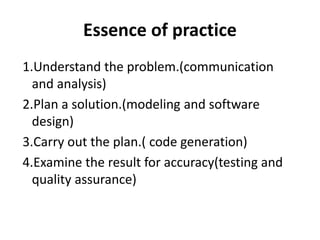
Essence of practice
1.Understand the problem.(communication
and analysis)
2.Plan a solution.(modeling and software
design)
3.Carry out the plan.( code generation)
4.Examine the result for accuracy(testing and
quality assurance)
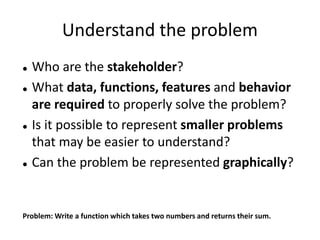
Understand the problem
 Who are the stakeholder?
 What data, functions, features and behavior
are required to properly solve the problem?
 Is it possible to represent smaller problems
that may be easier to understand?
 Can the problem be represented graphically?
Problem: Write a function which takes two numbers and returns their sum.
Plan a solution
 Have you seen similar problems before?
 Has a similar problem been solved?
 Can sub-problems be defined?
 Can you represent a solution in a manner that
leads to effective implementation?
 Can a design model be created?
Carry out the plan.
 Does the solution conform to the plan?
 Is each component part of the solution
provably correct?
 Has the design and code been reviewed?
Examine the result
 Is it possible to test each component part of
the solution?
 Has a reasonable testing strategy been
implemented?
 Has the software been validated against all
stakeholder requirements?
Core principles of Software
Engineering
1. The Reason It All Exists.
2.Keep It Simple, Stupid!
3.Maintain The Vision.
4.What you produce ,Others will Consume.
5.Be Open To The Future.
6.Plan Ahead For Reuse
7.Think!
The First Principle: The Reason It All Exists
 The software exists for one reason: to provide
value to its users.
 Before specifying system requirement,
functionality, hardware platform, development
process ask question such as:
“Dose this add real value to the system?”
 If answer is no, don't do it.
The Second Principle: Keep It Simple,Stupid!
 All design should be as simple as possible, but
no simpler.
 This facilitates having a more easily understood
and easily maintained system.
 Simple does not mean that features should be
discarded in the name of simplicity.
 Indeed, the more elegant designs are usually
the more simple ones.
The Third Principle: Maintain The Vision
 A Clear vision is essential to the success of a
software project.
 Compromising the architectural vision of a
software system weakens and will eventually
break even a well designed system.
 Having an empowered architect who can hold
the vision and enforce compliance helps ensure
a very successful software project.
The Fourth Principle: What you produce ,Others
will Consume
 Always specify design and implement knowing
someone else will have to understand what you
are doing.
 Someone may have to debug the code you
write, and that makes them a user of your code.
 Making their job easier adds value to the
System.
The Fifth Principle: Be open to the Future
 A system with a long lifetime has more value.
 Software lifetimes are typically measured in
months instead of years.
 System should be ready to adapt changes.
 System that adapt changes have been designed
this way from start.
 Never design yourself to a corner.
 Always keep asking “what if?” and prepare for
all possible answers.
The Sixth Principle: Plan ahead for Reuse
 Reuse saves time and effort.
 Achieving a high level of reuse is arguably the
hardest goal to accomplish in developing a
software system.
 The reuse of code and designs has been
proclaimed as a major benefit of using object
oriented technologies.
The Seventh Principle: Think!
 Placing clear, complete thought before action
almost always produces better results.
 When you think about something, you are more
likely to do it right.
 You also gain knowledge about how to do it
right again.
 When clear thoughts has gone into system,
value comes out.
Communication Practices
 Before customer requirements can be
analyzed, modeled, or specified they must be
gathered through a communication activity.
 Effective communication is among the most
challenging activities that confront a software
engineer.
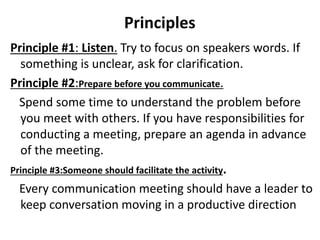
Principles
Principle #1: Listen. Try to focus on speakers words. If
something is unclear, ask for clarification.
Principle #2:Prepare before you communicate.
Spend some time to understand the problem before
you meet with others. If you have responsibilities for
conducting a meeting, prepare an agenda in advance
of the meeting.
Principle #3:Someone should facilitate the activity.
Every communication meeting should have a leader to
keep conversation moving in a productive direction
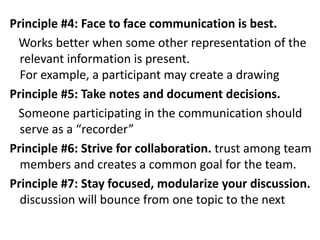
Principle #4: Face to face communication is best.
Works better when some other representation of the
relevant information is present.
For example, a participant may create a drawing
Principle #5: Take notes and document decisions.
Someone participating in the communication should
serve as a “recorder”
Principle #6: Strive for collaboration. trust among team
members and creates a common goal for the team.
Principle #7: Stay focused, modularize your discussion.
discussion will bounce from one topic to the next
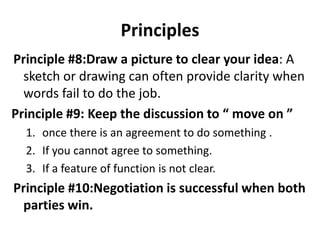
Principles
Principle #8:Draw a picture to clear your idea: A
sketch or drawing can often provide clarity when
words fail to do the job.
Principle #9: Keep the discussion to “ move on ”
1. once there is an agreement to do something .
2. If you cannot agree to something.
3. If a feature of function is not clear.
Principle #10:Negotiation is successful when both
parties win.
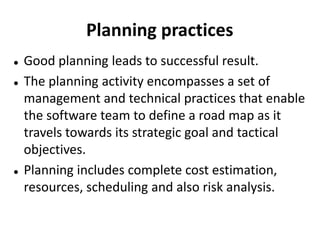
Planning practices
 Good planning leads to successful result.
 The planning activity encompasses a set of
management and technical practices that enable
the software team to define a road map as it
travels towards its strategic goal and tactical
objectives.
 Planning includes complete cost estimation,
resources, scheduling and also risk analysis.
Principle 1: Understand the scope of
the project.
Its impossible to use a road map if you don't
know where you are going. Scope provides the
software team with destination.
Principle 2: Involve the customer in
the planning activity.
The customer defines priorities and establishes
project constraints.
To accommodate these realities software
engineers must often negotiate order of
delivery,time lines and other project related
issues.
Principle 3: Recognize that planning is iterative.
Principle 4:Estimate based on what you know
Principle 5:Consider risk as you define the plan
Principle 6: Be realistic.
Principle 7: Adjust granularity as you define the
plan.
Principle 8: Define how you intend to ensure
Quality.
Principle 9: Describe how you intend to
accommodate change.
Principle 10: Track the plan frequently and make
adjustment as required.
Modeling Practice
 Models are created for better understanding of
the actual entity to be built or design.
 When the entity is a physical thing, we can
build model that is identical in form and shape
but smaller in scale.
 When entity is software our model must take
different form. It must be capable of
representing information, Architecture,
functions ,features and behavior of the system.
In SE work, Two classes of model is created.
1. Analysis Model.
2. Design Model.
Principle 1: The information domain of problem
must be clearly represented.
Information domain encompasses the data that
flow into the system(from end user, external
devices),data that flow out of the system(via
user interface, n/w interface, graphics), data
stores collection of objects(data i.e. maintained
permanently).
Principle 2: The function of the software must
be defined clearly.
 Functions are the processes those transform
the I/p flow to the o/p flow.
 The process specification for example
algorithms provides function details. The
specification must be clearly defined.
Principle 3: The Behavior of the software must
be defined clearly.
 Analysis model uses state transition diagrams
to represent the behavior of the system clearly.
 It shows how the system makes transition from
one state to another on occurrence of some
external event.
Principle 4: The clear hierarchy among
information, functions and behavior must be
shown.
 The proper hierarchy of analysis model leads to
easy design. Hence information, functions and
behavior of the system must be represented
using proper hierarchy i.e. levels or layers.
Principle 5: analysis should be clear enough to
convert it into design model.
 If analysis of requirements is clear and simple
then it will be easy for design and
implementation in construction step. Hence
requirement analysis should be clear enough.
Design modeling
Principle 1: Design should be traceable from
analysis model.
Principle 2: Consider the architecture of the
system to be built.
Principle 3: Design of data is as important as
design of function.
Principle 4: Internal as well as external interfaces
must be designed.
Principle 5: user interface design must satisfy
all need of end user.
Principle 6: Component level design should be
functionally independent.
Principle 7: Components should be loosely
coupled to one another and to the external
environment.
Principle 8: designed modules should be easy
to understand.
Principle 9: Accept that design behavior is
Iterative.