Islamic Inheritance
and legal Wills
1/2-day workshop (16-Sep-2018) organized by:
Islamic Circle of Australia & New Zealand
www.icandawah.org
https://zoom.us/j/177163148
Trainer
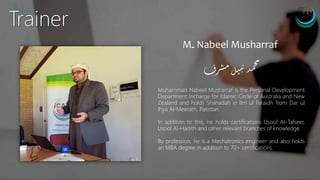
M‫۔‬ Nabeel Musharraf
Muhammad Nabeel Musharraf is the Personal Development
Department Incharge for Islamic Circle of Australia and New
Zealand and holds Shahadah in Ilm ul Faraidh from Dar ul
Ihya Al-Meerath, Pakistan.
In addition to this, he holds certifications Usool At-Tafseer,
Usool Al-Hadith and other relevant branches of knowledge.
By profession, he is a Mechatronics engineer and also holds
an MBA degree in addition to 70+ certifications.
‫رف‬‫ش‬‫م‬‫ل‬‫ی‬‫ب‬‫ن‬‫د‬‫م‬‫ح‬‫م‬
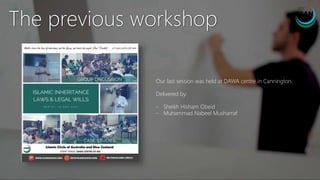
The previous workshop
Our last session was held at DAWA centre in Cannington.
Delivered by:
- Sheikh Hisham Obeid
- Muhammad Nabeel Musharraf
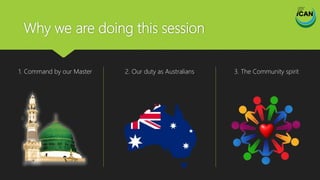
Why we are doing this session
1. Command by our Master 2. Our duty as Australians 3. The Community spirit
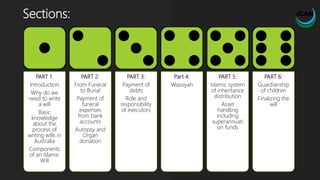
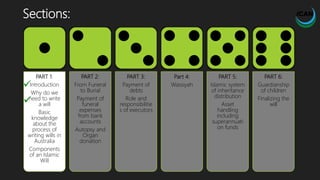
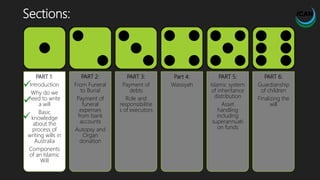
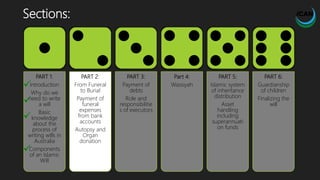
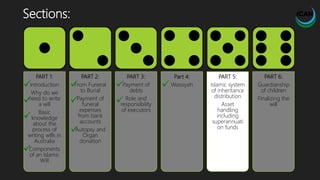
Sections:
PART 1:
Introduction
Why do we
need to write
a will
Basic
knowledge
about the
process of
writing wills in
Australia
Components
of an Islamic
Will
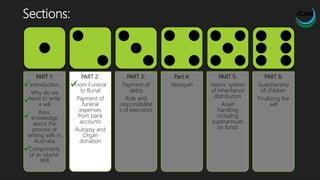
PART 2:
From Funeral
to Burial
Payment of
funeral
expenses
from bank
accounts
Autopsy and
Organ
donation
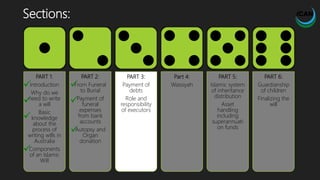
PART 3:
Payment of
debts
Role and
responsibility
of executors
Part 4:
Wassiyah
PART 5:
Islamic system
of inheritance
distribution
Asset
handling
including
superannuati
on funds
PART 6:
Guardianship
of children
Finalizing the
will
In this workshop
THEOLOGY
And
LAW
have been intertwined for a
cohesive coverage of the
matter at hand.
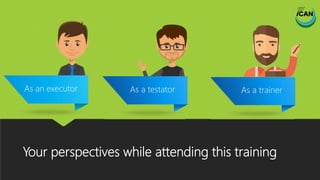
Your perspectives while attending this training
As a testatorAs an executor As a trainer
Be in the shoes..
Think as if you are in the actual situation
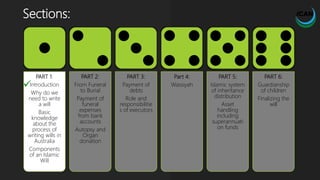
Sections:
PART 1:
Introduction
Why do we
need to write
a will
Basic
knowledge
about the
process of
writing wills in
Australia
Components
of an Islamic
Will
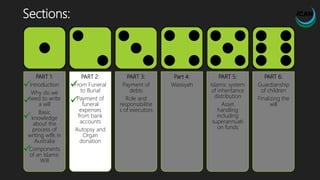
PART 2:
From Funeral
to Burial
Payment of
funeral
expenses
from bank
accounts
Autopsy and
Organ
donation
PART 3:
Payment of
debts
Role and
responsibilitie
s of executors
Part 4:
Wassiyah
PART 5:
Islamic system
of inheritance
distribution
Asset
handling
including
superannuati
on funds
PART 6:
Guardianship
of children
Finalizing the
will
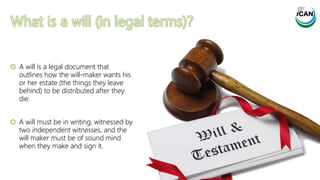
 A will is a legal document that
outlines how the will-maker wants his
or her estate (the things they leave
behind) to be distributed after they
die.
 A will must be in writing, witnessed by
two independent witnesses, and the
will maker must be of sound mind
when they make and sign it.
Why Make a will
o Religious responsibility
o Communicate Burial Preference
o Avoid excessive legal fees
o Avoid excessive times in the distribution of
estate
o Distribute estate Islamically
o Nominate a guardian for young children
o Nominate the person(s) who would administer
estate
o Allocate inheritance to children from previous
marriage
o To benefit the charitable causes
o Do (or don’t) donate organs
o Establish trusts for minors
Why make a will
 “It is prescribed for you, when death approaches
any of you, if he leaves wealth, that he makes a
bequest to parents and next of kin, according to
reasonable manners. (THIS IS) A DUTY upon Al-
Muttaqoon (the pious)” [Surat al-Baqarah 2:180]
 “IT IS THE DUTY of a Muslim who has anything
to bequest not to let two nights pass without
writing a will about it.” (Sahih al-Bukhari)
 Ibn Omar (radiyAllahu anhu) then noted, “Not
even one night passed me, ever since I heard
this from the Prophet (sallAllahu alayhi
wasallam), without having my will with me”
(Bukhari, Muslim, and others)
Why make a will
 It is not for a believing man or a believing
woman, when Allah and His Messenger have
decided a matter, that they should [thereafter]
have any choice about their affair. And whoever
disobeys Allah and His Messenger has certainly
strayed into clear error. (Quran 33:36)
HOW MANY
PEOPLE IN THIS
ROOM HAVE
WRITTEN THEIR
WILL?
Do you know
50Percent
Of
Australian
s
do not
Sections:
PART 1:
Introduction
Why do we
need to write
a will
Basic
knowledge
about the
process of
writing wills in
Australia
Components
of an Islamic
Will
PART 2:
From Funeral
to Burial
Payment of
funeral
expenses
from bank
accounts
Autopsy and
Organ
donation
PART 3:
Payment of
debts
Role and
responsibilitie
s of executors
Part 4:
Wassiyah
PART 5:
Islamic system
of inheritance
distribution
Asset
handling
including
superannuati
on funds
PART 6:
Guardianship
of children
Finalizing the
will
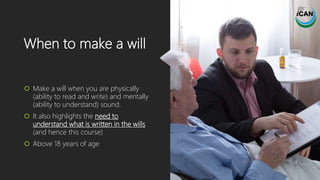
When to make a will
 Make a will when you are physically
(ability to read and write) and mentally
(ability to understand) sound.
 It also highlights the need to
understand what is written in the wills
(and hence this course)
 Above 18 years of age
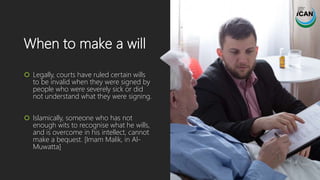
When to make a will
 Legally, courts have ruled certain wills
to be invalid when they were signed by
people who were severely sick or did
not understand what they were signing.
 Islamically, someone who has not
enough wits to recognise what he wills,
and is overcome in his intellect, cannot
make a bequest. [Imam Malik, in Al-
Muwatta]
Does the will need to be
on any particular format
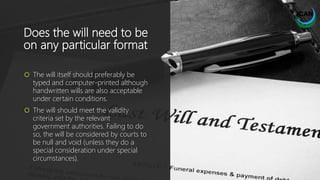
 The will itself should preferably be
typed and computer-printed although
handwritten wills are also acceptable
under certain conditions.
 The will should meet the validity
criteria set by the relevant
government authorities. Failing to do
so, the will be considered by courts to
be null and void (unless they do a
special consideration under special
circumstances).
Is there a problem with Will
kits available online or on
various shops?
Do I need to see a solicitor
to prepare my will?
Sections:
PART 1:
Introduction
Why do we
need to write
a will
Basic
knowledge
about the
process of
writing wills in
Australia
Components
of an Islamic
Will
PART 2:
From Funeral
to Burial
Payment of
funeral
expenses
from bank
accounts
Autopsy and
Organ
donation
PART 3:
Payment of
debts
Role and
responsibilitie
s of executors
Part 4:
Wassiyah
PART 5:
Islamic system
of inheritance
distribution
Asset
handling
including
superannuati
on funds
PART 6:
Guardianship
of children
Finalizing the
will
BRAINSTORM IN TEAMS
1. What happens with your left-over
money, property and assets
(called estate) after the death? (or
what should happen?)
2. In what sequence?
TWO Questions, TWO Minutes
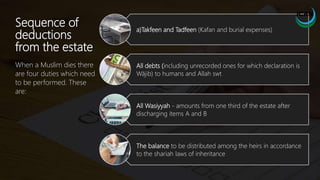
Sequence of
deductions
from the estate
When a Muslim dies there
are four duties which need
to be performed. These
are:
a)Takfeen and Tadfeen (Kafan and burial expenses)
All debts (including unrecorded ones for which declaration is
Wājib) to humans and Allah swt
All Wasiyyah - amounts from one third of the estate after
discharging items A and B
The balance to be distributed among the heirs in accordance
to the shariah laws of inheritance
Sections:
PART 1:
Introduction
Why do we
need to write
a will
Basic
knowledge
about the
process of
writing wills in
Australia
Components
of an Islamic
Will
PART 2:
From Funeral
to Burial
Payment of
funeral
expenses
from bank
accounts
Autopsy and
Organ
donation
PART 3:
Payment of
debts
Role and
responsibilitie
s of executors
Part 4:
Wassiyah
PART 5:
Islamic system
of inheritance
distribution
Asset
handling
including
superannuati
on funds
PART 6:
Guardianship
of children
Finalizing the
will
a. Funeral and Burial
Burial Expenses
 The first expense that has to come out
of estate is burial expenses –
consensus of scholars (God Willing)
 Scholars mention that as clothing
takes precedence over debts and
other needs during one’s life, the
same is applicable after death.
The process from
death to burial
 The process involves four essential
steps:
 Fulfilling legal responsibilities (e.g.
death certificate)
 Settlement of any debts straight
away (if possible)
 Washing & Shrouding the body
 The Funeral Prayer
 The Burial Process
Important things to
consider
 Contact the authorized organizations /
funeral directors for organizing the
funerals.
 There should be no extravagance in the
takfeen and burial
 Body should be buried within 24 hours
(failing to do so may come with cost and
repercussions)
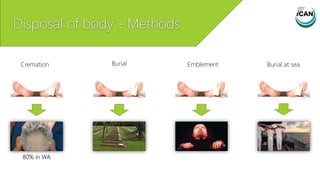
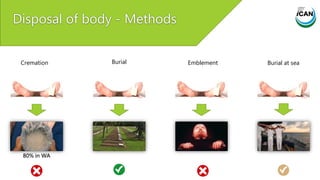
Disposal of body - Methods
80% in WA
Cremation Burial Emblement Burial at sea
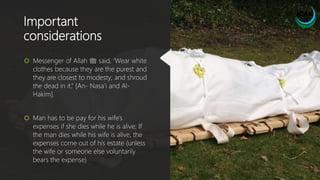
Important
considerations
 Messenger of Allah ‫ﷺ‬ said, 'Wear white
clothes because they are the purest and
they are closest to modesty; and shroud
the dead in it.“ [An- Nasa'i and Al-
Hakim].
 Man has to be pay for his wife’s
expenses if she dies while he is alive; If
the man dies while his wife is alive, the
expenses come out of his estate (unless
the wife or someone else voluntarily
bears the expense)
 “Hasten at a funeral” [Sahih Muslim]
 Muhammad b. Sirin used to learn how
to wash the dead from Umm 'Atiyyah:
he would was with lotus leaves twice
and with water and camphor for the
third time. [Sunan Abu Dawud]
Important
considerations
 Narrated Aisha, Ummul Mu'minin: The
Messenger of Allah ( ‫ﷺ‬) said: Breaking a
dead man's bone is like breaking it when
he is alive.
 "If a Muslim dies and forty people, who do
not associate anything with Allah in
worship, participate in the funeral prayer
over him, Allah will accept their
intercession for him." [Muslim]
 "Any Muslim who dies and three rows of
Muslims make salah for him, will be
forgiven.“ Ahkam al-Jana'iz, p. 99, with
support of the following hadith: Dawud,
vol. 2, p. 899, #3160
Important
considerations
 Fard Kifayah (Collective Obligation) -
Washing the body prior to shrouding
and the burial is obligatory, according
to numerous recorded instructions
given by the Prophet sallallahu 'alayhi
wa sallam. [Sahih Al-Bukhari, vol. 2, p.
194, #344]
 Imam ash-Shafi'i said, "I dislike
gatherings [at the houses of the
deceased], even if there is no wailing or
crying. For it only renews the [family's
feelings of] sorrow and puts burdens on
their food supplies." [Al-Umm]
Important
considerations
80% in WA
Cremation Burial Emblement Burial at sea
Disposal of body - Methods
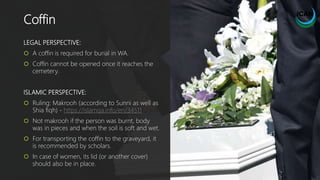
Coffin
LEGAL PERSPECTIVE:
 A coffin is required for burial in WA.
 Coffin cannot be opened once it reaches the
cemetery.
ISLAMIC PERSPECTIVE:
 Ruling: Makrooh (according to Sunni as well as
Shia fiqh) - https://islamqa.info/en/34511
 Not makrooh if the person was burnt, body
was in pieces and when the soil is soft and wet.
 For transporting the coffin to the graveyard, it
is recommended by scholars.
 In case of women, its lid (or another cover)
should also be in place.
Sections:
PART 1:
Introduction
Why do we
need to write
a will
Basic
knowledge
about the
process of
writing wills in
Australia
Components
of an Islamic
Will
PART 2:
From Funeral
to Burial
Payment of
funeral
expenses
from bank
accounts
Autopsy and
Organ
donation
PART 3:
Payment of
debts
Role and
responsibilitie
s of executors
Part 4:
Wassiyah
PART 5:
Islamic system
of inheritance
distribution
Asset
handling
including
superannuati
on funds
PART 6:
Guardianship
of children
Finalizing the
will
Payments for funerals
 Payment from banks before the
probate
 (Some) private health and life
insurance policies, which are
sometimes held through
superannuation funds
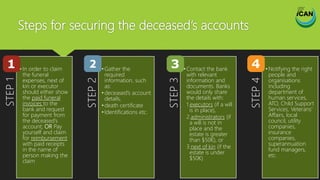
Steps for securing the deceased’s accounts
STEP1
• In order to claim
the funeral
expenses, next of
kin or executor
should either show
the paid funeral
invoices to the
bank and request
for payment from
the deceased’s
account; OR Pay
yourself and claim
for reimbursement
with paid receipts
in the name of
person making the
claim
STEP3
•Contact the bank
with relevant
information and
documents. Banks
would only share
the details with:
1.executors (if a will
is in place),
2.administrators (if
a will is not in
place and the
estate is greater
than $50K), or
3.next of kin (if the
estate is under
$50K)
STEP4
•Notifying the right
people and
organisations
including
department of
human services,
ATO, Child Support
Services, Veterans’
Affairs, local
council, utility
companies,
insurance
companies,
superannuation
fund managers,
etc.
STEP2
•Gather the
required
information, such
as:
•deceased’s account
details,
•death certificate
•Identifications etc.
What happens to Joint
accounts
 Gets transferred to the other joint account holder
 (JUST LIKE ANY OTHER JOINTLY OWNED ASSETS)
 More to come on this..
Bereavement
payment
 A lump sum or short term payment
when your partner, child or the
person you were caring for has died.
 Department of Human Services can
provide more details, as required.
ACTION ITEMS
 Keep all your personal details (including birth certificates for
children, marriage certificate etc) in one place
 Keep all your accounts, investments, and super information handy
so that the next of kin and executors should be able to find it
 Discuss these matters with your spouse and executor (if other than
your spouse)
Sections:
PART 1:
Introduction
Why do we
need to write
a will
Basic
knowledge
about the
process of
writing wills in
Australia
Components
of an Islamic
Will
PART 2:
From Funeral
to Burial
Payment of
funeral
expenses
from bank
accounts
Autopsy and
Organ
donation
PART 3:
Payment of
debts
Role and
responsibilitie
s of executors
Part 4:
Wassiyah
PART 5:
Islamic system
of inheritance
distribution
Asset
handling
including
superannuati
on funds
PART 6:
Guardianship
of children
Finalizing the
will
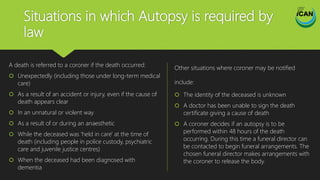
Situations in which Autopsy is required by
law
A death is referred to a coroner if the death occurred:
 Unexpectedly (including those under long-term medical
care)
 As a result of an accident or injury, even if the cause of
death appears clear
 In an unnatural or violent way
 As a result of or during an anaesthetic
 While the deceased was 'held in care' at the time of
death (including people in police custody, psychiatric
care and juvenile justice centres)
 When the deceased had been diagnosed with
dementia
Other situations where coroner may be notified
include:
 The identity of the deceased is unknown
 A doctor has been unable to sign the death
certificate giving a cause of death
 A coroner decides if an autopsy is to be
performed within 48 hours of the death
occurring. During this time a funeral director can
be contacted to begin funeral arrangements. The
chosen funeral director makes arrangements with
the coroner to release the body.
Autopsy and Muslims
 Generally disliked
 Permitted under limited conditions.
 In Australia, the bodies are treated
with respect during autopsy
 Can either be full or limited (case in
NZ)
ACTION ITEMS
 In your will, mention that autopsy should not be
performed on your body unless it is unavoidable as per
law.
Organ donation –
Islamic Perspective
Scholars have two opinions regarding this:
Opinion 1:
It is permissible to transplant an organ from a dead
person to a living person whose life or basic
essential functions depend on that organ, subject
to the condition that permission be given by the
deceased before his death, or by his heirs after his
death, or by the authorities in charge of the
Muslims if the identity of the deceased is unknown
or he has no heirs. Organs are not permitted to be
sold for this purpose.
Ruling: Permitted
(Illah: ‘necessities permit the prohibited’ and
“certainty takes priority over uncertainty)
https://donatelife.gov.au/register-donor-today
Organ donation –
Islamic Perspective
Opinion 2:
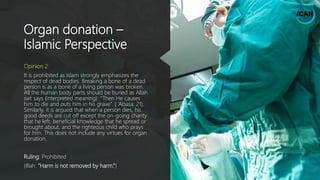
It is prohibited as Islam strongly emphasizes the
respect of dead bodies. Breaking a bone of a dead
person is as a bone of a living person was broken.
All the human body parts should be buried as Allah
swt says (interpreted meaning): ”Then He causes
him to die and puts him in his grave”. ( ’Abasa: 21).
Similarly, it is argued that when a person dies, his
good deeds are cut off except the on-going charity
that he left, beneficial knowledge that he spread or
brought about, and the righteous child who prays
for him. This does not include any virtues for organ
donation.
Ruling: Prohibited
(Illah: ”Harm is not removed by harm.”)
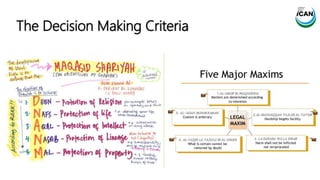
The Decision Making Criteria
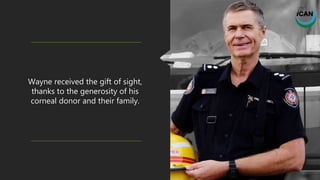
Wayne received the gift of sight,
thanks to the generosity of his
corneal donor and their family.
A liver transplant means that Brad
can now live every day to the
fullest, thanks to his donor and their
family.
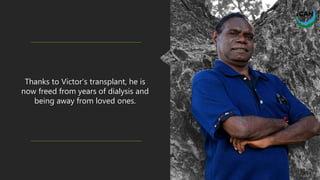
Thanks to Victor's transplant, he is
now freed from years of dialysis and
being away from loved ones.
A transplant would mean Archer
can start enjoying life and playing
with his friends.
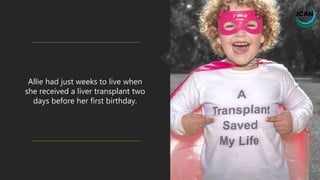
Allie had just weeks to live when
she received a liver transplant two
days before her first birthday.
Do you know…
 Many organ recipients need to wait for upto 7
years before they can find suitable organs
 Muslim community members are in need of
organ donations but there are very few who
come forward and donate (ABC News AUGUST
27, 2016)
 Although people from ethnic minorities
can receive organs from donors of more
prevalent ethnicities, the best match is often
from a person with the same ethnic background
Process
 If you mention about willingness to be the
organ donor, AND your next of kins
approve, your organ donation request will
be accepted.
 Record your organ donation wish on the
Australian Organ Donor Register. The
family of every potential donor will be
asked to confirm the donation decision of
their loved one before donation can
proceed.
 As per law, you are not allowed to sell
your tissue or organs (s 38(1)).
 http://www.austlii.edu.au/au/journals/ALR
CRefJl/2002/21.html
Sections:
PART 1:
Introduction
Why do we
need to write
a will
Basic
knowledge
about the
process of
writing wills in
Australia
Components
of an Islamic
Will
PART 2:
From Funeral
to Burial
Payment of
funeral
expenses
from bank
accounts
Autopsy and
Organ
donation
PART 3:
Payment of
debts
Role and
responsibility
of executors
Part 4:
Wassiyah
PART 5:
Islamic system
of inheritance
distribution
Asset
handling
including
superannuati
on funds
PART 6:
Guardianship
of children
Finalizing the
will
b. DEBT
Debts - Debts are to be
paid first
Al-Harith narrated from ‘Ali [that he addressed to
people]:
"The Prophet (s.a.w) judged with the debt before
the will, and you people recite the will before the
debt.“ (Jami Tirmidhi – Hadith 7)
Abu Hurairah (May Allah be pleased with him)
reported: The Prophet PBUH said, "The soul of the
deceased believer remains pending on account of
the debt till it (the debt) is repayed.“ (Riyad us
Saliheen - Book 7, Hadith 49)
It has been reported on the authority of 'Amr b. al-
'As that the Messenger of Allah ‫ﷺ‬ said: All the sins
of a Shahid (martyr) are forgiven except debt.
Debts - Debts are to be paid
even if they are not in wassiyyah:
It was narrated from Sa'd bin 'Ubadah that he
consulted the Prophet about a vow which his
mother had to fulfill, but she died before
doing so. The Messenger of Allah said: "Fulfill
it on her behalf.“ (Sunan Nasai - Book 30,
Hadith 47)
Debts - Debts to Allah
SWT are to be paid too
Ibn ’Abbas (RAA) narrated, ‘A woman from the
tribe of Juhainah came to the Prophet ( ‫ﷺ‬)
and said, ‘My mother had vowed to perform
Hajj, but she died before fulfilling her vow.
Should I perform Hajj on her behalf? The
Prophet ‫ﷺ‬ said:
"Yes perform Hajj on her behalf. Had there
been a debt on your mother, would you have
paid it or not? So, pay off her debt to Allah,
for He is most deserving of settlement of His
debt." Related by Al-Bukhari.
Debts - Debts to Allah
SWT are to be paid too
Narrated Ibn 'Abbas:
A woman came to the Prophet ( ‫ﷺ‬) and said
(to him) that one month's fast was due from
her mother who had died. May I fulfill them
on her behalf? He asked: Suppose some debt
was due from your mother, would you pay it ?
She replied: Yes. He said: So the debt due to
Allah is the one which most deserves to be
paid. [Saheeh Muslim]
Debts – Returning more
than what is payable
Narrated Jabir ibn Abdullah:
The Prophet ‫ﷺ‬ owed me a debt and gave
me something extra when he paid it.
Debts – Payment of Debts
by community or Islamic
governments
It was narrated from Jabir that the
Messenger of Allah ‫ﷺ‬ said:
“Whoever leaves behind money, it is for
his heirs, and whoever leaves behind a
debt for children, I am nearer to the
believers. [Sunan Ibn Majah]
DEBTS – LEGAL
PERSPECTIVE
 Legally, any debts that you have while you
are alive remain as debts.
 Anyone who can prove you owed them
money can make a claim from the assets
you leave in your will. This will happen even
if you don't mention the debt in your will.
What if the value of
estate is less than the
debts
 The debts are taken out of the estate first
before it is being transferred to heirs
 Items that can be sold to pay the debts are
sold.
 If the value of estate is less than the debts,
the estate can be declared bankrupt.
 Debts are not passed on to heirs if the
estate cannot pay that – HOW DOES THAT
STAND ISLAMICALLY?
Tax on estate
 Executor to lodge outstanding tax returns
(also including a final ‘date of death’
personal tax return)
 Tax will be paid from estate like debt. To
the extent that there is any tax payable
under those returns, the executor will have
to pay it out of your estate, just like any
other debt.
 If you are acting as an executor, seek
further guidance from ATO
ACTION ITEMS
 Advise the debts to be taken from your estate first
and paid as soon as possible
 If there are not enough funds, request the person
distributing your estate to request the community to
pay off your debt
 Also include directions regarding any unfulfilled
responsibilities towards Allah swt (e.g. fasting, hajj,
zakah etc.) – It would be an ihsan from the people if
they do it on your behalf as they are not liable for
this, unlike you yourself.
Sections:
PART 1:
Introduction
Why do we
need to write
a will
Basic
knowledge
about the
process of
writing wills in
Australia
Components
of an Islamic
Will
PART 2:
From Funeral
to Burial
Payment of
funeral
expenses
from bank
accounts
Autopsy and
Organ
donation
PART 3:
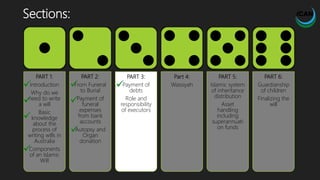
Payment of
debts
Role and
responsibility
of executors
Part 4:
Wassiyah
PART 5:
Islamic system
of inheritance
distribution
Asset
handling
including
superannuati
on funds
PART 6:
Guardianship
of children
Finalizing the
will
ESTATE MANAGEMENT
What do we
already know
about executors?
(The most important person in the
execution of your will!)
 Who is an executor? An executor is a person
you appoint in your will to carry out your
wishes after you die.
 What do executors do? They deal with your
estate, paying your debts and distributing
your assets to beneficiaries as set out in your
will. An executor is sometimes also called a
"personal representative".
 Who can be my executor? An executor can
be anyone over 18 who is trustworthy. They
could be someone like your spouse/de facto
partner or child.
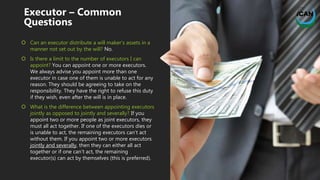
Executor – Common
Questions
 Can an executor distribute a will maker's assets in a
manner not set out by the will? No.
 Is there a limit to the number of executors I can
appoint? You can appoint one or more executors.
We always advise you appoint more than one
executor in case one of them is unable to act for any
reason. They should be agreeing to take on the
responsibility. They have the right to refuse this duty
if they wish, even after the will is in place.
 What is the difference between appointing executors
jointly as opposed to jointly and severally? If you
appoint two or more people as joint executors, they
must all act together. If one of the executors dies or
is unable to act, the remaining executors can't act
without them. If you appoint two or more executors
jointly and severally, then they can either all act
together or if one can't act, the remaining
executor(s) can act by themselves (this is preferred).
Executor – Common
Questions
Do I have to pay someone to act as my executor?
 If you appoint a professional person (such as a lawyer,
accountant, the Public Trustee or an authorised trustee
company) to act as your executor, they will generally
expect to be paid for their services. Usually, they will only
take on the role if your Will includes a provision allowing
them to charge their normal professional fees and a
commission.
 Relatives and friends will often take on the role of
executor free of charge. However, the responsibilities of
an executor are significant and any executor is entitled to
apply to the court to receive a commission for acting in
that role. Whether or not they charge a fee for their
services, if your executor incurs any out of pocket
expenses while acting as your executor, they are entitled
to be reimbursed from your estate for those expenses.
Executor – Common
Questions
What to consider when
selecting executors
 Things you should consider include:
 Are they likely to outlive you?
 Will they have time and motivation to do
what is needed?
 Will they be impartial if there is a dispute?
 Do they have some understanding of your
assets?
 Do they possess the right skills
 Will they be prepared to deal with your
assets confidently, and in the way that you
want? and
 Do you trust them?
Documents to keep with will to
facilitate the executors
 Identity and relationship documents (Birth certificate, Marriage
certificate, Medicare card, pensioner card etc.)
 Your Will
 Enduring power of attorney
 Advance healthcare directive (also called a living will)
 Insurance policies
 House deeds
 Bank account details
 Superannuation papers
 Investment documents (securities, share certificates, bonds)
 Any pre-payments of funeral investments
 Credit, charge and store cards
 Taxation records
 Log of investments, assets, and liabilities
 Log of living relatives (more details to come) and where they
are
 Names and addresses of the witnesses to the will
Duties of executers
The main duties of the administrators/ executors are:
 Pay the funeral expenses, taxes and other debts
 Obtain the death certificate (from next of kin or hospital)
 Inform the relevant organizations about the death
 Obtain the authorization to manage the estate to
execute the will (called ‘Grant of Probate’)
 Secure the assets (bank accounts, land, house,
superannuation, shares etc.)
 File any tax returns, if applicable
 List the assets and their value (seek advice in doing so,
as required)
 Discuss with beneficiaries if they can agree on assets
that can be distributed without selling (if your will
permits this)
 Establish the trusts in accordance with the will and legal
requirements
 Distribute the estate according to the will
 Prepare a final account showing all payments in and out
of the estate and set out how the assets have been dealt
with
 Complete the distribution of estate within 12 months
after the grant of probate
Best executor
 YOUR SPOUSE!
 You don’t want others to tell you wife or
husband what she or he needs to do!
 Other executors charge fee (usually 6% of
the estate which is very costly).
 Your spouse can also seek legal assistance
as the main executor which you can
mention in your will to be paid out.
If there is no will, who
can be the executor
Who can apply for permission to deal with the
deceased's estate if there is no will?
 Generally, anyone over the age of 18 who is
entitled to a share of the estate can apply
to the Probate Office of the Supreme Court
to administer and distribute the property.
 If a person entitled to a share of the estate
is not available the court can appoint
another person or body to administer the
estate.
 This person or body will be called
administrators.
What happens if my
executor dies or is
otherwise unable to
perform their duties as
executor ?
 No effect on your will
 Back up executors in your will kick in
 If there was only one executor in the will or if all of them
are unable to be the executors:
 One of the beneficiaries can apply for letter of
administration (All others will need to give consent)
 Public trustee (which also charges fees) will be appointed
as executor in case of disputes
 If the last surviving executor of your Will dies after
probate of your Will has been granted, the executor of
the deceased executor will take over the administration
of both your estate and the last surviving deceased
executor’s estate. That might be a person you have
never met.
ACTION ITEMS
 Appoint more than one executor. The first of them should
preferably be your spouse, if available and possible.
 Mention that executors should be able to serve jointly and/or
severally
 Specify any fee for service that you wish to give to executors
 Discuss with your spouse and adult children about the
responsibilities of executors and prepare them (time of death is
not the right time to know these things for the first time!)
 Record your marriage history (including your status when the will
was written) as this is required for the grant of probate
Who approves executors or
administrators
 THE SUPREME COURT
 Three types of approvals:
 Probate - where a person has died leaving a will that
nominates a person as executor
 Letters of Administration with the Will Annexed - where a
person has died leaving a will that does not name an
executor or where the only executor named in the will is
unable or unwilling to apply for a grant of Probate
 Letters of Administration - where a person has died
without leaving a valid will the Court may grant Letters of
Administration to an appropriate person who will usually
be a beneficiary of the deceased's estate.
 These documents are the official evidence of the executor’s or
administrator's authority to deal with the deceased person's
property. Banks and other financial institutions, Landgate, and
share registries may refuse to allow any dealings in relation to
a deceased person's property until the Court has made a
grant.
How to apply for probate
 Apply to supreme court with your affidavit and
application – Sample Affidavit and associated
procedure
 Original will and death certificate are also
required to be attached
 Swear and affirm the affidavit in front of an
authorized person (followed by signatures)
 In some states (e.g. NSW), intention to apply for
probate has to be advertised prior to application
 Application for probate can be made 14 days
after the death of testator
 Court usually takes 8 weeks to approve the
application (if all requirements are met)
What is meant by
‘requisition’ in legal terms?
 If the registrar at court requires more information,
he/she will raise a requisition for further information.
 You will need to either refile a form or file a separate
affidavit to answer the requisition and attach a copy of
the requisition to your affidavit.
 The Court will not issue a grant of probate until you
have answered the requisition.
 The Court may raise further requisitions if the Court is
not satisfied with your response.
 Your application may be dismissed if you fail to
respond to the requisition
 If you do not understand the requisition or if you are
not sure how to respond, you can seek clarification
from court.
ACTION ITEMS
 Keep the relevant documents handy to smoothen the
process
 Understand the process and let your executors under it
too
Sections:
PART 1:
Introduction
Why do we
need to write
a will
Basic
knowledge
about the
process of
writing wills in
Australia
Components
of an Islamic
Will
PART 2:
From Funeral
to Burial
Payment of
funeral
expenses
from bank
accounts
Autopsy and
Organ
donation
PART 3:
Payment of
debts
Role and
responsibility
of executors
Part 4:
Wassiyah
PART 5:
Islamic system
of inheritance
distribution
Asset
handling
including
superannuati
on funds
PART 6:
Guardianship
of children
Finalizing the
will
c. Wassiyyah
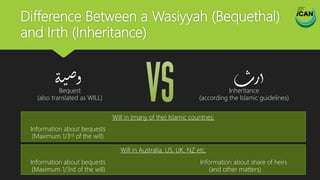
Difference Between a Wasiyyah (Bequethal)
and Irth (Inheritance)
‫ارث‬‫ة‬‫ی‬‫ص‬‫و‬Bequest
(also translated as WILL)
Inheritance
(according the Islamic guidelines)
Will in (many of the) Islamic countries:
Information about bequests
(Maximum 1/3rd of the will)
Will in Australia, US, UK, NZ etc.
Information about bequests Information about share of heirs
(Maximum 1/3rd of the will) (and other matters)
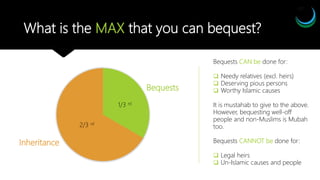
What is the MAX that you can bequest?
Bequests
Inheritance
1/3 rd
2/3 rd
Bequests CAN be done for:
 Needy relatives (excl. heirs)
 Deserving pious persons
 Worthy Islamic causes
It is mustahab to give to the above.
However, bequesting well-off
people and non-Muslims is Mubah
too.
Bequests CANNOT be done for:
 Legal heirs
 Un-Islamic causes and people
On-going charity
 Abu Huraira (Allah be pleased with him)
reported Allah's Messenger ‫ﷺ‬ as saying:
 When a man dies, his acts come to an
end, but three, recurring charity, or
knowledge (by which people) benefit, or a
pious son, who prays for him (for the
deceased). [Saheeh Muslim]
 Al-Tirmidhi (2470) narrated that they slaughtered
a sheep at the time of the Prophet (peace and
blessings of Allaah be upon him) and gave it in
charity except for its shoulder. The Prophet
(peace and blessings of Allaah be upon him)
asked ‘As’ishah, “What is left of it?” She said:
“Nothing is left except the shoulder.” He said: “All
of it will remain except its shoulder.” Classed as
saheeh by al-Albaani in Saheeh al-Tirmidhi.
 What this means is that whatever a person eats is
that which is gone and no longer remains, but
that which he gives in charity is what will remain
for him with Allaah and he will benefit from it on
the Day of Resurrection. This hadeeth is a
reference to the verse in which Allaah says
(interpretation of the meaning): “Whatever is with
you, will be exhausted, and whatever is with
Allaah (of good deeds) will remain” [al-Nahl
16:96]
On-going charity
ACTION ITEMS
 Include a bequest for the needy or Islamic organizations
working towards productive causes such as:
 Islamic dawah organizations
 Orphan care
 Universities
 Islamic schools
 Mosques
 Hospitals
 Book writing
 Teaching, training and knowledge sharing
 Relief work
 And other projects that can be a source of continuous
charity for you
Sections:
PART 1:
Introduction
Why do we
need to write
a will
Basic
knowledge
about the
process of
writing wills in
Australia
Components
of an Islamic
Will
PART 2:
From Funeral
to Burial
Payment of
funeral
expenses
from bank
accounts
Autopsy and
Organ
donation
PART 3:
Payment of
debts
Role and
responsibility
of executors
Part 4:
Wassiyah
PART 5:
Islamic system
of inheritance
distribution
Asset
handling
including
superannuati
on funds
PART 6:
Guardianship
of children
Finalizing the
will
d. Irth (Inheritance)
In this section:
What removes a person
from being an inheritor?
1
4 key recipients of the share
from estate and their
conditions
2
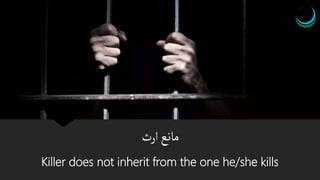
Killer does not inherit from the one he/she kills
‫مانع‬‫ارث‬
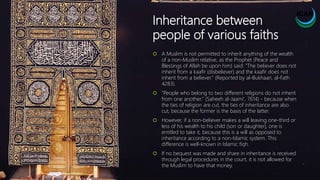
Inheritance between
people of various faiths
 A Muslim is not permitted to inherit anything of the wealth
of a non-Muslim relative, as the Prophet (Peace and
Blessings of Allah be upon him) said: "The believer does not
inherit from a kaafir (disbeliever) and the kaafir does not
inherit from a believer." (Reported by al-Bukhaari, al-Fath
4283).
 "People who belong to two different religions do not inherit
from one another." (Saheeh al-Jaami‘, 7614) - because when
the ties of religion are cut, the ties of inheritance are also
cut, because the former is the basis of the latter.
 However, if a non-believer makes a will leaving one-third or
less of his wealth to his child (son or daughter), one is
entitled to take it, because this is a will as opposed to
inheritance according to a non-Islamic system. This
difference is well-known in Islamic fiqh.
 If no bequest was made and share in inheritance is received
through legal procedures in the court, it is not allowed for
the Muslim to have that money.
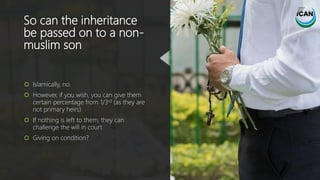
So can the inheritance
be passed on to a non-
muslim son
 Islamically, no.
 However, if you wish, you can give them
certain percentage from 1/3rd (as they are
not primary heirs)
 If nothing is left to them, they can
challenge the will in court
 Giving on condition?
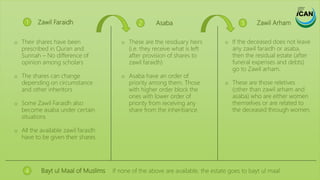
Zawil Faraidh Asaba Zawil Arham
o Their shares have been
prescribed in Quran and
Sunnah – No difference of
opinion among scholars
o The shares can change
depending on circumstance
and other inheritors
o Some Zawil Faraidh also
become asaba under certain
situations
o All the available zawil faraidh
have to be given their shares
o These are the residuary heirs
(i.e. they receive what is left
after provision of shares to
zawil faraidh)
o Asaba have an order of
priority among them. Those
with higher order block the
ones with lower order of
priority from receiving any
share from the inheritiance.
o If the deceased does not leave
any zawil faraidh or asaba,
then the residual estate (after
funeral expenses and debts)
go to Zawil arham.
o These are those reletives
(other than zawil arham and
asaba) who are either women
themselves or are related to
the deceased through women.
1 2 3
Bayt ul Maal of Muslims4 If none of the above are available, the estate goes to bayt ul maal.
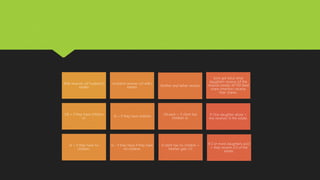
Wife receives (of husband’s
estate)
1/8 = if they have children
or
¼ = if they have no
children.
Husband receives (of wife’s
estate)
¼ = if they have children
½ - if they have if they have
no children
Mother and father receive
1/6 each = if client has
children or
If client has no children =
Mother gets 1/3
Sons get twice what
daughters receive (of the
residual estate) AFTER fixed
share inheritors receive
their shares.
If 2 or more daughters exist
= they receive 2/3 of the
estate.
If One daughter alone =
she receives ½ the estate.
Sections:
PART 1:
Introduction
Why do we
need to write
a will
Basic
knowledge
about the
process of
writing wills in
Australia
Components
of an Islamic
Will
PART 2:
From Funeral
to Burial
Payment of
funeral
expenses
from bank
accounts
Autopsy and
Organ
donation
PART 3:
Payment of
debts
Role and
responsibility
of executors
Part 4:
Wassiyah
PART 5:
Islamic system
of inheritance
distribution
Asset
handling
including
superannuati
on funds
PART 6:
Guardianship
of children
Finalizing the
will