Is It Safe to Buy Verified Square
Accounts? Complete Guide
Meta Description: Learn whether buying verified Square accounts is safe,
understand ownership and security risks, and discover safer ways to create
and manage a business payment account.
➤Telegram: @usaprohub
➤WhatsApp: +1 (262) 620-9492
Digital payment services have become an important part of modern business.
Freelancers, restaurants, retailers, consultants, contractors, online stores,
and service providers all depend on convenient ways to accept payments and
manage financial transactions.
As this need has grown, so has interest in searches such as “buy verified
Square accounts,” “verified Square account,” “aged Square account,” and
“Square account for business.”
1
At first, purchasing a pre-existing account can appear convenient. A seller
may advertise an account as verified, aged, USA-based, ready to use, or fully
established. However, a payment account is much more than a username and
password.
An account may be associated with an individual's identity, business
information, banking details, transaction history, recovery methods, security
records, and other account-specific information. When an account was
created for another person and later sold, the buyer may not receive
legitimate ownership of those underlying relationships.
So, is it safe to buy verified Square accounts?
There is no reliable way to guarantee that a third-party purchased account is
safe, transferable, or suitable for long-term business use.
For businesses, the more dependable approach is to create an account
through the appropriate official process, complete applicable verification
honestly, and build a genuine payment history.
This complete guide explains the major risks of purchasing pre-existing
accounts and provides a safer framework for legitimate account setup and
management. It covers verification, security, banking information, account
history, refunds, disputes, employee access, phishing, record keeping, and
long-term payment operations.
The guide is designed for beginners but also provides useful information for
experienced business owners. Readers interested in online business and
digital account security can also explore usaprohub for additional educational
resources.
What Is a Verified Square Account?
A verified Square account is generally an account for which relevant identity,
business, financial, or other information has been reviewed according to
applicable requirements.
Verification can depend on:
● Location
● Account type
2
● Business structure
● Services being used
● Business activity
● Information requested during review
The specific requirements may change over time.
Verification Does Not Mean Permanent Access
One of the biggest misunderstandings surrounding verified accounts is the
belief that verification guarantees unlimited and permanent access.
It does not.
An account can still be subject to:
● Security checks
● Additional verification
● Transaction reviews
● Policy requirements
● Business-information updates
Therefore, businesses should focus on responsible account management
rather than promises such as “100% verified,” “no limits,” or “permanent
access.”
Is Buying a Verified Square Account Safe?
For a business seeking long-term payment stability, purchasing an account
created for another person carries meaningful risks.
The central issue is that account access is not the same as legitimate account
ownership.
A seller can provide a username and password, but that does not necessarily
transfer:
● Original identity
● Business ownership
● Banking relationships
● Verification history
3
● Recovery methods
● Transaction history
● Future verification rights
This distinction is extremely important.
The Major Risks of Buying Verified
Square Accounts
1. Ownership Risk
A purchased account may have originally belonged to another person or
organization.
Even if the buyer receives full login credentials, the underlying account
history may still reflect the original owner.
If questions about ownership arise later, the buyer may have difficulty
establishing legitimate control.
2. Identity Verification Risk
If the account was verified using another person's identity information,
future verification can become complicated.
A buyer should not attempt to solve this problem by submitting false
information or altered documents.
3. Banking Risk
Payment accounts may have banking relationships associated with the
original account holder.
Changing profile information does not automatically make another person's
banking relationship legitimate for the buyer.
4. Security Risk
4
The seller may retain access through:
● Recovery email
● Phone number
● Authentication methods
● Old credentials
● Connected devices
● Other recovery options
The buyer may therefore never have complete confidence in account security.
5. Transaction-History Risk
A purchased account comes with historical activity that was generated by
someone else.
That history may not match the new business.
For example, an account previously used for one type of business may
suddenly be used for something completely different.
6. Account-Continuity Risk
If an account becomes unavailable, the business may lose access to an
important payment channel.
This can affect:
● Customer payments
● Refunds
● Invoices
● Cash flow
● Accounting
● Business operations
7. Seller Fraud Risk
Some sellers may disappear after receiving payment.
5
Others may sell the same credentials to multiple people or retain access after
the transaction.
8. Privacy Risk
A seller may request personal information, identity documents, banking
details, passwords, or authentication codes.
Providing sensitive information to unknown parties can create additional
security risks.
Why “Verified” Does Not Automatically
Mean “Safe”
The word “verified” can create a false sense of security.
A seller might advertise:
● Verified
● Fully verified
● Aged
● USA verified
● No limits
● Ready to use
● Instant delivery
These marketing descriptions do not independently prove that the account is
legitimate for your business.
Ask What Was Actually Verified
A meaningful question is:
Whose identity and business information were verified?
If the answer is another person, the buyer still faces an ownership problem.
Ask Who Controls the Recovery Methods
6
Even if the seller changes the password, the original owner may retain
recovery options.
Ask Whether Ownership Can Legitimately Transfer
Do not assume that receiving credentials means ownership has been
transferred.
Why “Aged” Accounts Can Be Misleading
Account sellers often promote account age as a major benefit.
However, an old account is not automatically a better account.
Age Does Not Guarantee Security
An account can be years old and still have weak security.
Age Does Not Guarantee Ownership
The account may belong to someone else.
Age Does Not Guarantee Future Approval
Past activity does not guarantee future account status.
Age Does Not Replace Genuine Business Activity
A legitimate business history is created by real transactions connected to the
actual business.
Why “No Limits” Claims Should Be
Treated Carefully
Financial services may have applicable controls, reviews, and requirements.
Therefore, businesses should be cautious about advertisements promising:
7
● Unlimited transactions
● No reviews
● No restrictions
● Permanent approval
● Guaranteed processing
A responsible business should never build its payment strategy around
avoiding legitimate controls.
The Safer Alternative: Create Your Own
Account
If your objective is a dependable business payment account, the strongest
approach is to establish one that you legitimately control.
Step 1: Understand Your Business
Identify:
● Products
● Services
● Customers
● Operating location
● Business structure
Step 2: Prepare Accurate Information
Depending on your circumstances, collect relevant information such as:
● Legal name
● Business name
● Business address
● Contact information
● Banking information
● Business description
● Identification documents if requested
8
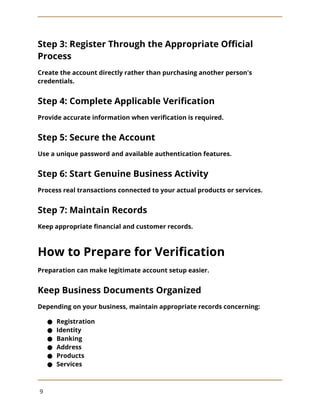
Step 3: Register Through the Appropriate Official
Process
Create the account directly rather than purchasing another person's
credentials.
Step 4: Complete Applicable Verification
Provide accurate information when verification is required.
Step 5: Secure the Account
Use a unique password and available authentication features.
Step 6: Start Genuine Business Activity
Process real transactions connected to your actual products or services.
Step 7: Maintain Records
Keep appropriate financial and customer records.
How to Prepare for Verification
Preparation can make legitimate account setup easier.
Keep Business Documents Organized
Depending on your business, maintain appropriate records concerning:
● Registration
● Identity
● Banking
● Address
● Products
● Services
9
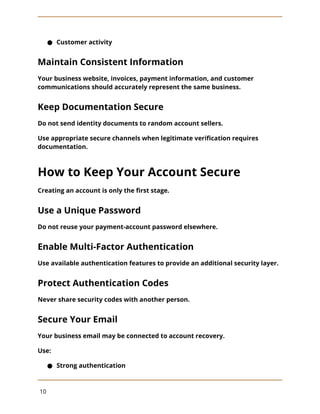
● Customer activity
Maintain Consistent Information
Your business website, invoices, payment information, and customer
communications should accurately represent the same business.
Keep Documentation Secure
Do not send identity documents to random account sellers.
Use appropriate secure channels when legitimate verification requires
documentation.
How to Keep Your Account Secure
Creating an account is only the first stage.
Use a Unique Password
Do not reuse your payment-account password elsewhere.
Enable Multi-Factor Authentication
Use available authentication features to provide an additional security layer.
Protect Authentication Codes
Never share security codes with another person.
Secure Your Email
Your business email may be connected to account recovery.
Use:
● Strong authentication
10
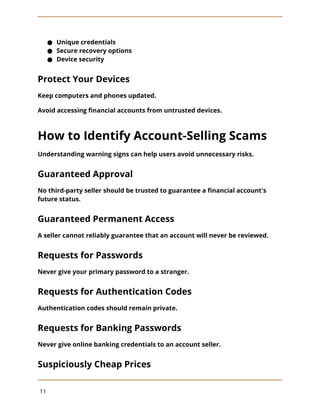
● Unique credentials
● Secure recovery options
● Device security
Protect Your Devices
Keep computers and phones updated.
Avoid accessing financial accounts from untrusted devices.
How to Identify Account-Selling Scams
Understanding warning signs can help users avoid unnecessary risks.
Guaranteed Approval
No third-party seller should be trusted to guarantee a financial account's
future status.
Guaranteed Permanent Access
A seller cannot reliably guarantee that an account will never be reviewed.
Requests for Passwords
Never give your primary password to a stranger.
Requests for Authentication Codes
Authentication codes should remain private.
Requests for Banking Passwords
Never give online banking credentials to an account seller.
Suspiciously Cheap Prices
11
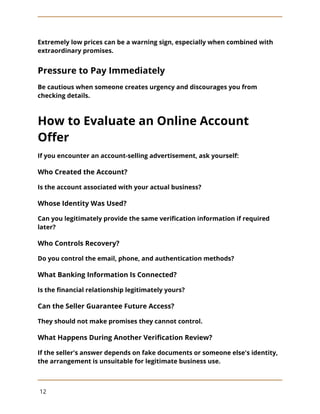
Extremely low prices can be a warning sign, especially when combined with
extraordinary promises.
Pressure to Pay Immediately
Be cautious when someone creates urgency and discourages you from
checking details.
How to Evaluate an Online Account
Offer
If you encounter an account-selling advertisement, ask yourself:
Who Created the Account?
Is the account associated with your actual business?
Whose Identity Was Used?
Can you legitimately provide the same verification information if required
later?
Who Controls Recovery?
Do you control the email, phone, and authentication methods?
What Banking Information Is Connected?
Is the financial relationship legitimately yours?
Can the Seller Guarantee Future Access?
They should not make promises they cannot control.
What Happens During Another Verification Review?
If the seller's answer depends on fake documents or someone else's identity,
the arrangement is unsuitable for legitimate business use.
12
Why Legitimate Ownership Matters
Legitimate ownership gives a business a much stronger foundation.
You Control the Credentials
You know the password and recovery methods.
You Control the Business Information
The account accurately represents your organization.
You Control the Banking Relationship
Financial information is connected appropriately.
You Can Respond to Verification
You have legitimate information relating to your own business.
You Can Build a Genuine History
Your payment activity reflects actual operations.
Building a Genuine Payment History
Businesses sometimes want to buy aged accounts because they believe
history will make processing easier.
A better approach is to develop your own history.
Process Real Payments
Use the account for legitimate customers.
Maintain Accurate Records
13
Keep invoices and transaction documentation.
Manage Refunds Properly
Create a consistent refund process.
Handle Customer Disputes Professionally
Keep appropriate evidence and communications.
Monitor Transactions
Review activity regularly.
Over time, the business creates a real operational record.
Managing Refunds
Refunds should be part of normal business operations.
Establish Clear Policies
Customers should understand when refunds are available.
Document Refunds
Record relevant information accurately.
Monitor Refund Rates
A sudden increase in refunds can indicate operational problems.
Potential causes include:
● Product issues
● Service-quality problems
● Customer misunderstandings
14
● Incorrect product descriptions
Managing Customer Disputes
Disputes can happen even with legitimate businesses.
Keep Evidence
Depending on the business, records may include:
● Orders
● Invoices
● Delivery confirmations
● Customer messages
● Service records
● Refund records
Respond Honestly
Provide accurate information through appropriate processes.
Do not fabricate evidence.
Employee Access and Account
Management
Growing businesses may have multiple people handling payment operations.
Use Individual Access
Avoid sharing one administrator password with an entire team.
Limit Permissions
Employees should receive only the access required for their roles.
15
Review Permissions
Update access when responsibilities change.
Remove Unnecessary Access
When an employee leaves, remove unnecessary access promptly.
Protecting Customer Information
Payment operations can involve sensitive customer information.
Businesses should:
● Limit access
● Protect devices
● Use secure systems
● Avoid unnecessary data storage
● Train employees
Good data security is part of responsible payment management.
How to Respond to an Account Review
A review does not automatically mean that an account is in violation.
Read the Request
Understand what information is needed.
Respond Accurately
Use legitimate documentation.
Ask for Clarification
If something is unclear, use appropriate official support.
16
Avoid Unofficial Fixers
Be cautious about people promising to remove reviews or restrictions for
money.
What If You Already Bought a Verified
Square Account?
If you already purchased an account, do not assume that changing the
password solves all problems.
Do Not Falsify Information
Never create fake identity documents or business records.
Do Not Give the Seller More Credentials
Do not send passwords, authentication codes, or banking credentials.
Review Legitimate Ownership Requirements
Understand what proper account management requires.
Seek Appropriate Official Assistance
If you need account-specific clarification, use legitimate support channels.
How Businesses Can Improve Payment
Security
Security should be treated as an ongoing process.
Conduct Regular Reviews
17
Review:
● Account permissions
● Login activity
● Business information
● Transaction patterns
● Refund trends
Train Employees
Teach staff how to recognize phishing and suspicious requests.
Protect Email Accounts
Use strong authentication.
Keep Software Updated
Security updates reduce avoidable vulnerabilities.
Building a Payment Continuity Plan
Businesses should prepare for unexpected interruptions.
Maintain Financial Records
Do not rely exclusively on one online dashboard.
Document Internal Procedures
Employees should know how to respond to payment-related problems.
Maintain Customer Communication Procedures
Have a plan for communicating with customers if payment operations are
temporarily affected.
18
How to Research Payment Accounts
Online
When searching for information, users may encounter different types of
websites.
These include:
● Official documentation
● Educational blogs
● User forums
● Social-media discussions
● Account marketplaces
● Advertisements
Not all sources provide reliable information.
Prefer Current Official Information
Requirements can change.
Avoid Guaranteed Claims
Be skeptical of promises involving permanent access or unlimited processing.
Protect Personal Information
Do not submit sensitive information simply to obtain a quote.
The Role of usaprohub
Online payment-account topics can be complicated for beginners.
usaprohub can serve as an educational resource for people researching:
● Digital business security
● Payment verification
19
● Account setup
● Online credential protection
● Responsible business practices
The goal should be to help readers understand legitimate processes rather
than encourage risky shortcuts.
Frequently Asked Questions
Is it safe to buy a verified Square account?
There is no reliable way to guarantee that a purchased account is safe. Third-
party accounts may have unknown ownership, identity, banking, and
recovery information.
What is the safest way to get a verified Square
account?
Create an account for your own eligible business through the appropriate
official process and complete applicable verification.
Does “verified” mean the account can never be
restricted?
No. Verification does not guarantee permanent access or immunity from
future reviews.
Is an aged account better than a new account?
Not necessarily. Legitimate ownership, accurate information, genuine
transactions, and security are more important than age alone.
Can I use someone else's identity to maintain a
purchased account?
You should not misrepresent your identity or submit false information.
20
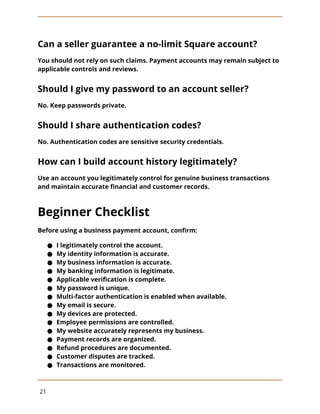
Can a seller guarantee a no-limit Square account?
You should not rely on such claims. Payment accounts may remain subject to
applicable controls and reviews.
Should I give my password to an account seller?
No. Keep passwords private.
Should I share authentication codes?
No. Authentication codes are sensitive security credentials.
How can I build account history legitimately?
Use an account you legitimately control for genuine business transactions
and maintain accurate financial and customer records.
Beginner Checklist
Before using a business payment account, confirm:
● I legitimately control the account.
● My identity information is accurate.
● My business information is accurate.
● My banking information is legitimate.
● Applicable verification is complete.
● My password is unique.
● Multi-factor authentication is enabled when available.
● My email is secure.
● My devices are protected.
● Employee permissions are controlled.
● My website accurately represents my business.
● Payment records are organized.
● Refund procedures are documented.
● Customer disputes are tracked.
● Transactions are monitored.
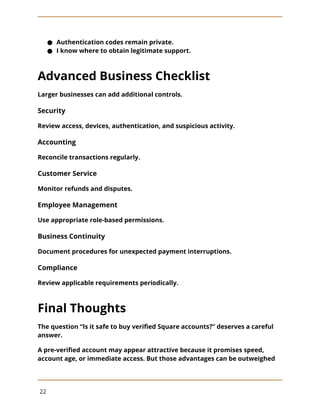
21
● Authentication codes remain private.
● I know where to obtain legitimate support.
Advanced Business Checklist
Larger businesses can add additional controls.
Security
Review access, devices, authentication, and suspicious activity.
Accounting
Reconcile transactions regularly.
Customer Service
Monitor refunds and disputes.
Employee Management
Use appropriate role-based permissions.
Business Continuity
Document procedures for unexpected payment interruptions.
Compliance
Review applicable requirements periodically.
Final Thoughts
The question “Is it safe to buy verified Square accounts?” deserves a careful
answer.
A pre-verified account may appear attractive because it promises speed,
account age, or immediate access. But those advantages can be outweighed
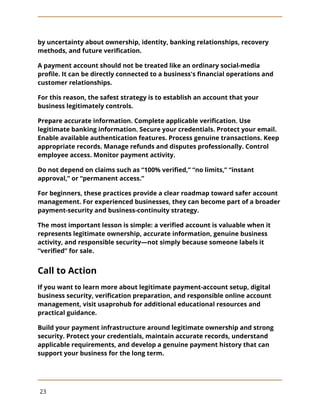
22
by uncertainty about ownership, identity, banking relationships, recovery
methods, and future verification.
A payment account should not be treated like an ordinary social-media
profile. It can be directly connected to a business's financial operations and
customer relationships.
For this reason, the safest strategy is to establish an account that your
business legitimately controls.
Prepare accurate information. Complete applicable verification. Use
legitimate banking information. Secure your credentials. Protect your email.
Enable available authentication features. Process genuine transactions. Keep
appropriate records. Manage refunds and disputes professionally. Control
employee access. Monitor payment activity.
Do not depend on claims such as “100% verified,” “no limits,” “instant
approval,” or “permanent access.”
For beginners, these practices provide a clear roadmap toward safer account
management. For experienced businesses, they can become part of a broader
payment-security and business-continuity strategy.
The most important lesson is simple: a verified account is valuable when it
represents legitimate ownership, accurate information, genuine business
activity, and responsible security—not simply because someone labels it
“verified” for sale.
Call to Action
If you want to learn more about legitimate payment-account setup, digital
business security, verification preparation, and responsible online account
management, visit usaprohub for additional educational resources and
practical guidance.
Build your payment infrastructure around legitimate ownership and strong
security. Protect your credentials, maintain accurate records, understand
applicable requirements, and develop a genuine payment history that can
support your business for the long term.
23