IPM of fruit insect pests
Insect pests of fruits
• Mealy bug (Drosicha mangiferae)
• Fruit flies (Bactrocera dorsalis)
• Fruit borer: (Deanolis albizonalis)
• Leaf miner: (Acrocercops syngramma)
• Fruit flies (Guava fruit fly)
• Thrips (Redbanded thrips)
• Leaf webber (Orthaga euadrusalis)
Cultural Control
• Avoid dense plantings, maintained open
canopy; prune overcrowded overlapping
branches after rainy season.
• Orchards should be kept clean by regular
ploughing and removal of weeds.
• Flooding of orchard with water in the month
of October kill the eggs. Ploughing of orchard
in November
Pruning
• Pruning is a key IPM tool for stone fruit production.
• Young fruit trees should be pruned each year to create
an open and healthy branch structure.
• Pruning stone fruits is best done in March or April,
shortly before bloom, and this is also the best time to
look for problems with branches in trees.
• Inspect each tree for crossing branches, dead branches
or branches with cracks, discolored bark or abnormal
growths or swellings.
• Remove enough branches so that sunlight can reach
the center of the tree.
• Branches that are crossing and touching often rub
together, creating a shallow wound that can allow
wood rotting fungi to enter the tree.
• Branches with cracked or discolored bark or with
abnormal growths may be infected with a pathogen.
• Prune out any suspicious looking branches 4-6 inches
below visible symptoms. Infected branches should be
removed and destroyed.
• Proper pruning will allow fruit and leaves to dry more
quickly after rain, resulting in lower disease pressure
• Prior to harvest (30-40 days) collect and
dispose off infested and fallen fruits to
prevent further, multiplication and carry over
of population
• Collection of fruits and dead wood after fruit
harvest.
• Destroy all fallen fruits
• Clipped off destroy the affected shoots
Biological Control Agents
• Predators
• Consume many prey during development.
• Generally larger than prey
• All stages may be predators.
• Are often generalists rather than specialists on any one prey type
and eat both adults and immatures.
• Sand Wasps, Syrphid Flies, Minute Pirate Bug, Green and Brown
Lacewings .
• Parasitoids
• Immatures feed only on a single host and
almost always kill it.
• Are smaller than the host.
• Are often specialized in their choice of host
species and life stages thereof.
• Only the female attacks the host and lays eggs
or larvae on or in the host.
• Immatures remain on or in the host, adults are
free living and mobile and may be predaceous,
feed on nectar, or not feed at all.
• Tachinid Flies, Scelionid Wasps, Braconid and
Ichneumon Wasps
• Parasites
• Smaller than host and don’t generally kill it
(e.g., mites)
• Pathogens
• Diseases caused by fungi, bacteria, and viruses
that kill the host.
• Some are naturally occurring and some have
been commercially developed.
• Bacillus thuriengensis (Bt) toxins and spores—
Dipel, etc.
• Fermentation products from fungi are
precursors to making abamenctin and
spinosad.
• Codling moth polyhedrosis virus available
commercially for control.
• Naturally occurring Beauvaria and Hirsutella
fungal pathogens
• Conservation of bio control agents, Beauveria
bassiana, predators, Menochilus
sexmaculatus, Rodolia fumida and Sumnius
renardi.
• Releasing 10-15 grubs of coccinellid predator,
C. montrozieri per tree
Chemical control
• In IPM, pesticide sprays are used only when
cultural controls are not effective or as a
supplement to cultural controls.
• If using pesticides, gardeners should choose
an effective product that has the lowest
impact on human health, non-target
organisms like bees, and the environment.
• Apply specific pesticides can be found on the
product label. If pesticides are necessary,
always use them exactly as directed by the
product label as mandated by federal law.
• Three weeks before the harvest, spray
decamethrin 2.8 EC @ 0.5 ml/l + Azadirachtin
(0.3%) 2 ml/lt and take up timely harvest.
• If fruit fly is very serious (> 5/Surveillance
trap), give bait sprays on the tree trunks at
weekly interval: (Bait spray is prepared by
mixing 100g of jaggery in one litre of water to
which 2 mL of deltamethrin (2.8 EC) is
added).
• The harvested fruits may be treated with hot
water for 1 hour at 48oC.
• The adult flies may be trapped and killed by
poison baiting or bait spray (20 ml malathion +
200 g molasses in 20 liters of water)
• 2. The hedges around the guava trees may be
sprayed with endosulfan (0.1%), carbaryl
(0.1%) or Quinalphos (0.05%).
IPM IN APPLE
Apples are susceptible to many diseases and insect pests.
Integrated Pest Management (IPM) is the science of
combining cultural, biological and chemical pest control
methods to reduce the reliance upon chemical inputs.
Before IPM, products were sprayed on a schedule, with
minimal attention paid to the actual need for these
applications.
Organic agriculture is indebted to many of these IPM
strategies. The emphasis in an Organic System Plan is
more on the mechanical, cultural and biological pest
control options, but if needed, natural pesticide and
preventive inputs can be used to minimize economic
loss.
INSECT PESTS OF APPLE
Apple Clearwing Moth
Apple Maggot
Aphids
Apple Curculio
Apple Leaf Curling Midge
Apple Mealybug
Cherry Fruit Fly
Codling Moth
Cutworms
Earwigs
 Green Fruitworms
 Leafrollers
 Mites
Shothole Borer
Spotted Wing Drosophila
 Western Flower Thrips
White Apple Leafhopper
Pest Management
• Strategies
Do nothing
 Eradication
 Prevention **
 Suppression *
• Tactics
 Cultural
 Mechanical
Biological
 Behavioral
 Microbial
 Chemical
Cultural Controls
• Minimize infestations by choosing
appropriate crop management
practices
• Categories:
– Crop location
– Crop selection
– How crop is maintained
• Crop location
– Do not plant near alternate
hosts (or remove alternate
hosts)
Example: blackberry psyllid
• Winter hosts: pines, spruces,
cedars, hemlocks
• Do not plant blackberries
within 1/8 mile of conifers; 1
mile better
• Crop selection
– Choose resistant varieties
• Not many examples for insects
• Aphid resistant raspberries
– Ground cover (between tree rows
in orchards)
• Broadleaf covers better refuge for
predatory mites
• For better biocontrol, use broadleaf
rather than grass ground cover
• How crop is maintained
– Pruning
– Mowing
– Sanitation (‘clean culture’)
– Fertilizer
– Plant growth regulators
– Weed control
– Irrigation/hosing
Mechanical Controls
• Use mechanical tactics to
prevent or delay pests from
infesting a site; use tools not
needed for purposes other than
pest management
• Exclusion
• Removal
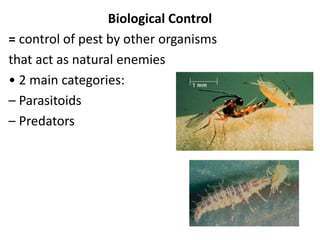
Biological Control
= control of pest by other organisms
that act as natural enemies
• 2 main categories:
– Parasitoids
– Predators
Microbial Control
• Control by micro-organisms
that cause disease in insect
• Bacteria
– BT sprays
– (Transgenic BT plants)
• Viruses
• (fungi)
• (nematodes)
• (protozoans)
Chemical control
• OMRI-approved insecticides
– spinosad (Entrust)
– kaolin (Surround)
– Soaps
– Oils
– Pyrethrins
IPM IN CITRUS
Citrus is one of the most important fruits and is
grown in more than 52 countries around the world.
A number of insect pests attack citrus in Pakistan.
To control these pests farmers mainly rely on
pesticides.
Indiscriminate use of synthetic chemicals results in
residual toxicity endangering human and animal
health apart from causing environmental degradation.
It is estimated that as much as 17% of pesticides are
used in fruits and vegetables in Pakistan.
INSECT PESTS OF CITRUS
Fruit flies
Citrus psylla
Leaf miner
Mealy bugs and scale insects
Citrus Thrips
Citrus Cutworm
PEST MANAGEMENT
Citrus leafminer and Citrus peelminer share many
of the same parasites:
Closterocerus
Pnigalio
Chrysocharis
Sympiesis
Cirrospilus
Natural enemies of D. citri and recorded six species of
parasitoids including Tetrastichus sp. Tetrastichodes sp.,
Psyllaephagus spp. Aphycoide ssp. And Achrysochari ssp.
Pesticide and pheromone treatments for citrus leafminer
recommended for nurseries and new plantings
•Neonicotinoids: acetamiprid, imidacloprid,
thiamethoxam, dinotefuran
•Oil at frequent intervals
•methoxyfenozide
•Insect growth regulators:
diflubenzuron, neem
•abamectin
•spinetoram
•Spirotetramt
•rynaxypyr, cyazypyr