DRUG DEVELOPMENT
For patients,new medicines offer fewer side effects, fewer
hospitalizations, improved quality of life, increased
productivity, and importantly, extended lives. But developing
medicines is a long, complex process.
The rapid pace of scientific advances is enabling a greater
understanding of diseases at the molecular level.
2.
INTRODUCTION- DRUG DEVELOPMENT
Onaverage, it takes at least ten years for a new medicine to
complete the journey from initial discovery to the market
place, with clinical trials alone taking six to seven years on
average.
The average cost to research and develop each successful
drug is estimated to be $2.6 billion.
3.
INTRODUCTION- DRUG DEVELOPMENT
Theoverall probability of clinical success is estimated to be less than
12%.
Success requires immense resources — the best scientific minds, highly
sophisticated technologies, ever-evolving manufacturing processes, and
complex project management.
4.
PRE-DISCOVERY: UNDERSTAND THEDISEASE OR CONDITION
Companies perform basic research independently and in partnership with
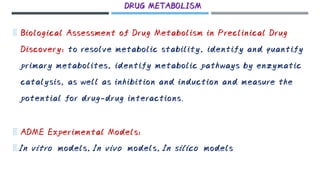
researchers and others.
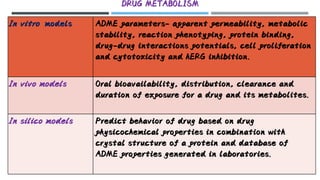
Advancements in science and technology are changing the way we define
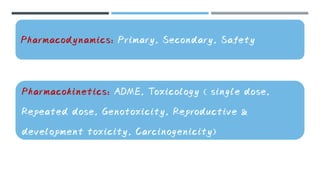
disease, develop drugs and prescribe treatments.
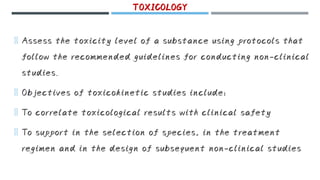
As researchers and scientists investigate new compounds, they are building
off of a growing body of evidence that has accumulated over time,
illuminating pathways of disease and providing insight into the optimal drug
targets.
5.
TARGET IDENTIFICATION ANDVALIDATION: CHOOSE A MOLECULE TO TARGET
WITH A DRUG
Armed with an idea, researchers work to identify biological targets for a
potential medicine.
A drug target is a molecular structure in the body that, when it interacts
with a potential drug compound, produces a clinical effect.
Target validation is crucial to help scientists identify the most promising
approaches before going into the laboratory to develop potential drug
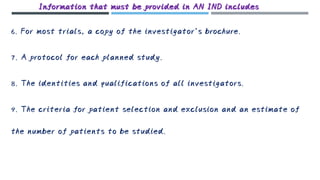
candidates, increasing the efficiency and effectiveness of the R&D process.
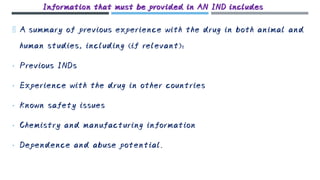
6.
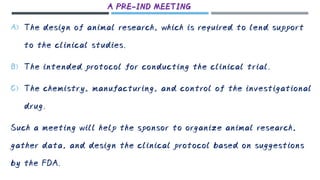
FIND A PROMISINGMOLECULE (A “LEAD COMPOUND”) THAT
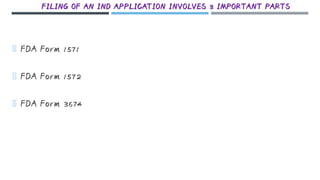
COULD BECOME A NEW MEDICINE
After learning more about the underlying disease pathway and
identifying potential targets, researchers then seek to narrow the field
of compounds to one lead compound – a potentially, become a medicine.
Even at this early stage, investigators are already thinking about the final
product, and how it will be administered to patients.
7.
EARLY SAFETY TESTS:PERFORM INITIAL TESTS ON PROMISING COMPOUNDS.
Scientists assess how the body processes the investigational compound,
also referred to as pharmacokinetics.
They also evaluate the impact the investigational compound has on
various functions within the body, or the pharmacodynamics.
Successful drugs must be: • absorbed into the bloodstream, •
distributed to the proper site of action in the body, • metabolized
efficiently and effectively, • successfully excreted from the body,
and • demonstrated to be not toxic in the tests performed.
8.
LEAD OPTIMIZATION: ALTERTHE STRUCTURE OF LEAD CANDIDATES TO
IMPROVE PROPERTIES
Lead investigational compounds that survive the initial screening are
then “optimized,” or altered to make them more effective and safer.
By changing the structure of a compound, scientists can give it
different properties.
Hundreds of different variations or “analogues” of the initial leads are
produced and tested.
9.
DRUG DEVELOPMENT TEAM
Oneof the main role of the project team is to coordinate the various
studies necessary for successful development of a drug candidate and to
ensure that the timeline for development is on schedule.
Other responsibilities performed by the project team include the following:
Review of the results of research or experiments conducted various
scientific disciplines.
Integration of results from new search with previously generated data.
10.
DRUG DEVELOPMENT TEAM
Drugcandidate characterization and planning of research studies.
Compare research findings, development status and timelines of drug
candidates under development with competitors available.
Conduct market research to assure that the drug candidate development is
financially justified and continues to satisfy a medical need.
Reports drug development program status to management with further
recommending the continued development of the drug candidate.
11.
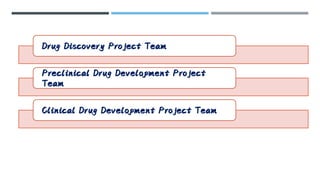
Drug Discovery ProjectTeam
Preclinical Drug Development Project
Team
Clinical Drug Development Project Team
12.
PRECLINICAL TESTING
LAB ANDANIMAL TESTING TO DETERMINE IF THE DRUG IS SAFE FOR HUMAN TESTING
With one or more lead compounds identified, researchers turn their
attention to extensive testing to determine if they are ready to be
studied in humans.
Scientists carry out both in vitro and in vivo tests.
In vitro tests are experiments conducted in the lab and in vivo studies
are those in living cell and tissue cultures and animal models.
13.
STUDIES: NON-CLINICAL DEVELOPMENT
Insilico: computer simulation: toxicological profile
In vitro: effect of drug on specific isolated tissue or organ.
In Vivo: using a whole living organism as opposed to tissues
or cells. Animal models- mice, rats, rabbits are used.
14.
NON-CLINICAL DRUG DEVELOPMENT
1)
2)
3)
4)
VeryLittle information is available about the pharmacokinetics, safety and
toxicity of NCE in Humans: clinical and non-clinical studies.
Non-clinical development: safety and Pharmacology data.
Objectives of Non-clinical studies:
To determination of pharmacological properties
To perform a laboratory test on new drug or new medical devices
Toxic effects categorization with respect to target organs
For clinical monitoring of potential adverse effects, identification of
specific parameters.
15.
TYPES OF NON-CLINICALSTUDIES
Screening Test: indicate the presence or absence of a
particular pharmacodynamic activity.
Tests on isolated organs or bacterial culture: Preliminary tests
to detect specific activities.
Test of Human Diseases on Animal Models: animal models used to
test the drug activity by producing disease symptoms.
Mechanism of Action: Attempts are made to discover the
mechanism of action.
16.
TYPES OF NON-CLINICALSTUDIES
Systemic Pharmacology: Effect of drug on major organ
systems- nervous, cardiovascular, respiratory, renal
Pharmacokinetics: Dose-response relationship, maximal
effects and comparative efficacy
Toxicity Test: Acute Toxicity (LD50), Organ Toxicity
17.
PHARMACOLOGY: DRUG DISCOVERY
Studyof the effects of chemicals or Pharmacological substances on
living systems.
Specific Pharmacological studies: demonstrate therapeutic potential of
drug substances for humans.
Safety pharmacology studies investigate the possible unwanted
pharmacodynamic effects of a substance.
Investigating effect of test drugs on vital organs- CVS, respiratory and
CNS.
18.
COMPONENTS OF PHARMACOLOGICALEVALUATION
Selectivity Testing: Molecular target (determine drug
potency), Binding Assay (dissociation constant of the
compound, measure of receptor affinity)
Pharmacological Profiling: Pharmacodynamic effects, In-
vitro models, In-vivo models
Testing of Disease in Animal Models: Acute Physiological
and Pharmacological Model- Epilepsy model, Pain model,
Asthma model
19.
Chronic Physiological andPharmacological Model- Self
Administration of opoids, nicotine : Drug Addiction model
Alloxan- inhibit insulin secretions- Type I diabetes Model
Genetic models: Animals produced by deletion or over expression of
specific genes to show abnormalities resembling the human disease.
20.
SAFETY PHARMACOLOGY
Safety Pharmacologyis the evaluation and study of the
potential lethal pharmacological effects of a potential drug
not related to the desired therapeutic effect & it can
present a hazard.
Identify the unexpected effects of new drugs on the main
functions of the organs.
21.
SAFETY PHARMACOLOGY
Detect possibleunwanted or dangerous effects on the
exposure of the drug to therapeutic doses.
Safety Pharmacology studies are not required for locally
applied agents- dermal or ocular.
Safety Pharmacology tests are not necessary in case of a new
derivatives that has similar Pharmacokinetics and
Pharmacodynamics.
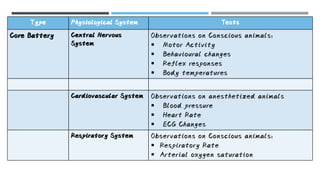
22.
Type Physiological SystemTests
Core Battery Central Nervous
System
Observations on Conscious animals:
Motor Activity
Behavioural changes
Reflex responses
Body temperatures
Cardiovascular System Observations on anesthetized animals
Blood pressure
Heart Rate
ECG Changes
Respiratory System Observations on Conscious animals:
Respiratory Rate
Arterial oxygen saturation
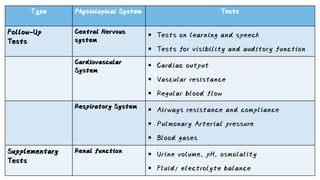
23.
Type Physiological SystemTests
Follow-Up
Tests
Central Nervous
system
Tests on learning and speech
Tests for visibility and auditory function
Cardiovascular
System
Cardiac output
Vascular resistance
Regular blood flow
Respiratory System Airways resistance and compliance
Pulmonary Arterial pressure
Blood gases
Supplementary
Tests
Renal function Urine volume, pH, osmolality
Fluid/ electrolyte balance
24.
DRUG METABOLISM
Drug Metabolism-natural mechanism for eliminating drugs/ foreign
objects.
The enzyme induced drug metabolism involves phase I reactions
(Oxidation, reduction and hydrolysis), with subsequent phase II
(conjugation such as glycosylation, methylation) reactions.
Metabolic organs: liver metabolism- drug metabolism in liver
Chemistry of Drug Metabolism: use pharmacokinetics to evaluate drug
levels (Toxicity) to optimize drug therapy.
25.
DRUG METABOLISM
Biological Assessmentof Drug Metabolism in Preclinical Drug
Discovery: to resolve metabolic stability, identify and quantify
primary metabolites, identify metabolic pathways by enzymatic
catalysis, as well as inhibition and induction and measure the
potential for drug-drug interactions.
ADME Experimental Models:
In vitro models,In vivo models,In silico models
26.
DRUG METABOLISM
In vitromodels ADME parameters- apparent permeability, metabolic
stability, reaction phenotyping, protein binding,
drug-drug interactions potentials, cell proliferation
and cytotoxicity and hERG inhibition.
In vivo models Oral bioavailability, distribution, clearance and
duration of exposure for a drug and its metabolites.
In silico models Predict behavior of drug based on drug
physicochemical properties in combination with
crystal structure of a protein and database of
ADME properties generated in laboratories.
27.
Pharmacodynamics: Primary, Secondary,Safety
Pharmacokinetics: ADME, Toxicology ( single dose,
Repeated dose, Genotoxicity, Reproductive &
development toxicity, Carcinogenicity)
28.
TOXICOLOGY
Assess the toxicitylevel of a substance using protocols that
follow the recommended guidelines for conducting non-clinical
studies.
Objectives of toxicokinetic studies include:
To correlate toxicological results with clinical safety
To support in the selection of species, in the treatment
regimen and in the design of subsequent non-clinical studies
29.
TOXICOLOGY
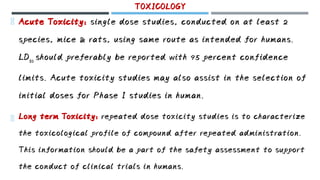
Acute Toxicity: singledose studies, conducted on at least 2
species, mice & rats, using same route as intended for humans.
LD50 should preferably be reported with 95 percent confidence
limits. Acute toxicity studies may also assist in the selection of
initial doses for Phase I studies in human.
Long term Toxicity: repeated dose toxicity studies is to characterize
the toxicological profile of compound after repeated administration.
This information should be a part of the safety assessment to support
the conduct of clinical trials in humans.
30.
TOXICOLOGY
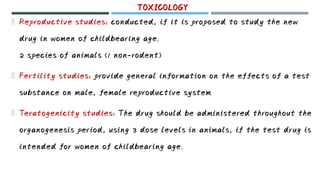
Reproductive studies: conducted,if it is proposed to study the new
drug in women of childbearing age.
2 species of animals (1 non-rodent)
Fertility studies: provide general information on the effects of a test
substance on male, female reproductive system
Teratogenicity studies: The drug should be administered throughout the
organogenesis period, using 3 dose levels in animals, if the test drug is
intended for women of childbearing age.
31.
TOXICOLOGY
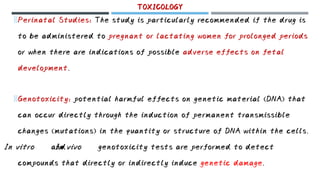
Perinatal Studies: Thestudy is particularly recommended if the drug is
to be administered to pregnant or lactating women for prolonged periods
or when there are indications of possible adverse effects on fetal
development.
Genotoxicity: potential harmful effects on genetic material (DNA) that
can occur directly through the induction of permanent transmissible
changes (mutations) in the quantity or structure of DNA within the cells.
In vitro and
In vivo genotoxicity tests are performed to detect
compounds that directly or indirectly induce genetic damage.
32.
TOXICOLOGY
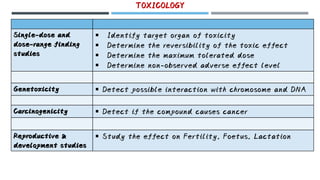
Single-dose and
dose-range finding
studies
Identifytarget organ of toxicity
Determine the reversibility of the toxic effect
Determine the maximum tolerated dose
Determine non-observed adverse effect level
Genetoxicity Detect possible interaction with chromosome and DNA
Carcinogenicity Detect if the compound causes cancer
Reproductive &
development studies
Study the effect on Fertility, Foetus, Lactation
33.
PHASE I CLINICALTRIAL
In Phase I trials the candidate drug is tested in people for the first
time.
These studies are usually conducted with a small number of healthy
volunteers, generally 100 or less.
The main goal of a Phase I trial is to assess the safety of the medicine
when used in humans.
INITIAL SAFETY TESTING IN A SMALL GROUP OF HEALTHY VOLUNTEERS
34.
In Phase IItrials researchers evaluate the candidate drug’s
effectiveness in 100 to 500 patient volunteers with the disease under
study.
Many Phase II trials study patients receiving the drug compared with
patients receiving a different treatment, either an inactive substance
(placebo), or a different drug that is usually considered the standard
of care for the disease.
PHASE II CLINICAL TRIAL
ASSESS SAFETY AND EFFICACY IN A SMALL GROUP OF PATIENTS
35.
PHASE III CLINICALTRIAL
Phase III trials generate statistically significant data about the safety,
efficacy and the overall benefit-risk relationship of the investigational
medicine.
Phase III trials may enroll 1,000 to 5,000 patients or more across numerous
clinical trials sites around the world.
This phase of research is essential in determining whether the drug is safe
and effective.
DEMONSTRATE SAFETY AND EFFICACY IN A LARGE GROUP OF PATIENTS
36.
INVESTIGATIONAL NEW DRUG(IND)
It is an application filed to the FDA in order to start the clinical
trials in humans, if the drug was found to be safe from the reports of
preclinical trials.
Sponsor is responsible for submitting the IND application advances to
the next stage of drug development known as clinical trials.
Investigational New Drug has been defined under 21CFR 312.3(b) USFDA
as a new drug or biological drug that is used in a clinical investigation.
37.
INVESTIGATIONAL NEW DRUG(IND)
Investigational new drug means a new drug or biological drug that is used
in a clinical investigation. The term also includes a biological product
that is used in vitro for diagnostic purposes. The terms "investigational
drug" and "investigational new drug" are deemed to be synonymous for
purposes of this
part. [21CFR 312.3(b)
USFDA]
In India, investigational new drug has been defined under explanation
38.
Investigational New Drugmeans a new chemical entity or a
product having therapeutic indication but which have never been
earlier tested on human being. [Rule 122-DA (3)]
39.
INFORMATION THAT MUSTBE PROVIDED IN AN IND INCLUDES
1.
2.
3.
4.
The identity and contact information of the sponsor and the
phase of the trial.
A commitment that an IRB will be responsible for initial and
continuing review of the trial.
The objectives and planned duration of the proposed clinical
trials.
The name of the drug, a list of its active ingredients, and its
dosage and route of administration.
40.
•
•
•
•
•
5. A briefdescription of the plan for investigating the drug,
including
The reasoning behind the drug or the study.
The indication(s) to be studied
The kinds of clinical trials to be conducted in the first year after
the IND submission.
The estimated number of patients who will be given the drug in the
clinical trial(s)
Any serious risks that are anticipated on the basis of animal studies
or previous human studies of the drug.
Information that must be provided in AN IND includes
41.
6. For mosttrials, a copy of the investigator’s brochure.
7. A protocol for each planned study.
8. The identities and qualifications of all investigators.
9. The criteria for patient selection and exclusion and an estimate of
the number of patients to be studied.
Information that must be provided in AN IND includes
42.
•
•
•
•
•
A summary ofprevious experience with the drug in both animal and
human studies, including (if relevant):
Previous INDs
Experience with the drug in other countries
Known safety issues
Chemistry and manufacturing information
Dependence and abuse potential.
Information that must be provided in AN IND includes
43.
A PRE-IND MEETING
A)
B)
C)
Thedesign of animal research, which is required to lend support
to the clinical studies.
The intended protocol for conducting the clinical trial.
The chemistry, manufacturing, and control of the investigational
drug.
Such a meeting will help the sponsor to organize animal research,
gather data, and design the clinical protocol based on suggestions
by the FDA.
44.
FILING OF ANIND APPLICATION INVOLVES 3 IMPORTANT PARTS
FDA Form 1571
FDA Form 1572
FDA Form 3674
FORM 1571 OFFDA
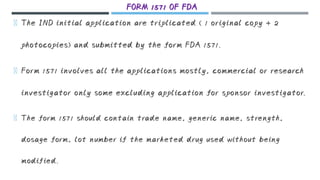
The IND initial application are triplicated ( 1 original copy + 2
photocopies) and submitted by the form FDA 1571.
Form 1571 involves all the applications mostly, commercial or research
investigator only some excluding application for sponsor investigator.
The form 1571 should contain trade name, generic name, strength,
dosage form, lot number if the marketed drug used without being
modified.
48.
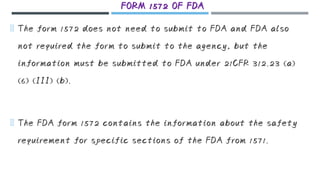
FORM 1572 OFFDA
The form 1572 does not need to submit to FDA and FDA also
not required the form to submit to the agency, but the
information must be submitted to FDA under 21CFR 312.23 (a)
(6) (III) (b).
The FDA form 1572 contains the information about the safety
requirement for specific sections of the FDA from 1571.
49.
SEC. 312.23 INDCONTENT AND FORMAT
21CFR 312.23 (a) (6) (III) (b): The name and address and a
statement of the qualifications (curriculum vitae or other
statement of qualifications) of each investigator, and the
name of each sub-investigator
50.
FORM 3674 OFFDA
Form 3674 involves amendment, supplements, resubmissions
under §§§§505, 515, 520 (m) or 510 (k) of the federal food drug
and cosmetic act or §351 of the Public Health Service Act.
All clinical investigators must get registered with the FDA for
Phase I study, which needs to provide all the trial information,
through the US National Library of Medicine.
51.
CDER (CENTRE FORDRUG EVALUATION & RESEARCH)
Once the IND application is submitted, the sponsor must
wait 30 calendar days before initiating any clinical trials.
If the sponsor hears nothing from CDER (Centre for Drug
Evaluation and Research), then on day 31 after submission of IND
application, the study may proceed as submitted.
The CDER is a division of the FDA that reviews New Drug
Applications to ensure that the drugs are safe and effective.
52.
TYPE’S OF INDAPPLICATIONS
Investigator IND Application: An application is submitted by a
physician, who both initiates and conducts an investigation, and
under whose immediate direction the investigational drug is
administered or dispensed. A physician might submit a research
IND application to propose studying of:
An unapproved drug
An approved product for a new indication or
An approved product in a new patient population.
53.
TYPE’S OF INDAPPLICATIONS
Emergency Use IND application:
An application allows the FDA to authorize use of an
experimental drug in an emergency situation that does not
allow time for submission of an IND application, in
accordance with 21CFR, sec. 312.23 or Sec. 312.20.
It is also used for patients who do not meet the criteria of
an existing study protocol, or if an approved study protocol
does not exist.
54.
Treatment IND application:
Anapplication is submitted for experimental drugs showing promise in
clinical testing for serious or immediately life-threatening conditions
while the final clinical work is conducted and the FDA review takes
place.
A drug that is not approved for marketing may be under clinical
investigation for a serious or immediately life-threatening disease
condition in patients for whom no comparable or satisfactory
alternative drug.
55.
In the caseof a serious disease, a drug ordinarily may be made
available for treatment use during phase III investigations or
after all clinical trials have been completed.
In the case of an immediately life threatening disease, a drug
may be made available for treatment use earlier than phase III,
but ordinarily not earlier than phase III.
56.
Screening IND application:
Itis filed for multiple, closely related compounds in order to screen
for the preferred compounds or formulations.
The preferred compound can then be developed under a separate IND.
Also used for screening different salts, esters and other drug
derivatives that are chemically different, but pharmacodynamically
similar.
57.
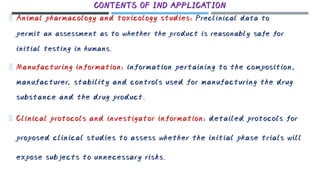
CONTENTS OF INDAPPLICATION
Animal pharmacology and toxicology studies: Preclinical data to
permit an assessment as to whether the product is reasonably safe for
initial testing in humans.
Manufacturing information: information pertaining to the composition,
manufacturer, stability and controls used for manufacturing the drug
substance and the drug product.
Clinical protocols and investigator information: detailed protocols for
proposed clinical studies to assess whether the initial phase trials will
expose subjects to unnecessary risks.
58.
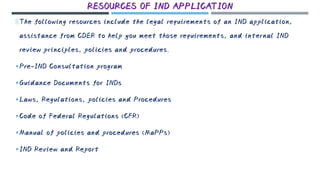
RESOURCES OF INDAPPLICATION
The following resources include the legal requirements of an IND application,
assistance from CDER to help you meet those requirements, and internal IND
review principles, policies and procedures.
Pre-IND Consultation program
Guidance Documents for INDs
Laws, Regulations, policies and Procedures
Code of Federal Regulations (CFR)
Manual of policies and procedures (MaPPs)
IND Review and Report
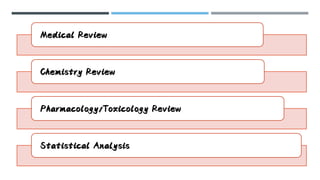
MEDICAL REVIEW
During theIND application review process, the medical
reviewer evaluates the clinical trial protocol to determine if
1) The participants will be protected from unnecessary risk
2) The study design will provide data relevant to the safety
and effectiveness of the drug.
Under federal regulations, proposed phase I studies are
evaluated almost exclusively for safety reasons.
62.
CHEMISTRY REVIEW
The addressissues related to drug identity, manufacturing
control and analysis.
The reviewing chemist evaluates the manufacturing and processing
procedures for a drug to ensure that the compound is adequately
reproducible and stable.
63.
PHARMACOLOGY/TOXICOLOGY REVIEW
This teamis staffed by pharmacologists and toxicologists who evaluate
the results of animal testing and attempt to relate animal drug
effects to potential effects in humans.
This section of application should contain, if known- A description of
the pharmacological effects and mechanism of action of drug in
animals- information on the absorption, distribution, metabolism and
excretion (ADME) of the drug.
64.
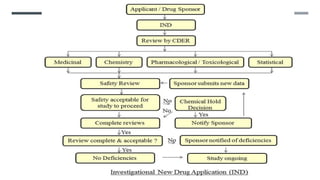
SAFETY REVIEW
Following reviewof an initial IND application submission, CDER has 30
calendar days in which to decide if a clinical hold is necessary
(i.e. if patients would be at an unacceptable risk of if CDER doesn’t
have to make such a determination)
Generally, Drug Review Divisions do not contact the sponsor if no
concerns arise with drug safety and the proposed clinical trials.
65.
INVESTIGATOR’S BROCHURE (IB)
IBis a comprehensive document summarizing the information about
the investigational product obtained during clinical trials.
Investigator brochure is a collection of the clinical and non-
clinical data on the investigational product that are relevant to
the study of the product in human subject.
66.
IB is preparedby the sponsor who also controls the distribution of
the document.
Sponsor is responsible for ensuring that an up-to date IB is made
available to the investigator and investigators are responsible for
providing the up-to-date IB to the responsible IRB/IEC.
Investigator’s Brochure (IB)
67.
IB provides theinvestigator and other staff with background
information about the investigational medicinal product.
The information should be presented in short, simple, objective
and non-promotional form that enables a clinical or potential
investigator to understand it.
Investigator’s Brochure (IB)
68.
General Consideration: TheIB should include:
1) Title Page: This should provide the sponsor’s name, the identity of each
investigational product (research no., chemical or approved generic name,
trade name, and the release date). It also suggested that an edition no.,
reference no. and date of edition.
Title page
Sponsor’s Name
Product
Research Number
Name: chemical, Generic, trade name
Investigator’s Brochure (IB)
69.
INVESTIGATOR’S BROCHURE (IB)
Confidentialitystatement: Sponsor may wish to include a statement
instructing the investigator/recipients to treat IB as a confidential
document for the sole information and use of Investigator’s team and
the IRB/IEC.
Summary: A brief summary should be given highlighting the significant
physical, chemical, pharmaceutical, pharmacological, toxicological,
metabolic and clinical information of the investigational product.
70.
INVESTIGATOR’S BROCHURE (IB)
Introduction:A brief introductory statement should be provided that
contains
i) The chemical name ( generic name & trade name) of Investigational product.
ii) All active ingredients
iii) The investigational product
iv) Pharmacological class and its expected position within this class
(advantages)
v) Therapeutic or diagnostic indication
71.
Physical, Chemical andpharmaceutical properties and formulation:
1) A description should be provided for the investigational product
substance (chemical, structural formula and physicochemical properties)
2) To permit appropriate safety measures to be taken in the course of the
trial, a description of the formulation(s) used.
3) Any structural similarities to other known compounds should be mentioned.
4) Instructions for the storage and handling of the dosage forms
72.
NON-CLINICAL STUDIES
•
•
•
•
•
•
The resultsnonclinical pharmacology, toxicology, pharmacokinetic and investigational
product metabolite studies should be provided in summary form.
The information provided may include the following, as appropriate, if known/ available:
Species tested
Number and sex of animals in each group
Unit dose
Dose interval
Route of administration
Duration of dosing
73.
NON-CLINICAL PHARMACOLOGY:
A summaryof the pharmacological aspects of the investigational product,
its significant metabolites studies in animals, should be included.
Pharmacokinetics and product metabolism in animals:
A summary of the Pharmacokinetics and biological transformation of the
investigation product in all species studied.
74.
EFFECTS IN HUMANS
Effectsof the Investigational product(s) is human should be provided,
including information on Pharmacokinetics, metabolism,
pharmacodynamics, dose response, safety, efficacy and other
pharmacological activities.
75.
CLINICAL RESEARCH
For Newdrug substances discovered in India, clinical trials are
required to be carried out in India right from Phase-I.
For New drug substances discovered in countries other than
India, Phase I data as required along with the Application.
Phase III trials are required to be conducted in India before
permission to market the drug in India is granted.
76.
CLINICAL RESEARCH
The datarequired will depend upon the purpose of the new drug
application.
The number of study subjects and sites to be involved in the conduct
of clinical trial will depend upon the nature and objective of the
study:
Phase I clinical trials should usually be carried out by investigators
trained in clinical pharmacology
Phase II clinical trials should normally be carried out on 10-12
patients at each dose level.
77.
CLINICAL RESEARCH
If thedrug is already approved in other countries, phase III data should
generally be obtained on at least 100 patients distributed over 3-4
centers primary to confirm the efficacy and safety of the drug, in
Indian patients when used as recommended in the product monograph.
CDSCO will initially examine such applications, if any particular data is
lacking same will be informed to the applicant or else the applicants will
be forwarded to the members of IND committees in case of IND.
78.
CLINICAL RESEARCH
In casesof life threatening/ serious diseases, it is desirable to
expedite the development, evaluation and marketing of new therapies
intended to treat persons especially, where no satisfactory
alternative therapy exists.
In such cases patients/ clinicians are generally willing to accept
greater risks or side effects from products that treat life-
threatening/ serious diseases, than they would accept from products
that treat less serious illness.
79.
CLINICAL RESEARCH
For permissionof clinical trials the documents required to be submitted are
as follows:
Form 44
Treasury challan of INR 50,000 (phase-I), 25,000 (phase-II/phase-III clinical
trials)
Source of bulk drugs/raw materials
Chemical and Pharmaceutical information: information on active
ingredients, data on formulation, animal pharmacology, animal toxicology
80.
For Phase Iclinical trials: systemic toxicity studies: 1) Single dose
toxicity studies 2) Dose ranging studies 3) Repeat-dose systemic
toxicity studies.
For Phase II clinical trials: provide a summary of all the non-clinical
safety data already submitted while obtaining the permissions for Phase
I trial, with appropriate references.
Repeat-dose systemic toxicity studies of appropriate duration to
support the duration of proposed human exposure.
81.
Reproductive/developmental toxicity studies
Carcinogenicitystudies
For Phase IV clinical Trials: provide summary of all the non-
clinical safety data already submitted while obtaining the
permissions for Phase I, II and III trials, with appropriate
references.
82.
CLINICAL RESEARCH PROTOCOL
ClinicalResearch protocols are research studies conducted by
NIH ( National Institute of environmental health sciences)
staff.
The protocol may test something for a specified condition or
purpose e.g. drug or medical device.
The staff on a protocol consists of: Principal Investigator (PI),
Co-Principal Investigator, one or several Associate
Investigators, Medical Advisor Investigator, A research Contact
83.
THE CLINICAL RESEARCHPROTOCOL SHOULD CONTAIN THE INFORMATION
MENTIONED BELOW:
Title Page: Full title of clinical study, protocol/ study number, and protocol
version number with date, complete name and address of the sponsor.
Table of contents: background and Introduction, preclinical experience, clinical
experience
Study Rationale: a brief summary of the background information relevant to the
study design and protocol methodology.
Study Objective(s): Primary as well as secondary and their logical relation to
the study design.
84.
THE CLINICAL RESEARCHPROTOCOL SHOULD CONTAIN THE INFORMATION
MENTIONED BELOW:
Study Design: Overview of the study design including a description
of the type of study ( double blind, multicenter, placebo controlled)
Study Population: The number of subjects required to be enrolled in
the study at the investigative site and by all sites along with a
brief description of the nature of the subject population required is
also mentioned.
Subject Eligibility: Inclusion criteria, Exclusion criteria
85.
BIOEQUIVALENCE STUDY
It isrelative term which denotes that the drug substance in two or
more identical dosage forms, reaches the systemic circulation at same
relative rate and relative extent.
Types of Bioequivalence studies: 1) In-Vivo Bioequivalence studies: Oral
immediate release products with systemic action, Non-oral immediate
release products
2) In-vitro Bioequivalence studies: In comparative in vitro dissolution
studies. In vivo Bioequivalence under certain circumstances called as
biowaivers.
86.
BIOEQUIVALENCE STUDY
Bioequivalence Experimentalstudy design:
1) Completely randomization: In a completely randomized design, all
treatments are randomly allocated among all experimental subjects.
2) Randomized block design: First subject are homogenous groups called
blocks and the treatments are then assigned at random within the blocks.
3) Repeated measures, cross over and carry over designs:
The randomised block design in which the same subject serves as a block.
The administration of two or more treatments one after the other in a
specified order to the same group of patients is called a cross over design.