Involving the Right Stakeholders at the Right Time - Rural Proofing and Stakeholder Engagement in Estonia
1.
Rural proofing ecosystemand stakeholder
engagement in Estonia: some examples
OECD rural proofing intelligence session
“Involving the right stakeholders at the right time”
Wednesday, 1 April, 15:00-16:30 (CET)
Draft2
Aare Kasemets, PhD
Adviser in regulatory impact assessment and civic engagement
Department of Strategy and Finance / Interreg Coop4RuralGov
e-mail: aare.kasemets@agri.ee
CV & publications: https://www.etis.ee/CV/Aare_Kasemets
LinkedIn: https://www.linkedin.com/in/aarekasemets/
2.
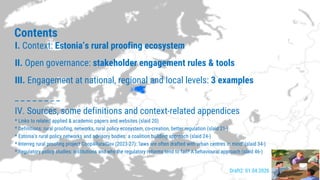
Contents
I. Context: Estonia’srural proofing ecosystem
II. Open governance: stakeholder engagement rules & tools
III. Engagement at national, regional and local levels: 3 examples
_ _ _ _ _ _ _ _
IV. Sources, some definitions and context-related appendices
* Links to related applied & academic papers and websites (slaid 20)
* Definitions: rural proofing, networks, rural policy ecosystem, co-creation, better regulation (slaid 21-)
* Estonia’s rural policy networks and advisory bodies: a coalition building approach (slaid 24-)
* Interreg rural proofing project Coop4RuralGov (2023-27): ‘laws are often drafted with urban centres in mind’ (slaid 34-)
* Regulatory policy studies: institutions and why the regulatory reforms tend to fail? A behavioural approach (slaid 46-)
Draft2: 01.04.2026
3.
Some key questions
Inthe EU Network for Rural Development discussions one of ‘Estonian key questions’ (and
ambitions☺) has been how to make the regional and rural impact assessment with local
stakeholder engagement, a routine part of the decision-making process of officials across
the government, in all ministries?
The core of this question is not how to be perfect in assessing the regional and rural impacts
of every single draft law or service project — the core issue is how to slow the decline in
ministries’ institutional credibility and strengthen the legitimacy of public policies and laws
— because without trust, words, even laws, lose legitimacy and authority. The core is
“invisible” trust in institutional values such as equity in rights and opportunities for each
person, family, and community.
Those direct and hidden questions led us, together with the Spanish Navarra, Irish Galway and
Bulgarian Bratisgavo and Estonian Tartu regions, to the INTERREG project „Rural Proofing.
Cooperation for better sparsely populated rural, coastal and mountain focused governance“
2023-2027 (Coop4RURALGov).
Today, I’ll give a brief overview of Estonia’s rural policy ecosystem. Then I will cover the rules
and tools for stakeholder engagement within the open governance framework, and then share
some examples from the national, regional, and local levels... believing that rural policy
becomes meaningful on the ground in counties and municipalities, where places, people,
interests and hopes are real and specific, with names …
4.
I. Context:
Estonia’s ruralpolicy & rural proofing
ecosystem*
*An innovation ecosystem is a network where parties jointly create-offer-generate value. While an ecosystem in nature is a network of relationships
involving organisms and the environment in an area, in a social ecosystem cooperation, mutual trust between participants and common goals and
activities are central, where each participant knows their roles, impact and that we depend on each other’s results and survival…
5.
Context
In the broadercontext of the OECD Principles on Rural Policy (2019)
and EU Rural Pact (2021), Estonia’s rural proofing 'model building'
could offer some added value for three reasons:
1. Estonia is a newcomer in the field of rural proofing (start: 2019)
actively testing and adapting existing rural proofing practices, e.g. how
to link spatial data analysis with rural stakeholders engagement?*
2. Estonia has applied ex ante regulatory impact assessment (RIA) to
primary lawmaking since 2012 (OECD 2025: best in the EU). The current
challenge is how to integrate new regional & rural impact assessment
tools into the existing better regulation practices (e.g. RIA & inclusion)?
3. Existential challenges. Estonia, as a small EU/OECD/NATO member
state with limited human and budgetary resources, seeks how to offset
its constraints through smart planning, data-driven RIA, co-creation, AI,
e-State, simplification, etc. Estonia’s territory is larger than that of the
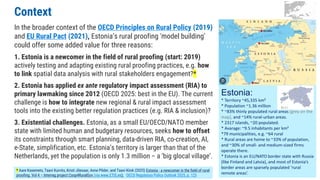
Netherlands, yet the population is only 1.3 million – a ‘big glocal village’.
Estonia:
* Territory ~45,335 km²
* Population ~1.36 million
* ~83% thinly populated rural areas [grey on the
map], and ~14% rural-urban areas.
* 2317 islands, ~20 populated.
* Avarage: ~9.5 inhabitants per km²
*79 municipalities, e.g. ~64 rural
* Rural areas are home to ~33% of population,
and ~30% of small- and medium-sized firms
operate there.
* Estonia is an EU/NATO border state with Russia
(like Finland and Latvia), and most of Estonia’s
border areas are sparsely populated ‘rural
remote areas’.
* Aare Kasemets, Taavi Kurvits, Kristi Jõesaar, Anne Põder, and Taavi Kiisk (2025) Estonia - a newcomer in the field of rural
proofing. Vol 4 – Interreg project Coop4RuralGov (via www.ETIS.ee); OECD Regulatory Policy Outlook 2025, p. 125
6.
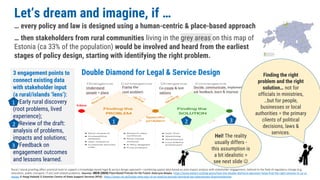
… every policyand law is designed using a human-centric & place-based approach
… then stakeholders from rural communities living in the grey areas on this map of
Estonia (ca 33% of the population) would be involved and heard from the earliest
stages of policy design, starting with identifying the right problem.
Let’s dream and imagine, if …
Rural / island proofing offers practical tools to support a knowledge-based legal & service design approach—combining spatial data-based ex ante impact analysis with stakeholder engagement, tailored to the field of regulatory change (e.g.
education, public transport, IT etc) and related problems. Sources: OECD (2024) Place-Based Policies for the Future; Kateryna Mayka https://www.eleken.co/blog-posts/how-the-double-diamond-approach-helps-find-the-right-solution-in-ux-ui-
design & Peegi Kaibald & Estonian Centre of State Support Services (RTK): https://www.rtk.ee/kuidas-teha-asju-nii-et-need-ka-pariselt-toimiksid-kas-lahenduseks-disainmotlemine
Double Diamond for Legal & Service Design
3 engagement points to
connect existing data
with stakeholder input
(a rural/islands ‘lens’):
1. Early rural discovery
(root problems, lived
experience);
2. Review of the draft:
analysis of problems,
impacts and solutions;
3. Feedback on
engagement outcomes
and lessons learned.
1 2 3
1
2
3
Hei! The reality
usually differs -
this assumption is
a bit idealistic >
see next slide ☺
Finding the right
problem and the right
solution… not for
officials in ministries,
…but for people,
businesses or local
authorities = the primary
clients of political
decisions, laws &
services.
7.
Riigikantselei
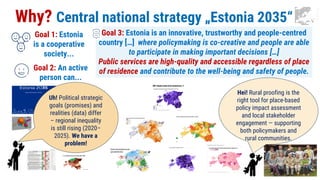
Why? Central nationalstrategy „Estonia 2035“
Goal 1: Estonia
is a cooperative
society...
Goal 2: An active
person can...
Goal 3: Estonia is an innovative, trustworthy and people-centred
country […] where policymaking is co-creative and people are able
to participate in making important decisions […]
Public services are high-quality and accessible regardless of place
of residence and contribute to the well-being and safety of people.
Uh! Political strategic
goals (promises) and
realities (data) differ
– regional inequality
is still rising (2020–
2025). We have a
problem!
Hei! Rural proofing is the
right tool for place-based
policy impact assessment
and local stakeholder
engagement — supporting
both policymakers and
rural communities.
8.
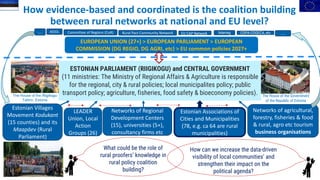
How evidence-based andcoordinated is the coalition building
between rural networks at national and EU level?
EUROPEAN UNION (27+) > EUROPEAN PARLIAMENT > EUROPEAN
COMMISSION (DG REGIO, DG AGRI, etc) > EU common policies 2027+
Rural Pact Community Network
LEADER
Union, Local
Action
Groups (26)
Estonian Associations of
Cities and Municipalities
(78, e.g. ca 64 are rural
municipalities)
Networks of Regional
Development Centers
(15), universities (5+),
consultancy firms etc
ESTONIAN PARLIAMENT (RIIGIKOGU) and CENTRAL GOVERNMENT
(11 ministries: The Ministry of Regional Affairs & Agriculture is responsible
for the regional, city & rural policies; local municipalites policy; public
transport policy; agriculture, fisheries, food safety & bioeconomy policies).
Committee of Regions (CoR)
Estonian Villages
Movement Kodukant
(15 counties) and its
Maapäev (Rural
Parliament)
Networks of agricultural,
forestry, fisheries & food
& rural, agro etc tourism
business organisations
Interreg COPA-COGECA, etc
EU CAP Network
AEIDL
What could be the role of
rural proofers’ knowledge in
rural policy coalition
building?
How can we increase the data-driven
visibility of local communities’ and
strengthen their impact on the
political agenda?
The House of the Riigikogu
Tallinn, Estonia
The House of the Government
of the Republic of Estonia
….. …..
9.
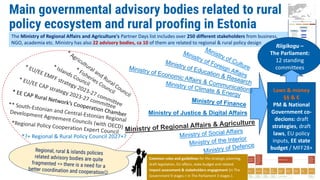
Main governmental advisorybodies related to rural
policy ecosystem and rural proofing in Estonia
Laws & money
§§ & €
PM & National
Government co-
decions: draft
strategies, draft
laws, EU policy
inputs, EE state
budget / MFF28+
The Ministry of Regional Affairs and Agriculture's Partner Days list includes over 250 different stakeholders from business,
NGO, academia etc. Ministry has also 22 advisory bodies, ca 10 of them are related to regional & rural policy design
Riigikogu –
The Parliament:
12 standing
committees
Ministry of Justice & Digital Affairs
*?+ Regional & Rural Policy Council 2027+?
Common rules and guidelines for the strategic planning,
draft legislation, EU affairs, state budget and related
impact assessment & stakeholders engagement (in The
Government 9 stages > in The Parliament 3 stages ).
10.
II. Open governance:
stakeholderengagement
rules & tools
Why do we need open governance and stakeholder engagement? There are different explanations and theories.
Jürgen Habermas’s discourse ethics envisions a society of dialoguing subjects striving to achieve a consensus acceptable to the
majority. If the law functions as an instrument of a particular lobby group, the market, or state interests, people’s lifeworld has been
colonised through systematically distorted communication. As Habermas argues: “Only those norms can claim legitimacy that could
meet the approval of all affected in rational discourse.” (Habermas, 1996, Between Facts and Norms: Contributions to a Discourse
Theory of Law and Democracy, Cambridge: Polity Press.)
11.
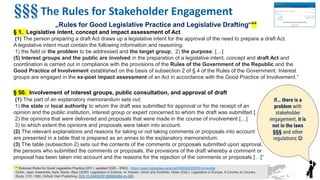
§§§The Rules forStakeholder Engagement
„Rules for Good Legislative Practice and Legislative Drafting“**
§ 1. Legislative intent, concept and impact assessment of Act
(1) The person preparing a draft Act draws up a legislative intent for the approval of the need to prepare a draft Act.
A legislative intent must contain the following information and reasoning:
1) the field or the problem to be addressed and the target group; 2) the purpose; […]
(5) Interest groups and the public are involved in the preparation of a legislative intent, concept and draft Act and
coordination is carried out in compliance with the provisions of the Rules of the Government of the Republic and the
Good Practice of Involvement established on the basis of subsection 2 of § 4 of the Rules of the Government. Interest
groups are engaged in the ex-post impact assessment of an Act in accordance with the Good Practice of Involvement.“
§ 50. Involvement of interest groups, public consultation, and approval of draft
(1) The part of an explanatory memorandum sets out:
1) the state or local authority to whom the draft was submitted for approval or for the receipt of an
opinion and the public institution, interest group or expert concerned to whom the draft was submitted […];
2) the opinions that were delivered and proposals that were made in the course of involvement […].
3) to which extent the opinions and proposals were taken into account.
(2) The relevant explanations and reasons for taking or not taking comments or proposals into account
are presented in a table that is prepared as an annex to the explanatory memorandum.
(3) The table (subsection 2) sets out the contents of the comments or proposals submitted upon approval,
the persons who submitted the comments or proposals, the provisions of the draft whereby a comment or
proposal has been taken into account and the reasons for the rejection of the comments or proposals […]“
If… there is a
problem with
stakeholder
engagement, it is
not in the laws
§§§ and other
regulations ☺
** Estonian Rules for Good Legislative Practice (2011, updated 2025 – ENG) - https://www.riigiteataja.ee/en/eli/508092025003/consolide
Ginter, Jaan; Kasemets, Aare; Narits, Raul (2020). Legislation in Estonia. In: Karpen, Ulrich and Xanthaki, Helen (Eds.). Legislation in Europe. A Country to Country
Study. (151−166). Oxford: Hart Publishing. DOI:10.5040/9781509924684.ch-009
12.
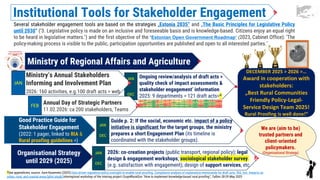
Several stakeholder engagementtools are based on the strategies „Estonia 2035“ and „The Basic Principles for Legislative Policy
until 2030“ (‘3. Legislative policy is made on an inclusive and foreseeable basis and is knowledge-based. Citizens enjoy an equal right
to be heard in legislative matters.’) and the first objective of the “Estonian Open Government Roadmap“ (2023, Cabinet Office): ‘The
policy-making process is visible to the public, participation opportunities are published and open to all interested parties.’
Good Practice Guide for
Stakeholder Engagement
(2022: 1 pager, linked to RIA &
Rural proofing guidelines >)
Guide p. 2: If the social, economic etc. impact of a policy
initiative is significant for the target groups, the ministry
prepares a short Engagement Plan (its timeline is
coordinated with the stakeholder groups).
JAN
DEC
Ongoing review/analysis of draft acts >
quality check of impact assessments &
stakeholder engagement’ information
2025: 9 departments > 121 draft acts>*
JAN
DEC
*See appendicies, source: Aare Kasemets (2025) Data-driven regulatory policy oversight to enable rural proofing. Compliance analysis of explanatory memoranda for draft acts: RIA, incl. impacts on
urban, rural, and coastal areas [pilot study] Interregional workshop of the Interreg project Coop4RuralGov "How to implement knowledge-based rural proofing", Tallinn 28-29 May 2025
DECEMBER 2025 > 2026 >…
Award in cooperation with
stakeholders:
„Best Rural Communities
Friendly Policy-Legal-
Service Design Team 2025!
Rural Proofing is well done!“
2026: co-creation projects (public transport, regional policy); legal
design & engagement workshops; sociological stakeholder survey
(e.g. satisfaction with engagement); design of support services, etc
Ministry of Regional Affairs and Agriculture
Organisational Strategy
until 2029 (2025)
JAN
DEC
Annual Day of Strategic Partners
11.02.2026: ca 200 stakeholders, Teams
FEB
Ministry’s Annual Stakeholders
Informing and Involvement Plan
2026: 160 activities, e.g.100 draft acts > web
JAN
Institutional Tools for Stakeholder Engagement
We are (aim to be)
trusted partners and
client-oriented
policymakers.
(Organisational Strategy)
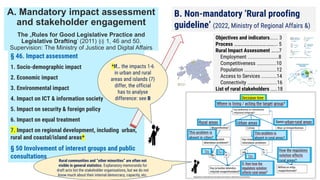
13.
A. Mandatory impactassessment
and stakeholder engagement
The „Rules for Good Legislative Practice and
Legislative Drafting’ (2011) §§ 1, 46 and 50.
Supervision: The Ministry of Justice and Digital Affairs
§ 46. Impact assessment
1. Socio-demographic impact
2. Economic impact
3. Environmental impact
4. Impact on ICT & information society
5. Impact on security & foreign policy
6. Impact on equal treatment
7. Impact on regional development, including urban,
rural and coastal/island areas*
§ 50 Involvement of interest groups and public
consultations
B. Non-mandatory ‘Rural proofing
guideline’ (2022, Ministry of Regional Affairs &)
Objectives and indicators...... 3
Process ………………………….……... 5
Rural Impact Assessment ….…7
Employment ......................8
Competitiveness ..............10
Population .......................12
Access to Services ...........14
Connectivity .....................16
List of rural stakeholders .....18
*If.. the impacts 1-6
in urban and rural
areas and islands (7)
differ, the official
has to analyse
difference: see B
Rural communities and “other minorities” are often not
visible in general statistics. Explanatory memoranda for
draft acts list the stakeholder organisations, but we do not
know much about their internal democracy, capacity, etc.
14.
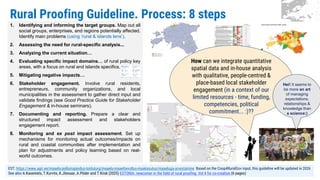
Rural Proofing Guideline.Process: 8 steps
1. Identifying and informing the target groups. Map out all
social groups, enterprises, and regions potentially affected.
Identify main problems (using ‘rural & islands lens’).
2. Assessing the need for rural-specific analysis...
3. Analyzing the current situation…
4. Evaluating specific impact domains… of rural policy key
areas, with a focus on rural and islands specifics.
5. Mitigating negative impacts…
6. Stakeholder engagement. Involve rural residents,
entrepreneurs, community organizations, and local
municipalities in the assessment to gather direct input and
validate findings (see Good Practice Guide for Stakeholder
Engagement & in-house seminars).
7. Documenting and reporting. Prepare a clear and
structured impact assessment and stakeholders
engagement report.
8. Monitoring and ex post impact assessment. Set up
mechanisms for monitoring actual outcomes/impacts on
rural and coastal communities after implementation and
plan for adjustments and policy learning based on real-
world outcomes.
EST: https://www.agri.ee/maaelu-pollumajandus-toiduturg/maaelu-maaettevotlus-maakasutus/maaeluga-arvestamine Based on the Coop4RuralGov input, this guideline will be updated in 2026
See also A.Kasemets, T.Kurvits, K.Jõesaar, A.Põder and T.Kiisk (2025) ESTONIA: newcomer in the field of rural proofing. Vol 4 for co-creation (6 pages)
How can we integrate quantitative
spatial data and in-house analysis
with qualitative, people-centred &
place-based local stakeholder
engagement (in a context of our
limited resources - time, funding,
competencies, political
commitment... :)??
Hei! It seems to
be more an art
of managing
expectations,
relationships &
knowledge than
a science:)
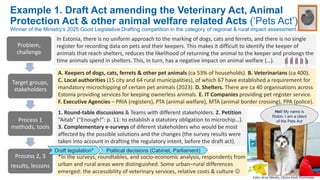
Example 1. DraftAct amending the Veterinary Act, Animal
Protection Act & other animal welfare related Acts (‘Pets Act’)
Winner of the Ministry’s 2025 Good Legislative Drafting competition in the category of regional & rural impact assessment.
Foto: Arvo Meeks, Lõuna-Eesti Postimees
Problem,
challenge
Target groups,
stakeholders
Process 1
methods, tools
Process 2, 3
results, lessons
In Estonia, there is no uniform approach to the marking of dogs, cats and ferrets, and there is no single
register for recording data on pets and their keepers. This makes it difficult to identify the keeper of
animals that reach shelters, reduces the likelihood of returning the animal to the keeper and prolongs the
time animals spend in shelters. This, in turn, has a negative impact on animal welfare (…).
A. Keepers of dogs, cats, ferrets & other pet animals (ca 53% of households). B. Veterinarians (ca 400).
C. Local authorities (15 city and 64 rural municipalities), of which 67 have established a requirement for
mandatory microchipping of certain pet animals (2023). D. Shelters. There are ca 40 organisations across
Estonia providing services for keeping ownerless animals. E. IT Companies providing pet register service.
F. Executive Agencies – PRIA (registers), PTA (animal welfare), MTA (animal border crossing), PPA (police).
1. Round-table discussions & Teams with different stakeholders. 2. Petition
“Aitab” (“Enough!”: p. 11: to establish a statutory obligation to microchip…).
3. Complementary e-surveys of diferent stakeholders who would be most
affected by the possible solutions and the changes (the survey results were
taken into account in drafting the regulatory intent, before the draft act).
*In the surveys, roundtables, and socio-economic analysis, respondents from
urban and rural areas were distinguished. Some urban–rural differences
emerged: the accessibility of veterinary services, relative costs & culture ☺
Draft legislation* Political decisions (Cabinet, Parliament)
Hei! My name is
Robin. I am a client
of the Pets Act
17.
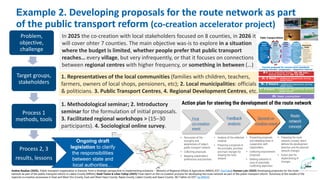
Example 2. Developingproposals for the route network as part
of the public transport reform (co-creation accelerator project)
Andres Ruubas (2026). Public transport organisation in Estonia: from a strategic perspective to implementing solutions – Ministry of Regional Affairs & Agriculture (MRAA, EST YouTube); Hannes Luts (2025) Developing proposals for the route
network as part of the public transport reform in Lääne County (MRAA); Kaidi Tamm & Lilian Yallop (2025) Final report on the co-creation process for developing the route network as part of the public transport reform. Summary of the results of the
regional co-creation processes in East and West Viru County, East and West Harju County, Rapla County, Lääne County and Saare County. SEI Tallinn (in EST via MRAA).
Problem,
objective,
challenge
Target groups,
stakeholders
Process 1
methods, tools
Process 2, 3
results, lessons
In 2025 the co-creation with local stakeholders focused on 8 counties, in 2026 it
will cover ohter 7 counties. The main objective was-is to explore in a situation
where the budget is limited, whether people prefer that public transport
reaches… every village, but very infrequently, or that it focuses on connections
between regional centres with higher frequency, or something in between (…)
1. Representatives of the local communities (families with children, teachers,
farmers, owners of local shops, pensioners, etc); 2. Local municipalities: officials
& politicians. 3. Public Transport Centres, 4. Regional Development Centres, etc.
1. Methodological seminar; 2. Introductory
seminar for the formulation of initial proposals.
3. Facilitated regional workshops > (15–30
participants). 4. Sociological online survey.
Ongoing draft
legislation to clarify
the responsibilities
between state and
local authorities…
18.
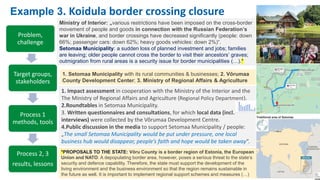
Example 3. Koidulaborder crossing closure
Problem,
challenge
Target groups,
stakeholders
Process 1
methods, tools
Process 2, 3
results, lessons
Ministry of Interior: „various restrictions have been imposed on the cross-border
movement of people and goods in connection with the Russian Federation’s
war in Ukraine, and border crossings have decreased significantly (people: down
66%; passenger cars: down 62%; heavy goods vehicles: down 2%)“.
Setomaa Municipality: a sudden loss of planned investment and jobs; families
are leaving; older people cannot cross the border to visit their ancestors’ graves;
outmigration from rural areas is a security issue for border municipalities (…).*
1. Setomaa Municipality with its rural communities & businesses; 2. Võrumaa
County Development Center; 3. Ministry of Regional Affairs & Agriculture
1. Impact assessment in cooperation with the Ministry of the Interior and the
The Ministry of Regional Affairs and Agriculture (Regional Policy Department).
2.Roundtables in Setomaa Municipality.
3. Written questionnaires and consultations, for which local data (incl.
interviews) were collected by the Võrumaa Development Centre.
4.Public discussion in the media to support Setomaa Municipality / people:
„The small Setomaa Municipality would be put under pressure, one local
business hub would disappear, people’s faith and hope would be taken away“.
*PROPOSALS TO THE STATE: Võru County is a border region of Estonia, the European
Union and NATO. A depopulating border area, however, poses a serious threat to the state’s
security and defence capability. Therefore, the state must support the development of the
living environment and the business environment so that the region remains sustainable in
the future as well. It is important to implement regional support schemes and measures (…)
Some sources (ideas,draft2)
European Rural Pact Community Platform https://ruralpact.rural-vision.europa.eu/discover-platform_en
European Rural Pact Policy Lab (12.06.2025) ‘Rural proofing: looking at policies through the rural lens’
Rural Pact Policy Lab (05.11.2025) Rural areas and communities in the post-2027 EU budget and policies | Rural Pact Community Platform
EU Commission (2024) The long-term vision for the EU’s rural areas: key achievements and ways forward (see, ch 3.1)
EU CAP Network (2022) A Framework of Rural Proofing Actions: https://eu-cap-network.ec.europa.eu/publications/framework-rural-proofing-actions_en
OECD (2024) Rural Proofing | Lessons from OECD countries and potential application to health: https://www.oecd.org/en/publications/rural-proofing_4011899a-en.html
OECD (2024) Place-Based Policies for the Future. https://www.oecd.org/en/about/projects/place-based-policies-for-the-future.html
Antonia Husberg, Toivo Muilu, Hilkka Vihinen, Olli Voutilainen (2022). Rural impact assessment of legislative proposals. Rural impact assessment guide for drafters - Finnish Ministry of
Agriculture and Forestry 2022, 65 pages ….
Jane Atterton (2019). Learning Lessons from early Islands Communities Impact Assessments ….
Knowledge Centre for Territorial Policies (July 2024): https://knowledge4policy.ec.europa.eu/territorial/about_en
Aare Kasemets, Taavi Kurvits, Kristi Jõesaar, Anne Põder, Taavi Kiisk (2025) ESTONIA: newcomer in the field of rural proofing. Vol 4 (6 p, via www.ETIS.ee)
Anne Põder, Taavi Kiisk (2025) Comparative study on rural proofing in Spain, Bulgaria, Ireland and Estonia. Final report – Interreg project Coop4RuralGov, Estonian University of Life Sciences
https://www.agri.ee/sites/default/files/documents/2025-07/uuring-2025-coop4ruralgov.pdf
Aare Kasemets (2026) Ten golden recommendations for leaders of participatory policy, law and service design to increase the effectiveness of cooperation and participants’ satisfaction -
Moldova-Estonia-Netherlands Twinnig Project in Moldovan Ministry for Agriculture and Food Industry – Mission, 9-13.02.2026 (by request)
Aare Kasemets (2025) Data-driven regulatory policy oversight to enable rural proofing. Compliance analysis of explanatory memoranda for draft acts: RIA, incl. impacts on urban, rural, and
coastal areas [pilot study] Interregional workshop of the Interreg project Coop4RuralGov "How to implement knowledge-based rural proofing", Tallinn 28-29 May 2025
Aare Kasemets (2025) Institutionalization of rural proofing in policy, legal and service design: the case of Estonia - Coop4RuralGov (Interreg) and G30 Rural Proofing CLM (Spain) 14 April,’25.
Aare Kasemets & Taavi Kurvits (2022). How to make the regional impact assessment & rural proofing a routine part of the decision-making process of officials across the government, in all
ministries? Some ideas and examples from Estonia. Slides via web of EU Network of Rural Development (ENRD)
Aare Kasemets, Jacob Van Ingen Bro, Oskar Ernst, Ligija Ozolina, Vygantas Katkevičius, Marjeta Bizjak, Tii Tammik-Võsu, Maarja Malm, Paula Talijärv and Merle Vesiloo (2022) A
comparative pilot study on advisory bodies and stakeholder involvement in the ministries responsible for agriculture, fisheries and rural development: Estonia, Denmark, Latvia, Lithuania,
Slovenia. – Estonian Ministry of Rural Affairs: https://www.agri.ee/sites/default/files/documents/2023-02/uuring-2022-advisory-bodies.pdf
Aare Kasemets et al (2025). Digitalization, RIA and Simplification of the EU/EE Agricultural, Fisheries & Rural Policies [14 Examples from the Estonian Ministry of Regional Affairs and
Agriculture and Its Executive Agencies with General Context, Government Initiatives on Deregulation, Bureaucracy & Standard Cost Reduction, and some Ideas How to Support a Proactive
Better Regulation Approach. Working paper]. EU DG AGRI CAP Simplification TG5 working papers 02.07.2025 (by request)
21.
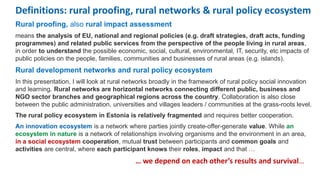
Definitions: rural proofing,rural networks & rural policy ecosystem
Rural proofing, also rural impact assessment
means the analysis of EU, national and regional policies (e.g. draft strategies, draft acts, funding
programmes) and related public services from the perspective of the people living in rural areas,
in order to understand the possible economic, social, cultural, environmental, IT, security, etc impacts of
public policies on the people, families, communities and businesses of rural areas (e.g. islands).
Rural development networks and rural policy ecosystem
In this presentation, I will look at rural networks broadly in the framework of rural policy social innovation
and learning. Rural networks are horizontal networks connecting different public, business and
NGO sector branches and geographical regions across the country. Collaboration is also close
between the public administration, universities and villages leaders / communities at the grass-roots level.
The rural policy ecosystem in Estonia is relatively fragmented and requires better cooperation.
An innovation ecosystem is a network where parties jointly create-offer-generate value. While an
ecosystem in nature is a network of relationships involving organisms and the environment in an area,
in a social ecosystem cooperation, mutual trust between participants and common goals and
activities are central, where each participant knows their roles, impact and that …
… we depend on each other’s results and survival…
22.
Definitions: from informingto co-creation
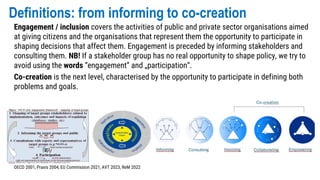
Engagement / inclusion covers the activities of public and private sector organisations aimed
at giving citizens and the organisations that represent them the opportunity to participate in
shaping decisions that affect them. Engagement is preceded by informing stakeholders and
consulting them. NB! If a stakeholder group has no real opportunity to shape policy, we try to
avoid using the words “engagement” and „participation“.
Co-creation is the next level, characterised by the opportunity to participate in defining both
problems and goals.
OECD 2001, Praxis 2004, EU Commission 2021, AVT 2023, ReM 2022
23.
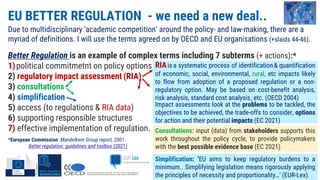
Due to multidisciplinary‘academic competition’ around the policy- and law-making, there are a
myriad of definitions. I will use the terms agreed on by OECD and EU organisations (+slaids 44-46).
Better Regulation is an example of complex terms including 7 subterms (+ actions):*
1)political commitmetnt on policy options
2) regulatory impact assessment (RIA)
3) consultations
4) simplification
5) access (to regulations & RIA data)
6) supporting responsible structures
7) effective implementation of regulation.
*European Commission: Mandelkern Group report, 2001.
Better regulation: guidelines and toolbox (2021)
EU BETTER REGULATION - we need a new deal..
RIAis a systematic process of identification & quantification
of economic, social, environmental, rural, etc impacts likely
to flow from adoption of a proposed regulation or a non-
regulatory option. May be based on cost-benefit analysis,
risk analysis, standard cost analysis, etc. (OECD 2004)
Simplification: ‘EU aims to keep regulatory burdens to a
minimum.. Simplifying legislation means rigorously applying
the principles of necessity and proportionality…’ (EUR-Lex).
Impact assessments look at the problems to be tackled, the
objectives to be achieved, the trade-offs to consider, options
for action and their potential impacts (EC 2021)
Consultations: input (data) from stakeholders supports this
work throughout the policy cycle, to provide policymakers
with the best possible evidence base (EC 2021)
24.
Rural policy networksand advisory
bodies in Estonia: a coalition building
14th Antennae Cluster meeting,
28 January 2026
Aare
25.
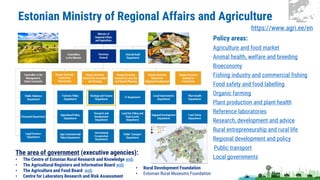
Estonian Ministry ofRegional Affairs and Agriculture
Policy areas:
• Agriculture and food market
• Animal health, welfare and breeding
• Bioeconomy
• Fishing industry and commercial fishing
• Food safety and food labelling
• Organic farming
• Plant production and plant health
• Reference laboratories
• Research, development and advice
• Rural entrepreneurship and rural life
• Regional development and policy
Public transport
• Local governments
https://www.agri.ee/en
The area of government (executive agencies):
• The Centre of Estonian Rural Research and Knowledge web
• The Agricultural Registers and Information Board web
• The Agriculture and Food Board web
• Centre for Laboratory Research and Risk Assessment
• Rural Development Foundation
• Estonian Rural Museums Foundation
26.
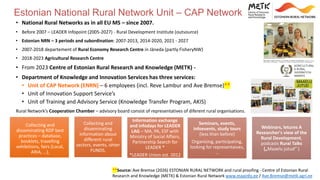
Estonian National RuralNetwork Unit – CAP Network
**Source: Ave Bremse (2026) ESTONIAN RURAL NETWORK and rural proofing - Centre of Estonian Rural
Research and Knowledge (METK) & Estonian Rural Network www.maainfo.ee / Ave.Bremse@metk.agri.ee
• National Rural Networks as in all EU MS – since 2007.
• Before 2007 – LEADER Infopoint (2005-2027) - Rural Development Institute (outsource)
• Estonian NRN – 3 periods and subordination: 2007-2013, 2014-2020, 2021 - 2027
• 2007-2018 departement of Rural Economy Research Centre in Jäneda (partly FisheryNW)
• 2018-2023 Agricultural Research Centre
• From 2023 Centre of Estonian Rural Research and Knowledge (METK) -
• Department of Knowledge and Innovation Services has three services:
• Unit of CAP Network (ENRN) – 6 employees (incl. Reve Lambur and Ave Bremse)**
• Unit of Innovation Support Service’s
• Unit of Training and Advisory Service (Knowledge Transfer Program, AKIS)
Rural Network’s Cooperation Chamber – advisory board consist of representatives of diferent rural organisations.
Collecting and
disseminating RDP best
practices – database,
booklets, travelling
exhibitions, fairs (Local,
ARIA, …),
Collecting and
disseminating
information about
different rural
sectors, events, ohter
FUNDS,
Information exchange
and infodays for LEADER
LAG – MA, PA, ESF with
Ministry of Social Affairs,
Partnership Search for
LEADER *
*LEADER Union est. 2012
Seminars, events,
infoevents, study tours
(less than before)
Organising, participating,
looking for representaives,
…
Webinars, letures A
Researcher's view of the
Rural Development,
podcasts Rural Talks
(„Maaelu jutud“ )
27.
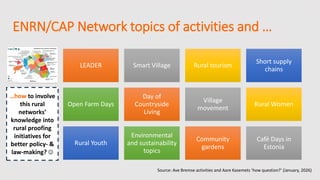
ENRN/CAP Network topicsof activities and …
LEADER
LEADER Smart Village
Smart Village Rural tourism
Rural tourism
Short supply
chains
Short supply
chains
Open Farm Days
Open Farm Days
Day of
Countryside
Living
Day of
Countryside
Living
Village
movement
Village
movement
Rural Women
Rural Women
Rural Youth
Rural Youth
Environmental
and sustainability
topics
Environmental
and sustainability
topics
Community
gardens
Community
gardens
Café Days in
Estonia
Café Days in
Estonia
…how to involve
this rural
networks’
knowledge into
rural proofing
initiatives for
better policy- &
law-making? ☺
Source: Ave Bremse activities and Aare Kasemets ‘how question?’ (January, 2026)
28.
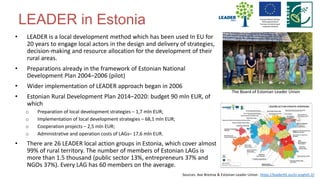
LEADER in Estonia
•LEADER is a local development method which has been used In EU for
20 years to engage local actors in the design and delivery of strategies,
decision-making and resource allocation for the development of their
rural areas.
• Preparations already in the framework of Estonian National
Development Plan 2004–2006 (pilot)
• Wider implementation of LEADER approach began in 2006
• Estonian Rural Development Plan 2014–2020: budget 90 mln EUR, of
which
o Preparation of local development strategies – 1,7 mln EUR;
o Implementation of local development strategies – 68,1 mln EUR;
o Cooperation projects – 2,5 mln EUR;
o Administrative and operation costs of LAGs– 17,6 mln EUR.
• There are 26 LEADER local action groups in Estonia, which cover almost
99% of rural territory. The number of members of Estonian LAGs is
more than 1.5 thousand (public sector 13%, entrepreneurs 37% and
NGOs 37%). Every LAG has 60 members on the average.
Sources: Ave Bremse & Estonian Leader Union: https://leaderliit.eu/in-english-2/
The Board of Estonian Leader Union
29.
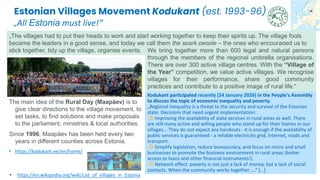
Estonian Villages MovementKodukant (est. 1993-96)
„All Estonia must live!“
The main idea of the Rural Day (Maapäev) is to
give clear directions to the village movement, to
set tasks, to find solutions and make proposals
to the parliament, ministries & local authorities.
Since 1996, Maapäev has been held every two
years in different counties across Estonia.
• https://kodukant.ee/en/home/
„The villages had to put their heads to work and start working together to keep their spirits up. The village fools
became the leaders in a good sense, and today we call them the spark people – the ones who encouraged us to
stick together, tidy up the village, organise events.
• https://en.wikipedia.org/wiki/List_of_villages_in_Estonia
Kodukant participated recently (24 January 2026) in the People's Assembly
to discuss the topic of economic inequality and poverty.
„Regional inequality is a threat to the security and survival of the Estonian
state. Decisions that need urgent implementation:
Improving the availability of state services in rural areas as well. There
are still many active and willing people who stand up for their homes in our
villages... They do not expect any handouts - it is enough if the availability of
public services is guaranteed - a reliable electricity grid, internet, roads and
transport.
Simplify legislation, reduce bureaucracy, and focus on micro and small
businesses to promote the business environment in rural areas (better
access to loans and other financial instruments!).
Network effect: poverty is not just a lack of money, but a lack of social
contacts. When the community works together ….“ […]
We bring together more than 600 legal and natural persons
through the members of the regional umbrella organisations.
There are over 300 active village centres. With the “Village of
the Year” competition, we value active villages. We recognise
villages for their performance, share good community
practices and contribute to a positive image of rural life.“
30.
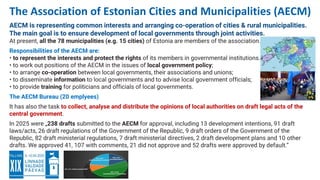
The Association ofEstonian Cities and Municipalities (AECM)
AECM is representing common interests and arranging co-operation of cities & rural municipalities.
The main goal is to ensure development of local governments through joint activities.
At present, all the 78 municipalities (e.g. 15 cities) of Estonia are members of the association.
Responsibilities of the AECM are:
• to represent the interests and protect the rights of its members in governmental institutions…;
• to work out positions of the AECM in the issues of local government policy;
• to arrange co-operation between local governments, their associations and unions;
• to disseminate information to local governments and to advise local government officials;
• to provide training for politicians and officials of local governments.
The AECM Bureau (20 emplyees)
It has also the task to collect, analyse and distribute the opinions of local authorities on draft legal acts of the
central government.
In 2025 were „238 drafts submitted to the AECM for approval, including 13 development intentions, 91 draft
laws/acts, 26 draft regulations of the Government of the Republic, 9 draft orders of the Government of the
Republic, 82 draft ministerial regulations, 7 draft ministerial directives, 2 draft development plans and 10 other
drafts. We approved 41, 107 with comments, 21 did not approve and 52 drafts were approved by default.“
31.
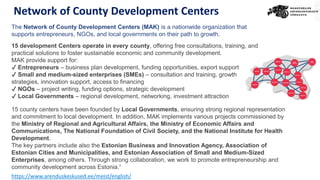
Network of CountyDevelopment Centers
The Network of County Development Centers (MAK) is a nationwide organization that
supports entrepreneurs, NGOs, and local governments on their path to growth.
15 development Centers operate in every county, offering free consultations, training, and
practical solutions to foster sustainable economic and community development.
MAK provide support for:
Entrepreneurs – business plan development, funding opportunities, export support
Small and medium-sized enterprises (SMEs) – consultation and training, growth
strategies, innovation support, access to financing
NGOs – project writing, funding options, strategic development
Local Governments – regional development, networking, investment attraction
15 county centers have been founded by Local Governments, ensuring strong regional representation
and commitment to local development. In addition, MAK implements various projects commissioned by
the Ministry of Regional and Agricultural Affairs, the Ministry of Economic Affairs and
Communications, The National Foundation of Civil Society, and the National Institute for Health
Development.
The key partners include also the Estonian Business and Innovation Agency, Association of
Estonian Cities and Municipalities, and Estonian Association of Small and Medium-Sized
Enterprises, among others. Through strong collaboration, we work to promote entrepreneurship and
community development across Estonia.“
https://www.arenduskeskused.ee/meist/english/
32.
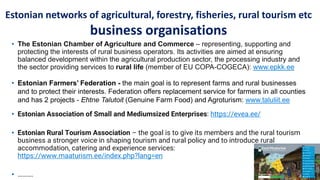
Estonian networks ofagricultural, forestry, fisheries, rural tourism etc
business organisations
• The Estonian Chamber of Agriculture and Commerce – representing, supporting and
protecting the interests of rural business operators. Its activities are aimed at ensuring
balanced development within the agricultural production sector, the processing industry and
the sector providing services to rural life (member of EU COPA-COGECA): www.epkk.ee
• Estonian Farmers’ Federation - the main goal is to represent farms and rural businesses
and to protect their interests. Federation offers replacement service for farmers in all counties
and has 2 projects - Ehtne Talutoit (Genuine Farm Food) and Agroturism: www.taluliit.ee
• Estonian Association of Small and Mediumsized Enterprises: https://evea.ee/
• Estonian Rural Tourism Association – the goal is to give its members and the rural tourism
business a stronger voice in shaping tourism and rural policy and to introduce rural
accommodation, catering and experience services:
https://www.maaturism.ee/index.php?lang=en
• ……….
33.
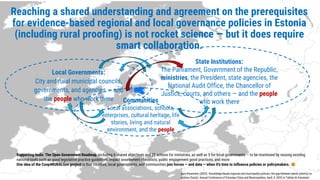
Reaching a sharedunderstanding and agreement on the prerequisites
for evidence-based regional and local governance policies in Estonia
(including rural proofing) is not rocket science — but it does require
smart collaboration.
Communities
Local associations, schools,
enterprises, cultural heritage, life
stories, living and natural
environment, and the people
State Institutions:
The Parliament, Government of the Republic,
ministries, the President, state agencies, the
National Audit Office, the Chancellor of
Justice, courts, and others — and the people
who work there
Local Governments:
City and rural municipal councils,
governments, and agencies — and
the people who work there
Supporting tools: The Open Government Roadmap, including 6 shared objectives and 25 actions for ministries, as well as 5 for local governments — to be monitored by reusing existing
national tools such as good legislative practice guidelines, impact assessment checklists, public engagement good practices, and more.
One idea of the Coop4RURALGov project is that counties, local governments, and communities join forces — and data — when it's time to influence policies or policymakers.
Aare Kasemets (2025). Knowledge-based regional and municipality policies: the gap between words (norms) vs
actions (facts). Annual Conference of Estonian Cities and Municipalities, April, 9, 2025 in Tallinn (in Estonian)
34.
Looking for ‘workingideas’ & solutions togerher…
INTERREG project Coop4RURALGov (2023-2027)
Rural Proofing. Cooperation for better
sparsely populated rural, coastal and
mountain focused governance.
35.
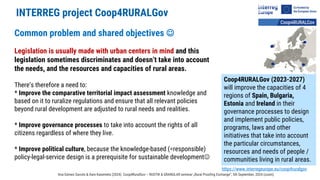
INTERREG project Coop4RURALGov
Commonproblem and shared objectives ☺
Legislation is usually made with urban centers in mind and this
legislation sometimes discriminates and doesn’t take into account
the needs, and the resources and capacities of rural areas.
There’s therefore a need to:
* Improve the comparative territorial impact assessment knowledge and
based on it to ruralize regulations and ensure that all relevant policies
beyond rural development are adjusted to rural needs and realities.
* Improve governance processes to take into account the rights of all
citizens regardless of where they live.
* Improve political culture, because the knowledge-based (=responsible)
policy-legal-service design is a prerequisite for sustainable development☺
Coop4RURALGov (2023-2027)
will improve the capacities of 4
regions of Spain, Bulgaria,
Estonia and Ireland in their
governance processes to design
and implement public policies,
programs, laws and other
initiatives that take into account
the particular circumstances,
resources and needs of people /
communities living in rural areas.
Ana Gómez Garcés & Aare Kasemets (2024). Coop4RuralGov – RUSTIK & GRANULAR seminar „Rural Proofing Exchange“, 5th September, 2024 (zoom)
https://www.interregeurope.eu/coop4ruralgov
36.
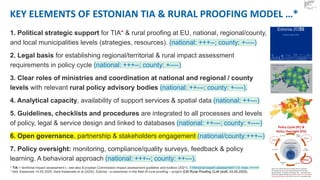
KEY ELEMENTS OFESTONIAN TIA & RURAL PROOFING MODEL …*
1. Political strategic support for TIA* & rural proofing at EU, national, regional/county,
and local municipalities levels (strategies, resources). (national: +++--; county: +----)
2. Legal basis for establishing regional/territorial & rural impact assessment
requirements in policy cycle (national: +++--; county: +----)
3. Clear roles of ministries and coordination at national and regional / county
levels with relevant rural policy advisory bodies (national: ++---; county: +----).
4. Analytical capacity, availability of support services & spatial data (national: ++---)
5. Guidelines, checklists and procedures are integrated to all processes and levels
of policy, legal & service design and linked to databases (national: ++---; county: +----)
6. Open governance, partnership & stakeholders engagement (national/county:+++--)
7. Policy oversight: monitoring, compliance/quality surveys, feedback & policy
learning. A behavioral approach (national: +++--; county: ++---).
* TIA = territorial impact assessment (– see also European Commission impact assessment guideline and toolbox (2021). // Personal expert assessment 1-5: max: +++++
* Ibid: Kasemets 14.05.2025; Aare Kasemets et al (2025). Estonia - a newcomer in the field of rural proofing – project G30 Rural Proofing CLM (draft, 03.05.2025).
37.
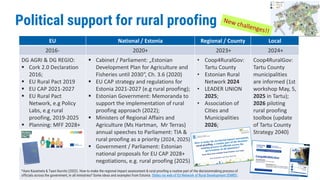
Political support forrural proofing
EU National / Estonia Regional / County Local
2016- 2020+ 2023+ 2024+
DG AGRI & DG REGIO:
▪ Cork 2.0 Declaration
2016;
▪ EU Rural Pact 2019
▪ EU CAP 2021-2027
▪ EU Rural Pact
Network, e.g Policy
Labs, e.g rural
proofing, 2019-2025
▪ Planning: MFF 2028+
▪ Cabinet / Parliament: „Estonian
Development Plan for Agriculture and
Fisheries until 2030“, Ch. 3.6 (2020)
▪ EU CAP strategy and regulations for
Estonia 2021-2027 (e.g rural proofing);
▪ Estonian Government: Memoranda to
support the implementation of rural
proofing approach (2022);
▪ Ministers of Regional Affairs and
Agriculture (Ms Hartman, Mr Terras)
annual speeches to Parliament: TIA &
rural proofing as a priority (2024, 2025)
▪ Government / Parliament: Estonian
national proposals for EU CAP 2028+
negotiations, e.g. rural proofing (2025)
• Coop4RuralGov:
Tartu County
• Estonian Rural
Network 2024
• LEADER UNION
2025;
• Association of
Cities and
Municipalities
2026;
Coop4RuralGov:
Tartu County
municipalities
are informed (1st
workshop May, 5,
2025 in Tartu);
2026 piloting
rural proofing
toolbox (update
of Tartu County
Strategy 2040)
*Aare Kasemets & Taavi Kurvits (2022). How to make the regional impact assessment & rural proofing a routine part of the decisionmaking process of
officials across the government, in all ministries? Some ideas and examples from Estonia. Slides via web of EU Network of Rural Development (ENRD).
38.
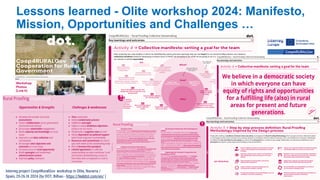
Lessons learned -Olite workshop 2024: Manifesto,
Mission, Opportunities and Challenges …
Interreg project Coop4RuralGov: workshop in Olite, Navarra /
Spain, 25-26.IX.2024 (by DOT, Bilbao - https://feeldot.com/en/ )
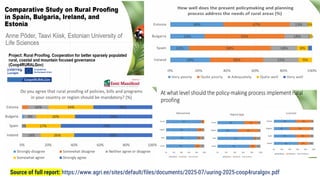
39.
Source of fullreport: https://www.agri.ee/sites/default/files/documents/2025-07/uuring-2025-coop4ruralgov.pdf
40.
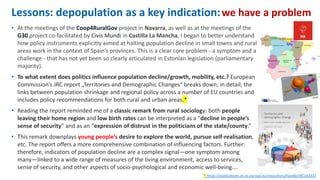
Lessons: depopulation asa key indication:we have a problem
• At the meetings of the Coop4RuralGov project in Navarra, as well as at the meetings of the
G30 project co-facilitated by Civis Mundi in Castilla La Mancha, I began to better understand
how policy instruments explicitly aimed at halting population decline in small towns and rural
areas work in the context of Spain’s provinces. This is a clear core problem - a symptom and a
challenge - that has not yet been so clearly articulated in Estonian legislation (parliamentary
majority).
• To what extent does politics influence population decline/growth, mobility, etc.? European
Commission’s JRC report „Territories and Demographic Changes“ breaks down, in detail, the
links between population shrinkage and regional policy across a number of EU countries and
includes policy recommendations for both rural and urban areas.*
• Reading the report reminded me of a classic remark from rural sociology: both people
leaving their home region and low birth rates can be interpreted as a “decline in people’s
sense of security” and as an “expression of distrust in the politicians of the state/county.”
• This remark downplays young people’s desire to explore the world, pursue self-realisation,
etc. The report offers a more comprehensive combination of influencing factors. Further:
therefore, indicators of population decline are a complex signal—one symptom among
many—linked to a wide range of measures of the living environment, access to services,
sense of security, and other aspects of socio-psychological and economic well-being….
* https://publications.jrc.ec.europa.eu/repository/handle/JRC143332
41.
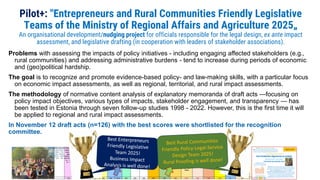
Pilot+: "Entrepreneurs andRural Communities Friendly Legislative
Teams of the Ministry of Regional Affairs and Agriculture 2025„
An organisational development/nudging project for officials responsible for the legal design, ex ante impact
assessment, and legislative drafting (in cooperation with leaders of stakeholder associations).
Problems with assessing the impacts of policy initiatives - including engaging affected stakeholders (e.g.,
rural communities) and addressing administrative burdens - tend to increase during periods of economic
and (geo)political hardship.
The goal is to recognize and promote evidence-based policy- and law-making skills, with a particular focus
on economic impact assessments, as well as regional, territorial, and rural impact assessments.
The methodology of normative content analysis of explanatory memoranda of draft acts —focusing on
policy impact objectives, various types of impacts, stakeholder engagement, and transparency — has
been tested in Estonia through seven follow-up studies 1998 - 2022. However, this is the first time it will
be applied to regional and rural impact assessments.
In November 12 draft acts (n=126) with the best scores were shortlisted for the recognition
committee.
Taustinfo 03.01.2022 + 149−162 (veebis). ReM osakond:
KMO; KPPO;
PMO / TTO,
TOO / REGO;
KOVO / MRO;
ÜTO / TAO
Probleemi,
vajaduseja
eesmärgi
selgus
seletuskirja
ptk-ides1-2
(on - 1, ei
ole - 0)
Seost riigi
keskse
strateegia
Eesti 2035
ja/või mõne
valdkonna
arengukava
(nt PõKa
2030) mõju-
eesmärgiga
on-või-ei ole
kirjeldatud
(on - 1, ei ole
0) [väide,
viide]
Seost EL-i
õigusega
on või ei
ole
nimetatud
(on- 1, ei
ole - 0)
[väide,
viide]. Kui
'ON',)
Sidus-ja
sihtrühmad,
keda SE/ME
mõjutab +
kes eesmärki
püüavad
(vähemalt
nimetamine,
vt ka pp 5.1,
5.2 ja 6)
Sotsiaal-
sed mõjud
(jah/ei-
väide >
kirjeldus >
andmed)
Majandus
-likud
mõjud
(jah/ei-
väide >
kirjeldus >
andmed)
Majandus
: haldus-
koormus
(jah/ei >
kirjeldus>
andmed)
Keskkonna-
mõjud
(jah/ei-väide
> kirjeldus >
andmed) (sh
kliimapoliitik
a suunad)
Infotehno-
loogia ja -
ühiskond
(jah/ei-väide
> kirjeldus >
andmed)
(JuMi MHKK-
s alates
2021)
Mõjud
haridus-(sh
teadus),
kultuuri-ja
spordielule
(MHKK-s
alates 2021)
Mõjud
turvalisusele,
julgeolekule ja
väliskoostööle
(jah/ei-väide>
kirjeldus >
andmed)
Mõjud
regionaal-
arengule,sh
maa- ja ranna-
piirkondadele
[rural proofing]
(jah/ei-väide>
kirjeldus >
andmed)
Mõjud riigi
asutuste
töökorraldusel
e / tegevustele
(jah/ei-väide*>
kirjeldus >
andmed) *sh
selge eristus
riigi ja KOV-ide
tegevuste kohta
Mõjud kohaliku
omavalitsuse
asutuste
töökorraldusel
e / tegevustele
(jah/ei-väide*>
kirjeldus >
andmed) *sh
selge eristus
riigi ja KOV-ide
tegevuste
kohta
Riske ja riskide
maandamist on
kirjeldatud (sh
negatiivsete
mõjude
kompeseerimis
e teabe
esitamine)
Ex post mõjude
hindamise
vajadust on
hinnatud, sh
JAH-otsustuse
korral andmete
kogumise
eesmärgid /
strateegia
Mõjud riigi ja
kohalike
omavalitsuste
eelarvele [sh
teenuste
kulumudelid]
(jah/ei-väide>
kirjeldus >
andmed)
Viited väidete
ja andmete
allikatele (sh
teadus-
kirjandus,
statistika,
analüüsid jm -
HÕNTE§46 lg
2)
Riigi- ja kohalike
omavalitsuste
asutuste/esindajate
kaasamise teave
(tasemed: nimede
loend > + kaasamis-
meetodid > ++
ettepanekutetabel)
Valitsusväliste
organisatsioonide
kaasamine (sh
ettevõtlus-,
keskkonna- ja
kogukonna-
ühendused - vt 5.1)
Mõjudehindamiseja
kaaasmisega seotud
avaliku teabe kvaliteet
(1.1-5.2 teabe eest: 0,
kui üldine kirjeldus, 1 kui
on nii sihtrühmade kui ka
oluliste mõjude kohta
arvandmed (andmed
vähemalt kolmes olulise
mõju kategoorias
kaheksast 3.1-3.7 ja
3.10)
Kokku (%)
1.1. 1.2. 1.3. 2.. 3.0. 3.1. 3.1.1. 3.2. 3.3. 3.4. 3.5. 3.6. 3.7. 3.7.1. 3.8. 3.9. 3.10. 4.. 5.1. 5.2. 6..
42.
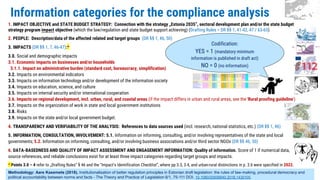
Information categories forthe compliance analysis
1. IMPACT OBJECTIVE and STATE BUDGET STRATEGY: Connection with the strategy „Estonia 2035“, sectoral development plan and/or the state budget
strategy program impact objective (which the law/regulation and state budget support achieving) (Drafting Rules = DR §§ 1, 41-42, 47 / 63-65)
2. PEOPLE: Description/data of the affected related and target groups (DR §§ 1, 46, 50)
3. IMPACTS (DR §§ 1, 7, 46-47):*
3.0. Social and demographic impacts
3.1. Economic impacts on businesses and/or households
3.1.1. Impact on administrative burden (standard cost, bureaucracy, simplification)
3.2. Impacts on environmental indicators
3.3. Impacts on information technology and/or development of the information society
3.4. Impacts on education, science, and culture
3.5. Impacts on internal security and/or international cooperation
3.6. Impacts on regional development, incl. urban, rural, and coastal areas (if the impact differs in urban and rural areas, see the 'Rural proofing guideline')
3.7. Impacts on the organization of work in state and local government institutions
3.8. Risks
3.9. Impacts on the state and/or local government budget.
4. TRANSPARENCY AND VERIFIABILITY OF THE ANALYSIS: References to data sources used (incl. research, national statistics, etc.) (DR §§ 1, 46)
5. INFORMATION, CONSULTATION, INVOLVEMENT: 5.1. Information on informing, consulting, and/or involving representatives of the state and local
governments; 5.2. Information on informing, consulting, and/or involving business associations and/or third sector NGOs (DR §§ 46, 50)
6. DATA-BASEDNESS AND QUALITY OF IMPACT ASSESSMENT AND ENGAGEMENT INFORMATION: Quality of information. Score of 1 if numerical data,
source references, and reliable conclusions exist for at least three impact categories regarding target groups and impacts.
* Points 3.0 – 4 refer to „Drafting Rules“ § 46 and the “Impact’s Identification Checklist”, where pp 3.3, 3.4, and urban-rural distinctions in p. 3.6 were specified in 2022.
Codification:
YES = 1 (mandatory minimum
information is published in draft act)
NO = 0 (no information)
Methodology: Aare Kasemets (2018). Institutionalisation of better regulation principles in Estonian draft legislation: the rules of law-making, procedural democracy and
political accountability between norms and facts - The Theory and Practice of Legislation 6/1, 75-111 DOI. 10.1080/20508840.2018.1430105.
43.
0
10
20
30
40
50
60
70
80
90
100
1 2 3.0.3.1. 3.1.1. 3.2. 3.3. 3.4. 3.5. 3.6. 3.7. 3.8. 3.9 4 5.1. 5.2. 6
Compliance
with
'Drafting
Rules',
etc,
%
The categories of assessment (normative content analysis)
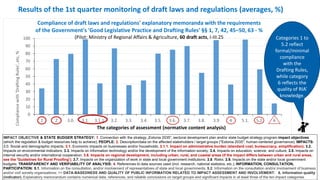
Compliance of draft laws and regulations' explanatory memoranda with the requirements
of the Government's 'Good Legislative Practice and Drafting Rules' §§ 1, 7, 42, 45–50, 63 - %
(Pilot: Ministry of Regional Affairs & Agriculture, 60 draft acts, I-III.25
IMPACT OBJECTIVE & STATE BUDGER STRATEGY: 1. Connection with the strategy „Estonia 2035“, sectoral development plan and/or state budget strategy program impact objectives
(which the regulation & budget resources help to achieve); PEOPLE: 2. Description/data on the affected stakeholders / target groups ("Estonia 2035": human-centered governance); IMPACTS:
3.0. Social and demographic impacts; 3.1. Economic impacts on businesses and/or households; 3.1.1. Impact on administrative burden (standard cost, bureaucracy, simplification); 3.2.
Impacts on environmental indicators; 3.3. Impacts on information technology and/or the development of the information society; 3.4. Impacts on education, science, and culture; 3.5. Impacts on
internal security and/or international cooperation; 3.6. Impacts on regional development, including urban, rural, and coastal areas (if the impact differs between urban and rural areas,
see the 'Guidelines for Rural Proofing'); 3.7. Impacts on the organization of work in state and local government institutions; 3.8. Risks; 3.9. Impacts on the state and/or local government
budgets; TRANSPARENCY AND VERIFIABILITY OF ANALYSIS: 4. References to data sources used (incl. research, national statistics, etc.); INFORMATION, CONSULTATION,
PARTICIPATION: 5.1. Information on the consultation, and/or involvement of representatives of state and local governments; 5.2. Information on the consultation and/or involvement of business
and/or civil society organizations; >> DATA-BASEDNESS AND QUALITY OF PUBLIC INFORMATION RELATED TO IMPACT ASSESSMENT AND INVOLVEMENT: 6. Information quality
(indicator). Explanatory memorandum contains numerical data, references, and reliable conclusions on target groups and significant impacts in at least three of the ten impact categories.
Results of the 1st quarter monitoring of draft laws and regulations (averages, %)
Categories 1 to
5.2 reflect
formal/minimal
compliance
with the
Drafting Rules,
while category
6 reflects the
quality of RIA’
knowledge.
44.
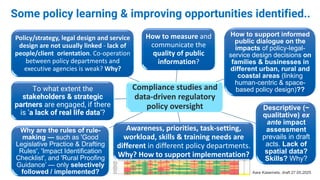
Some policy learning& improving opportunities identified..
Compliance studies and
data-driven regulatory
policy oversight
How to measure and
communicate the
quality of public
information?
How to support informed
public dialogue on the
impacts of policy-legal-
service design decisions on
families & businesses in
different urban, rural and
coastal areas (linking
human-centric & space-
based policy design)??
Descriptive (~
qualitative) ex
ante impact
assessment
prevails in draft
acts. Lack of
spatial data?
Skills? Why?
Awareness, priorities, task-setting,
workload, skills & training needs are
different in different policy departments.
Why? How to support implementation?
Why are the rules of rule-
making — such as 'Good
Legislative Practice & Drafting
Rules', 'Impact Identification
Checklist', and 'Rural Proofing
Guidance’ — only selectively
followed / implemented?
To what extent the
stakeholders & strategic
partners are engaged, if there
is ‘a lack of real life data’?
Policy/strategy, legal design and service
design are not usually linked - lack of
people/client orientation. Co-operation
between policy departments and
executive agencies is weak? Why?
Aare Kasemets, draft 27.05.2025
45.
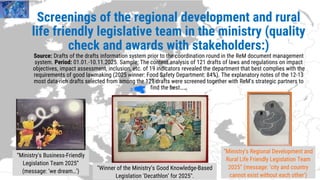
Screenings of theregional development and rural
life friendly legislative team in the ministry (quality
check and awards with stakeholders:)
Source: Drafts of the drafts information system prior to the coordination round in the ReM document management
system. Period: 01.01.-10.11.2025. Sample: The content analysis of 121 drafts of laws and regulations on impact
objectives, impact assessment, inclusion, etc. of 19 indicators revealed the department that best complies with the
requirements of good lawmaking (2025 winner: Food Safety Department: 84%). The explanatory notes of the 12-13
most data-rich drafts selected from among the 121 drafts were screened together with ReM's strategic partners to
find the best……
.
“Ministry's Business-Friendly
Legislation Team 2025”
(message: ‘we dream…’)
"Winner of the Ministry’s Good Knowledge-Based
Legislation 'Decathlon’ for 2025".
“Ministry's Regional Development and
Rural Life Friendly Legislation Team
2025” (message: ‘city and country
cannot exist without each other’)
46.
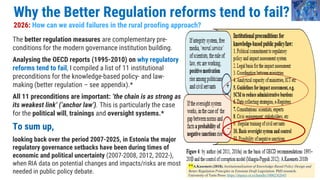
The better regulationmeasures are complementary pre-
conditions for the modern governance institution building.
Analysing the OECD reports (1995-2010) on why regulatory
reforms tend to fail, I compiled a list of 11 institutional
preconditions for the knowledge-based policy- and law-
making (better regulation – see appendix).*
All 11 preconditions are important: ‘the chain is as strong as
its weakest link’ (‘anchor law’). This is particularly the case
for the political will, trainings and oversight systems.*
To sum up,
looking back over the period 2007-2025, in Estonia the major
regulatory governance setbacks have been during times of
economic and political uncertainty (2007-2008, 2012, 2022-),
when RIA data on potential changes and impacts/risks are most
needed in public policy debate.
Why the Better Regulation reforms tend to fail?
2026: How can we avoid failures in the rural proofing approach?
**A.Kasemets (2018). Institutionalisation of Knowledge-Based Policy Design and
Better Regulation Principles in Estonian Draft Legislation. PhD research.
University of Tartu Press: https://dspace.ut.ee/handle/10062/62643
47.
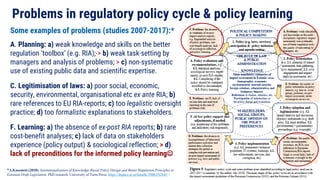
Problems in regulatorypolicy cycle & policy learning
Some examples of problems (studies 2007-2017):*
A. Planning: a) weak knowledge and skills on the better
regulation ‘toolbox’ (e.g. RIA);-> b) weak task-setting by
managers and analysis of problems; > c) non-systematic
use of existing public data and scientific expertise.
C. Legitimisation of laws: a) poor social, economic,
security, environmental, organisational etc ex ante RIA; b)
rare references to EU RIA-reports; c) too legalistic oversight
practice; d) too formalistic explanations to stakeholders.
F. Learning: a) the absence of ex-post RIA reports; b) rare
cost-benefit analyses; c) lack of data on stakeholders
experience (policy output) & sociological reflection; > d)
lack of preconditions for the informed policy learning☺
*A.Kasemets (2018). Institutionalisation of Knowledge-Based Policy Design and Better Regulation Principles in
Estonian Draft Legislation. PhD research. University of Tartu Press: https://dspace.ut.ee/handle/10062/62643 >
48.
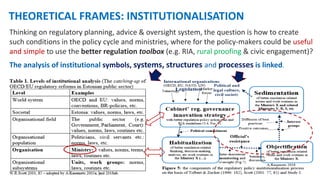
Thinking on regulatoryplanning, advice & oversight system, the question is how to create
such conditions in the policy cycle and ministries, where for the policy-makers could be useful
and simple to use the better regulation toolbox (e.g. RIA, rural proofing & civic engagement)?
The analysis of institutional symbols, systems, structures and processes is linked.
THEORETICAL FRAMES: INSTITUTIONALISATION
49.
Regulatory oversight modeland behavioral approach (4)
in the of better regulation and open governance activities
The Ministry of Regional Affairs and Agriculture. We have 3-4 lines of oversight (Q-check):
1. Policy initiaves, bills (draft acts), etc, prepared in the Ministry’s policy departments;
2. Service design, budget propsals, etc of the Ministry’s implementing agencies;
3. Policy initiatives, bills, etc of other ministries: focus on regional impact assessment (e.g rural proofing, local
authorities); also agriculture, fisheries, food & bioeconomy buisnesses impact assessment, etc;
4. Initiatives of other EU countries, DG AGRI, DG REGIO, DG MARE, etc: we focus on regional/rural affairs, the
local municipalities, agriculture, fisheries, food industry, food markets.
How the oversight system may support the institutionalization of better regulation, e.g.
our-people-centred policy/law/service design, RIA, rural proofing, consultations, and simplication?
Estonian regulatory oversight model has achieved many structural changes since 2011
1) The Legislative Quality Division of the Ministry of Justice & Digital Affairs provides an oversight and challenge function for RIAs and ex ante assessments
in relation to primary legislation based on ‘Rules of Drafting’ (2011). It reviews the quality of RIAs and can return them for revision if the quality is inadequate.
2) All other ministries must do the same regarding their field of competence, but despite this obligation, there is a lack of advisory services and cost-benefit,
standard costs, social impact assessment, etc analyses.
3) For government strategies and EU affairs negotiations, oversight responsibilities lie with the Government Office Strategy and EU Coordination Bureaus.
Source: Aare Kasemets: Better regulation & RIA seminars for Moldovan and Montenegro officials (EU accession projects 2024-2026)
50.
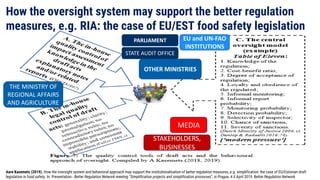
THE MINISTRY OF
REGIONALAFFAIRS
AND AGRICULTURE
OTHER MINISTRIES
STAKEHOLDERS,
BUSINESSES
MEDIA
EU and UN-FAO
INSTITUTIONS
STATE AUDIT OFFICE
PARLIAMENT
How the oversight system may support the better regulation
measures, e.g. RIA: the case of EU/EST food safety legislation
Aare Kasemets (2019). How the oversight system and behavioral approach may support the institutionalisation of better regulation measures, e.g. simplification: the case of EU/Estonian draft
legislation in food safety. In: Presentation - Better Regulation Network meeting "Simplification projects and simplification processes", in Prague, 4-5 April 2019. Better Regulation Network
51.
Behavioural policy research:‘Nudge’ vs. ‘Sludge’ (proposal 5)*
A recent inspiration: Prof Leonhard Lades „Administrative Burden & „Sludge““ > IAREP 2025: Behavioural Insights
in Research and Policymaking in Tallinn (for officials, 16.06.2025), and in Tartu (for academics, 17-19.06.2025).
Estonia faces evolving structural challenges as a small EU/OECD/NATO member state with limited human, economic,
budgetary and scientific capacities (slides 5–12, 28–32). This makes the adoption of IT/AI solutions that reduce
working time, limit civil service size, cut regulatory standard costs, and simplify laws/services existential policy
choices for long-term sustainability. At the same time, Estonia’s small scale and fewer hierarchical layers enable
faster experimentation with innovative methods, regulations, and technologies — serving as a governance ‘testbed’
Looking at Estonian examples of CAP, CFP & rural policy digitalisation, impact assessment, and simplification
(slides 13–26), Estonia’s digital innovations are largely driven by IT solutions and EU/EE legal frameworks, with
limited incorporation of data-driven behavioural science perspectives — such as the ‘nudge vs sludge’ discourse.
These innovations often lack deeper analysis of social, economic, and regional/rural impacts, spatial inequality, and
cognitive or psychological costs. As a result, the costs and risks for several policy target groups may be
underestimated, hidden, and only emerge over time.
In brief, there is a need for stronger behavioural
science input, and science-policy interaction.
Universities — as holders of ‘academic capital ’—
could play a greater role in supporting evidence-
based policy design and interdisciplinary
collaboration.
*A.Kasemets et al (2025). Digitalization, RIA and Simplification
of the EU/EE Agricultural, Fisheries & Rural Policies... Working
paper: EU DG AGRI CAP Simplification TG5 working papers 02.07
52.
Aare Kasemets -BIO in brief
WORKING & LEARNING:
2016- Estonian Ministry of Regional Affairs and Agriculture, adviser in regulatory impact assessment & stakeholders’ engagement,
member of many networks, 2023-2027 ca 1/4 of my work is related to the EU Interreg rural proofing project Coop4RuralGov.*
2011-2016 Estonian Academy of Security Sciences (Tallinn) and The Hertie School of Governance (Berlin), researcher in EU/EE good
governance, better regulation, anti-corruption, internal security, and public sector reform projects (e.g. 2014-15 PADOS project in Moldova).*
2008-2010 University of Tartu, EU College, vice director, and manager of better regulation and civil society programme.*
2004-2007 Estonian Ministry of Environment, adviser in better regulation, and head of strategy bureau (e.g. EU/EE green procurement).*
1993-2003 The Chancellery of Riigikogu, Estonian Parliament, adviser of Economic Committee 1993-1995, head of socio-economic
information department, and the correspondent of European Parliamentary Research and Documentation Centre (ECPRD) 1995-2003.*
1989-1993 Estonian Academy of Agriculture [now Estonian University of Life Sciences], member of rural sociology research group.*
EDUCATION:
PhD in sociology (2018). Study: „Institutionalisation of Knowledge-Based Policy Design and Better Regulation Principles in Estonian
Draft Legislation.“ University of Tartu (e.g. 2004-05 a visiting PhD student at University of Oxford, Linacre).*
MA in sociology (2001) and BA in journalism (1995), University of Tartu.
Studies of agronomy and rural sociology (1983, 1985-1988), Estonian Academy of Agriculture.
*CV & publications: https://www.etis.ee/CV/Aare_Kasemets/eng/ E-mail: aare.kasemets@agri.ee
The House of the Five Ministries in
Tallinn, e.g. Estonian Ministry of
Regional Affairs and Agriculture.
My country home.
Kriimani village.
Tartu County.
Estonia.