Contents
Definition
Typesof Manufacturing
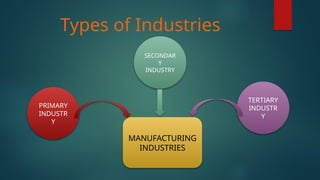
Types of Industries
Types of Manufacturing Operations
What is JIT?
3.
Definition
What is “Manufacturing”?
“the process of converting Raw materials into products.”
The word “manufacturing” is delivered from the Latin manu factus,
meaning made by hand.
“the conversion of stuff into things” – (by DeGramon, 1998)
“economic terms for making goods and services available to satisfy
customer” – (by T. Black, 1991)
4.
Types of Manufacturing
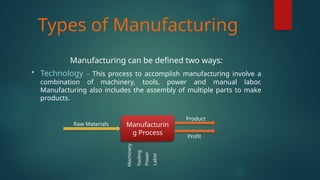
Manufacturingcan be defined two ways:
Technology – This process to accomplish manufacturing involve a
combination of machinery, tools, power and manual labor.
Manufacturing also includes the assembly of multiple parts to make
products.
Manufacturin
g Process
Raw Materials
Product
Profit
Machinery
Tooling
Power
Labor
5.
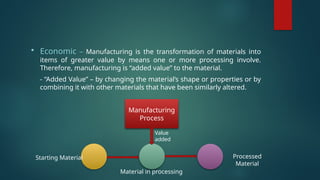
Economic –Manufacturing is the transformation of materials into
items of greater value by means one or more processing involve.
Therefore, manufacturing is “added value” to the material.
- “Added Value” – by changing the material’s shape or properties or by
combining it with other materials that have been similarly altered.
Manufacturing
Process
Material in processing
Starting Material Processed
Material
Value
added
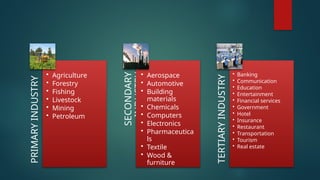
PRIMARY
INDUSTRY
• Agriculture
• Forestry
•Fishing
• Livestock
• Mining
• Petroleum
SECONDARY
INDUSTRY
• Aerospace
• Automotive
• Building
materials
• Chemicals
• Computers
• Electronics
• Pharmaceutica
ls
• Textile
• Wood &
furniture
TERTIARY
INDUSTRY
• Banking
• Communication
• Education
• Entertainment
• Financial services
• Government
• Hotel
• Insurance
• Restaurant
• Transportation
• Tourism
• Real estate
8.
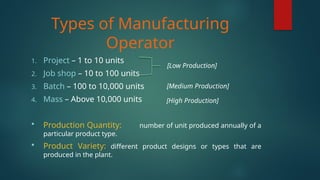
Types of Manufacturing
Operator
1.Project – 1 to 10 units
2. Job shop – 10 to 100 units
3. Batch – 100 to 10,000 units
4. Mass – Above 10,000 units
Production Quantity: number of unit produced annually of a
particular product type.
Product Variety: different product designs or types that are
produced in the plant.
[Low Production]
[Medium Production]
[High Production]
9.
1. Project
Productposition – remains stationary during the manufacturing
process – size, weight, location of the product.
Materials, people, machinery are brought to the product or product
site.
Based on customer specifications.
Example: bridge, building construction, aircraft, ships, locomotive.
10.
2. Job Shop
Low volume and production quantities called lot sizes with high
product variety.
Satisfies a market for nonstandard or unique product.
Require high skill levels labor – to operate a variety of equipments.
A short duration activities to provide custom goods.
Example: space vehicles, reactor vessels, turbines, aircraft component.
11.
3. Batch
Batchproduction produce or process any product in groups which is
called “batches”.
Can produce a variety of products – opposed to a continuous
production process, or a one time production.
Useful for industries that makes seasonal itemsproducts for which it
is difficult to forecast the demand.
Example: similar standard items made periodically in batches; bakery,
paint, hand tools.
12.
4. Mass
Alsoknown as flow production, repetitive flow production, series
production.
Machinery (e.g.: robots, machine press) that is needed to set up the
mass production line is so expensive.
Involved fewer labor cost and a faster rate of production.
Plant and equipments are arranged in a flow line layout.
Example: light bulbs, refrigerator, TV.
13.
What is JustIn Time (JIT)?
Raw materials, parts & components are delivered to the manufacturer
just in time to used, parts & components are produced JIT to be made
into subassemblies & assemblies, and products are finished JIT to be
delivered to the customer.
JIT is also known as “Pull System”.
It tends to simplify and break the whole system into small,
autonomous units.
14.
Benefits ofJIT:
Low inventory – carrying cost.
Reduced inspection and reworking of parts.
High quality products made at low cost.
Reduction of:
20% to 40% in product cost.
60% to 80% in inventory.
Up to 90% in rejection rates.
90% in lead times.
50% in scrap & rework.