INTRODUCTION TO THE PROFESSION OF
PHYSIOTHERAPY
Role of Physiotherapy in National Health Issues &
Expectations of Society from Physiotherapists
Presented by:
Dr. Etika Rana
BPT,MPT,(PhD)
Department of Physiotherapy
Maharishi Markandeshwar Institute of Physiotherapy & Rehabilitation
Maharishi Markandeshwar (Deemed to be University)
LEARNING OBJECTIVES
By the end of this presentation, the learner will be able to:
• Define physiotherapy and understand its scope as a healthcare profession.
• Describe the roles and responsibilities of physiotherapists across healthcare
settings.
• Explain the contribution of physiotherapy to major national health challenges.
• Discuss the role of physiotherapy in prevention, rehabilitation, disability
reduction and health promotion.
• Identify the expectations of society from contemporary physiotherapists.
• Recognize the evolving role of physiotherapists in population health and
healthcare delivery.
WHAT IS PHYSIOTHERAPY?
• Physiotherapy is a healthcare profession concerned with optimizing
movement, function and physical independence across the lifespan.
According to World Physiotherapy:
• “Physiotherapists provide services that develop, maintain and restore
people’s maximum movement and functional ability.”
• Physiotherapy addresses movement and function throughout the lifespan
when these are threatened by: Ageing , Injury, Disease , Disorders, Health
conditions, Environmental factors
• Physiotherapists aim to maximize quality of life by considering physical,
psychological, emotional and social well-being.
PHYSIOTHERAPY AS A HEALTHCARE
PROFESSION
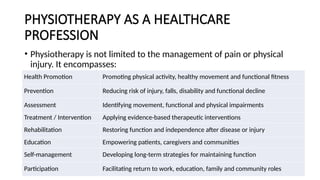
• Physiotherapy is not limited to the management of pain or physical
injury. It encompasses:
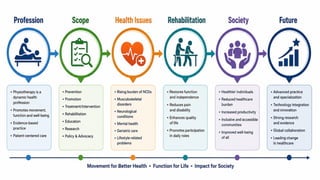
Health Promotion Promoting physical activity, healthy movement and functional fitness
Prevention Reducing risk of injury, falls, disability and functional decline
Assessment Identifying movement, functional and physical impairments
Treatment / Intervention Applying evidence-based therapeutic interventions
Rehabilitation Restoring function and independence after disease or injury
Education Empowering patients, caregivers and communities
Self-management Developing long-term strategies for maintaining function
Participation Facilitating return to work, education, family and community roles
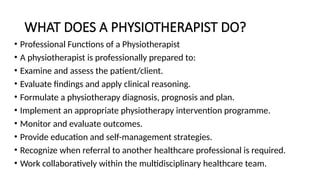
WHAT DOES A PHYSIOTHERAPIST DO?
• Professional Functions of a Physiotherapist
• A physiotherapist is professionally prepared to:
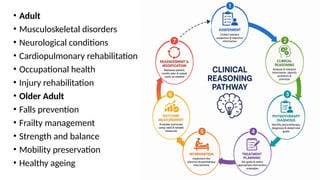
• Examine and assess the patient/client.
• Evaluate findings and apply clinical reasoning.
• Formulate a physiotherapy diagnosis, prognosis and plan.
• Implement an appropriate physiotherapy intervention programme.
• Monitor and evaluate outcomes.
• Provide education and self-management strategies.
• Recognize when referral to another healthcare professional is required.
• Work collaboratively within the multidisciplinary healthcare team.
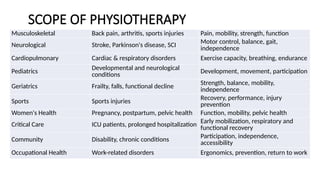
SCOPE OF PHYSIOTHERAPY
Musculoskeletal Back pain, arthritis, sports injuries Pain, mobility, strength, function
Neurological Stroke, Parkinson's disease, SCI
Motor control, balance, gait,
independence
Cardiopulmonary Cardiac & respiratory disorders Exercise capacity, breathing, endurance
Pediatrics Developmental and neurological
conditions
Development, movement, participation
Geriatrics Frailty, falls, functional decline
Strength, balance, mobility,
independence
Sports Sports injuries Recovery, performance, injury
prevention
Women's Health Pregnancy, postpartum, pelvic health Function, mobility, pelvic health
Critical Care ICU patients, prolonged hospitalization
Early mobilization, respiratory and
functional recovery
Community Disability, chronic conditions
Participation, independence,
accessibility
Occupational Health Work-related disorders Ergonomics, prevention, return to work
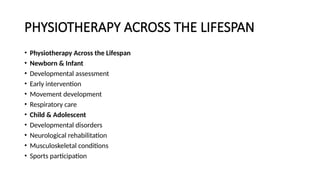
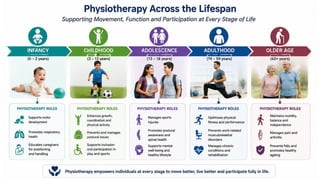
PHYSIOTHERAPY ACROSS THE LIFESPAN
• Physiotherapy Across the Lifespan
• Newborn & Infant
• Developmental assessment
• Early intervention
• Movement development
• Respiratory care
• Child & Adolescent
• Developmental disorders
• Neurological rehabilitation
• Musculoskeletal conditions
• Sports participation
• Adult
• Musculoskeletal disorders
• Neurological conditions
• Cardiopulmonary rehabilitation
• Occupational health
• Injury rehabilitation
• Older Adult
• Falls prevention
• Frailty management
• Strength and balance
• Mobility preservation
• Healthy ageing
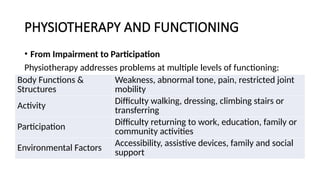
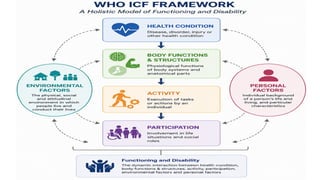
PHYSIOTHERAPY AND FUNCTIONING
• From Impairment to Participation
Physiotherapy addresses problems at multiple levels of functioning:
Body Functions &
Structures
Weakness, abnormal tone, pain, restricted joint
mobility
Activity Difficulty walking, dressing, climbing stairs or
transferring
Participation Difficulty returning to work, education, family or
community activities
Environmental Factors
Accessibility, assistive devices, family and social
support
PHYSIOTHERAPY AND REHABILITATION
• Why is Rehabilitation Important?
WHO defines rehabilitation as:
A set of interventions designed to optimize functioning and reduce disability in individuals
with health conditions in interaction with their environment
Rehabilitation helps people to:
• Maximize independence
• Improve functioning
• Reduce disability
• Participate in education and employment
• Resume family and social roles
• Improve quality of life
THE GROWING NEED FOR PHYSIOTHERAPY
• WHO estimates: 2.4 BILLION PEOPLE worldwide are living with a health condition
that may benefit from rehabilitation.
The need is increasing because of:
• Population ageing
• Increasing chronic diseases
• Growing burden of disability
• Injuries and trauma
• Neurological disorders
• Cardiovascular diseases
• Musculoskeletal conditions
• Developmental conditions
• Long-term consequences of illness
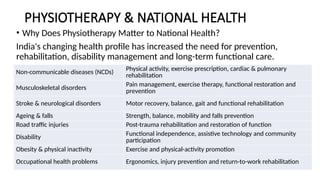
PHYSIOTHERAPY & NATIONAL HEALTH
• Why Does Physiotherapy Matter to National Health?
India's changing health profile has increased the need for prevention,
rehabilitation, disability management and long-term functional care.
Non-communicable diseases (NCDs) Physical activity, exercise prescription, cardiac & pulmonary
rehabilitation
Musculoskeletal disorders Pain management, exercise therapy, functional restoration and
prevention
Stroke & neurological disorders Motor recovery, balance, gait and functional rehabilitation
Ageing & falls Strength, balance, mobility and falls prevention
Road traffic injuries Post-trauma rehabilitation and restoration of function
Disability Functional independence, assistive technology and community
participation
Obesity & physical inactivity Exercise and physical-activity promotion
Occupational health problems Ergonomics, injury prevention and return-to-work rehabilitation
PHYSIOTHERAPY & MUSCULOSKELETAL
HEALTH
Physiotherapy in Musculoskeletal Health: Musculoskeletal conditions affect the bones,
joints, muscles and connective tissues and are a major cause of pain, disability and loss of
productivity.
• Common conditions
• Low back pain
• Neck pain
• Osteoarthritis
• Shoulder disorders
• Tendinopathies
• Sports injuries
• Work-related musculoskeletal disorders
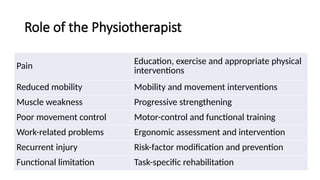
Role of the Physiotherapist
Pain
Education, exercise and appropriate physical
interventions
Reduced mobility Mobility and movement interventions
Muscle weakness Progressive strengthening
Poor movement control Motor-control and functional training
Work-related problems Ergonomic assessment and intervention
Recurrent injury Risk-factor modification and prevention
Functional limitation Task-specific rehabilitation
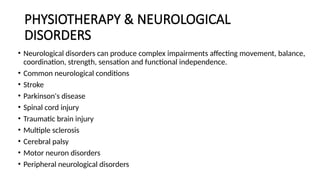
PHYSIOTHERAPY & NEUROLOGICAL
DISORDERS
• Neurological disorders can produce complex impairments affecting movement, balance,
coordination, strength, sensation and functional independence.
• Common neurological conditions
• Stroke
• Parkinson's disease
• Spinal cord injury
• Traumatic brain injury
• Multiple sclerosis
• Cerebral palsy
• Motor neuron disorders
• Peripheral neurological disorders
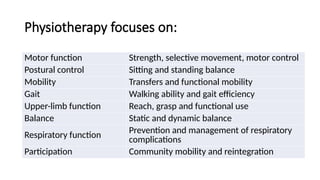
Physiotherapy focuses on:
Motor function Strength, selective movement, motor control
Postural control Sitting and standing balance
Mobility Transfers and functional mobility
Gait Walking ability and gait efficiency
Upper-limb function Reach, grasp and functional use
Balance Static and dynamic balance
Respiratory function Prevention and management of respiratory
complications
Participation Community mobility and reintegration
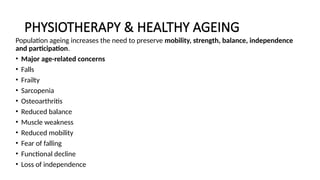
PHYSIOTHERAPY & HEALTHY AGEING
Population ageing increases the need to preserve mobility, strength, balance, independence
and participation.
• Major age-related concerns
• Falls
• Frailty
• Sarcopenia
• Osteoarthritis
• Reduced balance
• Muscle weakness
• Reduced mobility
• Fear of falling
• Functional decline
• Loss of independence
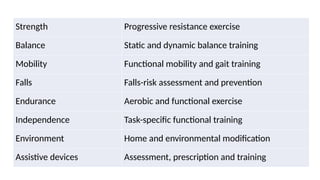
Strength Progressive resistance exercise
Balance Static and dynamic balance training
Mobility Functional mobility and gait training
Falls Falls-risk assessment and prevention
Endurance Aerobic and functional exercise
Independence Task-specific functional training
Environment Home and environmental modification
Assistive devices Assessment, prescription and training
PHYSIOTHERAPY IN PRIMARY & COMMUNITY
HEALTHCARE
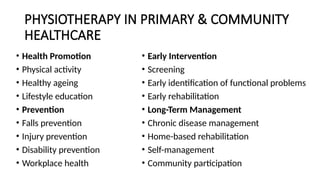
• Health Promotion
• Physical activity
• Healthy ageing
• Lifestyle education
• Prevention
• Falls prevention
• Injury prevention
• Disability prevention
• Workplace health
• Early Intervention
• Screening
• Early identification of functional problems
• Early rehabilitation
• Long-Term Management
• Chronic disease management
• Home-based rehabilitation
• Self-management
• Community participation
PHYSIOTHERAPY & ROAD TRAFFIC INJURIES
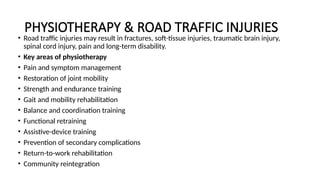
• Road traffic injuries may result in fractures, soft-tissue injuries, traumatic brain injury,
spinal cord injury, pain and long-term disability.
• Key areas of physiotherapy
• Pain and symptom management
• Restoration of joint mobility
• Strength and endurance training
• Gait and mobility rehabilitation
• Balance and coordination training
• Functional retraining
• Assistive-device training
• Prevention of secondary complications
• Return-to-work rehabilitation
• Community reintegration
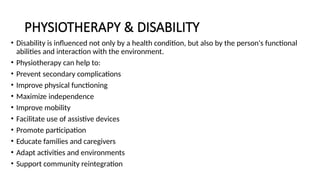
PHYSIOTHERAPY & DISABILITY
• Disability is influenced not only by a health condition, but also by the person's functional
abilities and interaction with the environment.
• Physiotherapy can help to:
• Prevent secondary complications
• Improve physical functioning
• Maximize independence
• Improve mobility
• Facilitate use of assistive devices
• Promote participation
• Educate families and caregivers
• Adapt activities and environments
• Support community reintegration
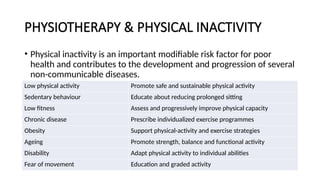
PHYSIOTHERAPY & PHYSICAL INACTIVITY
• Physical inactivity is an important modifiable risk factor for poor
health and contributes to the development and progression of several
non-communicable diseases.
Low physical activity Promote safe and sustainable physical activity
Sedentary behaviour Educate about reducing prolonged sitting
Low fitness Assess and progressively improve physical capacity
Chronic disease Prescribe individualized exercise programmes
Obesity Support physical-activity and exercise strategies
Ageing Promote strength, balance and functional activity
Disability Adapt physical activity to individual abilities
Fear of movement Education and graded activity
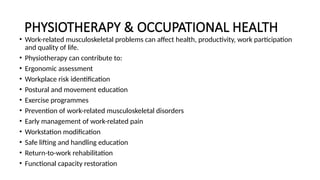
PHYSIOTHERAPY & OCCUPATIONAL HEALTH
• Work-related musculoskeletal problems can affect health, productivity, work participation
and quality of life.
• Physiotherapy can contribute to:
• Ergonomic assessment
• Workplace risk identification
• Postural and movement education
• Exercise programmes
• Prevention of work-related musculoskeletal disorders
• Early management of work-related pain
• Workstation modification
• Safe lifting and handling education
• Return-to-work rehabilitation
• Functional capacity restoration
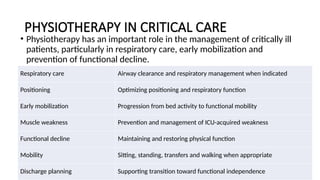
PHYSIOTHERAPY IN CRITICAL CARE
• Physiotherapy has an important role in the management of critically ill
patients, particularly in respiratory care, early mobilization and
prevention of functional decline.
Respiratory care Airway clearance and respiratory management when indicated
Positioning Optimizing positioning and respiratory function
Early mobilization Progression from bed activity to functional mobility
Muscle weakness Prevention and management of ICU-acquired weakness
Functional decline Maintaining and restoring physical function
Mobility Sitting, standing, transfers and walking when appropriate
Discharge planning Supporting transition toward functional independence
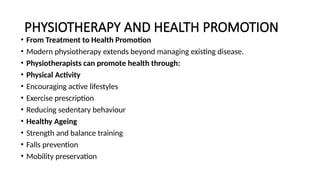
PHYSIOTHERAPY AND HEALTH PROMOTION
• From Treatment to Health Promotion
• Modern physiotherapy extends beyond managing existing disease.
• Physiotherapists can promote health through:
• Physical Activity
• Encouraging active lifestyles
• Exercise prescription
• Reducing sedentary behaviour
• Healthy Ageing
• Strength and balance training
• Falls prevention
• Mobility preservation
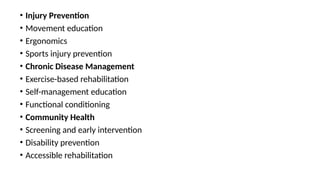
• Injury Prevention
• Movement education
• Ergonomics
• Sports injury prevention
• Chronic Disease Management
• Exercise-based rehabilitation
• Self-management education
• Functional conditioning
• Community Health
• Screening and early intervention
• Disability prevention
• Accessible rehabilitation
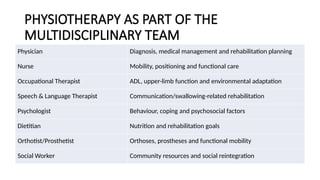
PHYSIOTHERAPY AS PART OF THE
MULTIDISCIPLINARY TEAM
Physician Diagnosis, medical management and rehabilitation planning
Nurse Mobility, positioning and functional care
Occupational Therapist ADL, upper-limb function and environmental adaptation
Speech & Language Therapist Communication/swallowing-related rehabilitation
Psychologist Behaviour, coping and psychosocial factors
Dietitian Nutrition and rehabilitation goals
Orthotist/Prosthetist Orthoses, prostheses and functional mobility
Social Worker Community resources and social reintegration
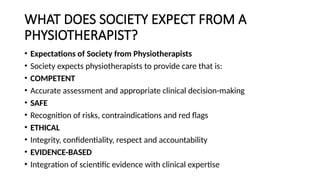
WHAT DOES SOCIETY EXPECT FROM A
PHYSIOTHERAPIST?
• Expectations of Society from Physiotherapists
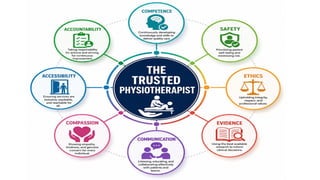
• Society expects physiotherapists to provide care that is:
• COMPETENT
• Accurate assessment and appropriate clinical decision-making
• SAFE
• Recognition of risks, contraindications and red flags
• ETHICAL
• Integrity, confidentiality, respect and accountability
• EVIDENCE-BASED
• Integration of scientific evidence with clinical expertise
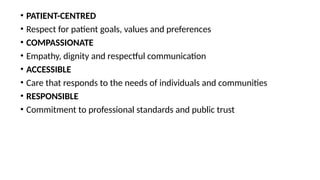
• PATIENT-CENTRED
• Respect for patient goals, values and preferences
• COMPASSIONATE
• Empathy, dignity and respectful communication
• ACCESSIBLE
• Care that responds to the needs of individuals and communities
• RESPONSIBLE
• Commitment to professional standards and public trust
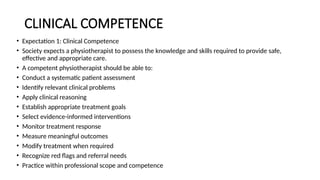
CLINICAL COMPETENCE
• Expectation 1: Clinical Competence
• Society expects a physiotherapist to possess the knowledge and skills required to provide safe,
effective and appropriate care.
• A competent physiotherapist should be able to:
• Conduct a systematic patient assessment
• Identify relevant clinical problems
• Apply clinical reasoning
• Establish appropriate treatment goals
• Select evidence-informed interventions
• Monitor treatment response
• Measure meaningful outcomes
• Modify treatment when required
• Recognize red flags and referral needs
• Practice within professional scope and competence
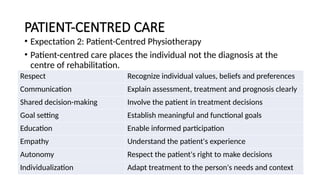
PATIENT-CENTRED CARE
• Expectation 2: Patient-Centred Physiotherapy
• Patient-centred care places the individual not the diagnosis at the
centre of rehabilitation.
Respect Recognize individual values, beliefs and preferences
Communication Explain assessment, treatment and prognosis clearly
Shared decision-making Involve the patient in treatment decisions
Goal setting Establish meaningful and functional goals
Education Enable informed participation
Empathy Understand the patient's experience
Autonomy Respect the patient's right to make decisions
Individualization Adapt treatment to the person's needs and context
COMMUNICATION & COMPASSION
• Expectation 3: Communication, Empathy & Compassion
• Technical knowledge alone does not define a good physiotherapist.
• Effective physiotherapy communication involves:
• Active listening
• Clear and understandable explanations
• Respectful language
• Appropriate non-verbal communication
• Empathy
• Encouragement
• Honest discussion of prognosis
• Patient education
• Involving family/caregivers when appropriate
• Respecting cultural and individual differences
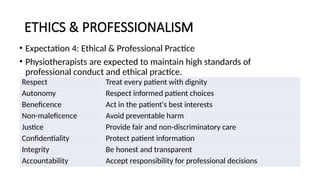
ETHICS & PROFESSIONALISM
• Expectation 4: Ethical & Professional Practice
• Physiotherapists are expected to maintain high standards of
professional conduct and ethical practice.
Respect Treat every patient with dignity
Autonomy Respect informed patient choices
Beneficence Act in the patient's best interests
Non-maleficence Avoid preventable harm
Justice Provide fair and non-discriminatory care
Confidentiality Protect patient information
Integrity Be honest and transparent
Accountability Accept responsibility for professional decisions
EVIDENCE-BASED PRACTICE
• Expectation 5: Evidence-Based Physiotherapy
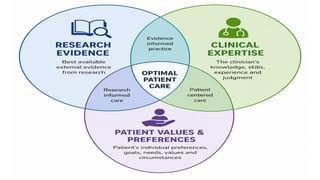
• Evidence-based practice does not mean treating every patient identically;
it means using the best available evidence while considering clinical
expertise and the individual patient's needs and preferences.
• Modern physiotherapy should be grounded in evidence-based practice
(EBP).
• Evidence-Based Practice integrates:
• BEST AVAILABLE RESEARCH EVIDENCE
• CLINICAL EXPERTISE
• PATIENT VALUES & PREFERENCES
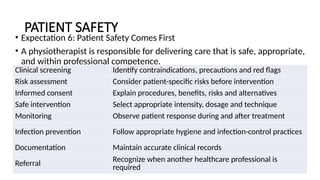
PATIENT SAFETY
• Expectation 6: Patient Safety Comes First
• A physiotherapist is responsible for delivering care that is safe, appropriate,
and within professional competence.
Clinical screening Identify contraindications, precautions and red flags
Risk assessment Consider patient-specific risks before intervention
Informed consent Explain procedures, benefits, risks and alternatives
Safe intervention Select appropriate intensity, dosage and technique
Monitoring Observe patient response during and after treatment
Infection prevention Follow appropriate hygiene and infection-control practices
Documentation Maintain accurate clinical records
Referral
Recognize when another healthcare professional is
required
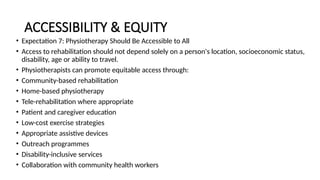
ACCESSIBILITY & EQUITY
• Expectation 7: Physiotherapy Should Be Accessible to All
• Access to rehabilitation should not depend solely on a person's location, socioeconomic status,
disability, age or ability to travel.
• Physiotherapists can promote equitable access through:
• Community-based rehabilitation
• Home-based physiotherapy
• Tele-rehabilitation where appropriate
• Patient and caregiver education
• Low-cost exercise strategies
• Appropriate assistive devices
• Outreach programmes
• Disability-inclusive services
• Collaboration with community health workers
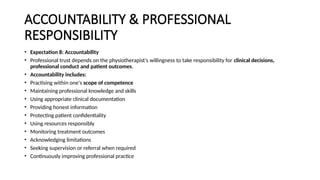
ACCOUNTABILITY & PROFESSIONAL
RESPONSIBILITY
• Expectation 8: Accountability
• Professional trust depends on the physiotherapist's willingness to take responsibility for clinical decisions,
professional conduct and patient outcomes.
• Accountability includes:
• Practising within one's scope of competence
• Maintaining professional knowledge and skills
• Using appropriate clinical documentation
• Providing honest information
• Protecting patient confidentiality
• Using resources responsibly
• Monitoring treatment outcomes
• Acknowledging limitations
• Seeking supervision or referral when required
• Continuously improving professional practice
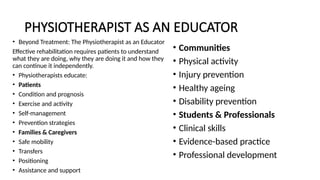
PHYSIOTHERAPIST AS AN EDUCATOR
• Beyond Treatment: The Physiotherapist as an Educator
Effective rehabilitation requires patients to understand
what they are doing, why they are doing it and how they
can continue it independently.
• Physiotherapists educate:
• Patients
• Condition and prognosis
• Exercise and activity
• Self-management
• Prevention strategies
• Families & Caregivers
• Safe mobility
• Transfers
• Positioning
• Assistance and support
• Communities
• Physical activity
• Injury prevention
• Healthy ageing
• Disability prevention
• Students & Professionals
• Clinical skills
• Evidence-based practice
• Professional development
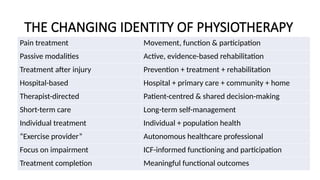
THE CHANGING IDENTITY OF PHYSIOTHERAPY
Pain treatment Movement, function & participation
Passive modalities Active, evidence-based rehabilitation
Treatment after injury Prevention + treatment + rehabilitation
Hospital-based Hospital + primary care + community + home
Therapist-directed Patient-centred & shared decision-making
Short-term care Long-term self-management
Individual treatment Individual + population health
“Exercise provider” Autonomous healthcare professional
Focus on impairment ICF-informed functioning and participation
Treatment completion Meaningful functional outcomes
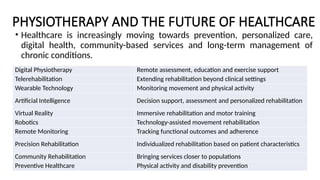
PHYSIOTHERAPY AND THE FUTURE OF HEALTHCARE
• Healthcare is increasingly moving towards prevention, personalized care,
digital health, community-based services and long-term management of
chronic conditions.
Digital Physiotherapy Remote assessment, education and exercise support
Telerehabilitation Extending rehabilitation beyond clinical settings
Wearable Technology Monitoring movement and physical activity
Artificial Intelligence Decision support, assessment and personalized rehabilitation
Virtual Reality Immersive rehabilitation and motor training
Robotics Technology-assisted movement rehabilitation
Remote Monitoring Tracking functional outcomes and adherence
Precision Rehabilitation Individualized rehabilitation based on patient characteristics
Community Rehabilitation Bringing services closer to populations
Preventive Healthcare Physical activity and disability prevention
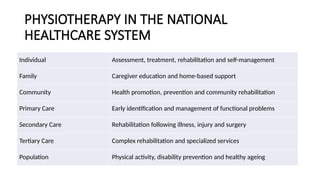
PHYSIOTHERAPY IN THE NATIONAL
HEALTHCARE SYSTEM
Individual Assessment, treatment, rehabilitation and self-management
Family Caregiver education and home-based support
Community Health promotion, prevention and community rehabilitation
Primary Care Early identification and management of functional problems
Secondary Care Rehabilitation following illness, injury and surgery
Tertiary Care Complex rehabilitation and specialized services
Population Physical activity, disability prevention and healthy ageing
REFERENCES
• World Physiotherapy. What is physiotherapy? Geneva: World Physiotherapy.
• World Health Organization. Rehabilitation. Geneva: WHO.
• World Health Organization. Rehabilitation in health systems. Geneva: WHO; 2017.
• World Health Organization. Noncommunicable diseases. Geneva: WHO.
• World Health Organization. Global action plan on physical activity 2018–2030: More active people
for a healthier world. Geneva: WHO; 2018.
• World Health Organization. World report on ageing and health. Geneva: WHO; 2015.
• World Health Organization. Global status report on physical activity 2022. Geneva: WHO; 2022.
• World Health Organization. International Classification of Functioning, Disability and Health (ICF).
Geneva: WHO; 2001.
• World Physiotherapy. Policy statement: Description of physiotherapy. Geneva: World Physiotherapy.
• Cott CA, Finch E, Gasner D, Yoshida K, Thomas SG, Verrier MC. The movement continuum theory of
physical therapy. Physiother Can. 1995;47(2):87-95.
THANK YOU