INTRODUCTION TO CATIA
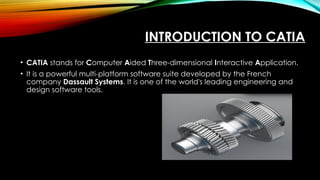
•CATIA stands for Computer Aided Three-dimensional Interactive Application.
• It is a powerful multi-platform software suite developed by the French
company Dassault Systems. It is one of the world's leading engineering and
design software tools.
3.
KEY FEATURES ANDCAPABILITIES
• Multi-Disciplinary Suite: Unlike simple drawing tools, CATIA combines three
major areas:
• CAD (Computer-Aided Design): For creating 2D drawings and 3D models.
• CAM (Computer-Aided Manufacturing): For simulating manufacturing
processes and generating codes for CNC machines.
• CAE (Computer-Aided Engineering): For analyzing physical properties
(thermal, stress, fluid dynamics) to test designs virtually.
4.
•Parametric & Feature-BasedModeling: It allows designers to use parameters (dimensions, constraints)
to define a model. If you change one dimension later, the entire 3D model updates automatically to reflect
that change.
•Advanced Surface Modeling: CATIA is famous for its Generative Shape Design workbench. It excels at
creating complex, free-form surfaces (like the aerodynamic curves of a car body or airplane wing) often
referred to as "Class A" surfacing.
•Product Lifecycle Management (PLM): It manages the product's entire life cycle—from the initial concept
and design to manufacturing, analysis, and maintenance.
•Workbench Architecture: The software is organized into specific "Workbenches" based on the task, such
as: Part Design (Solid modeling)Assembly Design (Putting parts together)Drafting (2D manufacturing
sheets)Kinematics (Simulating movement)
5.
INDUSTRIAL USES
• Becauseof its ability to handle extremely large and complex assemblies,
CATIA is the standard choice in heavy industries:
• Aerospace: Used by major companies like Boeing and Airbus to design
entire aircraft.
• Automotive: Used by manufacturers like BMW, Ford, and Honda for
bodywork and engine components.
• Industrial Machinery: Used for designing complex tooling and heavy
equipment.
6.
INTRODUCTION TO SOLIDWORKS
•SolidWorks is a solid modeling computer-aided design (CAD) and computer-
aided engineering (CAE) application.
• Like CATIA, it is currently owned and developed by Dassault Systems, but it
was originally created to be a more user-friendly, desktop-focused
alternative to high-end systems. It is widely considered the industry standard
for product design and mechanical engineering.
7.
KEY FEATURES &CAPABILITIES
• Parametric Feature-Based Modeling: This is the core logic of SolidWorks. You
create 2D sketches and apply "features" (like extrusions, cuts, or revolves) to
turn them into 3D solids. "Parametric" means the model is driven by
dimensions; if you change a dimension value (e.g., length from 100mm to
120mm), the 3D model updates automatically.
• Assembly Design: You can combine individual "Part" files into an "Assembly"
file. It allows you to define how parts interact using "Mates" (rules that align
faces, holes, or edges) to simulate mechanical motion.
8.
• Ease ofUse: SolidWorks is famous for its intuitive user interface. It utilizes a
clear "Feature Manager Design Tree" (a history of every step you took to
make the part) which makes editing and fixing errors much easier than in
many other CAD programs.
• Simulation (CAE): It includes robust tools to test designs before they are built,
such as:
1. Finite Element Analysis (FEA) to test stress and strength.
2. Fluid Flow (CFD) to test aerodynamics or cooling.
• Drafting: It automatically generates 2D manufacturing drawings from the 3D
model. These drawings remain linked to the 3D file, so they update instantly if
the design changes.
9.
INDUSTRIAL USES
• WhileCATIA is preferred for massive systems (like whole airplanes), SolidWorks
is the king of product design and machine components:
• Consumer Products: Used to design everything from blenders and cameras
to furniture and toys.
• Industrial Machinery: The standard tool for designing robots, conveyor belts,
and factory automation equipment.
• Medical Devices: Widely used for creating precise medical instruments and
prosthetics.