2
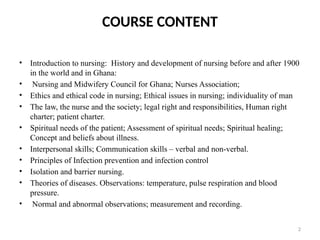
COURSE CONTENT
• Introductionto nursing: History and development of nursing before and after 1900
in the world and in Ghana:
• Nursing and Midwifery Council for Ghana; Nurses Association;
• Ethics and ethical code in nursing; Ethical issues in nursing; individuality of man
• The law, the nurse and the society; legal right and responsibilities, Human right
charter; patient charter.
• Spiritual needs of the patient; Assessment of spiritual needs; Spiritual healing;
Concept and beliefs about illness.
• Interpersonal skills; Communication skills – verbal and non-verbal.
• Principles of Infection prevention and infection control
• Isolation and barrier nursing.
• Theories of diseases. Observations: temperature, pulse respiration and blood
pressure.
• Normal and abnormal observations; measurement and recording.
3.
3
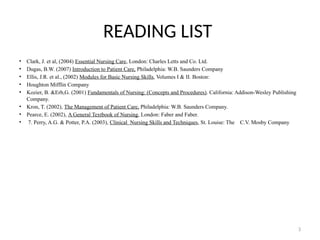
READING LIST
• Clark,J. et al, (2004) Essential Nursing Care, London: Charles Letts and Co. Ltd.
• Dugas, B.W. (2007) Introduction to Patient Care, Philadelphia: W.B. Saunders Company
• Ellis, J.R. et al., (2002) Modules for Basic Nursing Skills, Volumes I & II. Boston:
• Houghton Mifflin Company
• Kozier, B. &Erb,G. (2001) Fundamentals of Nursing: (Concepts and Procedures). California: Addison-Wesley Publishing
Company.
• Kron, T. (2002), The Management of Patient Care, Philadelphia: W.B. Saunders Company.
• Pearce, E. (2002), A General Textbook of Nursing, London: Faber and Faber.
• 7. Perry, A.G. & Potter, P.A. (2003), Clinical Nursing Skills and Techniques, St. Louise: The C.V. Mosby Company
4.
4
• The AustralianCouncil of Professions (2004)
defined a profession as ‘a disciplined group of
individuals who adhere to ethical standards and
uphold themselves to, and are accepted by, the
public as possessing special knowledge and skills
in a widely recognized body of learning derived
from research, education, and training at a high
level and who are prepared to exercise this
knowledge and these skills in the interest of others.
What is a profession? Contd.
5.
5
Professions have aclearly defined, highly
developed, specialized and theoretical
knowledge base; and they control training,
certification, and licensing of new entrants;
they are self-governing and self-policing
authority, especially with regard to professional
ethics; and they have a commitment to public
service.
Profession
6.
6
• Professions haveautonomy and therefore
professionals are seen to have considerable
work autonomy, and they enjoy comfortable
salaries, and engage in creative and
intellectually challenging work.
• How can we apply creativity in our
profession?
Profession contd.
7.
7
Criteria includeacademic qualification leading to
expert and specialized knowledge.
With this knowledge, the professional is able to
exhibit excellent manual/practical and literally skills
and have high quality work output.
Observes high standard of professional ethics and
behaviour that helps him/her to put the interest of
the client first;
Self-motivated and does not require supervision
when working.
Profession Contd.
8.
8
Regulated bystatutes and laws of the state.
Professional bodies also have responsibilities to
define, promote, oversee, support, and regulate the
affairs of its members.
Where individual professionals fail to perform at the
desired level of expertise, colleagues are trusted to
undertake the proper regulatory action against such a
member.
Professions enjoy a high social status, regard, and
esteem conferred upon them by society
Profession Contd.
9.
9
• Nursing isboth an art and a science and also
nurses work in a complex multidisciplinary
environment that create many challenges due to
the interlacing roles and responsibilities bestowed
on the nurse.
• The subject area of nursing also encompasses the
social and the natural sciences and hence, nursing
does not have a single area of theoretical base
that could be associated with other professions.
Nursing as a profession with a focus on the
Ghanaian context
10.
10
The professionalnurse has a plethora of subjects that
prepares him/her to be that ‘expert’ that is required of a
professional.
Nursing cannot lay ownership of one subject area and this
creates many challenges during the education/training of the
nurse.
Nursing programmes are seen to be overloaded and the
student has to carry many credit hours during the course of
training.
Where tutors are inadequate, the few tutors available may
be over-worked as they try to teach all the prescribed
courses.
Nursing as a profession contd.
11.
11
INTRODUCTION TO NURSING
•Definition of Nursing
Nursing has been defined by various nursing theorists .A
nursing theorist is a person who has tried systematically to
explain the bases and principles of nursing practice.
The first Theorist was Florence Nightingale . She advance a
new concept of the profession by viewing nursing as based on a
separate body of knowledge from that of medicine she
defined nursing as the “Art of utilizing the environment of the
patient to assist him or her in his recovery”. She also stated that
“put the patient in the best condition for nature to act on him”.
12.
12
DEFINITION OF NURSINGCONT.
• VIRGINIA HENDERSON(1966):-“The unique function of
the nurse is to assist the individual sick or well in the
performance of those activities contributing to health or his
recovery (or to a peaceful death), that he would have
performed unaided if he had the necessary strength ,will or
knowledge. To do this in such a way as to help him gain
independence as rapidly as possible.
DOROTHEA OREM (1985):- Defined nursing as “The ability
to assist other in the design, provision and management of
systems of health care to improve or to maintain human
function at some level of effectiveness “.
13.
13
DEFINITION OF NURSINGCONT.
• TRAVEL BEE:- Defined nursing as “An interpersonal
process whereby the nurse practitioner assist an individual
or family to prevent or cope with the experience of illness
and suffering and if necessary assist the individual or
family to find meaning in his experiences.
• INTERNATIONAL COUCIL OF NURSES (1975):-
Adopted Virginia Henderson’s definition but defined the
nurse as “a person who had completed a programme of
basic nursing education and is qualified and authorized in
his or her country to practice nursing by virtue of his
technical knowledge and practical ability.
14.
14
Definition of nursingcont.
According to the Royal College of nursing (2003) the characteristic
that define nursing make the profession unique. Most of the definitions
of nursing have common themes that run through them which show the
complexity of nursing .Some of these themes demonstrates that
• Nursing is Caring
• Nursing is an Art
• Nursing is a Science
• Nursing is Patient Centered
• Nursing is Holistic
• Nursing is Adaptive
• Nursing is concerned with Health education, Health Promotion and
prevention of ill health.
• Nursing is evidence based
15.
15
Definition of nursingcont.
• In 2003, the Royal College of nursing defined nursing,
stating that the purpose of nursing is to promote health
,healing, growth and development and to prevent
disease, illness, injury and disability(2003). This is one
of the few recent definitions of nursing.
• A nurse is therefore a person who has completed a
program of basic nursing education and is qualified
and authorised in his/her country to practice by virtue
of his technical knowledge and practical ability (ICN).
16.
16
Brief History anddevelopment of nursing before and
after 1900 in the world (including history of Florence
Nightingale).
• Nursing is believed to have originated from the
primitive mother who cared for all sick members
of her family. The term nurse originated from Latin
word ‘nutrix’ or ‘nutrio’ which means to nourish.
• It is believed that men and women were caring for
the needs of their children and the sick from
beginning of civilisation. However very little has
been written about nursing as a unique function in
primitive times.
17.
17
History of nursingcont.
• Later the Romans established nursing homes for their
slaves and nursing activities were carried out by the
slaves themselves as well as doctors.
• There were deaconesses called Sisters of Mercy
(nuns) whose fed, bathed and comforted the sick and
wounded during wars.
• This continued until the nineteenth century when a
group called the sisters of charity under the leadership
of Florence Nightingale offered another form of
organized nursing care.
18.
18
FLORENCE NIGHTINGALE
Florence Nightingaleis known as the heroine of
the Crimean war, the reformer of the
administration in the military and civil hospitals
and public hygiene. Florence Nightingale is
regarded as the founder of modern nursing.
She was born on May 12th
, 1820, in Florence,
Italy. Florence Nightingale belonged to a
renowned British family, the second daughter of
William Edward Nightingale and Frances Smith
19.
19
FLORENCE NIGHTINGALE CONT.
•At the age of sixteen Florence told her parents
she wanted to go into nursing. She wrote ‘‘ I
should like to advise all young ladies to feel
the call to come to the nursing profession,
train you for it in the way man trains for his
work. Do not believe that you can learn to
understand it in any other way’’
20.
20
FLORENCE AND THECRIMEAN WAR
• Crimean war broke in 1854, at that time,
England had only untrained men to look after
soldiers. She offered her services to the
Minister of War, Sir Sidney Herbert. With
his help, she went with a team of 38 nurses
and went to help at Scutari where the war was
taking place
21.
21
FLORENCE AND THECREMEAN WAR
cont.
• She worked in the barracks hospitals. The
hospitals were dirty, crowded and poorly
ventilated. There was no clothing or other
hospital equipment. The quality of food was
poor, 40% of patients used to die due to
infections and poor sanitary conditions,
however, it reduced to 2% under her watch
22.
22
FLORENCE AND THECREMEAN WAR
cont.
• As an excellent commander, Florence
Nightingale accepted the responsibility of
nursing the soldiers. Her nurses worked under
strict discipline with doctors and improved the
hygienic and dietary conditions of the soldiers.
She visited the wounded soldiers with a
lighted lamp during the night shifts, so she was
known as the “Lady with the lamp”
23.
23
FLORENCE AND THECREMEAN WAR
cont.
• Nurses all over the world rightly
commemorate her birthday as “International
Nurses Day”
• She died on 13th
August, 1910
24.
24
HISTORY OF NURSINGIN GHANA
• The first modern medical workers in Ghana were
missionary Doctors who employed male orderlies to
do most elementary duties such as washing and
feeding the male patients.
• Organized medical works started in 1878 when
medical officers sent by the colonial government
arrived in Ghana. Like their missionary counterparts
they also used male orderlies. The first colonial
nursing sister arrived in the Gold Coast in the year
1899 and started the training of Nurses.
25.
25
HISTORY OF NURSINGIN GHANA cont.
• In 1947, the Nurses Board was set up and the
first principal was appointed to head the
nursing service of the country. The first
Principal Matron was Miss Gladys R. Mutton.
• In 1953 under the first Ghanaian Minister of
Health Mr. Imoro Egala, the ministry of
health was set up to replace the colonial
medical service department.
26.
26
THE NURSING TRAININGPROGRAMME
IN GHANA
• Formal nursing education began in the Gold
Coast in 1899 when a British ward Sister was
sent to Accra and in the years that followed the
British sisters gradually instituted organized
training for both men and women based on
apprenticeship system. This resulted in the
Qualified Registered Nursing (QRN) training
programme
27.
27
THE NURSING TRAININGPROGRAMME
IN GHANA cont.
In the early 1940s it was felt that the a new system of
training should be introduced to bring the Gold Coast
in line with other countries like the U.K. and U.S.A.
As a result of this, the first State Registered
Nursing (SRN) training programme commenced
in January 1945 at Kumasi with six candidates.
The SRN school moved to Accra in 1948 when the
Nurses Training College Korle-Bu was opened
28.
28
THE NURSING TRAINING
PROGRAMMEIN GHANA cont.
• In 1970, the enrolled nurses’ training programme
was introduced to relieve professional nurses of
the non-skilled nursing duties.
• Currently, the SRN programme has been
upgraded to DIPLOMA in Nursing programme
since 1999. It is a 6 semester course
• Today, we have BSc., MSc./Mphil, PhD/DNP,
many specializations, nursing Consultants,
Professors in nursing and the list goes on and
on…..
29.
29
THE NURSES PLEDGE
Iacknowledge that the special training I have
received has prepared me as a responsible
member of the community. I promise to care for
the sick with all the skill I possess, no matter
what their race, creed, colour, political, or social
status, sparing no effort to conserve life, alleviate
pain and promote health. I promise to respect at
all times the dignity of the patient in my charge.
30.
30
NURSES PLEDGE CONT.
•I promise to hold in confidence all personal
information entrusted to me. I promise to keep my
knowledge and skill at the professional level and to
give the highest standard of nursing care to my
patients. I promise to carry out intelligently and
loyally medical instructions given to me . I promise
that my personal life shall at all times bring credit to
my profession. I promise to share in the responsibility
of other professions and citizens for promoting health
locally, nationally and internationally. So help me God
 Most read
 Most read