PRODUCTION AND OPERATIONS
MANAGEMENT
UNIT I
Meaning of Production Management
Definition:
Production Management is the process of
planning, organizing, directing, and
controlling production activities to create
goods or services efficiently.
Nature
• Goal-Oriented – Achieves production targets.
• Continuous – Ongoing activity.
• Systematic – Follows structured processes.
• Decision-Based – Involves strategic choices.
• Integrated – Works with other departments.
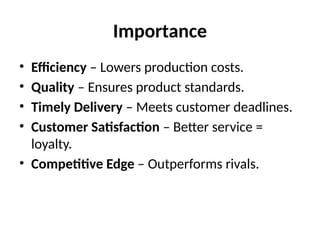
Importance
• Efficiency – Lowers production costs.
• Quality – Ensures product standards.
• Timely Delivery – Meets customer deadlines.
• Customer Satisfaction – Better service =
loyalty.
• Competitive Edge – Outperforms rivals.
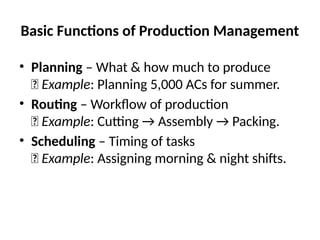
Basic Functions of Production Management
• Planning – What & how much to produce
🔹 Example: Planning 5,000 ACs for summer.
• Routing – Workflow of production
🔹 Example: Cutting → Assembly → Packing.
• Scheduling – Timing of tasks
🔹 Example: Assigning morning & night shifts.
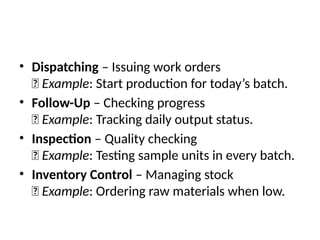
• Dispatching – Issuing work orders
🔹 Example: Start production for today’s batch.
• Follow-Up – Checking progress
🔹 Example: Tracking daily output status.
• Inspection – Quality checking
🔹 Example: Testing sample units in every batch.
• Inventory Control – Managing stock
🔹 Example: Ordering raw materials when low.
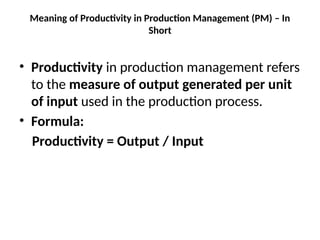
Meaning of Productivity in Production Management (PM) – In
Short
• Productivity in production management refers
to the measure of output generated per unit
of input used in the production process.
• Formula:
Productivity = Output / Input
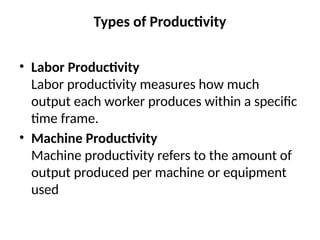
Types of Productivity
• Labor Productivity
Labor productivity measures how much
output each worker produces within a specific
time frame.
• Machine Productivity
Machine productivity refers to the amount of
output produced per machine or equipment
used
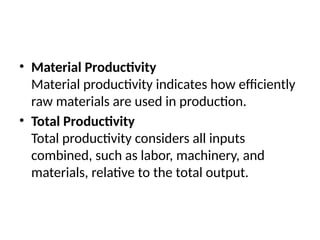
• Material Productivity
Material productivity indicates how efficiently
raw materials are used in production.
• Total Productivity
Total productivity considers all inputs
combined, such as labor, machinery, and
materials, relative to the total output.
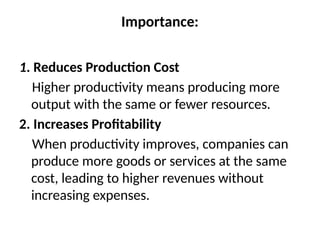
Importance:
1. Reduces Production Cost
Higher productivity means producing more
output with the same or fewer resources.
2. Increases Profitability
When productivity improves, companies can
produce more goods or services at the same
cost, leading to higher revenues without
increasing expenses.
3. Enhances Competitiveness in the Market
Companies with higher productivity can offer
better prices, improved quality, or faster
delivery compared to competitors.
4. Ensures Optimal Resource Utilization
Productivity encourages the effective use of
all resources, including labor, machinery, and
raw materials.
5. Supports Business Growth and Customer
Satisfaction
Sustained productivity improvements enable
businesses to meet growing customer
demands by producing high-quality products
on time.
Efficiency meaning
Efficiency in production management refers to
the ability to produce maximum output with
minimum input, such as time, labor, and
materials.
Types of Efficiency in Production Management
• Technical Efficiency
• Operational Efficiency
• Cost Efficiency
Importance of Efficiency in Production Management
• Cost Reduction
• Improved Productivity
• Higher Quality Output
• Faster Production Cycles
• Sustainable Resource Use
Effectiveness in Production Management
Meaning
Effectiveness is about producing the right
products that meet customer needs, at the
right time, and in the right quantity and
quality.
Importance of Effectiveness in Production Management
1. Customer Satisfaction
2. Alignment with Business Goals
3. Market Competitiveness
4. Reduction of Wasteful Production
5. Long-Term Business Success
6. Improved Coordination and Focus
Types of Effectiveness in Production Management
1. Product Effectiveness
2. Process Effectiveness (six sigma) - A way to make
things better by reducing mistakes.
• Define – What’s the problem?
• Measure – How bad is it?
• Analyze – Why is it happening?
• Improve – How can we fix it?
• Control – How do we keep it fixed?
3. Strategic Effectiveness
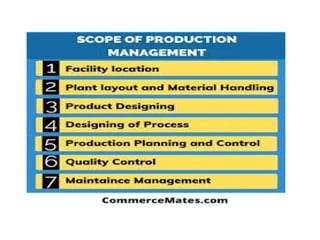
PLANT LOCATION
Plant location means where the plant should
be located. This is very important business
activity which decide the fate of the business
locating.
IMPORTANCE
1. Cost Reduction
An ideal plant location can significantly reduce
production and distribution costs.
2. Efficient Supply Chain
Locating a plant near suppliers and customers
enhances supply chain efficiency. It shortens
lead times, reduces inventory holding costs,
and improves delivery reliability.
3. Access to Resources:
A good location ensures easy access to essential
resources like raw materials, power, and skilled labor.
4. Market Proximity:
Being close to the target market reduces distribution
time and costs
5. Long-Term Viability
A well-researched plant location contributes to long-
term business sustainability.
When the need for selecting suitable
selection arise??
o While starting a new factory.
o During the expansion of existing plant.
o When the existing plant is to be re-located
at some other place to remove the drawback
of present location or to gain benefits of still
better location.
THE PROBLEM OF LOCATION:
The problem of site selection of a factory can
be solved in the following three steps:
1. Selection of region
2. Selection of locality
3. Selection of actual site
• Selection of region
Generally the geographical area is divided on the basis of
natural regions or political boundaries with in the nation.
Problems:
• Large regions may have varied conditions, making it hard
to choose the best one.
• Political issues or policies in some regions may cause
delays or restrictions.
• Cost advantages may change due to economic shifts,
making one region less attractive over time.
• Selection of Locality
Within the chosen region, a specific locality is selected.
The options are usually urban, suburban, or rural areas.
Problems:
• Urban areas may have higher costs and congestion but
better facilities.
• Rural areas might have cheaper land but lack
infrastructure and skilled labor.
• Choosing the wrong locality can increase transport costs
or cause supply chain issues.
• Selection of Site
While selecting the exact site, factors like possibility of
plant expansion and availability of infrastructure such
as transport, banking, power, and communication are
considered.
Problems:
• Limited space for future expansion can restrict growth.
• Poor infrastructure may lead to delays or higher
operating costs.
ADVANTAGES
• Good transportation facilities.
• Good postal and communication facility.
• Banking and insurance facility.
• Skilled and unskilled workers.
• Fairly high local demand.
DISADVANTAGES
• Cost of land is very high.
• Due to high standard of living, cost of labour is
high.
• Even at high cost, sufficient land is not
available.
• Various types of taxes are charge and at high
rate.
PLANT LAYOUT
Plant layout refers to the arrangement of
machines, equipment, workstations, and
resources within a manufacturing or
production facility.
PRINCIPLES OF PLANT LAYOUT
• Integration
• Minimum Movements and Material Handling
• Smooth and Continuous Flow
• Cubic Space Utilization - Use both floor and
vertical space effectively.
• Safe and Improved Environments
• Flexibility - the ability to adapt easily to changes in
production, such as new products, processes, or
volume.
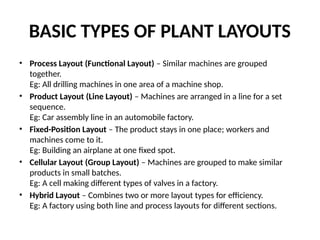
BASIC TYPES OF PLANT LAYOUTS
• Process Layout (Functional Layout) – Similar machines are grouped
together.
Eg: All drilling machines in one area of a machine shop.
• Product Layout (Line Layout) – Machines are arranged in a line for a set
sequence.
Eg: Car assembly line in an automobile factory.
• Fixed-Position Layout – The product stays in one place; workers and
machines come to it.
Eg: Building an airplane at one fixed spot.
• Cellular Layout (Group Layout) – Machines are grouped to make similar
products in small batches.
Eg: A cell making different types of valves in a factory.
• Hybrid Layout – Combines two or more layout types for efficiency.
Eg: A factory using both line and process layouts for different sections.
HYBRID LAYOUT
A Hybrid Layout is a type of plant or facility
layout that combines two or more traditional
layout types—such as product layout, process
layout, and fixed-position layout—to benefit
from the strengths of each and minimize their
limitations.
PROS OF HYBRID LAYOUTS
• Flexibility
• Efficient Use of Resources
• Improved Workflow
• Supports Variety and Volume
• Better Space Utilization
Cons of Hybrid Layouts
• Complex Design
• Higher Initial Cost
• Material Handling Challenges
• Management Difficulty
• Training Requirements