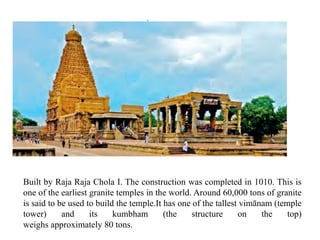
Built by RajaRaja Chola I. The construction was completed in 1010. This is
one of the earliest granite temples in the world. Around 60,000 tons of granite
is said to be used to build the temple.It has one of the tallest vimānam (temple
tower) and its kumbham (the structure on the top)
weighs approximately 80 tons.
3.
Overview of IndianKnowledge System (IKS)
• IKS refers to the diverse and comprehensive
body of knowledge that has developed in India
over millennia.
• Covers various fields: Philosophy, Science,
Mathematics, Medicine, Art, Architecture,
Language, etc.
• Rooted in ancient texts, oral traditions, and
practical knowledge.
4.
Core Concepts ofIKS
Vedic Knowledge: Rituals, cosmic principles,
and the understanding of the universe.
Yoga & Meditation: Philosophical systems
for self-realization and health.
Sanskrit: The language of many classical
texts.
Dharma: Ethical principles and righteous
living.
5.
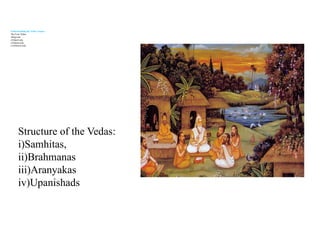
Understanding the VedicCorpus
The Four Vedas:
i)Rigveda
ii)Yajurveda
iii)Samaveda
iv)Atharvaveda
Structure of the Vedas:
i)Samhitas,
ii)Brahmanas
iii)Aranyakas
iv)Upanishads
6.
Ancient Indian contributionsto various
fields.
Mathematics (zero, decimal system, algebra).
Astronomy (calculations of planetary movements).
Medicine (Ayurveda and holistic healing).
Architecture (Vastu Shastra).
Historical Development of IKS
7.
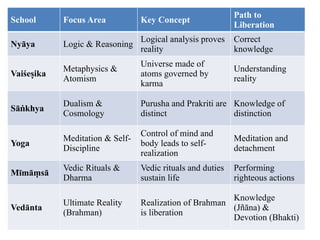
Philosophical Foundations ofIKS
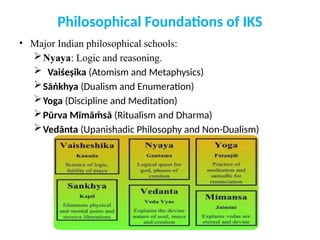
• Major Indian philosophical schools:
Nyaya: Logic and reasoning.
Vaiśeṣika (Atomism and Metaphysics)
Sāṅkhya (Dualism and Enumeration)
Yoga (Discipline and Meditation)
Pūrva Mīmāṁsā (Ritualism and Dharma)
Vedānta (Upanishadic Philosophy and Non-Dualism)
8.
School Focus AreaKey Concept
Path to
Liberation
Nyāya Logic & Reasoning
Logical analysis proves
reality
Correct
knowledge
Vaiśeṣ
ika
Metaphysics &
Atomism
Universe made of
atoms governed by
karma
Understanding
reality
Sā khya
ṅ
Dualism &
Cosmology
Purusha and Prakriti are
distinct
Knowledge of
distinction
Yoga
Meditation & Self-
Discipline
Control of mind and
body leads to self-
realization
Meditation and
detachment
Mīmāṃsā
Vedic Rituals &
Dharma
Vedic rituals and duties
sustain life
Performing
righteous actions
Vedānta
Ultimate Reality
(Brahman)
Realization of Brahman
is liberation
Knowledge
(Jñāna) &
Devotion (Bhakti)
9.
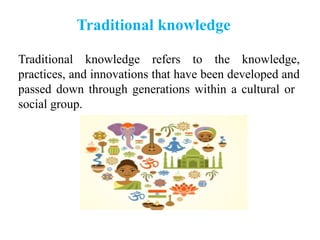
Traditional knowledge refersto the knowledge,
practices, and innovations that have been developed and
passed down through generations within a cultural or
social group.
Traditional knowledge
10.
Ayurveda: Health andwellness through holistic
approaches.
Vastu Shastra: Traditional architecture and its
impact on harmony and energy flow.
Agriculture: Indigenous methods and
sustainable practices.
Oral traditions and texts: Vedas, Upanishads,
Puranas, and more.
11.
Indigenous Knowledge (IK)
Indigenousknowledge is the unique,
traditional knowledge of Indigenous
communities developed through long-standing
interactions with their environment.
Indigenous knowledge (IK) includes the
expres-sions,practices, beliefs,understandings,
insights,and experiences of Indigenous groups,
generated over centuries
12.
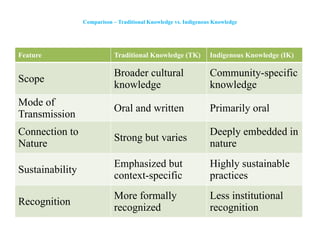
Comparison – TraditionalKnowledge vs. Indigenous Knowledge
Feature Traditional Knowledge (TK) Indigenous Knowledge (IK)
Scope
Broader cultural
knowledge
Community-specific
knowledge
Mode of
Transmission
Oral and written Primarily oral
Connection to
Nature
Strong but varies
Deeply embedded in
nature
Sustainability
Emphasized but
context-specific
Highly sustainable
practices
Recognition
More formally
recognized
Less institutional
recognition
13.
Examples of TraditionalKnowledge in India
Ayurveda – Ancient Indian medical system
based on nature and balance.
Yoga & Meditation – Physical and spiritual
well-being practices.
Vedic Mathematics – Ancient mathematical
concepts and techniques.
Rasayana (Alchemy & Metallurgy) –
Indigenous methods for material processing.
14.
Examples of IndigenousKnowledge in India
Tribal Agricultural Practices – Mixed
cropping, seed preservation.
Ethnomedicine – Traditional healing methods
in tribal communities.
Handloom & Craft Traditions – Weaving
techniques unique to communities.
Sacred Groves & Conservation – Indigenous
conservation practices.
15.
Western Knowledge (WK)
•Definition: Western knowledge is a system of
knowledge developed through structured
methodologies, empirical evidence, and
scientific reasoning, largely influenced by the
Enlightenment era.
16.
Features:
Evidence-based and systematicallyrecorded.
Emphasizes logic, rationality, and objectivity.
Frequently updated with new discoveries and
innovations.
Highly institutionalized through universities
and research centers.
17.
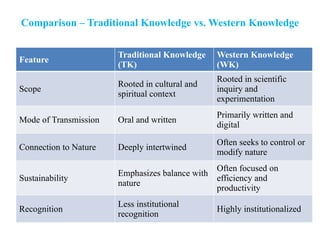
Comparison – TraditionalKnowledge vs. Western Knowledge
Feature
Traditional Knowledge
(TK)
Western Knowledge
(WK)
Scope
Rooted in cultural and
spiritual context
Rooted in scientific
inquiry and
experimentation
Mode of Transmission Oral and written
Primarily written and
digital
Connection to Nature Deeply intertwined
Often seeks to control or
modify nature
Sustainability
Emphasizes balance with
nature
Often focused on
efficiency and
productivity
Recognition
Less institutional
recognition
Highly institutionalized
18.
Examples of WesternKnowledge Contributions
Modern Medicine & Pharmaceuticals –
Scientific approach to healthcare.
Technology & Engineering – Innovations in
computing, AI, and engineering.
Astronomy & Space Science – Space
exploration advancements.
Physics & Chemistry – Fundamental scientific
theories and applications.
 Most read
 Most read
 Most read