Decoding the Future
An Introduction to Generative AI & Large Language Models
A foundational guide to understanding the technology reshaping how humans
think, work, and create — from the architecture behind the models to their real-
world impact today.
The AI Turning Point
We are living through one of the most significant technological inflection points in
history. Three landmark moments define this era:
1 2017
Google publishes the landmark Attention Is All You Need paper,
introducing the Transformer architecture — the foundational
blueprint for every modern LLM.
2 2022
The launch of ChatGPT triggers the fastest consumer technology
adoption in history, reaching 100 million users in just two months.
3 Today
Generative AI has evolved from a curiosity into an essential
cognitive partner — embedded in enterprise workflows, research,
and everyday productivity tools.
What is Generative AI?
Generative AI represents a fundamental departure from traditional
software. Conventional programs follow explicit, deterministic rules
written by engineers. Generative AI systems, by contrast, learn
patterns from vast datasets and produce entirely new content —
text, code, images, audio — that was never explicitly programmed.
This is the shift from rule-based logic to probabilistic intelligence:
systems that approximate human reasoning by learning the
statistical structure of language and knowledge itself.
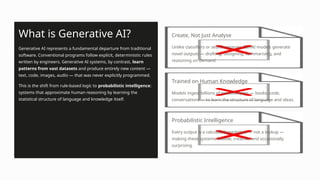
Create, Not Just Analyse
Unlike classifiers or search engines, GenAI models generate
novel outputs — drafting, designing, summarising, and
reasoning on demand.
Trained on Human Knowledge
Models ingest billions of text examples — books, code,
conversations — to learn the structure of language and ideas.
Probabilistic Intelligence
Every output is a calculated prediction — not a lookup —
making these systems flexible, creative, and occasionally
surprising.
Anatomy of an LLM: The Basics
The name Large Language Model is deliberately descriptive. Each word carries critical meaning about how these systems are built and why they
behave as they do.
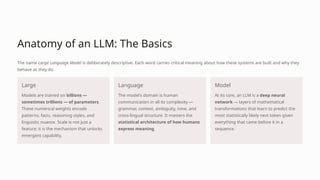
Large
Models are trained on billions —
sometimes trillions — of parameters.
These numerical weights encode
patterns, facts, reasoning styles, and
linguistic nuance. Scale is not just a
feature; it is the mechanism that unlocks
emergent capability.
Language
The model's domain is human
communication in all its complexity —
grammar, context, ambiguity, tone, and
cross-lingual structure. It masters the
statistical architecture of how humans
express meaning.
Model
At its core, an LLM is a deep neural
network — layers of mathematical
transformations that learn to predict the
most statistically likely next token given
everything that came before it in a
sequence.
How It Works: The Art of Prediction
At its heart, an LLM is a remarkably sophisticated next-token prediction engine. Understanding
this mechanism demystifies both its impressive capabilities and its known limitations.
Tokenisation
Text is broken into tokens — not just whole words, but sub-word units,
numbers, punctuation, and symbols. A single sentence may become 15–25
tokens.
Probability Calculation
The model computes a probability distribution over its entire vocabulary
for what token should come next, given the full context of the conversation
so far.
Emergent Reasoning
Having trained on virtually all available human text, the model's predictions
encode reasoning, coding ability, summarisation, and creativity —
capabilities that emerge from scale, not explicit instruction.
Major Architectures
Not all language models are built the same way. The architectural choices made during design determine what tasks a model excels at and how
it is deployed in practice.
Decoder-Only
The dominant architecture for conversational
AI. Models like GPT-4, Claude, and Llama use
decoder-only transformers that generate text
autoregressively — one token at a time, left
to right — making them powerful generalists
for chat, code, and content creation.
Encoder-Decoder
Architectures like T5 and BART use an
encoder to deeply understand input and a
decoder to produce output. These are
purpose-built for tasks requiring structured
transformation — particularly translation,
summarisation, and question answering
over long documents.
Foundation Models
The raw, massively pre-trained powerhouses
that serve as a starting point for fine-
tuning. Organisations adapt foundation
models to specific industries — legal, medical,
financial — without the cost of training from
scratch.
The Real-World Transformation
Generative AI is no longer a research curiosity — it is actively reshaping how professionals work across every sector of the economy. The
productivity gains are measurable and compounding.
1
Software Development
GitHub Copilot studies show developers
write code up to 55% faster with AI
assistance. Models suggest completions,
catch bugs, generate boilerplate, and
explain legacy code — compressing
hours of work into minutes.
2
Business Operations
Enterprises are deploying LLMs to
automate customer support, internal
knowledge retrieval, contract drafting,
and marketing workflows — freeing
human talent for higher-order strategic
and creative work.
3
Scientific Research
Researchers are using LLMs to parse
decades of academic literature in
seconds, identify novel hypotheses, and
accelerate drug discovery — dramatically
compressing the timeline from idea to
insight.
The Reality Check
Generative AI is a powerful but imperfect technology.
Deploying it responsibly requires a clear-eyed
understanding of its inherent limitations — not as reasons
to avoid it, but as challenges to engineer around
thoughtfully.
Understanding these limitations is not optional for
serious practitioners — it is the foundation of
responsible AI deployment.
Hallucinations
LLMs generate statistically plausible text — not verified facts. When a
model lacks knowledge, it may confidently fabricate citations, figures,
or events. Mitigation requires retrieval-augmented generation (RAG)
and human oversight.
Bias
Models trained on historical human text inherit the prejudices,
stereotypes, and imbalances present in that data. Left unaddressed,
this can result in discriminatory or unfair outputs at scale.
Drift
The world changes; training data does not. Models face a knowledge
cutoff challenge, and their performance can degrade as the gap
between training data and current context widens over time.
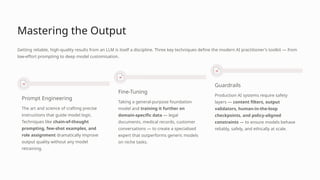
Mastering the Output
Getting reliable, high-quality results from an LLM is itself a discipline. Three key techniques define the modern AI practitioner's toolkit — from
low-effort prompting to deep model customisation.
Prompt Engineering
The art and science of crafting precise
instructions that guide model logic.
Techniques like chain-of-thought
prompting, few-shot examples, and
role assignment dramatically improve
output quality without any model
retraining.
Fine-Tuning
Taking a general-purpose foundation
model and training it further on
domain-specific data — legal
documents, medical records, customer
conversations — to create a specialised
expert that outperforms generic models
on niche tasks.
Guardrails
Production AI systems require safety
layers — content filters, output
validators, human-in-the-loop
checkpoints, and policy-aligned
constraints — to ensure models behave
reliably, safely, and ethically at scale.
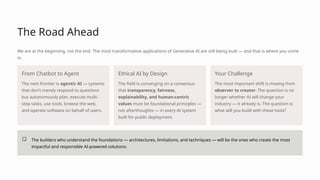
The Road Ahead
We are at the beginning, not the end. The most transformative applications of Generative AI are still being built — and that is where you come
in.
From Chatbot to Agent
The next frontier is agentic AI — systems
that don't merely respond to questions
but autonomously plan, execute multi-
step tasks, use tools, browse the web,
and operate software on behalf of users.
Ethical AI by Design
The field is converging on a consensus
that transparency, fairness,
explainability, and human-centric
values must be foundational principles —
not afterthoughts — in every AI system
built for public deployment.
Your Challenge
The most important shift is moving from
observer to creator. The question is no
longer whether AI will change your
industry — it already is. The question is:
what will you build with these tools?
The builders who understand the foundations — architectures, limitations, and techniques — will be the ones who create the most
impactful and responsible AI-powered solutions.