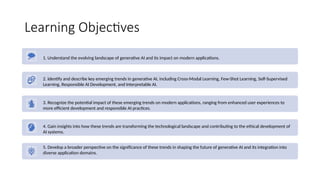
Learning Objectives
1. Understandthe evolving landscape of generative AI and its impact on modern applications.
2. Identify and describe key emerging trends in generative AI, including Cross-Modal Learning, Few-Shot Learning, Self-Supervised
Learning, Responsible AI Development, and Interpretable AI.
3. Recognize the potential impact of these emerging trends on modern applications, ranging from enhanced user experiences to
more efficient development and responsible AI practices.
4. Gain insights into how these trends are transforming the technological landscape and contributing to the ethical development of
AI systems.
5. Develop a broader perspective on the significance of these trends in shaping the future of generative AI and its integration into
diverse application domains.
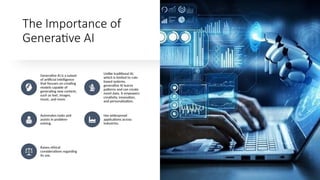
3.
The Importance of
GenerativeAI
Generative AI is a subset
of artificial intelligence
that focuses on creating
models capable of
generating new content,
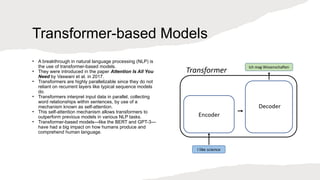
such as text, images,
music, and more.
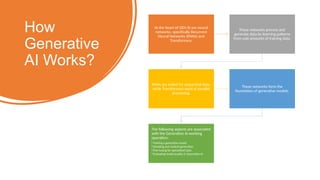
Unlike traditional AI,
which is limited to rule-
based systems,
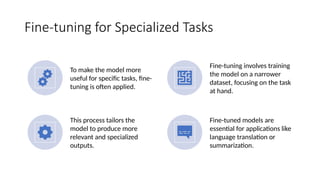
generative AI learns
patterns and can create
novel data. It empowers
creativity, innovation,
and personalization.
Automates tasks and
assists in problem-
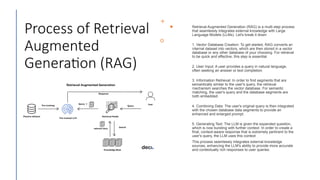
solving.
Has widespread
applications across
industries.
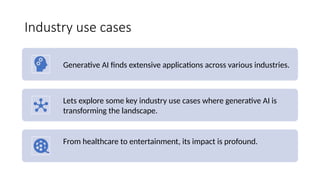
Raises ethical
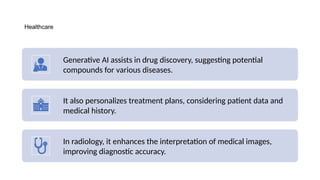
considerations regarding
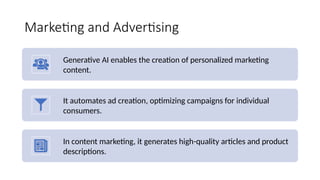
its use.
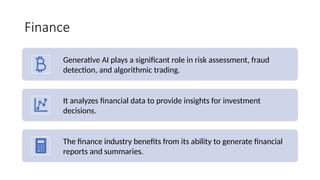
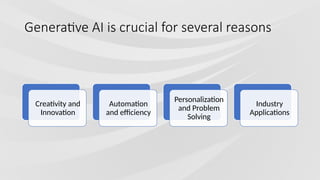
4.
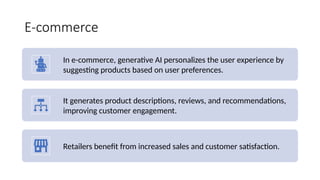
Generative AI iscrucial for several reasons
Creativity and
Innovation
Automation
and efficiency
Personalization
and Problem
Solving
Industry
Applications
5.
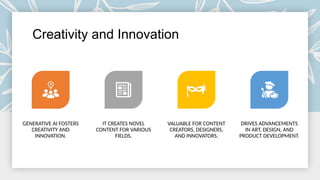
Creativity and Innovation
GENERATIVEAI FOSTERS
CREATIVITY AND
INNOVATION.
IT CREATES NOVEL
CONTENT FOR VARIOUS
FIELDS.
VALUABLE FOR CONTENT
CREATORS, DESIGNERS,
AND INNOVATORS.
DRIVES ADVANCEMENTS
IN ART, DESIGN, AND
PRODUCT DEVELOPMENT.
6.
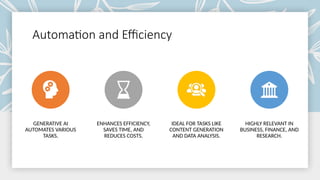
Automation and Efficiency
GENERATIVEAI
AUTOMATES VARIOUS
TASKS.
ENHANCES EFFICIENCY,
SAVES TIME, AND
REDUCES COSTS.
IDEAL FOR TASKS LIKE
CONTENT GENERATION
AND DATA ANALYSIS.
HIGHLY RELEVANT IN
BUSINESS, FINANCE, AND
RESEARCH.
7.
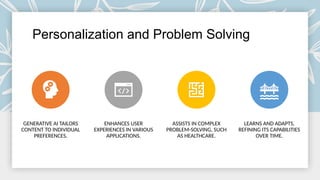
Personalization and ProblemSolving
GENERATIVE AI TAILORS
CONTENT TO INDIVIDUAL
PREFERENCES.
ENHANCES USER
EXPERIENCES IN VARIOUS
APPLICATIONS.
ASSISTS IN COMPLEX
PROBLEM-SOLVING, SUCH
AS HEALTHCARE.
LEARNS AND ADAPTS,
REFINING ITS CAPABILITIES
OVER TIME.
8.
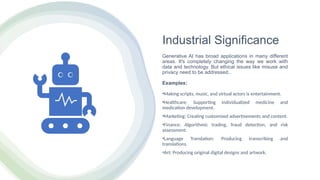
Industrial Significance
Generative AIhas broad applications in many different
areas. It's completely changing the way we work with
data and technology. But ethical issues like misuse and
privacy need to be addressed..
Examples:
•Making scripts, music, and virtual actors is entertainment.
•Healthcare: Supporting individualized medicine and
medication development.
•Marketing: Creating customized advertisements and content.
•Finance: Algorithmic trading, fraud detection, and risk
assessment.
•Language Translation: Producing transcribing and
translations.
•Art: Producing original digital designs and artwork.
9.
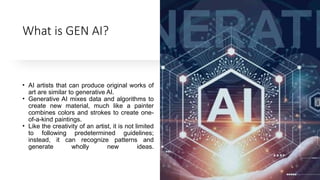
What is GENAI?
• AI artists that can produce original works of
art are similar to generative AI.
• Generative AI mixes data and algorithms to
create new material, much like a painter
combines colors and strokes to create one-
of-a-kind paintings.
• Like the creativity of an artist, it is not limited
to following predetermined guidelines;
instead, it can recognize patterns and
generate wholly new ideas.
10.
Generative
AI Analogy
Think ofgenerative AI as a chef in a kitchen.
The chef has a set of ingredients (data) and recipes
(algorithms).
Instead of following a fixed recipe, the chef can experiment,
create new dishes, and surprise you with unique flavors.
Similarly, generative AI uses data and algorithms as
ingredients to cook up new content, adding its own creative
touch.
11.
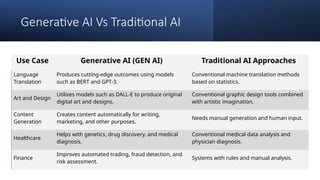
Generative AI VsTraditional AI
Use Case Generative AI (GEN AI) Traditional AI Approaches
Language
Translation
Produces cutting-edge outcomes using models
such as BERT and GPT-3.
Conventional machine translation methods
based on statistics.
Art and Design
Utilizes models such as DALL-E to produce original
digital art and designs.
Conventional graphic design tools combined
with artistic imagination.
Content
Generation
Creates content automatically for writing,
marketing, and other purposes.
Needs manual generation and human input.
Healthcare
Helps with genetics, drug discovery, and medical
diagnosis.
Conventional medical data analysis and
physician diagnosis.
Finance
Improves automated trading, fraud detection, and
risk assessment.
Systems with rules and manual analysis.
12.
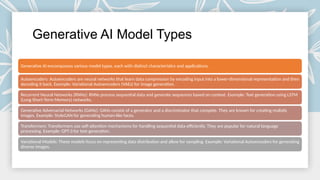
Generative AI ModelTypes
Generative AI encompasses various model types, each with distinct characteristics and applications.
Autoencoders: Autoencoders are neural networks that learn data compression by encoding input into a lower-dimensional representation and then
decoding it back. Example: Variational Autoencoders (VAEs) for image generation.
Recurrent Neural Networks (RNNs): RNNs process sequential data and generate sequences based on context. Example: Text generation using LSTM
(Long Short-Term Memory) networks.
Generative Adversarial Networks (GANs): GANs consist of a generator and a discriminator that compete. They are known for creating realistic
images. Example: StyleGAN for generating human-like faces.
Transformers: Transformers use self-attention mechanisms for handling sequential data efficiently. They are popular for natural language
processing. Example: GPT-3 for text generation.
Variational Models: These models focus on representing data distribution and allow for sampling. Example: Variational Autoencoders for generating
diverse images.
13.
Applications of GenerativeAI
Model Types
Generative AI model types find application in various domains.
• Autoencoders: Utilized in healthcare for anomaly
identification, dimensionality reduction, and image denoising.
• Recurrent Neural Networks (RNNs): Utilized in speech
recognition systems, language translation, and text production.
• Generative Adversarial Networks (GANs): Utilized for
deepfake video creation, image-to-image translation, and
image quality enhancement.
• Transformers: Vital for text summarization, chatbots, and
machine translation.
• Variational Models: Utilized in semi-supervised learning, data
augmentation, and picture synthesis.
These diverse model types allow generative AI to address a wide
range of problems and contribute to innovation across industries.
14.
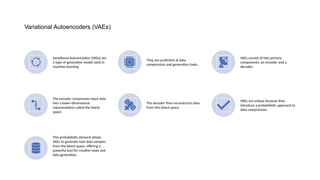
Variational Autoencoders (VAEs)
VariationalAutoencoders (VAEs) are
a type of generative model used in
machine learning.
They are proficient at data
compression and generation tasks.
VAEs consist of two primary
components: an encoder and a
decoder.
The encoder compresses input data
into a lower-dimensional
representation called the latent
space.
The decoder then reconstructs data
from this latent space.
VAEs are unique because they
introduce a probabilistic approach to
data compression.
This probabilistic element allows
VAEs to generate new data samples
from the latent space, offering a
powerful tool for creative tasks and
data generation.
15.
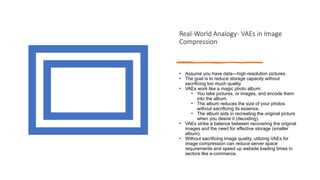
Real-World Analogy- VAEsin Image
Compression
• Assume you have data—high-resolution pictures.
• The goal is to reduce storage capacity without
sacrificing too much quality.
• VAEs work like a magic photo album:
• You take pictures, or images, and encode them
into the album.
• The album reduces the size of your photos
without sacrificing its essence.
• The album aids in recreating the original picture
when you desire it (decoding).
• VAEs strike a balance between recovering the original
images and the need for effective storage (smaller
album).
• Without sacrificing image quality, utilizing VAEs for
image compression can reduce server space
requirements and speed up website loading times in
sectors like e-commerce.
16.
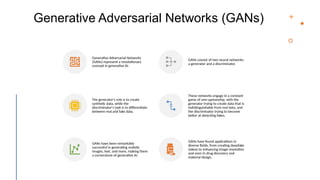
Generative Adversarial Networks(GANs)
Generative Adversarial Networks
(GANs) represent a revolutionary
concept in generative AI.
GANs consist of two neural networks:
a generator and a discriminator.
The generator's role is to create
synthetic data, while the
discriminator's task is to differentiate
between real and fake data.
These networks engage in a constant
game of one-upmanship, with the
generator trying to create data that is
indistinguishable from real data, and
the discriminator trying to become
better at detecting fakes.
GANs have been remarkably
successful in generating realistic
images, text, and more, making them
a cornerstone of generative AI.
GANs have found applications in
diverse fields, from creating deepfake
videos to enhancing image resolution
and even in drug discovery and
material design.
17.
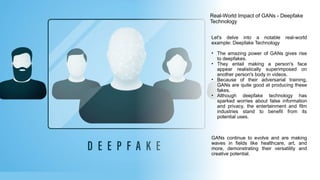
Real-World Impact ofGANs - Deepfake
Technology
Let's delve into a notable real-world
example: Deepfake Technology
• The amazing power of GANs gives rise
to deepfakes.
• They entail making a person's face
appear realistically superimposed on
another person's body in videos.
• Because of their adversarial training,
GANs are quite good at producing these
fakes.
• Although deepfake technology has
sparked worries about false information
and privacy, the entertainment and film
industries stand to benefit from its
potential uses.
GANs continue to evolve and are making
waves in fields like healthcare, art, and
more, demonstrating their versatility and
creative potential.
18.
Transformer-based Models
• Abreakthrough in natural language processing (NLP) is
the use of transformer-based models.
• They were introduced in the paper Attention Is All You
Need by Vaswani et al. in 2017.
• Transformers are highly parallelizable since they do not
reliant on recurrent layers like typical sequence models
do.
• Transformers interpret input data in parallel, collecting
word relationships within sentences, by use of a
mechanism known as self-attention.
• This self-attention mechanism allows transformers to
outperform previous models in various NLP tasks.
• Transformer-based models—like the BERT and GPT-3—
have had a big impact on how humans produce and
comprehend human language.
19.
Real-World Impact ofTransformers -
Language Translation
One practical example of Transformer-based Models is their
use in language translation.
• Conventional translation programs had trouble
understanding context in lengthy sentences and required
a fixed vocabulary.
• Transformers, on the other hand, are adept at translating
words while preserving context.
• They have enhanced the accuracy and fluency of
translations by powering tools like Google Translate.
• International commerce, travel, and internet content have
all benefited from the increased accessibility and
accuracy of cross-language communication.
Transformer-based models have a broad range of
applications, such as sentiment analysis, content
summarization, and chatbots, and they are still
revolutionizing natural language processing.
20.
How
Generative
AI Works?
At theheart of GEN AI are neural
networks, specifically Recurrent
Neural Networks (RNNs) and
Transformers.
These networks process and
generate data by learning patterns
from vast amounts of training data.
RNNs are suited for sequential data,
while Transformers excel at parallel
processing.
These networks form the
foundation of generative models.
The following aspects are associated
with the Generative AI working
operation:
•Training a generative model
•Sampling and content generation
•Fine-tuning for specialized tasks
•Evaluating model quality in Generative AI
21.
Training a
Generative Model
•A GEN AI model must be exposed
to enormous datasets in order to be
trained.
• The model gains the ability to
predict the following word or
element in a sequence through
training.
• This procedure uses
backpropagation to optimize a
collection of parameters.
• Training could require a large
investment of time and computing
power.
22.
Sampling and
Content Generation
•The model can produce content by
sampling from the probability
distributions it has learned after training.
• Sampling is the process of selecting the
subsequent word or element based on
the learnt information of the model.
• The method can be used stochastically
or deterministically, which will affect how
creative the result is.
• One important factor in assessing the
randomness of the result is the
sampling temperature.
23.
Fine-tuning for SpecializedTasks
To make the model more
useful for specific tasks, fine-
tuning is often applied.
Fine-tuning involves training
the model on a narrower
dataset, focusing on the task
at hand.
This process tailors the
model to produce more
relevant and specialized
outputs.
Fine-tuned models are
essential for applications like
language translation or
summarization.
24.
Evaluating Model Qualityin Generative AI
Assessing the quality of content generated by Generative AI models
is vital for choosing the right model and identifying areas for
improvement.
• Choosing the appropriate model for a given activity is essential
because every work has different needs. Models using
generative AI have specific advantages and disadvantages. For
example, one model may be really good at creating crisp visuals,
but another one might be very good at creating language that
makes sense.
• Assessing generative models is critical to choose the best model
for a particular task and improving the AI system's overall
performance. It assists you in making the best decision and lets
you customize the model to suit your individual requirements.
Three main requirements must be met when evaluating generative
models:
• Quality: In applications where consumers are directly involved,
the output quality is of utmost importance. For example, in
picture generation, image quality is important, while in voice
generation, low speech quality might impede understanding.
• Diversity: A well-designed generative model need to encompass
the entire spectrum of data distribution while maintaining the
caliber of generation. By reducing unwanted biases in the
trained models, this diversity ensures more balanced outputs.
• Speed: Fast generation speeds are required for many interactive
applications, such as content production and real-time image
editing. Rapidity of output generation is a key component in
assessing the efficacy of the model.
25.
Example – DALL-E
OpenAIcreated the generative AI model DALL-E as an example. A transformer
architecture with 12 billion parameters is utilized.
DALL-E has the amazing capacity to create visuals out of written information.
Its broad range of talents, all based on textual prompts, extends from producing
incredibly realistic images to creating surrealistic art.
For example, when given the prompt "an armchair in the shape of an avocado,"
DALL-E can cleverly generate a picture of an avocado-shaped armchair.
26.
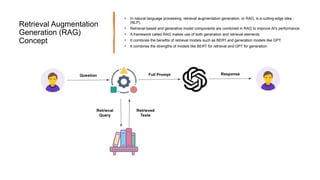
Retrieval Augmentation
Generation (RAG)
Concept
•In natural language processing, retrieval augmentation generation, or RAG, is a cutting-edge idea
(NLP).
• Retrieval-based and generative model components are combined in RAG to improve AI's performance.
• A framework called RAG makes use of both generation and retrieval elements.
• It combines the benefits of retrieval models such as BERT and generation models like GPT.
• It combines the strengths of models like BERT for retrieval and GPT for generation.
27.
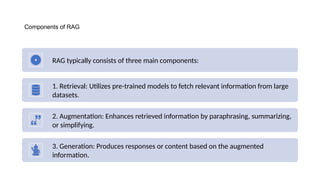
Components of RAG
RAGtypically consists of three main components:
1. Retrieval: Utilizes pre-trained models to fetch relevant information from large
datasets.
2. Augmentation: Enhances retrieved information by paraphrasing, summarizing,
or simplifying.
3. Generation: Produces responses or content based on the augmented
information.
28.
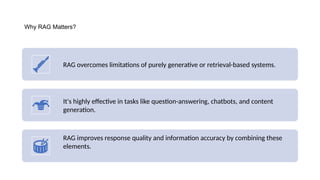
Why RAG Matters?
RAGovercomes limitations of purely generative or retrieval-based systems.
It's highly effective in tasks like question-answering, chatbots, and content
generation.
RAG improves response quality and information accuracy by combining these
elements.
29.
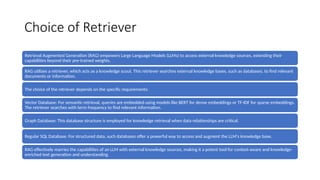
Choice of Retriever
RetrievalAugmented Generation (RAG) empowers Large Language Models (LLMs) to access external knowledge sources, extending their
capabilities beyond their pre-trained weights.
RAG utilizes a retriever, which acts as a knowledge scout. This retriever searches external knowledge bases, such as databases, to find relevant
documents or information.
The choice of the retriever depends on the specific requirements:
Vector Database: For semantic retrieval, queries are embedded using models like BERT for dense embeddings or TF-IDF for sparse embeddings.
The retriever searches with term frequency to find relevant information.
Graph Database: This database structure is employed for knowledge retrieval when data relationships are critical.
Regular SQL Database: For structured data, such databases offer a powerful way to access and augment the LLM's knowledge base.
RAG effectively marries the capabilities of an LLM with external knowledge sources, making it a potent tool for context-aware and knowledge-
enriched text generation and understanding.
30.
Process of Retrieval
Augmented
Generation(RAG)
Retrieval Augmented Generation (RAG) is a multi-step process
that seamlessly integrates external knowledge with Large
Language Models (LLMs). Let's break it down:
1. Vector Database Creation: To get started, RAG converts an
internal dataset into vectors, which are then stored in a vector
database or any other database of your choosing. For retrieval
to be quick and effective, this step is essential.
2. User Input: A user provides a query in natural language,
often seeking an answer or text completion.
3. Information Retrieval: In order to find segments that are
semantically similar to the user's query, the retrieval
mechanism searches the vector database. For semantic
matching, the user's query and the database segments are
both embedded.
4. Combining Data: The user's original query is then integrated
with the chosen database data segments to provide an
enhanced and enlarged prompt.
5. Generating Text: The LLM is given the expanded question,
which is now bursting with further context. In order to create a
final, context-aware response that is extremely pertinent to the
user's query, the LLM uses this context.
This process seamlessly integrates external knowledge
sources, enhancing the LLM's ability to provide more accurate
and contextually rich responses to user queries.
31.
RAG- Real-
World
Applications
RAG haspractical applications in various fields:
Customer support chatbots that provide
accurate and context-aware responses.
Search engines that understand user queries
and generate informative snippets.
Content generation for news articles, product
descriptions, and more.
32.
Importance of GenerativeAI in Modern
Applications
Generative AI is the cornerstone of modern
applications, reshaping how we interact with
technology and data.
It is a dynamic force behind innovation,
continuously pushing the boundaries of what
applications can achieve.
This technology adapts to evolving trends, making
it essential for applications to remain relevant in a
fast-paced digital landscape.
From automation and efficiency to personalization
and creative content generation, generative AI
powers the modern application ecosystem. It's a
driving force behind the advancements we see in
today's tech-driven world.
33.
Key Aspects ofGenerative AI in Modern Applications
Fueling Innovation: Generative AI drives innovation by
generating new and imaginative content. For instance,
it powers the creation of unique art, innovative
marketing campaigns, and virtual actors for
entertainment.
Adaptability and Learning: Generative AI continuously
learns and adapts to changing data. This adaptability is
essential in modern applications, such as in the
healthcare sector, where it assists in diagnosing new
diseases and suggests evolving treatment options.
Automation and Efficiency: Generative AI automates
routine tasks, significantly enhancing efficiency. For
instance, it streamlines customer support through
chatbots, automates data analysis in research, and
helps in generating content for digital marketing
campaigns.
Personalization: Generative AI tailors user experiences
by offering personalized recommendations and
content. E-commerce platforms use it to suggest
products based on user preferences. Similarly,
streaming services use it to recommend movies and
music tailored to individual tastes. This enhances user
engagement and satisfaction.
34.
Industry use cases
GenerativeAI finds extensive applications across various industries.
Lets explore some key industry use cases where generative AI is
transforming the landscape.
From healthcare to entertainment, its impact is profound.
35.
Healthcare
Generative AI assistsin drug discovery, suggesting potential
compounds for various diseases.
It also personalizes treatment plans, considering patient data and
medical history.
In radiology, it enhances the interpretation of medical images,
improving diagnostic accuracy.
36.
Marketing and Advertising
GenerativeAI enables the creation of personalized marketing
content.
It automates ad creation, optimizing campaigns for individual
consumers.
In content marketing, it generates high-quality articles and product
descriptions.
37.
Finance
Generative AI playsa significant role in risk assessment, fraud
detection, and algorithmic trading.
It analyzes financial data to provide insights for investment
decisions.
The finance industry benefits from its ability to generate financial
reports and summaries.
38.
E-commerce
In e-commerce, generativeAI personalizes the user experience by
suggesting products based on user preferences.
It generates product descriptions, reviews, and recommendations,
improving customer engagement.
Retailers benefit from increased sales and customer satisfaction.
39.
Language Translation
• GenerativeAI uses sophisticated language models to greatly improve language translation accuracy. It is
more sensitive to nuance, context, and colloquial language than other translation techniques. It can fill up
linguistic gaps by offering rapid translations and transcriptions.
• Users can instantly translate spoken and written language with generative AI, which makes multilingual
contexts more conducive to smooth conversation. In situations where real-time translation is crucial, such
as foreign business meetings or travel, it is very helpful.
• Language boundaries are being eliminated by generative AI, which is revolutionizing global
communication. It helps enterprises to access a wider global audience and encourages international
collaboration and cross-cultural understanding. This technology is crucial for enabling cross-border
encounters, boosting cooperation, and bridging linguistic gaps in a world growing more interconnected by
the day. These application cases show how generative AI is changing a variety of industries by bringing
about breakthroughs and solutions that were previously unthinkable.
40.
Emerging Trends
Future applicationsof generative AI are
being shaped by the new trends that
arise from its ongoing evolution. Let's
examine the main generative AI trends
that are now developing and how they
might affect contemporary applications.
• Cross-Modal Learning
• Few-Shot Learning
• Self-Supervised Learning
• Responsible AI Development
• Interpretable AI
41.
Cross-Modal Learning
Description: Cross-ModalLearning is a pioneering trend in Generative AI that focuses on training AI models to
comprehend and generate content across multiple modalities, such as text, images, and sound. It enables AI to bridge
the gap between different forms of data and understand their interconnections. Cross-Modal Learning facilitates the
creation of comprehensive, multimodal applications where a user can interact with the system using a combination of
text, images, and voice commands, and the AI can respond in kind.
Potential Impact: This trend is groundbreaking for applications, as it allows for seamless and natural interactions
between users and systems. For instance, consider a modern voice assistant that can not only understand your spoken
words but also analyze images and text to provide richer, more context-aware responses. This trend holds the promise
of creating immersive applications that engage users through various sensory channels.
42.
Few-Shot Learning
Description: Few-ShotLearning is a significant trend that empowers AI models to learn from a limited amount of data.
It's a critical advancement as it enables AI systems to adapt quickly to new tasks and scenarios with minimal training
samples. Instead of requiring extensive datasets, these models excel at generalizing knowledge from just a few
examples, making them highly versatile and efficient.
Potential Impact: In modern applications, Few-Shot Learning accelerates development and deployment. Consider a
language translation application that can learn to translate new languages with just a few examples, or a medical
diagnostic system that can identify rare diseases from a handful of patient records. This trend makes AI more agile and
adaptable to real-world, rapidly changing situations.
43.
Self-Supervised Learning
Description: Self-SupervisedLearning is a revolutionary trend in Generative AI. It involves training AI models using
unlabeled data, eliminating the need for extensive manual data annotation. These models generate their own labels
through various tasks, fostering an autonomous learning process.
Potential Impact: Modern applications stand to benefit significantly from this trend. Self-Supervised Learning reduces
the cost and effort associated with manual data labeling. In fields like image recognition or natural language processing,
applications can learn from massive volumes of unstructured data, making AI development more accessible and cost-
effective. This trend also opens the door for AI to autonomously adapt to new tasks and environments.
44.
Responsible AI Development
Description:Responsible AI Development is a crucial trend that focuses on ethical and mindful development of AI
systems, including generative models. It emphasizes ensuring AI aligns with societal values and doesn't perpetuate
biases or misuse.
Potential Impact: In modern applications, the trend of responsible AI development safeguards against ethical concerns
and misuse. It promotes transparency, fairness, and accountability. For example, in finance, responsible AI ensures that
automated trading algorithms adhere to ethical guidelines. In healthcare, it guarantees patient data privacy and
unbiased treatment recommendations. This trend builds trust in AI systems and encourages their responsible adoption.
45.
Interpretable AI
Description: InterpretableAI is a growing trend aimed at making AI models more transparent and understandable. It
allows users to comprehend the decision-making processes of AI systems.
Potential Impact: In modern applications, interpretable AI enhances user trust and confidence. For instance, in
autonomous vehicles, it enables users to understand why the AI made certain driving decisions, improving the overall
safety and user experience. In financial applications, users can better understand the rationale behind AI-driven
investment recommendations, leading to more informed decisions. This trend fosters a deeper connection between
users and AI systems, increasing their acceptance and usability.
 Most read
 Most read