Pharmacognosy
Pharmacognosy is abranch of pharmacy which deals with
the basic resources of medicines from nature (plant &
animal) and their uses as medicaments from ancient time
to present day.
• Pharmacognosy is derived from two Greek words,
Pharmakon & Gnosis
• Pharmakon – means ‘drug’.
• Gnosis – means ‘knowledge’.
• In brief, Pharmacognosy means ‘knowledge of drugs’.
It is a study of drugs that originate in the plant & animal
kingdoms.
1
2.
• At presentpharmacognosy involves not only the crude
drugs but also their natural derivatives (pure compounds
or constituents).
• Digitalis leaf and its isolated glycoside, digitoxin;
• Rauwolfia root and its purified alkaloid, reserpine; and
• thyroid gland with its extracted hormone, thyroxine, are all
part of the subject matter of pharmacognosy.
Pharmacognosy
Pharmacognosy may be defined as an important branch
of Pharmacy which deals with the study of structural,
physical, chemical, biochemical and sensory characters of
natural drugs of plant and animal origin. It also includes
a study of their history, distribution, cultivation,
collection, identification, preparation, evaluation,
preservation, use and commerce.
2
3.
Pharmacognosy - History
•The first or beginning of pre-history on use of
medicinal plants or herbs or animals, and the place
where and how used were not well known, and those
information were unwritten for a long time. As a
result, the pre-history on herbs was almost lost.
• However, some information was recorded by oral
transmission from generation to generation.
Pre-history:
History of pharmacognosy is actually the history of medicine
that is medicinal plants.
3
4.
Pharmacognosy - History
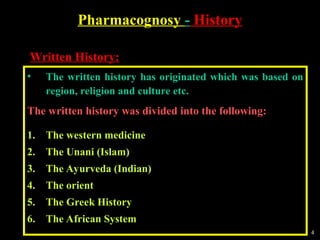
•The written history has originated which was based on
region, religion and culture etc.
The written history was divided into the following:
1. The western medicine
2. The Unani (Islam)
3. The Ayurveda (Indian)
4. The orient
5. The Greek History
6. The African System
Written History:
4
5.
Pharmacognosy - History
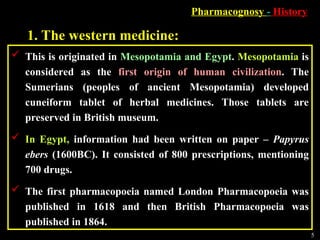
This is originated in Mesopotamia and Egypt. Mesopotamia is
considered as the first origin of human civilization. The
Sumerians (peoples of ancient Mesopotamia) developed
cuneiform tablet of herbal medicines. Those tablets are
preserved in British museum.
In Egypt, information had been written on paper – Papyrus
ebers (1600BC). It consisted of 800 prescriptions, mentioning
700 drugs.
The first pharmacopoeia named London Pharmacopoeia was
published in 1618 and then British Pharmacopoeia was
published in 1864.
1. The western medicine:
5
6.
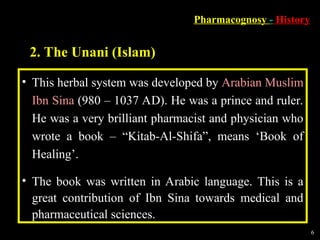
• This herbalsystem was developed by Arabian Muslim
Ibn Sina (980 – 1037 AD). He was a prince and ruler.
He was a very brilliant pharmacist and physician who
wrote a book – “Kitab-Al-Shifa”, means ‘Book of
Healing’.
• The book was written in Arabic language. This is a
great contribution of Ibn Sina towards medical and
pharmaceutical sciences.
Pharmacognosy - History
2. The Unani (Islam)
6
7.
Ayurveda is theterm for traditional medicine of ancient
India.
The word “Ayur” means ‘Life’ and “veda” means ‘The
study of’ that is “Study of Life”.
The Ayurvedic writings were divided into three systems:
1) Charaka Samhita, 2) Sushruta Samhita and 3)
Astanga samhita.
The oldest writing was Charaka Samhita (six to seven
century before Christ).
The book describes uses of many metallic drugs eg.,
iron, mercury, sulphur, copper etc with herbs.
Pharmacognosy - History
3. The Ayurveda (Indian, 2500-600 BC):
7
8.
This isoriginated from Chinese, Japanese and
Tibetians etc. The orient herbalism was very old
(142 – 220 BC) and called “Kampo”. The written
documents were made by the King ‘Shen Nung’
(2700 BC) and Shang (1766 – 1122 BC) etc.
Shen Nung investigated medicinal value of several
herbs and written a book – “Pen T-Sao” or native
herbal.
Pharmacognosy - History
4. The orient (2700 BC):
8
9.
Hippocrates (Fatherof Medicine, 460-370 BC):
He was the first natural doctor who utilized simple remedies such as
vinegar, honey, herbs etc in healing. He is also known to have collected
and identified a number of medicinal plants.
Aristotle (384-322 BC):
He gave the philosophy of medicine. He listed more than 500 plants of
medicinal importance.
Theophrastus (371-287 BC):
gave scientific basis of use of plants as medicine.
Galen (131-200 AD):
a Greek pharmacist-physician. He developed the methods of preparing
and compounding medicines by mechanical means. He was the
originator of the formulae for a cold cream.
Pharmacognosy - History
5. The Greek History:
Some of the early naturalists, scientists and physicians who contributed enormously to
the development of human knowledge about medicinal plants include following:
9
10.
They keepinformation in their groups or tribes.
The information transmitted from one generation
to another.
These regions are richest sources of medicinal
plants and needs to explore for new drug
discovery.
Pharmacognosy - History
6. The African System (Tropical Africa, North
and South America):
10
11.
Scope of Pharmacognosy
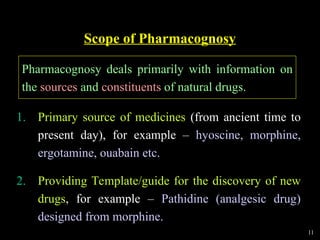
1.Primary source of medicines (from ancient time to
present day), for example – hyoscine, morphine,
ergotamine, ouabain etc.
2. Providing Template/guide for the discovery of new
drugs, for example – Pathidine (analgesic drug)
designed from morphine.
Pharmacognosy deals primarily with information on
the sources and constituents of natural drugs.
11
12.
Scope of Pharmacognosy
Pharmacognosyis one of the five major divisions of the
pharmaceutical curriculum which represents the oldest branch of the
profession of pharmacy. The ancients gathered herbs, animals, plants,
and minerals and concocted them into ill-flavored pungent mixtures.
Innumerable remedies were known to the early practitioners of
pharmacy and medicine, a fact indicated by the writings of
Theophrastus, Pliny, Dioscorides, and their contemporaries.
Thousands of plant and animal products used for the treatment of ills
were described by Dioscorides in his book "De Materia Medica."
Of these a surprisingly large number are still of importance in modern
therapeutic practice: Cinnamon, Ergot, Hyoscyamus, and Opium were
used in much the same manner as today.
12
13.
Scope of Pharmacognosy
Mostof the crude drugs are obtained from plants & only a small number
comes from animals & mineral origin.
Drugs obtained from plants consist of entire plants or their parts.
Ephedra & datura are entire plants. While senna leaves & pods, nux-
vomica seeds & cinchona bark are parts of plants.
Crude drugs may also be obtained by physical processes like drying
(opium) or extracting with water (catechu, agar)
several other useful substances affecting health of animals & human
being are also included along with crude drugs in the study of
pharmacognosy. These substances include allergens, anti-biotics,
flavouring agents, colours, pesticides, immunizing agents, vehicles &
diagnostic aids.
13
Standard dictionaries definedrug as “an original, simple
medicinal substance, organic or inorganic, used by itself
or as an ingredient in medicine”.
According to WHO’s definition – “any substance used in
a pharmaceutical product that is intended to modify or
explore physiological systems or pathological states for
the benefit of the recipient”.
Drug
Terminology
Pharmaceutical product/Medicine means “a dosage form
(tablet/capsule/syrup/Inj - IV/IM) containing one or more
drugs along with other substances included during the
manufacturing process”. 15
16.
Application of Drug
•Prevention of a disease : for example, vaccine.
• Fight against an infection: for example, antibiotics.
• Temporary blocking of a normal function: for example,
general & local anesthetics
• Detoxification of the body: for example, antidotes.
• Diagnostic agents: for example, radioisotopes.
• Correction of dysfunction: for example, cardiotonics (eg,
digoxin) for the treatment of congestive heart failure.
• Correction of hyperfuntion: for example, Rauwolfia root
(eg., reserpine) for the treatment of hypertension.
16
17.
Crude Drug:
The term“Crude”, as used in relation to natural products.
A crude drug is a natural drug of plant or animal origin
which has undergone no treatment other than collection
and drying, that is, the quality or appearance of the drug
has not been advanced in value or improved in condition
by any physical or chemical treatment.
For example: Digitalis leaf, Rauwolfia root etc.
Terminology
17
18.
Indigenous vs Naturalized
Indigenous:
Plants growing in their native countries are said to be indigenous to
those regions.
For example: Aconite (Aconitum napellus) in the mountainous region
of Europe. It is highly poisonous used as diuretic in Homeopathy
preparation
Terminology
Naturalized:
Plants are said to be naturalized when they grow in a foreign land or
in a locality other than their native homes.
For example: Datura (Datura stramonium) which was introduced into
the USA from Europe.
18
19.
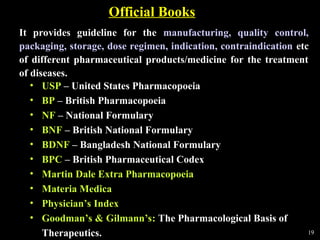
Official Books
It providesguideline for the manufacturing, quality control,
packaging, storage, dose regimen, indication, contraindication etc
of different pharmaceutical products/medicine for the treatment
of diseases.
• USP – United States Pharmacopoeia
• BP – British Pharmacopoeia
• NF – National Formulary
• BNF – British National Formulary
• BDNF – Bangladesh National Formulary
• BPC – British Pharmaceutical Codex
• Martin Dale Extra Pharmacopoeia
• Materia Medica
• Physician’s Index
• Goodman’s & Gilmann’s: The Pharmacological Basis of
Therapeutics. 19
20.
Official vs Unofficialvs Nonofficial drug
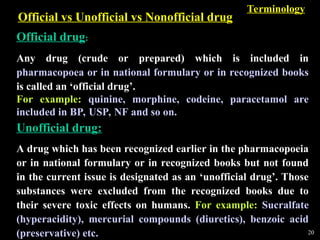
Official drug:
Any drug (crude or prepared) which is included in
pharmacopoea or in national formulary or in recognized books
is called an ‘official drug’.
For example: quinine, morphine, codeine, paracetamol are
included in BP, USP, NF and so on.
Terminology
Unofficial drug:
A drug which has been recognized earlier in the pharmacopoeia
or in national formulary or in recognized books but not found
in the current issue is designated as an ‘unofficial drug’. Those
substances were excluded from the recognized books due to
their severe toxic effects on humans. For example: Sucralfate
(hyperacidity), mercurial compounds (diuretics), benzoic acid
(preservative) etc. 20
21.
Official vs Unofficialvs Nonofficial drug
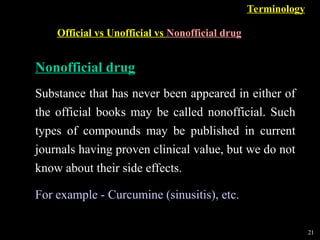
Nonofficial drug
Substance that has never been appeared in either of
the official books may be called nonofficial. Such
types of compounds may be published in current
journals having proven clinical value, but we do not
know about their side effects.
For example - Curcumine (sinusitis), etc.
Terminology
21
22.
Terminology
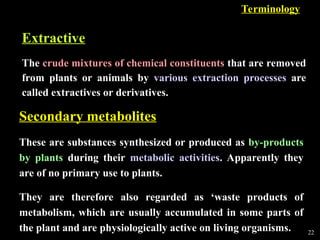
Extractive
The crude mixturesof chemical constituents that are removed
from plants or animals by various extraction processes are
called extractives or derivatives.
Secondary metabolites
These are substances synthesized or produced as by-products
by plants during their metabolic activities. Apparently they
are of no primary use to plants.
They are therefore also regarded as ‘waste products of
metabolism, which are usually accumulated in some parts of
the plant and are physiologically active on living organisms. 22
23.
Monograph
The descriptive materialpertaining to any drug,
therapeutic agent included in the pharmacopoeia is
known as the monograph.
The monograph of a drug includes the following
information on the drug:
official title, synonyms, definition, description,
collection or preparation, identity tests, tests for
adulterants, method of assay, storage, uses and doses.
Terminology
23
24.
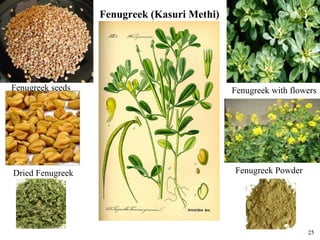
Monograph of
Trigonella foenum-graecum(Family: Papilionacacae)
Common name: Fenugreek (Eng.), Methi (Bengali)
Cultivation: It is cultivated in different area of Bangladesh, India, Pakistan, Middle
East, Africa.
Description: The Latin species name foenum-graecum means ‘Greek hay’, which
is a dried plant's (leaves or seeds) and has a strong hay-like scent. It has a
strong, pleasant and a peculiar odor and grows best in well-drained soils with
a low rainfall into brownish- yellow rhombic shape seeds.
Parts used: Ripe, dried seeds
Chemical constituents: Seeds are rich in mucilage (mainly galactomannans),
fixed oil, fatty acids and protein. They also contain alkaloids, saponine,
glycosides etc.
Uses: Seeds are diuretics, astringent. They are popularly used in the treatment
of loss of appetite, weight loss, menstrual disorder. Also used in
hypertension, diabetes, etc. It lowers TG, cholesterol, LDL.
Dose: Daily dose, 18 g. 24
Pharmacognosy & ModernMedicine
Simultaneous advancement in the field of chemistry,
biochemistry, biosynthesis and pharmacology has
developed pharmacognosy.
Various active compounds have been isolated from
plants which are used in modern medicine.
With the advancement of synthetic organic
chemistry most of the active constituents of plants
have been synthesized.
100s of plants are used in modern medicine in
various parts of the world. 26
26
27.
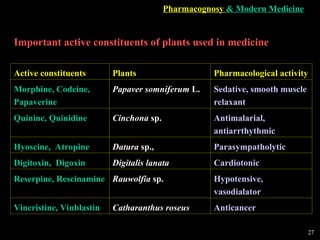
Pharmacognosy & ModernMedicine
Important active constituents of plants used in medicine
Active constituents Plants Pharmacological activity
Morphine, Codeine,
Papaverine
Papaver somniferum L. Sedative, smooth muscle
relaxant
Quinine, Quinidine Cinchona sp. Antimalarial,
antiarrthythmic
Hyoscine, Atropine Datura sp., Parasympatholytic
Digitoxin, Digoxin Digitalis lanata Cardiotonic
Reserpine, Rescinamine Rauwolfia sp. Hypotensive,
vasodialator
Vincristine, Vinblastin Catharanthus roseus Anticancer
27
28.
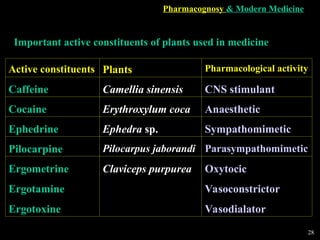
Pharmacognosy & ModernMedicine
Important active constituents of plants used in medicine
Active constituents Plants Pharmacological activity
Caffeine Camellia sinensis CNS stimulant
Cocaine Erythroxylum coca Anaesthetic
Ephedrine Ephedra sp. Sympathomimetic
Pilocarpine Pilocarpus jaborandi Parasympathomimetic
Ergometrine
Ergotamine
Ergotoxine
Claviceps purpurea Oxytocic
Vasoconstrictor
Vasodialator
28
29.
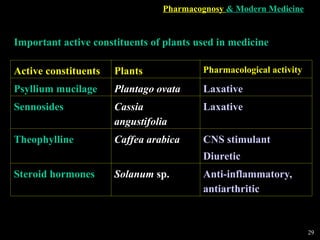
Pharmacognosy & ModernMedicine
Important active constituents of plants used in medicine
Active constituents Plants Pharmacological activity
Psyllium mucilage Plantago ovata Laxative
Sennosides Cassia
angustifolia
Laxative
Theophylline Caffea arabica CNS stimulant
Diuretic
Steroid hormones Solanum sp. Anti-inflammatory,
antiarthritic
29
30.
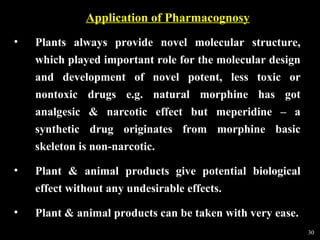
• Plants alwaysprovide novel molecular structure,
which played important role for the molecular design
and development of novel potent, less toxic or
nontoxic drugs e.g. natural morphine has got
analgesic & narcotic effect but meperidine – a
synthetic drug originates from morphine basic
skeleton is non-narcotic.
• Plant & animal products give potential biological
effect without any undesirable effects.
• Plant & animal products can be taken with very ease.
Application of Pharmacognosy
30
31.
Drugs obtained fromnatural sources have a variety of
limitations. The majors are;
• A natural compound may be highly active but usually this is
associated with high toxicity problem, ex- the toxic and
therapeutic dose of digitalis are very close which create
serious problem to use this medicine by the patient alone.
• Some compounds are found in nature that give beneficial
pharmacological actions but their potencies are too low to be
employed therapeutically.
• The yield of active natural products may be very low and
thus the production cost of those drugs will be very high
• The source of a natural drug may be very limited with
respect to geography, season and climate etc.
Limitation of Pharmacognosy
31
32.
• At presentthe prime source of modern or allopathic
medicines is synthesis in the laboratory by organic chemist.
• Only a few of compounds are isolated from plants, which
cannot be replaced by synthetic method.
• For example: morphine isolated from Papaver somniferum;
vincristin & vinblastin (anticancer drug) from Vinca rosea,
the most potent anticancer drug taxol from Texus
brevifolia;
the constituents of digitalis cannot be properly replaced by
any synthetic drug like quinidine which is used for the
treatment of arrhythmia.
Sources of Medicaments
32
 Most read