ISEW Goes Regional in
partnership with the
International Forum for Coal
Regions in Transition
14.10.2025
Samarinda, Indonesia
Welcome
Welcome remarks
Togu Pardede, Director of Energy, Mineral, and Mining Resources,
Bappenas, Indonesia
Philipp Schattenmann, Director “Innovation Regions for a Just
Energy Transition” (IKI JET)
International Forum for Coal Regions in Transition 2025
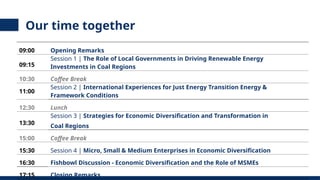
Our time together
09:00 Opening Remarks
09:15
Session 1 | The Role of Local Governments in Driving Renewable Energy
Investments in Coal Regions
10:30 Coffee Break
11:00
Session 2 | International Experiences for Just Energy Transition Energy &
Framework Conditions
12:30 Lunch
13:30
Session 3 | Strategies for Economic Diversification and Transformation in
Coal Regions
15:00 Coffee Break
15:30 Session 4 | Micro, Small & Medium Enterprises in Economic Diversification
16:30 Fishbowl Discussion - Economic Diversification and the Role of MSMEs
17:15 Closing Remarks
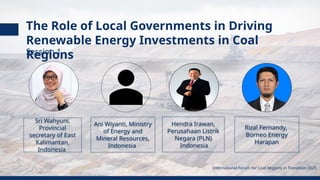
The Role of Local Governments in Driving
Renewable Energy Investments in Coal
Regions
International Forum for Coal Regions in Transition 2025
Sri Wahyuni,
Provincial
secretary of East
Kalimantan,
Indonesia
Ani Wiyanti, Ministry
of Energy and
Mineral Resources,
Indonesia
Session 1
Hendra Irawan,
Perusahaan Listrik
Negara (PLN)
Indonesia
Rizal Fernandy,
Borneo Energy
Harapan
With over 18 years of experience in public administration and tourism
development, Mrs. Sri Wahyuni currently serves as the Regional
Secretary of East Kalimantan Province. Her career began in Kutai
Kartanegara Regency, where she led public tourism and protocol
(2006–2012) and later served as Head of the Tourism Department
(2012–2019). She then advanced to become the Head of the Tourism
Department for East Kalimantan Province (2019–2022), where she
played a key role in promoting sustainable tourism and regional
economic growth.
Mrs. Sri Wahyuni has completed several international executive
programs, including Digital Transformation in Government at the
Harvard Kennedy School (2021) and Sustainable Tourism Management
at Griffith University, Australia (2021), along with other trainings
focused on post-pandemic tourism recovery and sustainable economic
development.
Sri Wahyuni
Provincial Secretary of
East Kalimantan,
Indonesia
Unlocking clean energy
investments in East Kalimantan
Sri Wahyuni - Provincial secretary of East Kalimantan, Indonesia
8
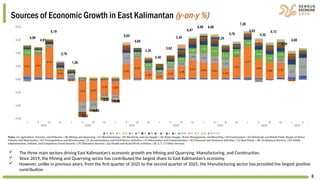
Sources of Economic Growth in East Kalimantan (y-on-y %)
 The three main sectors driving East Kalimantan’s economic growth are Mining and Quarrying, Manufacturing, and Construction.
 Since 2019, the Mining and Quarrying sector has contributed the largest share to East Kalimantan’s economy.
 However, unlike in previous years, from the first quarter of 2025 to the second quarter of 2025, the Manufacturing sector has provided the largest positive
contribution.
Note: (A) Agriculture, Forestry, and Fisheries | (B) Mining and Quarrying | (C) Manufacturing | (D) Electricity and Gas Supply | (E) Water Supply, Waste Management, and Recycling | (F) Construction | (G) Wholesale and Retail Trade; Repair of Motor
Vehicles and Motorcycles | (H) Transportation and Warehousing | (I) Accommodation and Food Service Activities | (J) Information and Communication | (K) Financial and Insurance Activities | (L) Real Estate | (M, N) Business Services | (O) Public
Administration, Defense, and Compulsory Social Security | (P) Education Services | (Q) Health and Social Work Activities | (R, S, T, U) Other Services.
I II III IV I II III IV I II III IV I II III IV I II III IV I II III IV I II
2019 2020 2021 2022 2023 2024 2025
-6.00
-4.00
-2.00
0.00
2.00
4.00
6.00
8.00
3.15 3.61
4.79
1.43
-0.27
-3.31 -3.13
-2.14 -2.09
2.32
2.96
1.28
0.79
1.32
1.78
2.67 2.36 2.42
1.54
3.31
4.77
2.89
2.60 2.31
-0.28
-0.06
-0.31
0.13
0.14
0.05
0.63
-1.53
-1.14
-0.33
-0.72
1.70
0.55
0.50
0.33
0.73
0.69
1.08 1.40
1.01
1.34
0.01
-0.09 -0.41 -0.02
0.67
1.55
2.75
1.05 0.48
0.23
0.12
0.09
0.07
-0.16
-0.25
0.00
-0.04
0.47
0.76
0.30
0.49
0.71
0.86
1.30
1.51
1.13
1.06
1.04
1.44
1.21
0.99
0.34
-0.01
A B C D E F G H I J K L M,N O P Q R,S,T,U
4,98
1,28
-5,42
2,79
6,19
-4,59
4,91
-2,87
5,62
4,66
3,34
2,40
3,62
5,34
6,47
6,99 6,89
5,30
-3,10
5,76
7,26
5,85
5,52
6,12
4,08
4,69
9
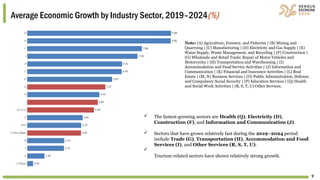
Average Economic Growth by Industry Sector, 2019–2024(%)
 The fastest-growing sectors are Health (Q), Electricity (D),
Construction (F), and Information and Communication (J).
 Sectors that have grown relatively fast during the 2019–2024 period
include Trade (G), Transportation (H), Accommodation and Food
Services (I), and Other Services (R, S, T, U).

Tourism-related sectors have shown relatively strong growth.
C Migas
A
L
B
C Non Migas
M,N
P
R,S,T,U
I
H
G
O
E
K
J
F
D
Q
0.40
1.18
2.52
2.54
3.69
3.70
3.81
4.58
4.85
4.95
5.37
5.83
6.49
6.52
7.58
7.88
9.86
9.88
Note: (A) Agriculture, Forestry, and Fisheries | (B) Mining and
Quarrying | (C) Manufacturing | (D) Electricity and Gas Supply | (E)
Water Supply, Waste Management, and Recycling | (F) Construction |
(G) Wholesale and Retail Trade; Repair of Motor Vehicles and
Motorcycles | (H) Transportation and Warehousing | (I)
Accommodation and Food Service Activities | (J) Information and
Communication | (K) Financial and Insurance Activities | (L) Real
Estate | (M, N) Business Services | (O) Public Administration, Defense,
and Compulsory Social Security | (P) Education Services | (Q) Health
and Social Work Activities | (R, S, T, U) Other Services.
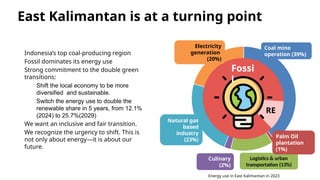
East Kalimantan is at a turning point
Indonesia’s top coal-producing region
Fossil dominates its energy use
Strong commitment to the double green
transitions:
Shift the local economy to be more
diversified and sustainable.
Switch the energy use to double the
renewable share in 5 years, from 12.1%
(2024) to 25.7%(2029)
We want an inclusive and fair transition.
We recognize the urgency to shift. This is
not only about energy—it is about our
future.
Fossi
l
RE
Coal mine
operation (39%)
Natural gas
based
industry
(23%)
Logistics & urban
transportation (13%)
Culinary
(2%)
Electricity
generation
(20%)
Palm Oil
plantation
(1%)
Energy use in East Kalimantan in 2023
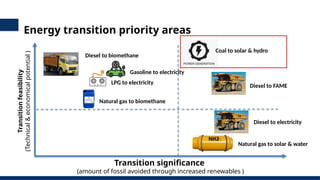
Energy transition priority areas
Transition
feasibility
(Technical
&
economical
potential
)
Transition significance
(amount of fossil avoided through increased renewables )
Diesel to FAME
Coal to solar & hydro
Diesel to electricity
Natural gas to solar & water
Natural gas to biomethane
Diesel to biomethane
Gasoline to electricity
LPG to electricity
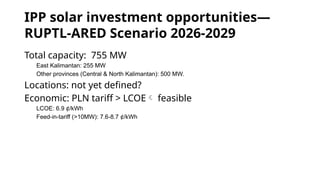
IPP solar investment opportunities—
RUPTL-ARED Scenario 2026-2029
Total capacity: 755 MW
East Kalimantan: 255 MW
Other provinces (Central & North Kalimantan): 500 MW.
Locations: not yet defined?
Economic: PLN tariff > LCOE feasible
LCOE: 6.9 ¢/kWh
Feed-in-tariff (>10MW): 7.6-8.7 ¢/kWh
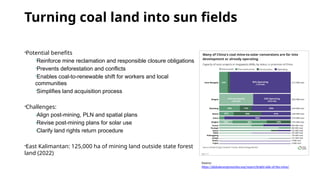
Turning coal land into sun fields
-Potential benefits
-Reinforce mine reclamation and responsible closure obligations
-Prevents deforestation and conflicts
-Enables coal-to-renewable shift for workers and local
communities
-Simplifies land acquisition process
-Challenges:
-Align post-mining, PLN and spatial plans
-Revise post-mining plans for solar use
-Clarify land rights return procedure
-East Kalimantan: 125,000 ha of mining land outside state forest
land (2022)
Source:
https://globalenergymonitor.org/report/bright-side-of-the-mine/
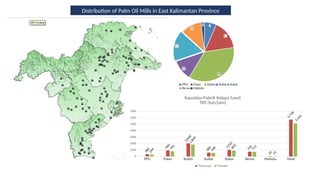
Distribution of Palm Oil Mills in East Kalimantan Province
7
17
38
12
17
12
2
PPU Paser Kutim Kubar Kukar
Berau Mahulu
PPU Paser Kutim Kubar Kukar Berau Mahulu Total
0
1000
2000
3000
4000
5000
6000
7000
360 940
2,040
585 1,015
745
45
5,730
299 792
1,829
548 899
713
51
5,131
Kapasitas Pabrik Kelapa Sawit
TBS (ton/jam)
Terpasang Terpakai
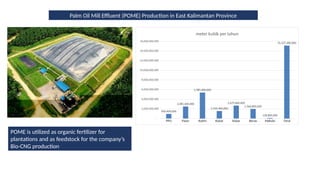
Palm Oil Mill Effluent (POME) Production in East Kalimantan Province
PPU Paser Kutim Kubar Kukar Berau Mahulu Total
-
2,000,000,000
4,000,000,000
6,000,000,000
8,000,000,000
10,000,000,000
12,000,000,000
14,000,000,000
16,000,000,000
950,400,000
2,481,600,000
5,385,600,000
1,544,400,000
2,679,600,000
1,966,800,000
118,800,000
15,127,200,000
meter kubik per tahun
POME is utilized as organic fertilizer for
plantations and as feedstock for the company’s
Bio-CNG production
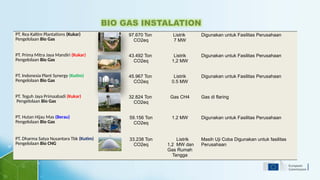
BIO GAS INSTALATION
PT. Rea Kaltim Plantations (Kukar)
Pengelolaan Bio Gas
97.670 Ton
CO2eq
Listrik
7 MW
Digunakan untuk Fasilitas Perusahaan
PT. Prima Mitra Jaya Mandiri (Kukar)
Pengelolaan Bio Gas
43.492 Ton
CO2eq
Listrik
1,2 MW
Digunakan untuk Fasilitas Perusahaan
PT. Indonesia Plant Synergy (Kutim)
Pengelolaan Bio Gas
45.967 Ton
CO2eq
Listrik
0.5 MW
Digunakan untuk Fasilitas Perusahaan
PT. Teguh Jaya Primaabadi (Kukar)
Pengelolaan Bio Gas
32.824 Ton
CO2eq
Gas CH4 Gas di flaring
PT. Hutan Hijau Mas (Berau)
Pengelolaan Bio Gas
59.156 Ton
CO2eq
1.2 MW Digunakan untuk Fasilitas Perusahaan
PT. Dharma Satya Nusantara Tbk (Kutim)
Pengelolaan Bio CNG
33.238 Ton
CO2eq
Listrik
1,2 MW dan
Gas Rumah
Tangga
Masih Uji Coba Digunakan untuk fasilitas
Perusahaan
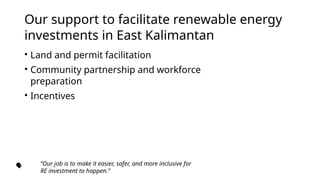
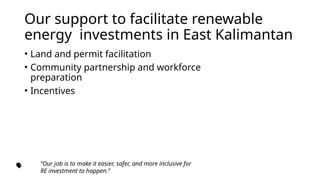
Our support to facilitate renewable energy
investments in East Kalimantan
• Land and permit facilitation
• Community partnership and workforce
preparation
• Incentives
“Our job is to make it easier, safer, and more inclusive for
RE investment to happen.”
️
🗣️
Our support to facilitate renewable
energy investments in East Kalimantan
• Land and permit facilitation
• Community partnership and workforce
preparation
• Incentives
“Our job is to make it easier, safer, and more inclusive for
RE investment to happen.”
🗣️
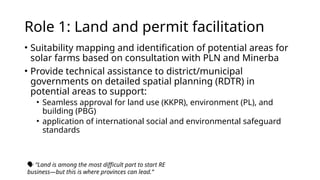
Role 1: Land and permit facilitation
• Suitability mapping and identification of potential areas for
solar farms based on consultation with PLN and Minerba
• Provide technical assistance to district/municipal
governments on detailed spatial planning (RDTR) in
potential areas to support:
• Seamless approval for land use (KKPR), environment (PL), and
building (PBG)
• application of international social and environmental safeguard
standards
🗣️“Land is among the most difficult part to start RE
business—but this is where provinces can lead.”
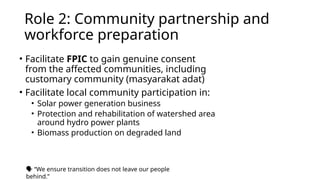
Role 2: Community partnership and
workforce preparation
• Facilitate FPIC to gain genuine consent
from the affected communities, including
customary community (masyarakat adat)
• Facilitate local community participation in:
• Solar power generation business
• Protection and rehabilitation of watershed area
around hydro power plants
• Biomass production on degraded land
“
🗣️ We ensure transition does not leave our people
behind.”
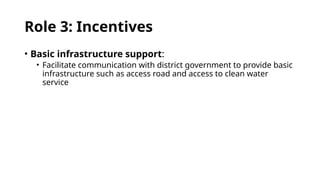
Role 3: Incentives
• Basic infrastructure support:
• Facilitate communication with district government to provide basic
infrastructure such as access road and access to clean water
service
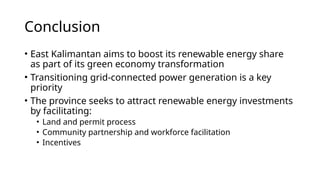
Conclusion
• East Kalimantan aims to boost its renewable energy share
as part of its green economy transformation
• Transitioning grid-connected power generation is a key
priority
• The province seeks to attract renewable energy investments
by facilitating:
• Land and permit process
• Community partnership and workforce facilitation
• Incentives
Mrs. Ani Wiyanti is a seasoned professional in Indonesia’s
energy sector with extensive experience in renewable energy and
energy conservation policy. After starting her career in the
telecommunications industry at PT Komselindo and PT Mobile-8
Telecom Tbk (1996–2005), she joined the Ministry of Energy and
Mineral Resources, where she held several key positions within the
Directorate General of New, Renewable Energy, and Energy
Conservation (DJEBTKE). Her roles included leading the Energy
Conservation Cooperation and Incentive Sections and coordinating
the Sub-Directorate of Investment and Cooperation. Since 2022,
she has served as a Senior Policy Analyst (Analis Kebijakan
Ahli Madya) at DJEBTKE, continuing her commitment to
promoting sustainable and efficient energy development in
Indonesia.
Ani Wiyanti
Ministry of Energy and
Mineral Resources,
Indonesia
24
Support and
Acceleration of
Regional Solar Power
(PLTS) Development
Policies
Directorate of Various New and Renewable Energy,
MEMR
Samarinda, 14 Oktober 2025
Presented at:
“Indonesia Sustainable Energy Week Goes Regional (ISEWGR) – Samarinda”
25
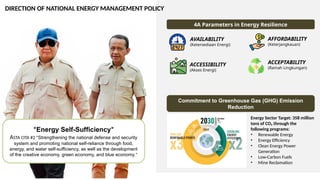
DIRECTION OF NATIONAL ENERGY MANAGEMENT POLICY
4A Parameters in Energy Resilience
AVAILABILITY
(Ketersediaan Energi)
ACCESSIBILITY
(Akses Energi)
AFFORDABILITY
(Keterjangkauan)
ACCEPTABILITY
(Ramah Lingkungan)
“Energy Self-Sufficiency”
ASTA CITA #2 “Strengthening the national defense and security
system and promoting national self-reliance through food,
energy, and water self-sufficiency, as well as the development
of the creative economy, green economy, and blue economy.”
Commitment to Greenhouse Gas (GHG) Emission
Reduction
Energy Sector Target: 358 million
tons of CO₂ through the
following programs:
• Renewable Energy
• Energy Efficiency
• Clean Energy Power
Generation
• Low-Carbon Fuels
• Mine Reclamation
26
Presidential Regulation No. 112 of 2022
Acceleration of Renewable Energy Development for Power Generation
MEMR Regulation No. 11 of 2024
Utilization of Local Products for Electricity Infrastructure
Development (Domestic Component Level / TKDN)
MEMR Regulation No. 10 of 2025
Energy Transition Roadmap for the Power Sector
MEMR Regulation No. 2 of 2024
Rooftop Solar Power Plants Connected to the Grid of Holders of Electricity
Supply Business Licenses for Public Interest
MEMR Regulation No. 5 of 2025
Guidelines for Power Purchase Agreements (PPA) from Renewable
Energy Power Plants
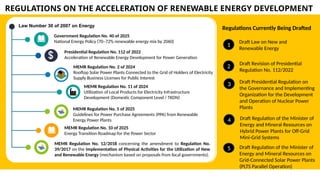
Law Number 30 of 2007 on Energy
Draft Law on New and
Renewable Energy
REGULATIONS ON THE ACCELERATION OF RENEWABLE ENERGY DEVELOPMENT
Draft Revision of Presidential
Regulation No. 112/2022
Draft Presidential Regulation on
the Governance and Implementing
Organization for the Development
and Operation of Nuclear Power
Plants
Draft Regulation of the Minister of
Energy and Mineral Resources on
Grid-Connected Solar Power Plants
(PLTS Parallel Operation)
Regulations Currently Being Drafted
MEMR Regulation No. 12/2018 concerning the amendment to Regulation No.
39/2017 on the Implementation of Physical Activities for the Utilization of New
and Renewable Energy (mechanism based on proposals from local governments).
1
2
3
4
5
Draft Regulation of the Minister of
Energy and Mineral Resources on
Hybrid Power Plants for Off-Grid
Mini-Grid Systems
Government Regulation No. 40 of 2025
National Energy Policy (70–72% renewable energy mix by 2060)
27
2025 2030 2035 2040 2045 2050 2055 2060
1028
Mt CO2e
885
Mt CO2e
129
Mt CO2e
558
Mt CO2e
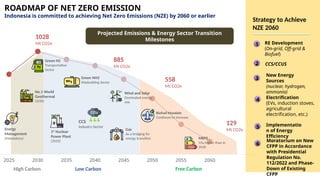
Strategy to Achieve
NZE 2060
RE Development
(On-grid, Off-grid &
Biofuel)
1
Electrification
(EVs, induction stoves,
agricultural
electrification, etc.)
2
Moratorium on New
CFPP in Accordance
with Presidential
Regulation No.
112/2022 and Phase-
Down of Existing
CFPP
3
CCS/CCUS
4
New Energy
Sources
(nuclear, hydrogen,
ammonia)
5 Implementatio
n of Energy
Efficiency
6
ROADMAP OF NET ZERO EMISSION
Indonesia is committed to achieving Net Zero Emissions (NZE) by 2060 or earlier
1st
Nuclear
Power Plant
(2032)
High Carbon Low Carbon Free Carbon
Green H2
Transportation
Sector
Green NH3
Shipbuilding Sector
CCS
Industry Sector
MEPS
55x higher than in
2030
Energy
Management
(Mandatory)
Wind and Solar
Dominated energy
mix
No.1 World
Geothermal
(2030)
Biofuel Mandate
Continues to Increase
Projected Emissions & Energy Sector Transition
Milestones
Gas
As a bridging for
energy transition
28
Electric Power Generation Roadmap (RUKN)
Solar (109 GW)
Wind (73 GW)
Hydro (71 GW)
H2 (25 GW)
Gas / Gas+CCS (38 GW)
Nuclear (35 GW)
Geothermal (23 GW)
Bioenergy (4 GW)
NH3 (8 GW)
Storage (34 GW)
2025 2030 2035 2040 2045 2050 2055 2060
-
5 0
1 0 0
1 5 0
2 0 0
2 5 0
3 0 0
3 5 0
4 0 0
4 5 0
5 0 0
59
75 73 69
56
46
8 -
3
4 4 4 4 4
4
4
2
4 7 15 17 20 22 23
26
47
49
53
51
49
8 1
9
11
22
28
57
63
65
71
- 3 9 10 13
28 33 34
5
10
27
43
64
65
73
13
28
35
45
88
95
109
2 3
14
22
51 54
7
15
22 27 35
0
1
3
27 37
2 3
7
8
24
25
106
160
199
242
307
386
407
443
Capacity (GW)
Storage Ocean Waste Heat Diesel
Solar Wind Hydro H2
Gas_CCS Gas Nuclear Geothermal
Bioenergy NH3 Coal_CCS_CfBio Coal
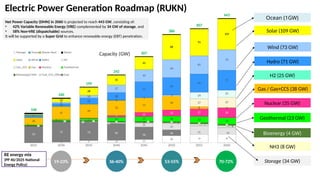
Net Power Capacity (DMN) in 2060 is projected to reach 443 GW, consisting of:
• 42% Variable Renewable Energy (VRE) complemented by 34 GW of storage, and
• 58% Non-VRE (dispatchable) sources.
It will be supported by a Super Grid to enhance renewable energy (EBT) penetration.
RE energy mix
(PP 40/2025 National
Energy Policy)
19-23% 36-40% 53-55% 70-72%
Ocean (1GW)
29
2025 - 2029
2030 - 2034
Total
RE Addition
42,6
GW
Sumatera
EBT9,5
ESS1,6
GW Satuan : MW
PLTA/M
PLTP
PLT Bio
PLTN
PLTS
PLTB
Storage
4.940
2.017
78
250
1.606
590
1.575
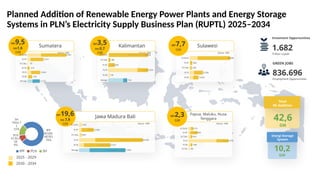
Planned Addition of Renewable Energy Power Plants and Energy Storage
Systems in PLN’s Electricity Supply Business Plan (RUPTL) 2025–2034
Kalimantan
EBT3,5
ESS 0,7
GW Satuan : MW
PLTA/M
PLT Bio
PLTN
PLTS
PLTB
Storage
1.533
80
250
1.524
70
725
Sulawesi
EBT7,7
GW
Satuan : MW
PLTA/M
PLTP
PLT Bio
PLTS
PLTB
4.606
305
236
1.530
1.010
Papua, Maluku, Nusa
Tenggara
EBT2,3
GW
Satuan : MW
PLTA/M
PLTP
PLT Bio
PLTS
PLTB
PLTAL
179
332
141
1.470
140
40
Jawa Madura Bali
EBT19,6
ESS 7,9
GW Satuan : MW
PLTA/M
PLTP
PLT Bio
PLTS
PLTB
Storage
432
2.503
399
10.932
5.377
7.956
1.682
Invesment Opportunities
Trillion rupiah
836.696
GREEN JOBS
Employment Opportunities
Energi Storage
System
10,2
GW
IPP
40186.
48781
76%
PLN
4734.0
58
9%
SH
7904.7
1
15%
IPP PLN SH
30
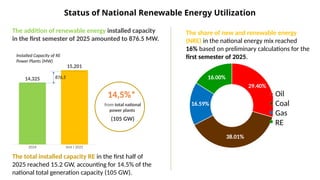
Status of National Renewable Energy Utilization
The addition of renewable energy installed capacity
in the first semester of 2025 amounted to 876.5 MW.
The total installed capacity RE in the first half of
2025 reached 15.2 GW, accounting for 14.5% of the
national total generation capacity (105 GW).
14,5%*
from total national
power plants
(105 GW)
2024 Smt I 2025
14,325
15,201
Installed Capacity of RE
Power Plants (MW)
29.40%
38.01%
16.59%
16.00%
Minyak Bumi
Batubara
Gas Bumi
EBT
The share of new and renewable energy
(NRE) in the national energy mix reached
16% based on preliminary calculations for the
first semester of 2025.
876,5
Oil
Coal
Gas
RE
31
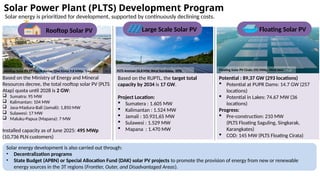
Solar Power Plant (PLTS) Development Program
Potential : 89,37 GW (293 locations)
 Potential at PUPR Dams: 14.7 GW (257
locations)
 Potential in Lakes: 74.67 MW (36
locations)
Progress:
 Pre-construction: 210 MW
(PLTS Floating Saguling, Singkarak,
Karangkates)
 COD: 145 MW (PLTS Floating Cirata)
Based on the RUPTL, the target total
capacity by 2034 is 17 GW.
Project Location:
 Sumatera : 1.605 MW
 Kalimantan : 1.524 MW
 Jamali : 10.931,65 MW
 Sulawesi : 1.529 MW
 Mapana : 1.470 MW
Rooftop Solar PV Large Scale Solar PV Floating Solar PV
Solar energy is prioritized for development, supported by continuously declining costs.
Based on the Ministry of Energy and Mineral
Resources decree, the total rooftop solar PV (PLTS
Atap) quota until 2028 is 2 GW:
 Sumatra: 95 MW
 Kalimantan: 104 MW
 Java-Madura-Bali (Jamali): 1,850 MW
 Sulawesi: 17 MW
 Maluku-Papua (Mapana): 7 MW
Installed capacity as of June 2025: 495 MWp
(10,736 PLN customers)
PLTS Amman 26,8 MW, West Sumbawa, NTB Floating Solar PV Cirata 192 MWp, West Java
Rooftop Solar PV PT Pabrik Kertas Tjiwi Kimia 9,8 MWp, East Java
Solar energy development is also carried out through:
• Decentralization programs
• State Budget (APBN) or Special Allocation Fund (DAK) solar PV projects to promote the provision of energy from new or renewable
energy sources in the 3T regions (Frontier, Outer, and Disadvantaged Areas).
32
Scope of Regulations
Related to the Preparation of the
Regional Regulation on RUED-P
Government Regulation No. 40
of 2025
Presidential Regulation No. 22 of
2017 on the National Energy
General Plan
Law Number 30 of 2007 on Energy
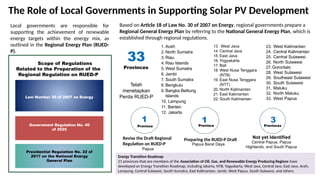
Based on Article 18 of Law No. 30 of 2007 on Energy, regional governments prepare a
Regional General Energy Plan by referring to the National General Energy Plan, which is
established through regional regulations.
1. Aceh
2. North Sumatra
3. Riau
4. Riau Islands
5. West Sumatra
6. Jambi
7. South Sumatra
8. Bengkulu
9. Bangka Belitung
Islands
10. Lampung
11. Banten
12. Jakarta
13. West Java
14. Central Java
15. East Java
16. Yogyakarta
17. Bali
18. West Nusa Tenggara
(NTB)
19. East Nusa Tenggara
(NTT)
20. North Kalimantan
21. East Kalimantan
22. South Kalimantan
23. West Kalimantan
24. Central Kalimantan
25. Central Sulawesi
26. North Sulawesi
27.Gorontalo
28. West Sulawesi
29. Southeast Sulawesi
30. South Sulawesi
31. Maluku
32. North Maluku
33. West Papua
33
Provinces
Telah
menetapkan
Perda RUED-P
Preparing the RUED-P Draft
Papua Barat Daya
1
Province
3
Provinces
Not yet Identified
Central Papua, Papua
Highlands, and South Papua
1
Province
Revise the Draft Regional
Regulation on RUED-P
Papua
The Role of Local Governments in Supporting Solar PV Development
Local governments are responsible for
supporting the achievement of renewable
energy targets within the energy mix, as
outlined in the Regional Energy Plan (RUED-
P).
Energy Transition Roadmap
21 provinces that are members of the Association of Oil, Gas, and Renewable Energy Producing Regions have
developed an Energy Transition Roadmap, including Jakarta, NTB, Yogyakarta, West Java, Central Java, East Java, Aceh,
Lampung, Central Sulawesi, South Sumatra, East Kalimantan, Jambi, West Papua, South Sulawesi, and others.
33
SUPPORT FROM CENTRAL AND REGIONAL GOVERNMENTS IN THE
DEVELOPMENT OF RENEWABLE ENERGY
Based on Articles 53 and 56 of Government Regulation No. 40 of 2025 on the National Energy
Policy, the Central Government and Regional Governments, in promoting and maximizing the
development of new and renewable energy sources, shall undertake:
1. Identification and inventory of new energy sources, including type, location, capacity, and
economic feasibility;
2. Establishment of development plans for new energy sources;
3. Land allocation; and
4. Provision of necessary facilitation.
34
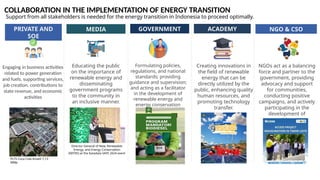
Support from all stakeholders is needed for the energy transition in Indonesia to proceed optimally.
Engaging in business activities
related to power generation
and fuels, supporting services,
job creation, contributions to
state revenue, and economic
activities
PRIVATE AND
SOE
Formulating policies,
regulations, and national
standards; providing
guidance and supervision;
and acting as a facilitator
in the development of
renewable energy and
energy conservation
programs.
GOVERNMENT
Educating the public
on the importance of
renewable energy and
disseminating
government programs
to the community in
an inclusive manner.
MEDIA
NGOs act as a balancing
force and partner to the
government, providing
advocacy and support
for communities,
conducting positive
campaigns, and actively
participating in the
development of
renewable energy.
NGO & CSO
Creating innovations in
the field of renewable
energy that can be
directly utilized by the
public, enhancing quality
human resources, and
promoting technology
transfer.
ACADEMY
PLTS Coca Cola Amatil 7,13
MWp
Director General of New, Renewable
Energy, and Energy Conservation
(EBTKE) at the Katadata SAFE 2024 event
COLLABORATION IN THE IMPLEMENTATION OF ENERGY TRANSITION
35
Terima Kasih
www.ebtke.esdm.go.id
Jl. Pegangsaan Timur No.1,
Cikini, Menteng Jakarta
Address
Kementerian Energi dan
Sumber Daya Mineral
@KementerianESDM
@kesdm
@djebtke
KementerianESDM
36
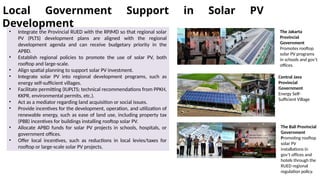
Central Java
Provincial
Government
Energy Self-
Sufficient Village
• Integrate the Provincial RUED with the RPJMD so that regional solar
PV (PLTS) development plans are aligned with the regional
development agenda and can receive budgetary priority in the
APBD.
• Establish regional policies to promote the use of solar PV, both
rooftop and large-scale.
• Align spatial planning to support solar PV investment.
• Integrate solar PV into regional development programs, such as
energy self-sufficient villages.
• Facilitate permitting (IUPLTS; technical recommendations from PPKH,
KKPR, environmental permits, etc.).
• Act as a mediator regarding land acquisition or social issues.
• Provide incentives for the development, operation, and utilization of
renewable energy, such as ease of land use, including property tax
(PBB) incentives for buildings installing rooftop solar PV.
• Allocate APBD funds for solar PV projects in schools, hospitals, or
government offices.
• Offer local incentives, such as reductions in local levies/taxes for
rooftop or large-scale solar PV projects.
The Jakarta
Provincial
Government
Promotes rooftop
solar PV programs
in schools and gov’t
offices.
The Bali Provincial
Government
Promoting rooftop
solar PV
installations in
gov’t offices and
hotels through the
RUED regional
regulation policy.
Local Government Support in Solar PV
Development
37
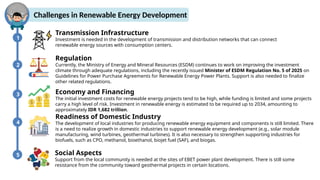
Challenges in Renewable Energy Development
Economy and Financing
The initial investment costs for renewable energy projects tend to be high, while funding is limited and some projects
carry a high level of risk. Investment in renewable energy is estimated to be required up to 2034, amounting to
approximately IDR 1,682 trillion.
Regulation
Currently, the Ministry of Energy and Mineral Resources (ESDM) continues to work on improving the investment
climate through adequate regulations, including the recently issued Minister of ESDM Regulation No. 5 of 2025 on
Guidelines for Power Purchase Agreements for Renewable Energy Power Plants. Support is also needed to finalize
other related regulations.
Transmission Infrastructure
Investment is needed in the development of transmission and distribution networks that can connect
renewable energy sources with consumption centers.
Readiness of Domestic Industry
The development of local industries for producing renewable energy equipment and components is still limited. There
is a need to realize growth in domestic industries to support renewable energy development (e.g., solar module
manufacturing, wind turbines, geothermal turbines). It is also necessary to strengthen supporting industries for
biofuels, such as CPO, methanol, bioethanol, biojet fuel (SAF), and biogas.
Social Aspects
Support from the local community is needed at the sites of EBET power plant development. There is still some
resistance from the community toward geothermal projects in certain locations.
1
2
3
4
5
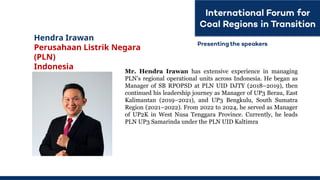
Mr. Hendra Irawan has extensive experience in managing
PLN’s regional operational units across Indonesia. He began as
Manager of SB RPOPSD at PLN UID DJTY (2018–2019), then
continued his leadership journey as Manager of UP3 Berau, East
Kalimantan (2019–2021), and UP3 Bengkulu, South Sumatra
Region (2021–2022). From 2022 to 2024, he served as Manager
of UP2K in West Nusa Tenggara Province. Currently, he leads
PLN UP3 Samarinda under the PLN UID Kaltimra
Hendra Irawan
Perusahaan Listrik Negara
(PLN)
Indonesia
www.pln.co.id |
1
RUPTL 2025 – 2034:
Beyond the
Greenest RUPTL
Present at:
The Indonesia Sustainable Energy Week Goes Regional (ISEWGR) in
Partnership with the International Forum for Coal Regions in
Transition
Theme :
The Role of Local Governments in Driving Renewable Energy
Investments in Coal Regions
PT PLN (Persero)
14 October 2025
Executive Summary
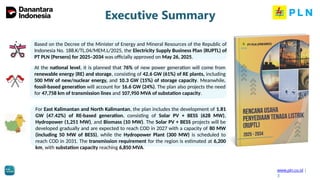
Based on the Decree of the Minister of Energy and Mineral Resources of the Republic of
Indonesia No. 188.K/TL.04/MEM.L/2025, the Electricity Supply Business Plan (RUPTL) of
PT PLN (Persero) for 2025–2034 was officially approved on May 26, 2025.
At the national level, it is planned that 76% of new power generation will come from
renewable energy (RE) and storage, consisting of 42.6 GW (61%) of RE plants, including
500 MW of new/nuclear energy, and 10.3 GW (15%) of storage capacity. Meanwhile,
fossil-based generation will account for 16.6 GW (24%). The plan also projects the need
for 47,758 km of transmission lines and 107,950 MVA of substation capacity.
For East Kalimantan and North Kalimantan, the plan includes the development of 1.81
GW (47.42%) of RE-based generation, consisting of Solar PV + BESS (628 MW),
Hydropower (1,251 MW), and Biomass (10 MW). The Solar PV + BESS projects will be
developed gradually and are expected to reach COD in 2027 with a capacity of 80 MW
(including 50 MW of BESS), while the Hydropower Plant (300 MW) is scheduled to
reach COD in 2031. The transmission requirement for the region is estimated at 6,200
km, with substation capacity reaching 6,850 MVA.
www.pln.co.id |
3
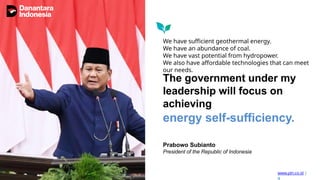
We have sufficient geothermal energy.
We have an abundance of coal.
We have vast potential from hydropower.
We also have affordable technologies that can meet
our needs.
The government under my
leadership will focus on
achieving
energy self-sufficiency.
Prabowo Subianto
President of the Republic of Indonesia
www.pln.co.id |
4
Government Fiscal
Sustainability
Environmental
Sustainability
Electricity System
Reliability
Corporate
Financial
Sustainability
Energy
Security
MINISTRY OF ENERGY
MINERAL RESOURCES
REPUBLIC OF INDONESIA
www.pln.co.id |
42
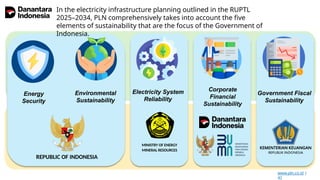
In the electricity infrastructure planning outlined in the RUPTL
2025–2034, PLN comprehensively takes into account the five
elements of sustainability that are the focus of the Government of
Indonesia.
www.pln.co.id |
6
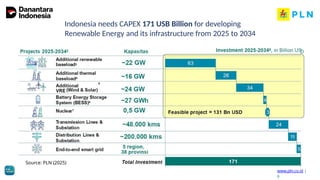
Indonesia needs CAPEX 171 USB Billion for developing
Renewable Energy and its infrastructure from 2025 to 2034
Source: PLN (2025)
www.pln.co.id |
7
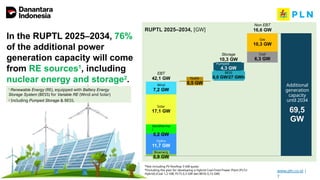
In the RUPTL 2025–2034, 76%
of the additional power
generation capacity will come
from RE sources1
, including
nuclear energy and storage2
.
1 Renewable Energy (RE), equipped with Battery Energy
Storage System (BESS) for Variable RE (Wind and Solar)
2 Including Pumped Storage & BESS.
RUPTL 2025–2034, [GW]
Solar
17,1 GW
Geotherma
l
5,2 GW
Hydro
11,7 GW
Bioenerg
y
0,9 GW
Nuklir
0,5 GW
Pumped
Storage
4,3 GW
BESS
6,0 GW/27 GWh
Gas
10,3 GW
Coal
6,3 GW
EBT
42,1 GW
Wind
7,2 GW
Storage
10,3 GW
Non EBT
16,6 GW
Additional
generation
capacity
until 2034
69,5
GW
*Not including PV Rooftop 3 GW quota
*Including the plan for developing a Hybrid Coal-Fired Power Plant (PLTU
Hybrid) (Coal 1,2 GW, PLTS 0,3 GW dan BESS 0,15 GW)
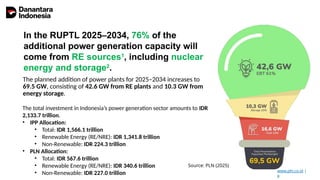
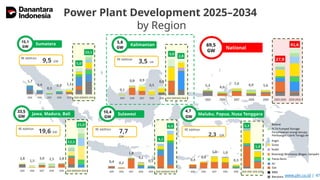
The planned addition of power plants for 2025–2034 increases to
69.5 GW, consisting of 42.6 GW from RE plants and 10.3 GW from
energy storage.
The total investment in Indonesia’s power generation sector amounts to IDR
2,133.7 trillion.
• IPP Allocation:
• Total: IDR 1,566.1 trillion
• Renewable Energy (RE/NRE): IDR 1,341.8 trillion
• Non-Renewable: IDR 224.3 trillion
• PLN Allocation:
• Total: IDR 567.6 trillion
• Renewable Energy (RE/NRE): IDR 340.6 trillion
• Non-Renewable: IDR 227.0 trillion
Source: PLN (2025)
www.pln.co.id |
8
In the RUPTL 2025–2034, 76% of the
additional power generation capacity will
come from RE sources1
, including nuclear
energy and storage2
.
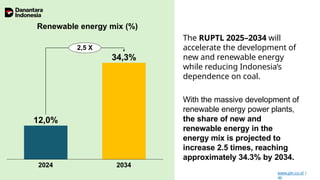
The RUPTL 2025–2034 will
accelerate the development of
new and renewable energy
while reducing Indonesia’s
dependence on coal.
With the massive development of
renewable energy power plants,
the share of new and
renewable energy in the
energy mix is projected to
increase 2.5 times, reaching
approximately 34.3% by 2034.
2024 2034
12,0%
34,3%
2,5 X
Renewable energy mix (%)
www.pln.co.id |
46
Power Plant Development 2025–2034
by Region
National
69,5
GW
15,1
GW
5,8
GW
4,7
GW
Sumatera
Jawa, Madura, Bali Sulawesi Maluku, Papua, Nusa Tenggara
Kalimantan
33,5
GW
10,4
GW
19,6 GW
9,5 GW 3,5 GW
RE Addition
7,7
GW 2,3 GW
RE Addition
RE Addition
RE Addition RE Addition
www.pln.co.id | 47
Mamberam
o
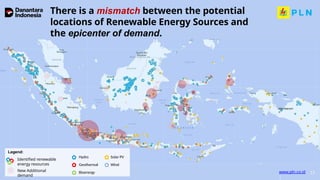
There is a mismatch between the potential
locations of Renewable Energy Sources and
the epicenter of demand.
Hydro
Geothermal
Solar PV
Wind
Legend:
Identified renewable
energy resources
New Additional
demand
www.pln.co.id
|
Bioenergy 11
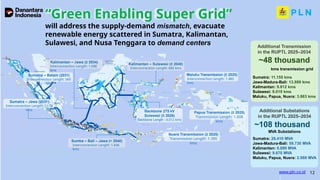
“Green Enabling Super Grid”
will address the supply-demand mismatch, evacuate
renewable energy scattered in Sumatra, Kalimantan,
Sulawesi, and Nusa Tenggara to demand centers
Sumatra – Jawa (2031)
Interconnection Length: 1,174
kms
Sumatra – Batam (2031)
Interconnection Length: 560
kms
Kalimantan – Jawa (≥ 2034)
Interconnection Length: 1.098
kms
Sumba – Bali – Jawa (> 2040)
Interconnection Length: 1.846
kms
Kalimantan – Sulawesi (≥ 2040)
Interconnection Length: 680 kms
Maluku Transmission (≥ 2025)
Interconnection Length: 1.485
kms
Backbone 275 kV
Sulawesi (≥ 2026)
Backbone Length : 4.012 kms
Nusra Transmission (≥ 2025)
Transmission Length: 1.390
kms
Papua Transmission (≥ 2025)
Transmission Length: 1.008
kms
Additional Transmission
in the RUPTL 2025–2034
~48 thousand
kms transmission grid
Sumatra: 11.155 kms
Jawa-Madura-Bali: 13.889 kms
Kalimantan: 9.812 kms
Sulawesi: 9.019 kms
Maluku, Papua, Nusra: 3.883 kms
Additional Substations
in the RUPTL 2025–2034
~108 thousand
MVA Substations
Sumatra: 28.410 MVA
Jawa-Madura-Bali: 59.730 MVA
Kalimantan: 8.080 MVA
Sulawesi: 9.670 MVA
Maluku, Papua, Nusra: 2.060 MVA
www.pln.co.id
|
12
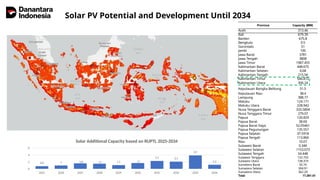
Solar PV Potential and Development Until 2034
Province Capacity (MW)
Aceh 313.46
Bali 679.39
Banten 675.8
Bengkulu 0.5
Gorontalo 51
Jambi 100
Jawa Barat 3781
Jawa Tengah 3808
Jawa Timur 1987.455
Kalimantan Barat 448.675
Kalimantan Selatan 6.68
Kalimantan Tengah 215.56
Kalimantan Timur 546.872
Kalimantan Utara 306.24
Kepulauan Bangka Belitung 51.5
Kepulauan Riau 38.4
Lampung 388.77
Maluku 124.171
Maluku Utara 228.942
Nusa Tenggara Barat 333.5804
Nusa Tenggara Timur 279.07
Papua 126.829
Papua Barat 38.69
Papua Barat Daya 52.05461
Papua Pegunungan 135.557
Papua Selatan 37.5918
Papua Tengah 113.866
Riau 10.07
Sulawesi Barat 0.346
Sulawesi Selatan 1153.073
Sulawesi Tengah 54.448
Sulawesi Tenggara 132.702
Sulawesi Utara 138.373
Sumatera Barat 35.74
Sumatera Selatan 304.91
Sumatera Utara 362.29
Total 17,061.61
0,8 1 1,1
2,3
1,6 1,5 1,7
2,1
3,9
1,2
0
2
4
6
2025 2026 2027 2028 2029 2030 2031 2032 2033 2034
Solar Additional Capacity based on RUPTL 2025-2034
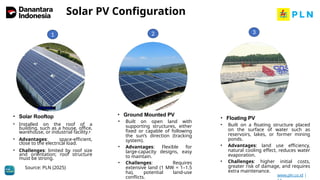
Solar PV Configuration
• Ground Mounted PV
• Built on open land with
supporting structures, either
fixed or capable of following
the sun’s direction (tracking
system).
• Advantages: Flexible for
large-capacity designs, easy
to maintain.
• Challenges: Requires
extensive land (1 MW = 1–1.5
ha), potential land-use
conflicts.
• Floating PV
• Built on a floating structure placed
on the surface of water such as
reservoirs, lakes, or former mining
ponds.
• Advantages: land use efficiency,
natural cooling effect, reduces water
evaporation.
• Challenges: higher initial costs,
greater risk of damage, and requires
extra maintenance.
www.pln.co.id |
tech7energy.co
m
• Solar Rooftop
• Installed on the roof of a
building, such as a house, office,
warehouse, or industrial facility.•
• Advantages: space-efficient,
close to the electrical load.
• Challenges: limited by roof size
and orientation; roof structure
must be strong.
1 2 3
Source: PLN (2025)
www.pln.co.id |
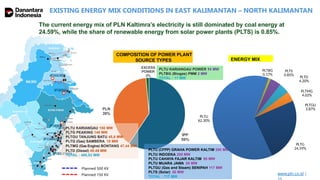
EXISTING ENERGY MIX CONDITIONS IN EAST KALIMANTAN – NORTH KALIMANTAN
Planned 500 KV
Planned 150 KV
ENERGY MIX
COMPOSITION OF POWER PLANT
SOURCE TYPES
IPP
59%
PLN
39%
EXCESS
POWER
2%
PLTU (CFPP) GRAHA POWER KALTIM 200 MW
PLTU INDOEKA 200 MW
PLTU CAHAYA FAJAR KALTIM 95 MW
PLTU MUARA JAWA 55 MW
PLTGU (Gas and Steam) SENIPAH 117 MW
PLTS (Solar) 50 MW
TOTAL : 717 MW
PLTU KARIANGAU 180 MW
PLTG PEAKING 140 MW
PLTGU TANJUNG BATU 45,6 MW
PLTG (Gas) SAMBERA 18 MW
PLTMG (Gas Engine) BONTANG 47,44 MW
PLTD (Diesel) 49,49 MW
TOTAL : 480,53 MW
PLTU KARIANGAU POWER 15 MW
PLTBG (Biogas) PMM 2 MW
TOTAL : 17 MW
The current energy mix of PLN Kaltimra’s electricity is still dominated by coal energy at
24.59%, while the share of renewable energy from solar power plants (PLTS) is 0.85%.
PLTU
62.30%
PLTBG
0.17%
PLTS
0.85%
PLTD
4.20%
PLTMG
4.02%
PLTGU
3.87%
PLTG
24.59%
www.pln.co.id |
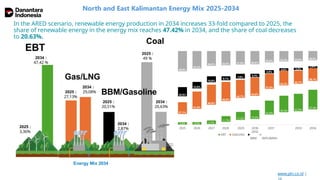
North and East Kalimantan Energy Mix 2025-2034
In the ARED scenario, renewable energy production in 2034 increases 33-fold compared to 2025, the
share of renewable energy in the energy mix reaches 47.42% in 2034, and the share of coal decreases
to 20.63%.
Energy Mix 2034
EBT
2034 :
47,42 %
Coal
2034 :
2,87%
2034 :
20,63%
2025 :
3,36%
Gas/LNG
2034 :
2025 : 29,08%
27,13%
BBM/Gasoline
2025 :
20,51%
2025 :
49 %
3,4% 3,5% 5,7%
11,7%
17,3% 19,9%
32,6%
39,3% 42,0%
47,4%
27,1%
41,5%
48,6%
46,6%
43,7%
44,0%
37,0%
33,3%
32,1%
29,1%
20,5%
12,8%
10,6%
8,1%
7,6% 5,3%
4,5%
4,0% 3,2%
2,9%
49,0%
42,2%
35,0% 33,6% 31,5% 30,8%
25,9% 23,4% 22,8% 20,6%
2025 2026 2027 2033 2034
2028 2029
EBT GAS/LNG
2030 2031
2032
BBM BATUBARA
www.pln.co.id |
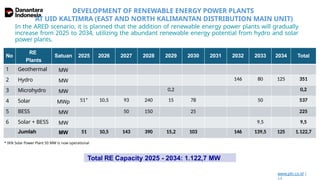
DEVELOPMENT OF RENEWABLE ENERGY POWER PLANTS
AT UID KALTIMRA (EAST AND NORTH KALIMANTAN DISTRIBUTION MAIN UNIT)
No
RE
Plants
Satuan 2025 2026 2027 2028 2029 2030 2031 2032 2033 2034 Total
1 Geothermal MW
2 Hydro MW 146 80 125 351
3 Microhydro MW 0,2 0,2
4 Solar MWp 51* 10,5 93 240 15 78 50 537
5 BESS MW 50 150 25 225
6 Solar + BESS MW 9,5 9,5
Jumlah MW 51 10,5 143 390 15,2 103 146 139,5 125 1.122,7
Total RE Capacity 2025 - 2034: 1.122,7 MW
* IKN Solar Power Plant 50 MW is now operational
In the ARED scenario, it is planned that the addition of renewable energy power plants will gradually
increase from 2025 to 2034, utilizing the abundant renewable energy potential from hydro and solar
power plants.
www.pln.co.id |
18
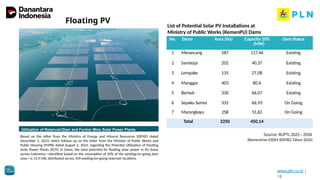
Utilization of Reservoir/Dam and Former Mine Solar Power Plants
Based on the letter from the Ministry of Energy and Mineral Resources (EBTKE) dated
December 1, 2023, which follows up on the letter from the Minister of Public Works and
Public Housing (PUPR) dated August 2, 2023, regarding the Potential Utilization of Floating
Solar Power Plants (PLTS) in Dams, the total potential for floating solar power in PU dams
across Indonesia—identified based on the assumption of 20% of the existing/on-going dam
area—is 13.9 GW, distributed across 109 existing/on-going reservoir locations.
No. Dams Area (Ha) Capacity 20%
(MW)
Dam Status
1 Merancang 587 117,46 Existing
2 Samboja 202 40,37 Existing
3 Lempake 135 27,08 Existing
4 Manggar 403 80,6 Existing
5 Beriwit 330 66,07 Existing
6 Sepaku Semoi 335 66,93 On Going
7 Marangkayu 258 51,63 On Going
Total 2250 450,14
List of Potential Solar PV Installations at
Ministry of Public Works (KemenPU) Dams
Floating PV
Source: RUPTL 2025 – 2034
(Kementrian ESDM (EBTKE) Tahun 2024)
www.pln.co.id |
19
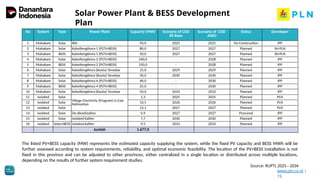
Solar Power Plant & BESS Development
Plan
No System Type Power Plant Capacity (MW) Scenario of COD
RE Base
Scenario of COD
ARED
Status Developer
1 Mahakam Solar IKN 50,0 2025 2025 On Construction IPP
2 Mahakam Solar Kalseltengtimra-1 (PLTS+BESS) 80,0 2027 2027 Planned SH-PLN
3 Mahakam BESS Kalseltengtimra-1 (PLTS+BESS) 50,0 2027 2027 Planned SH-PLN
4 Mahakam Solar Kalseltengtimra-2 (PLTS+BESS) 240,0 - 2028 Planned IPP
5 Mahakam BESS Kalseltengtimra-2 (PLTS+BESS) 150,0 - 2028 Planned IPP
6 Mahakam Solar Kalseltengtimra (Kuota) Tersebar 15,0 2029 2029 Planned IPP
7 Mahakam Solar Kalseltengtimra (Kuota) Tersebar 30,0 2030 2030 Planned IPP
8 Mahakam Solar Kalseltengtimra-4 (PLTS+BESS) 40,0 - 2030 Planned IPP
9 Mahakam BESS Kalseltengtimra-4 (PLTS+BESS) 25,0 - 2030 Planned IPP
10 Mahakam Solar Kalseltengtimra (Kuota) Tersebar 50,0 2033 2033 Planned IPP
11 Isolated Solar
Village Electricity (Program) in East
Kalimantan
1,3 2025 2025 Planned PLN
12 Isolated Solar 10,5 2026 2026 Planned PLN
13 Isolated Solar 12,1 2027 2027 Planned PLN
14 Isolated Solar De-dieselization 0,9 2027 2027 Procured IPP
15 Isolated Solar Isolated Kaltim 7,7 2030 2030 Planned IPP
16 Isolated Solar+BESS Isolated Kaltim 9,5 2033 2033 Planned IPP
Jumlah 1.677,0
The listed PV+BESS capacity (MW) represents the estimated capacity supplying the system, while the fixed PV capacity and BESS MWh will be
further assessed according to system requirements, reliability, and optimal economic feasibility. The location of the PV+BESS installation is not
fixed in this province and can be adjusted to other provinces, either centralized in a single location or distributed across multiple locations,
depending on the results of further system requirement studies.
Source: RUPTL 2025 – 2034
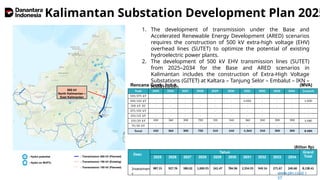
Kalimantan Substation Development Plan 2025
1. The development of transmission under the Base and
Accelerated Renewable Energy Development (ARED) scenarios
requires the construction of 500 kV extra-high voltage (EHV)
overhead lines (SUTET) to optimize the potential of existing
hydroelectric power plants.
2. The development of 500 kV EHV transmission lines (SUTET)
from 2025–2034 for the Base and ARED scenarios in
Kalimantan includes the construction of Extra-High Voltage
Substations (GITET) at Kaltara – Tanjung Selor – Embalut – IKN –
Balikpapan.
: Transmission 500 kV (Planned)
: Hydro potential
500 kV
North Kalimantan –
East Kalimantan
Trafo 2025 2026 2027 2028 2029 2030 2031 2032 2033 2034 Jumlah
500/275 kV - - - - - - - - - - -
500/150 kV - - - - - - 4.000 - - - 4.000
500 kV DC - - - - - - - - - - -
275/150 kV - - - - - - - - - - -
150/115 kV - - - - - - - - - - -
150/20 kV 450 360 300 720 510 540 360 240 300 300 4.080
70/20 kV - - - - - - - - - - -
Total 450 360 300 720 510 540 4,360 240 300 300 8.080
: Transmission 150 kV (Existing)
: Hydro on RUPTL
: Transmission 150 kV (Planned)
www.pln.co.id |
57
Rencana Gardu Induk (MVA)
Desc
Tahun Grand
Total
2025 2026 2027 2028 2029 2030 2031 2032 2033 2034
Investmen
t
987.31 927.76 580.02 1,000.93 241.47 784.96 2,554.55 549.14 271.67 240.60 8,138.41
(Billion Rp)
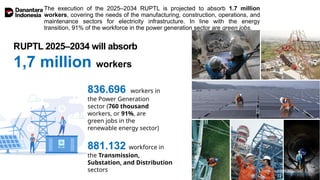
The execution of the 2025–2034 RUPTL is projected to absorb 1.7 million
workers, covering the needs of the manufacturing, construction, operations, and
maintenance sectors for electricity infrastructure. In line with the energy
transition, 91% of the workforce in the power generation sector are green jobs.
RUPTL 2025–2034 will absorb
1,7 million workers
836.696 workers in
the Power Generation
sector (760 thousand
workers, or 91%, are
green jobs in the
renewable energy sector)
881.132 workforce in
the Transmission,
Substation, and Distribution
sectors
14w.pln.co.id
|
w
w
www.pln.co.id |
22
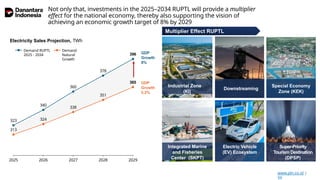
Not only that, investments in the 2025–2034 RUPTL will provide a multiplier
effect for the national economy, thereby also supporting the vision of
achieving an economic growth target of 8% by 2029
323
340
360
378
396
313
324
338
351
365
2025 2026 2027 2028 2029
Demand RUPTL
2025 - 2034
Demand
Natural
Growth
GDP
Growth
8%
GDP
Growth
5,2%
Industrial Zone
(KI)
Downstreaming
Special Economy
Zone (KEK)
Multiplier Effect RUPTL
Electricity Sales Projection, TWh
www.pln.co.id |
59
Integrated Marine
and Fisheries
Center (SKPT)
Electric Vehicle
(EV) Ecosystem
Super-Priority
Tourism Destination
(DPSP)
TERIMA KASIH
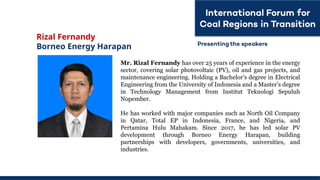
Rizal Fernandy
Borneo Energy Harapan
Mr. Rizal Fernandy has over 25 years of experience in the energy
sector, covering solar photovoltaic (PV), oil and gas projects, and
maintenance engineering. Holding a Bachelor’s degree in Electrical
Engineering from the University of Indonesia and a Master’s degree
in Technology Management from Institut Teknologi Sepuluh
Nopember.
He has worked with major companies such as North Oil Company
in Qatar, Total EP in Indonesia, France, and Nigeria, and
Pertamina Hulu Mahakam. Since 2017, he has led solar PV
development through Borneo Energy Harapan, building
partnerships with developers, governments, universities, and
industries.
IMPLEMENTING SOLAR PV
IN EAST KALIMANTAN PROVINCE
Presented by
Rizal Fernandy
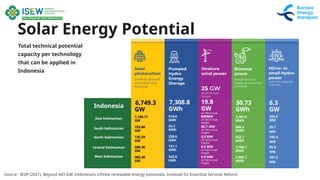
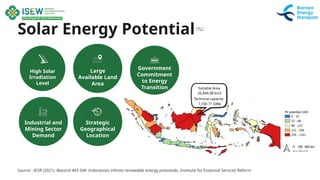
Solar Energy Potential
Total technical potential
capacity per technology
that can be applied in
Indonesia
Source : IESR (2021). Beyond 443 GW: Indonesia’s infinite renewable energy potentials. Institute for Essential Services Reform
6,749.3
GW
7,308.8
GWh
19.8
GW
at 100 m hub
height
30.73
GWh
6.3
GW
1,100.71
GW
518.6
GWh
0.0 MW
at 100 m hub
height
2,395.0
MWh
254.5
MW
193.80
GW
24.2
GWh
86.7 MW
at 100 m hub
height
866.3
MWh
35.7
MW
135.59
GW
228.6
GWh
0.0 MW
at 100 m hub
height
552.1
MWh
192.4
MW
586.46
GW
141.1
GWh
0.0 MW
at 100 m hub
height
3,766.7
MWh
95.8
MW
983.49
GW
342.8
GWh
0.0 MW
at 100 m hub
height
2,998.1
MWh
251.2
MW
Indonesia
East Kalimantan
South Kalimantan
North Kalimantan
Central Kalimantan
West Kalimantan
Solar Energy Potential
Government
Commitment
to Energy
Transition Suitable Area
26,846.08 km2
Technical capacity
1,100.71 GWp
High Solar
Irradiation
Level
Industrial and
Mining Sector
Demand
Large
Available Land
Area
Strategic
Geographical
Location
Source : IESR (2021). Beyond 443 GW: Indonesia’s infinite renewable energy potentials. Institute for Essential Services Reform
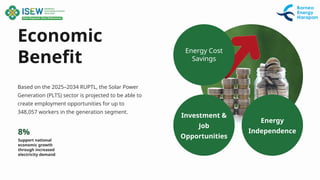
Energy Cost
Savings
Investment &
Job
Opportunities
Economic
Benefit
Based on the 2025–2034 RUPTL, the Solar Power
Generation (PLTS) sector is projected to be able to
create employment opportunities for up to
348,057 workers in the generation segment.
8%
Support national
economic growth
through increased
electricity demand
Energy
Independence
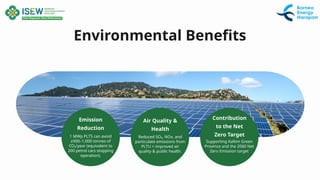
Environmental Benefits
1 MWp PLTS can avoid
±900–1,000 tonnes of
CO₂/year (equivalent to
200 petrol cars stopping
operation).
Emission
Reduction
Reduced SO₂, NOx, and
particulate emissions from
PLTU = improved air
quality & public health.
Air Quality &
Health
Supporting Kaltim Green
Province and the 2060 Net
Zero Emission target
Contribution
to the Net
Zero Target
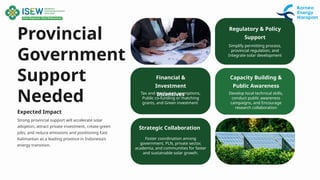
Simplify permitting process,
provincial regulation, and
Integrate solar development
Regulatory & Policy
Support
Tax and retribution exemptions,
Public co-funding or matching
grants, and Green investment
Financial &
Investment
Incentives Develop local technical skills,
conduct public awareness
campaigns, and Encourage
research collaboration
Capacity Building &
Public Awareness
Foster coordination among
government, PLN, private sector,
academia, and communities for faster
and sustainable solar growth.
Strategic Collaboration
Provincial
Government
Support
Needed
Strong provincial support will accelerate solar
adoption, attract private investment, create green
jobs, and reduce emissions and positioning East
Kalimantan as a leading province in Indonesia’s
energy transition.
Expected Impact
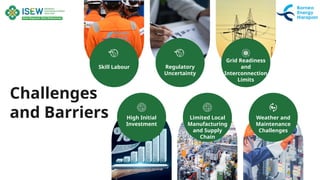
Challenges
and Barriers
Regulatory
Uncertainty
Limited Local
Manufacturing
and Supply
Chain
Weather and
Maintenance
Challenges
Grid Readiness
and
Interconnection
Limits
High Initial
Investment
Skill Labour
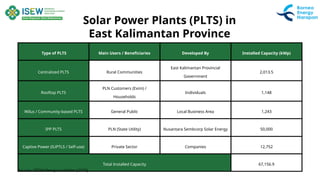
Type of PLTS Main Users / Beneficiaries Developed By Installed Capacity (kWp)
Centralized PLTS Rural Communities
East Kalimantan Provincial
Government
2,013.5
Rooftop PLTS
PLN Customers (Exim) /
Households
Individuals 1,148
Wilus / Community-based PLTS General Public Local Business Area 1,243
IPP PLTS PLN (State Utility) Nusantara Sembcorp Solar Energy 50,000
Captive Power (IUPTLS / Self-use) Private Sector Companies 12,752
Total Installed Capacity 67,156.9
Solar Power Plants (PLTS) in
East Kalimantan Province
Source : ESDM Pemprov Kaltim (2025)
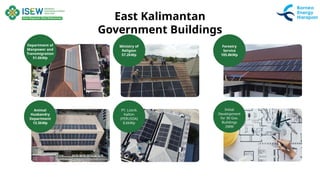
PT. Listrik
Kaltim
(PERUSDA)
8.6kWp
Department of
Manpower and
Transmigration
51.6kWp
East Kalimantan
Government Buildings
Ministry of
Religion
57.2kWp
Forestry
Service
105.8kWp
Initial
Development
for 30 Gov.
Buildings
2MW
Animal
Husbandry
Department
13.3kWp
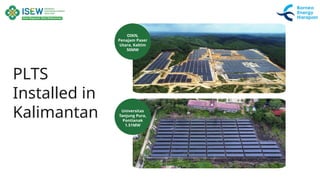
Universitas
Tanjung Pura,
Pontianak
1.51MW
OIKN,
Penajam Paser
Utara, Kaltim
50MW
PLTS
Installed in
Kalimantan
Adaro, Kelanis,
Kalteng
598kWp
Future Plan: 3
MW
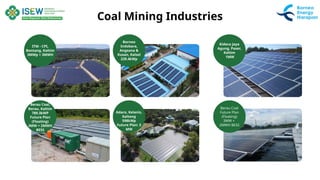
ITM - CPI,
Bontang, Kaltim
3MWp + 3MWH
Coal Mining Industries
Borneo
Indobara,
Angsana &
Kusan, Kalsel
229.4kWp
Kideco Jaya
Agung, Paser,
Kaltim
1MW
Berau Coal
Future Plan
(Floating)
3MW +
2MWH BESS
Berau Coal,
Berau, Kaltim
789.3kWP
Future Plan
(Floating)
3MW + 2MWH
BESS
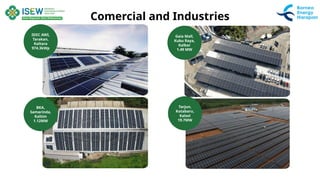
IDEC AWI,
Tarakan,
Kaltara
974.3kWp
BKA,
Samarinda,
Kaltim
1.12MW
Tarjun,
Kotabaru,
Kalsel
19.7MW
Gaia Mall,
Kubu Raya,
Kalbar
1.49 MW
Comercial and Industries
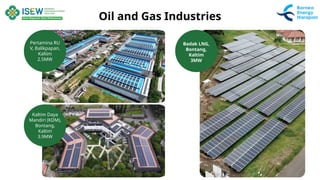
Badak LNG,
Bontang,
Kaltim
3MW
Pertamina RU
V, Balikpapan,
Kaltim
2.5MW
Kaltim Daya
Mandiri (KDM),
Bontang,
Kaltim
3.9MW
Oil and Gas Industries
Thank You
Presented by
Rizal Fernany
Coffee Break
Feel free to visit us on
jetknowledge.org
Join our community
Subscribe to our newsletter
• Regular digests of the latest just transition news,
commentary, publications and events
• Mix of content from coal regions across the world to
encourage knowledge sharing and positive exchange
between countries
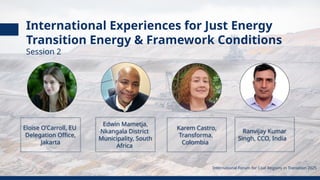
International Experiences for Just Energy
Transition Energy & Framework Conditions
International Forum for Coal Regions in Transition 2025
Eloïse O’Carroll, EU
Delegation Office,
Jakarta
Edwin Mametja,
Nkangala District
Municipality, South
Africa
Session 2
Karem Castro,
Transforma,
Colombia
Ranvijay Kumar
Singh, CCO, India
Eloïse O’Carroll,
EU Delegation, Jakarta
Eloïse O’Carroll is the Programme Manager for Forestry,
Natural Resources, and Energy at the EU Delegation to Indonesia,
leading on the Just Energy Transition Partnership (JETP) and
industrial decarbonisation. She also supports carbon pricing and
markets diplomacy with Indonesian ministries and works on
forestry, agricultural commodities, and development cooperation.
Previously posted in Vietnam, she co-led the EU’s JETP efforts
and supported the EU Deforestation Regulation. With prior
experience in the private sector on carbon markets and
sustainability, Eloïse holds an MSc in Environment and
Development from LSE and a BA in Economics and Development
from McGill University.
The just energy transition
Insights from the EU
experience
Eloise O’Carroll
EU Delegation to Indonesia
October 2025
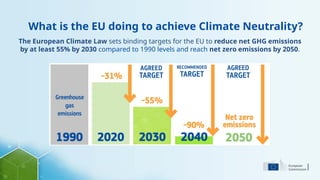
What is the EU doing to achieve Climate Neutrality?
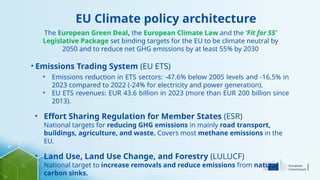
The European Climate Law sets binding targets for the EU to reduce net GHG emissions
by at least 55% by 2030 compared to 1990 levels and reach net zero emissions by 2050.
EU Climate policy architecture
• Emissions Trading System (EU ETS)
• Emissions reduction in ETS sectors: -47.6% below 2005 levels and -16.5% in
2023 compared to 2022 (-24% for electricity and power generation).
• EU ETS revenues: EUR 43.6 billion in 2023 (more than EUR 200 billion since
2013).
• Effort Sharing Regulation for Member States (ESR)
National targets for reducing GHG emissions in mainly road transport,
buildings, agriculture, and waste. Covers most methane emissions in the
EU.
• Land Use, Land Use Change, and Forestry (LULUCF)
National target to increase removals and reduce emissions from natural
carbon sinks.
The European Green Deal, the European Climate Law and the ‘Fit for 55’
Legislative Package set binding targets for the EU to be climate neutral by
2050 and to reduce net GHG emissions by at least 55% by 2030
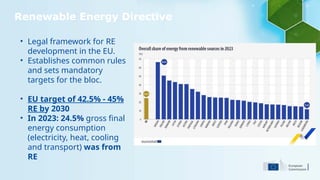
Renewable Energy Directive
• Legal framework for RE
development in the EU.
• Establishes common rules
and sets mandatory
targets for the bloc.
• EU target of 42.5% - 45%
RE by 2030
• In 2023: 24.5% gross final
energy consumption
(electricity, heat, cooling
and transport) was from
RE
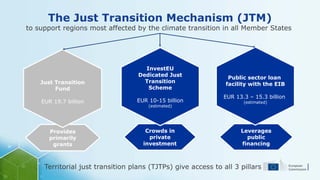
The Just Transition Mechanism (JTM)
to support regions most affected by the climate transition in all Member States
Provides
primarily
grants
Crowds in
private
investment
Leverages
public
financing
Territorial just transition plans (TJTPs) give access to all 3 pillars
Just Transition
Fund
EUR 19.7 billion
InvestEU
Dedicated Just
Transition
Scheme
EUR 10-15 billion
(estimated)
Public sector loan
facility with the EIB
EUR 13.3 – 15.3 billion
(estimated)
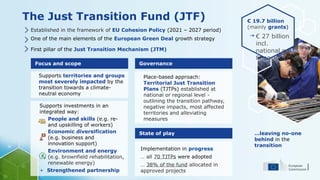
The Just Transition Fund (JTF)
One of the main elements of the European Green Deal growth strategy
Established in the framework of EU Cohesion Policy (2021 – 2027 period)
Governance
Place-based approach:
Territorial Just Transition
Plans (TJTPs) established at
national or regional level -
outlining the transition pathway,
negative impacts, most affected
territories and alleviating
measures
Focus and scope
Supports investments in an
integrated way:
Supports territories and groups
most severely impacted by the
transition towards a climate-
neutral economy
€ 19.7 billion
(mainly grants)
€ 27 billion
incl.
national co-
financing
Environment and energy
(e.g. brownfield rehabilitation,
renewable energy)
Economic diversification
(e.g. business and
innovation support)
People and skills (e.g. re-
and upskilling of workers)
…leaving no-one
behind in the
transition
First pillar of the Just Transition Mechanism (JTM)
+ Strengthened partnership
State of play
Implementation in progress
… all 70 TJTPs were adopted
… 38% of the fund allocated in
approved projects
→
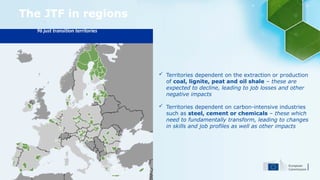
The JTF in regions
96 just transition territories
 Territories dependent on the extraction or production
of coal, lignite, peat and oil shale – these are
expected to decline, leading to job losses and other
negative impacts
 Territories dependent on carbon-intensive industries
such as steel, cement or chemicals – these which
need to fundamentally transform, leading to changes
in skills and job profiles as well as other impacts
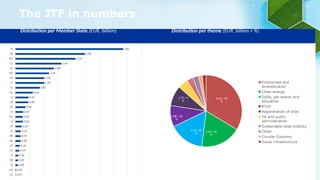
The JTF in numbers
Distribution per Member State (EUR, billion)
6.63 / 34
%
3.59 / 18
%
3.14 / 16
%
1.88 / 10
%
1.79 / 9
%
Enterprises and
diversification
Clean energy
Skills, job-search and
education
RTDI
Regeneration of sites
TA and public
administration
Sustainable local mobility
Other
Circular Economy
Social infrastructure
Distribution per theme (EUR, billion + %)
PL
DE
RO
CZ
EL
BG
FR
IT
ES
NL
FI
SK
EE
LT
HU
SI
PT
LV
HR
BE
SE
AT
CY
DK
IE
MT
LU
3.85
2.48
2.14
1.64
1.38
1.20
1.03
1.03
0.87
0.62
0.47
0.46
0.35
0.27
0.26
0.26
0.22
0.19
0.19
0.18
0.16
0.14
0.10
0.09
0.08
0.02
0.01
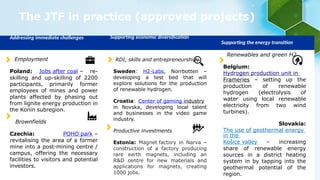
The JTF in practice (approved projects)
Addressing immediate challenges Supporting economic diversification
Renewables and green H2
Belgium:
Hydrogen production unit in
Frameries – setting up the
production of renewable
hydrogen (electrolysis of
water using local renewable
electricity from two wind
turbines).
Slovakia:
The use of geothermal energy
in the
Košice valley – increasing
share of renewable energy
sources in a district heating
system in by tapping into the
geothermal potential of the
region.
Employment
Poland: Jobs after coal – re-
skilling and up-skilling of 2200
participants, primarily former
employees of mines and power
plants affected by phasing out
from lignite energy production in
the Konin subregion.
Brownfields
Czechia: POHO park –
revitalising the area of a former
mine into a post-mining centre /
campus, offering the necessary
facilities to visitors and potential
investors.
RDI, skills and entrepreneurship
Sweden: H2-Labs, Norrbotten –
developing a test bed that will
explore solutions for the production
of renewable hydrogen.
Croatia: Center of gaming industry
in Novska, developing local talent
and businesses in the video game
industry.
Productive investments
Estonia: Magnet factory in Narva –
construction of a factory producing
rare earth magnets, including an
R&D centre for new materials and
applications for magnets, creating
1000 jobs.
Supporting the energy transition
Questions?
Terima kasih banyak! / Thank you!
Eloise.ocarroll@eeas.europa.eu
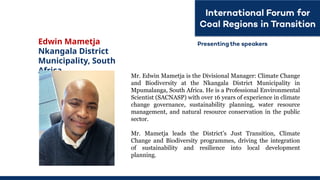
Mr. Edwin Mametja is the Divisional Manager: Climate Change
and Biodiversity at the Nkangala District Municipality in
Mpumalanga, South Africa. He is a Professional Environmental
Scientist (SACNASP) with over 16 years of experience in climate
change governance, sustainability planning, water resource
management, and natural resource conservation in the public
sector.
Mr. Mametja leads the District’s Just Transition, Climate
Change and Biodiversity programmes, driving the integration
of sustainability and resilience into local development
planning.
Edwin Mametja
Nkangala District
Municipality, South
Africa
“Working together with the people to push back the frontiers of poverty”
Access to basic services for all !
Victor Khanye
Dr JS Moroka
Emakhazeni
Emalahleni
Steve Tshwete
Thembisile
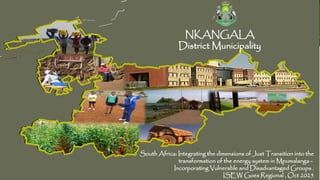
South Africa: Integrating the dimensions of Just Transition into the
transformation of the energy system in Mpumalanga -
Incorporating Vulnerable and Disadvantaged Groups .
ISEW Goes Regional , Oct 2025
NKANGALA
District Municipality
“Working together with the people to push back the frontiers of poverty”
Access to basic services for all !
Presentation Content
• Setting the Scene: South Africa’s Energy and Social Context
• Why Inclusion Matters: Building a People-Centred Transition
• National and Provincial Interventions: Turning Policy into Action
• Local Action: The Case of Nkangala District
• Conclusion and Recommendations
“Working together with the people to push back the frontiers of poverty”
Access to basic services for all !
South Africa’s Energy Landscape and Social Imperative
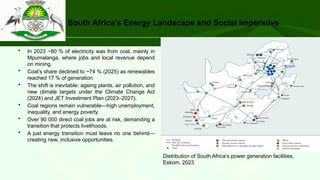
• In 2023 ~80 % of electricity was from coal, mainly in
Mpumalanga, where jobs and local revenue depend
on mining.
• Coal’s share declined to ~74 % (2025) as renewables
reached 17 % of generation.
• The shift is inevitable: ageing plants, air pollution, and
new climate targets under the Climate Change Act
(2024) and JET Investment Plan (2023–2027).
• Coal regions remain vulnerable—high unemployment,
inequality, and energy poverty.
• Over 90 000 direct coal jobs are at risk, demanding a
transition that protects livelihoods.
• A just energy transition must leave no one behind—
creating new, inclusive opportunities.
Distribution of South Africa’s power generation facilities,
Eskom, 2023
“Working together with the people to push back the frontiers of poverty”
Access to basic services for all !
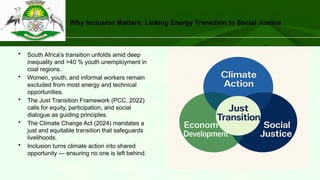
Why Inclusion Matters: Linking Energy Transition to Social Justice
• South Africa’s transition unfolds amid deep
inequality and >40 % youth unemployment in
coal regions.
• Women, youth, and informal workers remain
excluded from most energy and technical
opportunities.
• The Just Transition Framework (PCC, 2022)
calls for equity, participation, and social
dialogue as guiding principles.
• The Climate Change Act (2024) mandates a
just and equitable transition that safeguards
livelihoods.
• Inclusion turns climate action into shared
opportunity — ensuring no one is left behind.
“Working together with the people to push back the frontiers of poverty”
Access to basic services for all !
National and Provincial Interventions: Turning Policy into Action
• JET Investment Plan (2023–2027): R1.5 trillion
investment pipeline for energy, transport, skills, and
green industries.
• Presidential Climate Commission (PCC): coordinates
implementation and ensures justice, inclusion, and
dialogue.
• Department of Forestry, Fisheries and the
Environment (DFFE) and DMRE: mainstream climate
and energy justice into national policy.
• Mpumalanga Green Cluster Agency (MGCA):
promotes green manufacturing, circular economy, and
clean innovation.
• Provincial & District Governments: localise transition
through District Development Model (DDM) —
integrating JET into IDPs and LED strategies.
“Working together with the people to push back the frontiers of poverty”
Access to basic services for all !
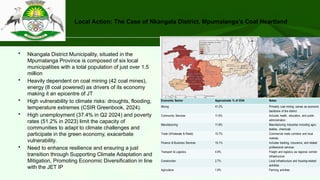
Local Action: The Case of Nkangala District, Mpumalanga’s Coal Heartland
• Nkangala District Municipality, situated in the
Mpumalanga Province is composed of six local
municipalities with a total population of just over 1.5
million
• Heavily dependent on coal mining (42 coal mines),
energy (8 coal powered) as drivers of its economy
making it an epicentre of JT
• High vulnerability to climate risks: droughts, flooding,
temperature extremes (CSIR Greenbook, 2024).
• High unemployment (37.4% in Q2 2024) and poverty
rates (51.2% in 2023) limit the capacity of
communities to adapt to climate challenges and
participate in the green economy, exacerbate
vulnerability.
• Need to enhance resilience and ensuring a just
transition through Supporting Climate Adaptation and
Mitigation, Promoting Economic Diversification in line
with the JET IP
“Working together with the people to push back the frontiers of poverty”
Access to basic services for all !
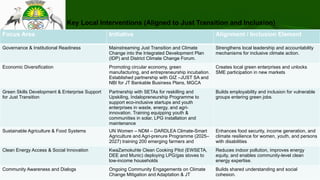
Key Local Interventions (Aligned to Just Transition and Inclusion)
Focus Area Initiative Alignment / Inclusion Element
Governance & Institutional Readiness Mainstreaming Just Transition and Climate
Change into the Integrated Development Plan
(IDP) and District Climate Change Forum.
Strengthens local leadership and accountability
mechanisms for inclusive climate action.
Economic Diversification Promoting circular economy, green
manufacturing, and entrepreneurship incubation.
Established partnership with GIZ –JUST SA and
NBI for JT Bankable Business Plans, MGCA
Creates local green enterprises and unlocks
SME participation in new markets
Green Skills Development & Enterprise Support
for Just Transition
Partnership with SETAs for reskilling and
Upskiling, Indalopreneurship Programme to
support eco-inclusive startups and youth
enterprises in waste, energy, and agri-
innovation. Training equipping youth &
communities in solar, LPG installation and
maintenance
Builds employability and inclusion for vulnerable
groups entering green jobs.
Sustainable Agriculture & Food Systems UN Women – NDM – DARDLEA Climate-Smart
Agriculture and Agri-prenure Programme (2025–
2027) training 200 emerging farmers and
Enhances food security, income generation, and
climate resilience for women, youth, and persons
with disabilities
Clean Energy Access & Social Innovation KwaZamokuhle Clean Cooking Pilot (EWSETA,
DEE and Munic) deploying LPG/gas stoves to
low-income households
Reduces indoor pollution, improves energy
equity, and enables community-level clean
energy expertise.
Community Awareness and Dialogs Ongoing Community Engagements on Climate
Change Mitigation and Adaptation & JT
Builds shared understanding and social
cohesion.
“Working together with the people to push back the frontiers of poverty”
Access to basic services for all !
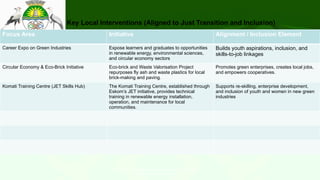
Key Local Interventions (Aligned to Just Transition and Inclusion)
Focus Area Initiative Alignment / Inclusion Element
Career Expo on Green Industries Expose learners and graduates to opportunities
in renewable energy, environmental sciences,
and circular economy sectors
Builds youth aspirations, inclusion, and
skills-to-job linkages
Circular Economy & Eco-Brick Initiative Eco-brick and Waste Valorisation Project
repurposes fly ash and waste plastics for local
brick-making and paving.
Promotes green enterprises, creates local jobs,
and empowers cooperatives.
Komati Training Centre (JET Skills Hub) The Komati Training Centre, established through
Eskom’s JET initiative, provides technical
training in renewable energy installation,
operation, and maintenance for local
communities.
Supports re-skilling, enterprise development,
and inclusion of youth and women in new green
industries
“Working together with the people to push back the frontiers of poverty”
Access to basic services for all !
“Working together with the people to push back the frontiers of poverty”
Access to basic services for all !