Integrating Gender Perspectives in Indonesia's Post-Coal Energy Transition Policies
1.
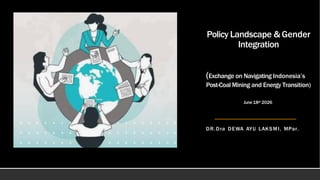
Policy Landscape &Gender
Integration
DR.Dra DEWA AYU LAKSMI, MPar.
(Exchange on Navigating Indonesia’s
Post-Coal Mining and Energy Transition)
June18th 2026
2.
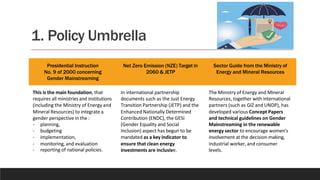
1. Policy Umbrella
PresidentialInstruction
No. 9 of 2000 concerning
Gender Mainstreaming
Net Zero Emission (NZE) Target in
2060 & JETP
Sector Guide from the Ministry of
Energy and Mineral Resources
This is the main foundation, that
requires all ministries and institutions
(including the Ministry of Energy and
Mineral Resources) to integrate a
gender perspective in the :
- planning,
- budgeting
- implementation,
- monitoring, and evaluation
- reporting of national policies.
In international partnership
documents such as the Just Energy
Transition Partnership (JETP) and the
Enhanced Nationally Determined
Contribution (ENDC), the GESI
(Gender Equality and Social
Inclusion) aspect has begun to be
mandated as a key indicator to
ensure that clean energy
investments are inclusive.
The Ministry of Energy and Mineral
Resources, together with international
partners (such as GIZ and UNDP), has
developed various Concept Papers
and technical guidelines on Gender
Mainstreaming in the renewable
energy sector to encourage women's
involvement at the decision-making,
industrial worker, and consumer
levels.
3.
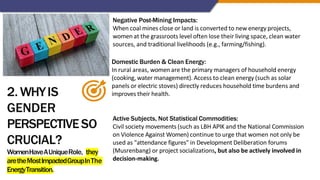
2. WHYIS
GENDER
PERSPECTIVESO
CRUCIAL?
WomenHaveAUniqueRole, they
aretheMostImpactedGroupInThe
EnergyTransition.
NegativePost-Mining Impacts:
When coal mines close or land is converted to new energy projects,
women at the grassroots level often lose their living space, clean water
sources, and traditional livelihoods (e.g., farming/fishing).
Domestic Burden & Clean Energy:
In rural areas, women are the primary managers of household energy
(cooking, water management). Access to clean energy (such as solar
panels or electric stoves) directly reduces household time burdens and
improves their health.
Active Subjects, Not Statistical Commodities:
Civil society movements (such as LBH APIK and the National Commission
on Violence Against Women) continue to urge that women not only be
used as "attendance figures" in Development Deliberation forums
(Musrenbang) or project socializations, but also be actively involved in
decision-making.
4.
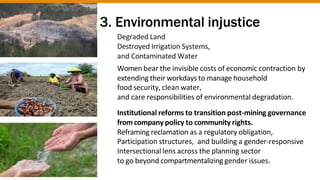
3. Environmental injustice
DegradedLand
Destroyed Irrigation Systems,
and Contaminated Water
Women bear the invisible costs of economic contraction by
extending their workdays to manage household
food security, clean water,
and care responsibilities of environmental degradation.
Institutional reforms to transition post-mining governance
from company policy to community rights.
Reframing reclamation as a regulatory obligation,
Participation structures, and building a gender-responsive
Intersectional lens across the planning sector
to go beyond compartmentalizing gender issues.
5.
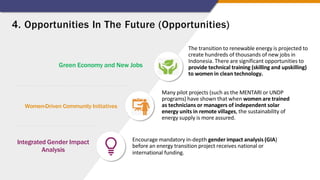
4. Opportunities InThe Future (Opportunities)
The transition to renewable energy is projected to
create hundreds of thousands of new jobs in
Indonesia. There are significant opportunities to
provide technical training (skilling and upskilling)
to women in clean technology.
Green Economy and New Jobs
Many pilot projects (such as the MENTARI or UNDP
programs) have shown that when women are trained
as technicians or managers of independent solar
energy units in remote villages, the sustainability of
energy supply is more assured.
Women-Driven Community Initiatives
Encourage mandatory in-depth gender impact analysis (GIA)
before an energy transition project receives national or
international funding.
Integrated Gender Impact
Analysis
6.
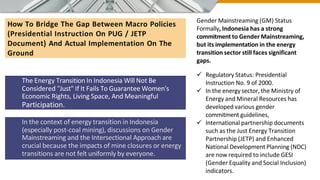
How To BridgeThe Gap Between Macro Policies
(Presidential Instruction On PUG / JETP
Document) And Actual Implementation On The
Ground
The Energy Transition In Indonesia Will Not Be
Considered "Just" If It Fails To Guarantee Women's
Economic Rights, Living Space, And Meaningful
Participation.
In the context of energy transition in Indonesia
(especially post-coal mining), discussions on Gender
Mainstreaming and the Intersectional Approach are
crucial because the impacts of mine closures or energy
transitions are not felt uniformly by everyone.
Gender Mainstreaming (GM) Status
Formally, Indonesia has a strong
commitment to Gender Mainstreaming,
but its implementation in the energy
transition sector still faces significant
gaps.
ü Regulatory Status: Presidential
Instruction No. 9 of 2000.
ü In the energy sector, the Ministry of
Energy and Mineral Resources has
developed various gender
commitment guidelines,
ü International partnership documents
such as the Just Energy Transition
Partnership (JETP) and Enhanced
National Development Planning (NDC)
are now required to include GESI
(Gender Equality and Social Inclusion)
indicators.
7.
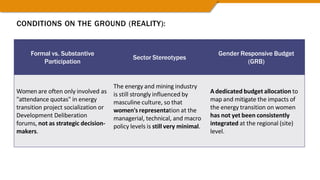
CONDITIONS ON THEGROUND (REALITY):
Formal vs. Substantive
Participation
Sector Stereotypes
Gender Responsive Budget
(GRB)
Women are often only involved as
"attendance quotas" in energy
transition project socialization or
Development Deliberation
forums, not as strategic decision-
makers.
The energy and mining industry
is still strongly influenced by
masculine culture, so that
women's representation at the
managerial, technical, and macro
policy levels is still very minimal.
A dedicated budget allocation to
map and mitigate the impacts of
the energy transition on women
has not yet been consistently
integrated at the regional (site)
level.
8.
2
Transformasi Sosial
Kesehatan untukSemua
Pendidikan Berkualitas yang Merata
Perlindungan Sosial yang Adaptif
IE1
IE2
IE3
Transformasi Ekonomi
Iptek, Inovasi, dan Produktivitas Ekonomi
Penerapan Ekonomi Hijau
Transformasi Digital
IE4
IE5
IE6
Integrasi Ekonomi Domestik dan Global
Perkotaan sebagai Pusat Pertumbuhan Ekonomi
IE7
IE8
Transformasi Tata Kelola
Regulasi dan Tata Kelola yang
Berintegritas dan Adaptif
IE9
Stabilitas dan Ketangguhan Diplomasi
Hukum Berkeadilan, Keamanan Nasional Tangguh,
dan Demokrasi Substansial
Stabilitas Ekonomi Makro
Ketangguhan Diplomasi dan
Pertahanan Berdaya Gentar Kawasan
IE10
IE11
IE12
Ketahanan Sosial Budaya dan Ekologi
Beragama Maslahat dan Berkebudayaan Maju
Lingkungan Hidup Berkualitas
IE13
IE15
Ketahanan Energi, Air, dan Kemandirian Pangan
Resiliensi terhadap Bencana dan Perubahan Ikli m
IE16
IE17
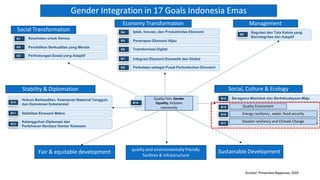
INTEGRASI GENDERDI 17 TUJUAN PEMBANGUNAN INDONESIA EMAS
Keluarga Berkualitas,
Kesetaraan Gender, dan
Masyarakat Inklusif
IE14
Mewujudkan Kesinambungan
Pembangunan
Mewujudkan Sarana dan Prasarana yang
Berkualitas dan Ramah Lingkungan
Mewujudkan Pembangunan Kewilayahan
yang Merata dan Berkeadilan
Sumber: Presentasi Bappenas, 2024
Gender Integration in 17 Goals Indonesia Emas
Social Transformation
Economy Transformation Management
Stability & Diplomation Social, Culture & Ecology
Quality Fam, Gender
Equality, Inclusive
community Quality Enviroment
Energy resiliency , water, food security
Disaster resiliency and Climate Change
Fair & equitable development quality and environmentally friendly
facilities & infrastructure
Sustainable Development
9.
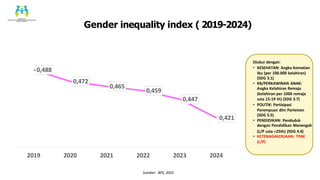
Gender inequality index( 2019-2024)
0,488
0,472
0,465
0,459
0,447
0,421
2019 2020 2021 2022 2023 2024
Diukur dengan:
• KESEHATAN: Angka Kematian
Ibu (per 100.000 kelahiran)
(SDG 3.1)
• KB/PERKAWINAN ANAK:
Angka Kelahiran Remaja
(kelahiran per 1000 remaja
usia 15-19 th) (SDG 3.7)
• POLITIK: Partisipasi
Perempuan dlm Parlemen
(SDG 5.5)
• PENDIDIKAN: Penduduk
dengan Pendidikan Menengah
(L/P usia >25th) (SDG 4.4)
• KETENAGAKERJAAN: TPAK
(L/P)
Sumber: BPS, 2025
10.
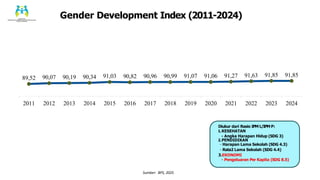
89,52 90,07 90,1990,34 91,03 90,82 90,96 90,99 91,07 91,06 91,27 91,63 91,85 91,85
2011 2012 2013 2014 2015 2016 2017 2018 2019 2020 2021 2022 2023 2024
Gender Development Index (2011-2024)
Diukur dari Rasio IPM L/IPM P:
1.KESEHATAN
- Angka Harapan Hidup (SDG 3)
2.PENDIDIKAN
- Harapan Lama Sekolah (SDG 4.3)
- Rata2 Lama Sekolah (SDG 4.4)
3.EKONOMI
- Pengeluaran Per Kapita (SDG 8.5)
Sumber: BPS, 2025
11.
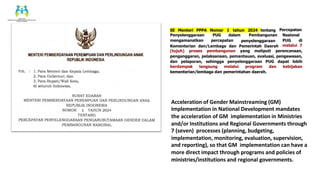
SE Menteri PPPANomor 1 tahun 2024 tentang
Penyelenggaraan PUG dalam Pembangunan
mengamanatkan percepatan penyelenggaraan
Kementerian dan/Lembaga dan Pemerintah Daerah
Percepatan
Nasional
PUG di
melalui 7
(tujuh) proses pembangunan yang meliputi perencanaan,
penganggaran, pelaksanaan, pemantauan, evaluasi, pengawasan,
dan pelaporan, sehingga penyelenggaraan PUG dapat lebih
berdampak langsung melalui program dan kebijakan
kementerian/lembaga dan pemerintahan daerah.
Acceleration of Gender Mainstreaming (GM)
Implementation in National Development mandates
the acceleration of GM implementation in Ministries
and/or Institutions and Regional Governments through
7 (seven) processes (planning, budgeting,
implementation, monitoring, evaluation, supervision,
and reporting), so that GM implementation can have a
more direct impact through programs and policies of
ministries/institutions and regional governments.
12.
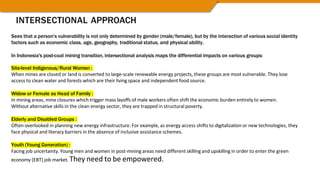
INTERSECTIONAL APPROACH
Sees thata person's vulnerability is not only determined by gender (male/female), but by the interaction of various social identity
factors such as economic class, age, geography, traditional status, and physical ability.
In Indonesia's post-coal mining transition, intersectional analysis maps the differential impacts on various groups:
Site-level Indigenous/Rural Women :
When mines are closed or land is converted to large-scale renewable energy projects, these groups are most vulnerable. They lose
access to clean water and forests which are their living space and independent food source.
Widow or Female as Head of Family :
In mining areas, mine closures which trigger mass layoffs of male workers often shift the economic burden entirely to women.
Without alternative skills in the clean energy sector, they are trapped in structural poverty.
Elderly and Disabled Groups :
Often overlooked in planning new energy infrastructure. For example, as energy access shifts to digitalization or new technologies, they
face physical and literacy barriers in the absence of inclusive assistance schemes.
Youth (Young Generation) :
Facing job uncertainty. Young men and women in post-mining areas need different skilling and upskilling in order to enter the green
economy (EBT) job market. They need to be empowered.
13.
GAPS THAT NEEDTO BE BRIDGING
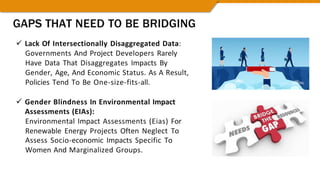
ü Lack Of Intersectionally Disaggregated Data:
Governments And Project Developers Rarely
Have Data That Disaggregates Impacts By
Gender, Age, And Economic Status. As A Result,
Policies Tend To Be One-size-fits-all.
ü Gender Blindness In Environmental Impact
Assessments (EIAs):
Environmental Impact Assessments (Eias) For
Renewable Energy Projects Often Neglect To
Assess Socio-economic Impacts Specific To
Women And Marginalized Groups.
14.
OPPORTUNITIES
Future Opportunities (InclusivePolicy Design:
Leveraging The Momentum Of The National Energy Policy Revision To
Explicitly Incorporate Intersectionality Indicators Into Every Energy
Transition Project.
.
Community-based Empowerment:
Encouraging Energy Transition Funding (Such As JETP Funds Or International Grants)
Directly To Local, Women-led Initiatives, Such As The Management Of Village Communal
Solar Power Plants Or Post-mining Green MSME Programs.)
Continuing The Discussion In Preparation For The Upcoming Expert Exchange, This
Third Point Focuses On :
ü The Gaps That Still Exist Between Macro Regulations And Realities On The
Ground,
ü As Well As Strategic Opportunities To Encourage The Design Of Truly Inclusive And
Gender-responsive Energy Transition Policies In Indonesia
15.
Gaps In CurrentPolicies
Although Strategic Documents Such As The JETP Or Enhanced National Development Planning (NDC) Have Begun To
Incorporate GESI (Gender Equality And Social Inclusion) Aspects.
The Implementation Still Faces Several Fundamental Challenges :
Tokenistic Approach (Quota-Based Formality):
The involvement of women and vulnerable groups in public consultations Regional Development Planning Forum is often
limited to meeting attendance quotas (an attendance list formality). Their participation is not yet substantive—meaning,
their voices and concerns rarely influence the final decisions on energy project outcomes.
Lack of Intersectionally Disaggregated Data: Policymakers generally lack specific data that disaggregates the impacts of the
energy transition (e.g., the impact of coal mine closures) by gender, age group, economic class, and indigenous community
status. As a result, policy interventions tend to be one-size-fits-all.
"Gender Blindness" in Environmental Impact Assessments:
Documents for large-scale new, renewable energy (NRE) infrastructure projects are still dominated by biophysical and
macroeconomic impact assessments, with minimal analysis of the specific socio-economic impacts on women's living spaces
at the site level.
Limited Regional Bureaucratic Capacity:
At the central level, understanding of Gender Mainstreaming may be strong, but policymakers at the regional level
(provinces/districts in post-mining areas) often do not have the capacity or technical guidance to prepare a Gender
Responsive Budget (ARG) in the energy sector.
16.
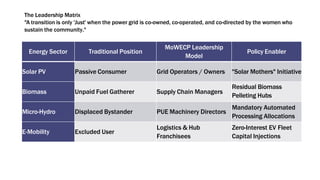
Energy Sector TraditionalPosition
MoWECP Leadership
Model
Policy Enabler
Solar PV Passive Consumer Grid Operators / Owners "Solar Mothers" Initiative
Biomass Unpaid Fuel Gatherer Supply Chain Managers
Residual Biomass
Pelleting Hubs
Micro-Hydro Displaced Bystander PUE Machinery Directors
Mandatory Automated
Processing Allocations
E-Mobility Excluded User
Logistics & Hub
Franchisees
Zero-Interest EV Fleet
Capital Injections
The Leadership Matrix
"A transition is only 'Just' when the power grid is co-owned, co-operated, and co-directed by the women who
sustain the community."
17.
OPPORTUNITIES FOR INCLUSIVEPOLICY DESIGN
The energy transition also brings significant momentum to overhaul outdated policy structures to make them more
equitable. Some valuable opportunities to seize include:
Ø Integrating GESI into Implementing Derivative Regulations: Capitalize on the momentum of developing derivative
regulations (such as the Presidential Regulation on Renewable Energy (Perpres EBT) or the continuously updated JETP
investment plan) to require legally binding Gender Impact Assessments for all energy project developers.
Ø Utilizing International Funding (Blended Finance): International donors and global green investors currently set very
high social compliance standards. Indonesia can leverage these funds to finance community-based energy transition
initiatives led directly by women (e.g., communal electric stoves, village solar power cooperatives).
Ø Targeted Skilling, Upskilling, and Reskilling Programs: Creating equitable green economy jobs. Inclusive policies can be
designed by providing scholarships, technical training, and digital literacy specifically for women and youth in post-
mining areas to ensure they are not left behind as the industry transitions to clean energy.
Ø Collaboration with Civil Society and Local CSOs: The government can partner with local organizations that have
an intersectional approach (such as PEKKA, AMAN, or LBH APIK) to help map vulnerabilities on the ground while
bringing the perspectives of marginalized groups directly to the national policy negotiating table.
18.
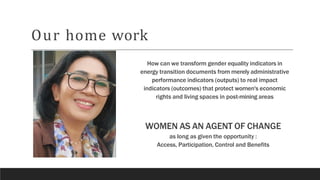
Our home work
Howcan we transform gender equality indicators in
energy transition documents from merely administrative
performance indicators (outputs) to real impact
indicators (outcomes) that protect women's economic
rights and living spaces in post-mining areas
WOMEN AS AN AGENT OF CHANGE
as long as given the opportunity :
Access, Participation, Control and Benefits