Integrated Pest Management: Sustainable Strategies for Effective Pest Control in Agriculture
Comprehensive overview of Integrated Pest Management (IPM) principles, tools, and sustainable approaches to minimize pest damage while protecting the environment and enhancing agricultural productivity.
Integrated Pest Management: Sustainable Strategies for Effective Pest Control in Agriculture
1.
INTEGRATED PEST MANAGEMENT-A
COMPREHENSIVE STUDY
Dr. N.Sannigrahi,
Associate Professor,
Department of Botany,
Nistarini college, Purulia
D.B. Road, Purulia,
INDIA (W.B)
2.
INTEGRATED PEST MANAGEMENT
Integrated Pest Management (IPM) is an effective and
environmentally sensitive approach to pest
management that relies on a combination of common-
sense practices.
IPM programs use current, comprehensive information
on the life cycles of pests and their interaction with
the environment.
This information, in combination with available pest
control methods, is used to manage pest damage by
the most economical means, and with the least
possible hazard to people, property, and the
environment.
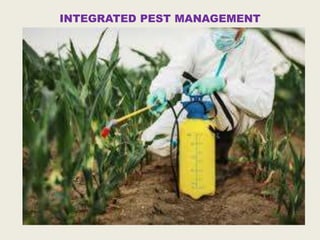
IPM takes advantage of all appropriate pest
management options including, but not limited to, the
judicious use of pesticides.
IPM is not a single pest control method but, rather, a
series of pest management evaluations, decisions and
controls.
IPM WORKING MODULE
PM is not a single pest control method but, rather, a
series of pest management evaluations, decisions and
controls. In practicing IPM, growers who are aware of the
potential for pest infestation follow a four-tiered
approach.
The four steps include:
• ACTION THRESHODS SETTINGS:
• Before taking any pest control action, IPM first sets an
action threshold, a point at which pest populations or
environmental conditions indicate that pest control action
must be taken. Sighting a single pest does not always
mean control is needed. The level at which pests will
become an economic threat is critical to guide future pest
control decisions.
IDENTIFICATION AND MONITORING OF PESTS
Not all insects, weeds, and other living organisms require
control. Many organisms are innocuous, and some are
even beneficial. IPM programs work to monitor for pests
and identify them accurately,
5.
IPM WORKING MODULE
•so that appropriate control decisions can be made in
conjunction with action thresholds. This monitoring
and identification removes the possibility that
pesticides will be used when they are not really
needed or that the wrong kind of pesticide will be
used.
PREVENTION:
As a first line of pest control, IPM programs work to
manage the crop, lawn, or indoor space to prevent
pests from becoming a threat. In an agricultural crop,
this may mean using cultural methods, such as
rotating between different crops, selecting pest-
resistant varieties, and planting pest-free rootstock.
These control methods can be very effective and cost-
efficient and present little to no risk to people or the
environment.
6.
IPM WORKING MODULE
•CONTROL: Once monitoring, identification, and action
thresholds indicate that pest control is required, and
preventive methods are no longer effective or
available, IPM programs then evaluate the proper
control method both for effectiveness and risk.
Effective, less risky pest controls are chosen first,
including highly targeted chemicals, such as
pheromones to disrupt pest mating, or mechanical
control, such as trapping or weeding.
• If further monitoring, identifications and action
thresholds indicate that less risky controls are not
working, then additional pest control methods would
be employed, such as targeted spraying of pesticides.
Broadcast spraying of non-specific pesticides is a last
resort.
7.
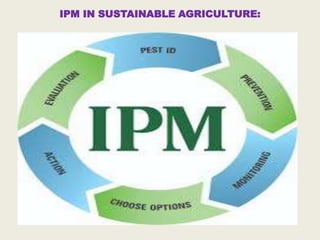
IPM IN SUSTAINABLEAGRICULTURE:
Applies sustainable pest control. IPM builds on
ecosystem services such as pest predation while
protecting others, such as pollination. It also contributes
to increased farm productivity and food availability by
reducing pre- and post-harvest crop losses.
Reduces pesticide residues. IPM contributes to food and
water safety, as reducing the amount of pesticides used
in turn reduces residues in food, feed and fiber, and
environment.
Enhances ecosystem services. IPM seeks to maintain the
national crop ecosystem balance. It conserves the
underlying natural resource base (i.e. soil, water and
biodiversity) and enhances ecosystem services (i.e.
pollination, healthy soils, diversity of species).
Increases income levels. IPM reduces production costs
through reduced levels of pesticide use. Higher quality
crops (with less residues) can command better prices
in markets and contribute to increased farmer
profitability.
Strengthens farmer knowledge. IPM promotes farmer
stewardship, increases farmer knowledge of ecosystem
functioning adapted to their local context.
PRINCIPLES APPRACHES OFIPM
• IPM generally follow three important approaches
based on the effectiveness-
Direct against the pests- the eradiation of the pests
from the site of infection is mostly addressed,
Genetic modification of pests- The Genetic
engineering method can be addressed for the pests
modification,
Modification of environment to make it unfavorable for
pests- the micro-environment should be designed and
modified to reduce the infection of pests in the desired
field.
Thus, the target oriented approaches shold be
considered whenever the IPM is to designed for the
same.
10.
WHY IPM?
TheIPM is very important in the quest of the
sustainable agriculture to ensure food sustainability.
The IPM is required to address the following needs-
Chemical pesticides uses and its side effects- most of
the chemical pesticides create a number of hazards
both in the site as well as in the consumes level in the
prey-predators relationship. The pesticides are
neurotoxin and it can create irreparable damages .
Resistance to chemical pesticides- the ongoing
traditional uses of pesticides has been creating a
environmental hazards by the development of
resistance against the pesticides by the pests. More
than 500 insects have developed resistance against
the pesticides.
Due to exclusions. Large number of plant diseases
transmit.
11.
BASIC PRINCIPLES OFIPM
Basically, the IPM is a very sustainable approach to
induce sustainable crop production by minimizing the
pests keeping in mind the environmental issues. The
following principles are laid down in this context-
Ecosystem consideration- the ecosystem is the
important issue in the IPM consideration as IPM needs
the ecosystem for its optimum benefits.
Pest surveillance- the surveillance of pests is very
important whenever the IPM will become functionally
operation,
Utilization of Economic Threshold Level ( ETL)- the
threshold level of economic parameters must be
addressed effectively,
Application of minimum selective hazards.
12.
BASIC COMPONENTS OFIPM
• The following basic components must be addressed in
this regard-
Acceptance of pest level,
Prevention of cultural practices,
Monitoring,
Mechanical Control,
Biological control,
Responsible pesticides uses
13.
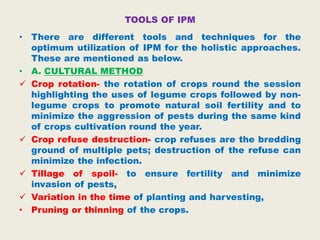
TOOLS OF IPM
•There are different tools and techniques for the
optimum utilization of IPM for the holistic approaches.
These are mentioned as below.
• A. CULTURAL METHOD
Crop rotation- the rotation of crops round the session
highlighting the uses of legume crops followed by non-
legume crops to promote natural soil fertility and to
minimize the aggression of pests during the same kind
of crops cultivation round the year.
Crop refuse destruction- crop refuses are the bredding
ground of multiple pets; destruction of the refuse can
minimize the infection.
Tillage of spoil- to ensure fertility and minimize
invasion of pests,
Variation in the time of planting and harvesting,
• Pruning or thinning of the crops.
14.
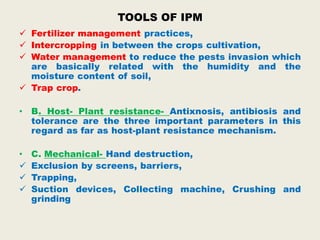
TOOLS OF IPM
Fertilizer management practices,
Intercropping in between the crops cultivation,
Water management to reduce the pests invasion which
are basically related with the humidity and the
moisture content of soil,
Trap crop.
• B. Host- Plant resistance- Antixnosis, antibiosis and
tolerance are the three important parameters in this
regard as far as host-plant resistance mechanism.
• C. Mechanical- Hand destruction,
Exclusion by screens, barriers,
Trapping,
Suction devices, Collecting machine, Crushing and
grinding
15.
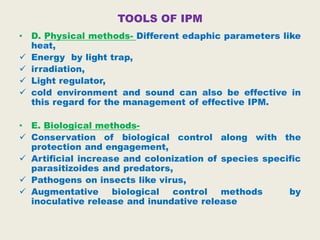
TOOLS OF IPM
•D. Physical methods- Different edaphic parameters like
heat,
Energy by light trap,
irradiation,
Light regulator,
cold environment and sound can also be effective in
this regard for the management of effective IPM.
• E. Biological methods-
Conservation of biological control along with the
protection and engagement,
Artificial increase and colonization of species specific
parasitizoides and predators,
Pathogens on insects like virus,
Augmentative biological control methods by
inoculative release and inundative release
16.
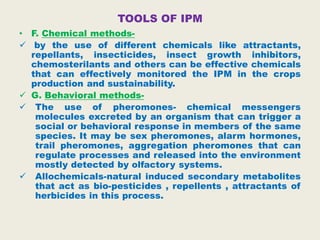
TOOLS OF IPM
•F. Chemical methods-
by the use of different chemicals like attractants,
repellants, insecticides, insect growth inhibitors,
chemosterilants and others can be effective chemicals
that can effectively monitored the IPM in the crops
production and sustainability.
G. Behavioral methods-
The use of pheromones- chemical messengers
molecules excreted by an organism that can trigger a
social or behavioral response in members of the same
species. It may be sex pheromones, alarm hormones,
trail pheromones, aggregation pheromones that can
regulate processes and released into the environment
mostly detected by olfactory systems.
Allochemicals-natural induced secondary metabolites
that act as bio-pesticides , repellents , attractants of
herbicides in this process.
17.
TOOLS OF IPM
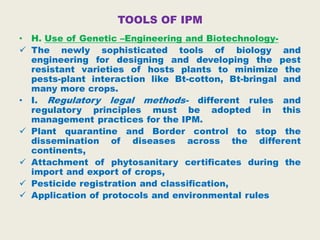
•H. Use of Genetic –Engineering and Biotechnology-
The newly sophisticated tools of biology and
engineering for designing and developing the pest
resistant varieties of hosts plants to minimize the
pests-plant interaction like Bt-cotton, Bt-bringal and
many more crops.
• I. Regulatory legal methods- different rules and
regulatory principles must be adopted in this
management practices for the IPM.
Plant quarantine and Border control to stop the
dissemination of diseases across the different
continents,
Attachment of phytosanitary certificates during the
import and export of crops,
Pesticide registration and classification,
Application of protocols and environmental rules
18.
THANKS FOR YOURVISIT
• ACKNOWLEDGEMENTS:
a. Google for images,
b. Different websites for enriching the course content,
c. Science Direct pages,
d. Plant diseases, insects and pests- NCBI-NH,
e. www.nature.com
f. www.spruce.com
g. www.aphis.usda.gov
h. Puregreensaz.com
i. https://www.epa.gov/safepestcontrol/integrated-pest-
management-ipm-principles
j. https://www.un.org/en/climatechange/science/causes-effects-climate-change
k. www.fao.org
l. https://ccd.gujarat.gov.in/causes-of-climate-change.htm
m. Many more websites for references.
• This presentation has been designed to address the academic fraternity
without any financial interest. This is absolutely free to use . The author does
not claim any kind of financial benefits from this content