Innovative Teaching Practices in Sustainable Aquaculture and Fisheries Education for Secondary Teachers
1.
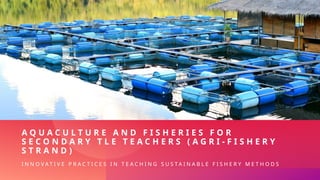
A Q UA C U L T U R E A N D F I S H E R I E S F O R
S E C O N D A R Y T L E T E A C H E R S ( A G R I - F I S H E R Y
S T R A N D )
I N N O V A T I V E P R A C T I C E S I N T E A C H I N G S U S T A I N A B L E F I S H E R Y M E T H O D S
Course Context: TLEGrade 8 Agri-
Fishery Focus
Curriculum Alignment
Lesson aligns with TLE Grade 8 Agri-Fishery strand and MATATAG K to 10
Curriculum standards.
Local Community Relevance
Focus on aquaculture reflects priorities of coastal and inland Philippine fishing
communities.
Practical Skills and Career Focus
Agri-Fishery strand emphasizes practical skills, food security, employment, and
entrepreneurship.
Interdisciplinary Connections
Lesson integrates science, social studies, and economics for holistic fisheries
education.
4.
Content and PerformanceStandards
in Fisheries
Content Standards Overview
Learners must understand core fisheries concepts like fish culture, aquatic
environments, and aquaculture systems.
Performance Standards Focus
Emphasizes practical skills in fisheries with adherence to safety precautions and
responsible work habits.
Theory and Practice Integration
Combining classroom discussions with simulations and hands-on activities
enhances learning effectiveness.
Competency-Based Education
Assessment is based on demonstrated understanding and skill performance
rather than rote memorization.
5.
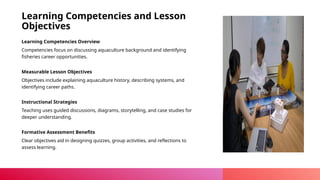
Learning Competencies andLesson
Objectives
Learning Competencies Overview
Competencies focus on discussing aquaculture background and identifying
fisheries career opportunities.
Measurable Lesson Objectives
Objectives include explaining aquaculture history, describing systems, and
identifying career paths.
Instructional Strategies
Teaching uses guided discussions, diagrams, storytelling, and case studies for
deeper understanding.
Formative Assessment Benefits
Clear objectives aid in designing quizzes, group activities, and reflections to
assess learning.
6.
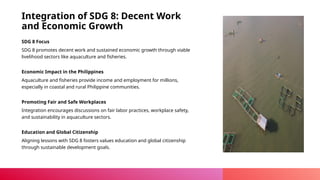
Integration of SDG8: Decent Work
and Economic Growth
SDG 8 Focus
SDG 8 promotes decent work and sustained economic growth through viable
livelihood sectors like aquaculture and fisheries.
Economic Impact in the Philippines
Aquaculture and fisheries provide income and employment for millions,
especially in coastal and rural Philippine communities.
Promoting Fair and Safe Workplaces
Integration encourages discussions on fair labor practices, workplace safety,
and sustainability in aquaculture sectors.
Education and Global Citizenship
Aligning lessons with SDG 8 fosters values education and global citizenship
through sustainable development goals.
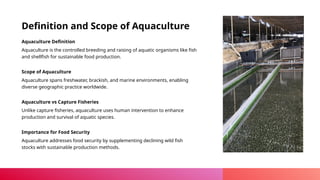
Definition and Scopeof Aquaculture
Aquaculture Definition
Aquaculture is the controlled breeding and raising of aquatic organisms like fish
and shellfish for sustainable food production.
Scope of Aquaculture
Aquaculture spans freshwater, brackish, and marine environments, enabling
diverse geographic practice worldwide.
Aquaculture vs Capture Fisheries
Unlike capture fisheries, aquaculture uses human intervention to enhance
production and survival of aquatic species.
Importance for Food Security
Aquaculture addresses food security by supplementing declining wild fish
stocks with sustainable production methods.
9.
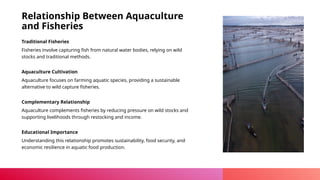
Relationship Between Aquaculture
andFisheries
Traditional Fisheries
Fisheries involve capturing fish from natural water bodies, relying on wild
stocks and traditional methods.
Aquaculture Cultivation
Aquaculture focuses on farming aquatic species, providing a sustainable
alternative to wild capture fisheries.
Complementary Relationship
Aquaculture complements fisheries by reducing pressure on wild stocks and
supporting livelihoods through restocking and income.
Educational Importance
Understanding this relationship promotes sustainability, food security, and
economic resilience in aquatic food production.
10.
Global Historical Developmentof
Aquaculture
Early Aquaculture Origins
Aquaculture began in China around 2953 B.C. with pond management and net
making techniques.
Roman and European Advances
Romans practiced fish farming for luxury food; Europeans advanced artificial
fecundation and fish culture.
American Aquaculture Beginnings
Late 18th-century America showed early interest in fishponds, culturing species
like goldfish.
Japanese Contributions
Japan pioneered seaweed and pearl culture, with Mikimoto leading pearl oyster
farming innovations.
11.
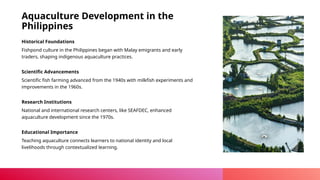
Aquaculture Development inthe
Philippines
Historical Foundations
Fishpond culture in the Philippines began with Malay emigrants and early
traders, shaping indigenous aquaculture practices.
Scientific Advancements
Scientific fish farming advanced from the 1940s with milkfish experiments and
improvements in the 1960s.
Research Institutions
National and international research centers, like SEAFDEC, enhanced
aquaculture development since the 1970s.
Educational Importance
Teaching aquaculture connects learners to national identity and local
livelihoods through contextualized learning.
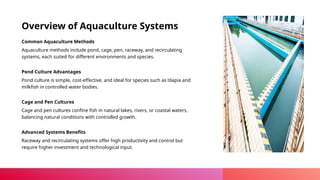
Overview of AquacultureSystems
Common Aquaculture Methods
Aquaculture methods include pond, cage, pen, raceway, and recirculating
systems, each suited for different environments and species.
Pond Culture Advantages
Pond culture is simple, cost-effective, and ideal for species such as tilapia and
milkfish in controlled water bodies.
Cage and Pen Cultures
Cage and pen cultures confine fish in natural lakes, rivers, or coastal waters,
balancing natural conditions with controlled growth.
Advanced Systems Benefits
Raceway and recirculating systems offer high productivity and control but
require higher investment and technological input.
14.
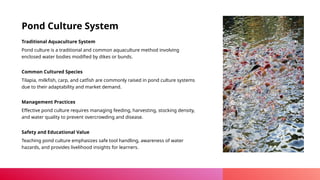
Pond Culture System
TraditionalAquaculture System
Pond culture is a traditional and common aquaculture method involving
enclosed water bodies modified by dikes or bunds.
Common Cultured Species
Tilapia, milkfish, carp, and catfish are commonly raised in pond culture systems
due to their adaptability and market demand.
Management Practices
Effective pond culture requires managing feeding, harvesting, stocking density,
and water quality to prevent overcrowding and disease.
Safety and Educational Value
Teaching pond culture emphasizes safe tool handling, awareness of water
hazards, and provides livelihood insights for learners.
15.
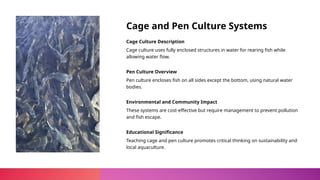
Cage and PenCulture Systems
Cage Culture Description
Cage culture uses fully enclosed structures in water for rearing fish while
allowing water flow.
Pen Culture Overview
Pen culture encloses fish on all sides except the bottom, using natural water
bodies.
Environmental and Community Impact
These systems are cost-effective but require management to prevent pollution
and fish escape.
Educational Significance
Teaching cage and pen culture promotes critical thinking on sustainability and
local aquaculture.
16.
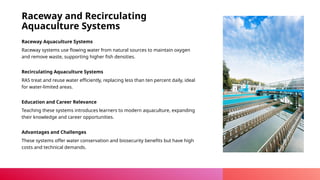
Raceway and Recirculating
AquacultureSystems
Raceway Aquaculture Systems
Raceway systems use flowing water from natural sources to maintain oxygen
and remove waste, supporting higher fish densities.
Recirculating Aquaculture Systems
RAS treat and reuse water efficiently, replacing less than ten percent daily, ideal
for water-limited areas.
Education and Career Relevance
Teaching these systems introduces learners to modern aquaculture, expanding
their knowledge and career opportunities.
Advantages and Challenges
These systems offer water conservation and biosecurity benefits but have high
costs and technical demands.
Career
Opportunities in
Aquaculture and
Fisheries
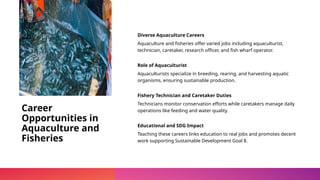
DiverseAquaculture Careers
Aquaculture and fisheries offer varied jobs including aquaculturist,
technician, caretaker, research officer, and fish wharf operator.
Role of Aquaculturist
Aquaculturists specialize in breeding, rearing, and harvesting aquatic
organisms, ensuring sustainable production.
Fishery Technician and Caretaker Duties
Technicians monitor conservation efforts while caretakers manage daily
operations like feeding and water quality.
Educational and SDG Impact
Teaching these careers links education to real jobs and promotes decent
work supporting Sustainable Development Goal 8.
19.
Business Opportunities inthe
Fisheries Sector
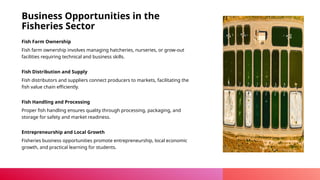
Fish Farm Ownership
Fish farm ownership involves managing hatcheries, nurseries, or grow-out
facilities requiring technical and business skills.
Fish Distribution and Supply
Fish distributors and suppliers connect producers to markets, facilitating the
fish value chain efficiently.
Fish Handling and Processing
Proper fish handling ensures quality through processing, packaging, and
storage for safety and market readiness.
Entrepreneurship and Local Growth
Fisheries business opportunities promote entrepreneurship, local economic
growth, and practical learning for students.
20.
Classroom Activities andLearner
Engagement
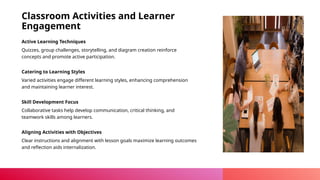
Active Learning Techniques
Quizzes, group challenges, storytelling, and diagram creation reinforce
concepts and promote active participation.
Catering to Learning Styles
Varied activities engage different learning styles, enhancing comprehension
and maintaining learner interest.
Skill Development Focus
Collaborative tasks help develop communication, critical thinking, and
teamwork skills among learners.
Aligning Activities with Objectives
Clear instructions and alignment with lesson goals maximize learning outcomes
and reflection aids internalization.
21.
Assessment, Reflection, andLesson
Synthesis
Formative Assessment Tools
Multiple-choice quizzes and oral questioning help evaluate student
understanding in aquaculture topics effectively.
Learner Reflection Activities
Reflection encourages learners to express their understanding and recognize
aquaculture’s importance.
Teacher Self-Evaluation
Teacher reflection helps improve instructional strategies, materials, and learner
engagement in TLE education.
Lesson Content Synthesis
Synthesizing assessment and reflection ensures meaningful learning and real-
life application of aquaculture knowledge.
#2 Course Context: TLE Grade 8 Agri-Fishery Focus, Content and Performance Standards in Fisheries, Learning Competencies and Lesson Objectives, Integration of SDG 8: Decent Work and Economic Growth
#3
This slide situates the lesson within the broader context of Technology and Livelihood Education (TLE) Grade 8 under the Agri-Fishery strand, specifically aligned with Quarter 2, Lesson 1 of the MATATAG K to 10 Curriculum. The focus on aquaculture and fisheries responds to both national development priorities and local community realities, particularly in coastal and inland fishing areas of the Philippines. For secondary TLE teachers, this lesson serves as a foundational entry point for learners to understand how food production, livelihoods, and sustainable resource management intersect within the fisheries sector. The Agri-Fishery strand emphasizes practical skills, applied knowledge, and career awareness, making aquaculture an ideal topic due to its relevance to food security, employment, and entrepreneurship. This lesson is designed to be developmentally appropriate for Grade 8 learners by balancing historical background, conceptual understanding, and real-world applications. It also reflects DepEd’s goal of contextualized learning, where examples such as local fish species, Philippine aquaculture practices, and regional research centers are integrated into instruction. By grounding the lesson in authentic contexts, teachers can help learners see the relevance of fisheries to their own communities and future opportunities. Additionally, the lesson supports interdisciplinary connections with Science (ecology, biology), Araling Panlipunan (local industries and history), and Economics (livelihoods and markets). For teachers, understanding this context ensures that lesson delivery is aligned with curriculum standards while remaining flexible enough to adapt to local resources, learners’ backgrounds, and school conditions. Ultimately, this course context frames aquaculture not just as a technical topic, but as a meaningful life skill and potential career pathway for Filipino learners.
#4
The content and performance standards define what learners should know and be able to do by the end of the lesson on aquaculture and fisheries. The content standard emphasizes that learners must demonstrate an understanding of core concepts and skills in fisheries, including fish culture, aquatic environments, and basic aquaculture systems. This understanding goes beyond memorization, requiring learners to grasp why aquaculture developed, how it relates to fisheries, and its role in addressing issues such as overfishing and food supply. The performance standard, on the other hand, focuses on the practical application of these concepts, requiring learners to perform fisheries-related skills while observing proper safety precautions. For secondary TLE teachers, these standards highlight the importance of combining theory with practice. Classroom discussions on aquaculture history and systems should be complemented by simulations, visual analyses, or simple hands-on activities such as diagramming fishpond layouts or identifying tools used in fish culture. Safety is a critical component of the performance standard, reinforcing responsible work habits that are essential in real aquaculture settings. By aligning instruction with these standards, teachers ensure that learners are not only informed but also prepared to apply basic fisheries skills responsibly. These standards also support competency-based education, where learners are assessed based on demonstrated understanding and skill performance rather than rote recall alone. For teachers, consistently referencing content and performance standards during lesson planning helps maintain instructional focus and ensures alignment with DepEd expectations.
#5
The learning competencies and objectives serve as the instructional roadmap for this lesson on aquaculture and fisheries. The primary learning competencies require students to discuss the background of aquaculture and its relationship to fisheries, as well as to identify career and business opportunities related to the sector. These competencies are translated into clear, measurable lesson objectives that guide both teaching and assessment. By the end of the lesson, learners are expected to explain the historical background of aquaculture, describe different types of aquaculture systems, and identify various careers and business opportunities in fisheries. For secondary TLE teachers, these objectives emphasize higher-order thinking skills such as explanation, description, and identification, rather than simple recall. This encourages teachers to use strategies like guided discussions, visual organizers, and contextualized examples. For instance, when explaining aquaculture history, teachers can connect global developments to Philippine practices. When describing aquaculture systems, diagrams and comparative discussions can be used to highlight differences among pond, cage, and recirculating systems. Identifying career opportunities can be enriched through storytelling, case studies, or community examples. Clearly stated objectives also help teachers design appropriate formative assessments, such as quizzes, group activities, and reflection exercises. Moreover, sharing lesson objectives with learners at the start of the lesson promotes transparency and helps students understand what is expected of them, fostering self-directed learning and engagement.
#6
This lesson integrates Sustainable Development Goal (SDG) 8, which focuses on promoting decent work and sustained economic growth, by highlighting aquaculture and fisheries as viable livelihood and business sectors. For secondary TLE teachers, this integration provides an opportunity to connect classroom learning with global and national development goals. Aquaculture supports SDG 8 by generating employment, supporting small-scale entrepreneurs, and contributing to local and national economies. In the Philippine context, fisheries and aquaculture provide income for millions of families, particularly in coastal and rural areas. By discussing career and business opportunities such as fish farming, fish distribution, and aquaculture research, teachers help learners understand how decent work can be created within the sector. This integration also encourages discussions about fair labor practices, workplace safety, and sustainability, which are essential components of decent work. Teachers can prompt learners to reflect on how responsible aquaculture practices contribute to long-term economic growth while protecting aquatic resources. Integrating SDG 8 also fosters values education, encouraging learners to see work not only as a means of income but as a way to contribute positively to society. For teachers, aligning lessons with SDGs enhances relevance and supports DepEd’s emphasis on global citizenship and sustainable development education.
#7 Definition and Scope of Aquaculture, Relationship Between Aquaculture and Fisheries, Global Historical Development of Aquaculture, Aquaculture Development in the Philippines
#8
Aquaculture is defined as the breeding, raising, and harvesting of aquatic organisms such as fish, shellfish, and aquatic plants under controlled or semi-controlled conditions. Unlike capture fisheries, which rely on harvesting naturally occurring fish stocks from oceans, rivers, and lakes, aquaculture involves human intervention to improve production, survival, and growth. For secondary TLE teachers, it is important to emphasize that aquaculture is both a science and a livelihood practice. It combines biological knowledge, environmental management, and practical skills to produce food sustainably. The scope of aquaculture includes freshwater, brackish water, and marine environments, allowing it to be practiced in diverse geographic settings. Aquaculture plays a crucial role in addressing food security issues, especially as wild fish stocks decline due to overfishing and environmental degradation. In the Philippines, aquaculture contributes significantly to fish supply through species such as tilapia, milkfish, and prawns. Teaching the definition and scope of aquaculture helps learners distinguish it from traditional fishing and appreciate its role in modern food systems. Teachers can use real-life examples, such as local fishponds or fish cages, to make the concept concrete and relatable. Understanding aquaculture also sets the foundation for later discussions on systems, careers, and business opportunities within the fisheries sector.
#9
Aquaculture and fisheries are closely related components of the broader aquatic food production sector. Fisheries traditionally refer to the capture of fish and other aquatic organisms from natural water bodies, while aquaculture focuses on their cultivation. For secondary TLE teachers, explaining this relationship helps learners understand how the two sectors complement each other. As natural fish stocks face pressure from population growth, habitat destruction, and illegal fishing, aquaculture has emerged as a sustainable alternative that reduces dependence on wild capture fisheries. At the same time, fisheries provide knowledge, species, and cultural practices that inform aquaculture development. In the Philippine context, many fishers engage in both capture fishing and aquaculture, depending on seasons and resource availability. This blended livelihood strategy highlights the interconnectedness of the two sectors. Teachers can also discuss how aquaculture supports fisheries by restocking depleted areas and providing alternative income sources for fishing communities. Understanding this relationship encourages learners to view aquaculture not as a replacement for fisheries, but as a complementary approach that supports sustainability, food security, and economic resilience. This perspective aligns with responsible resource management principles emphasized in TLE and environmental education.
#10
The historical development of aquaculture demonstrates how human societies have long sought ways to manage and produce aquatic food resources. Historical records indicate that fish culture began in China as early as 2953 B.C., where techniques such as net making and pond management were developed. The Romans later valued fish as luxury food items and practiced fish farming, although their focus was more on consumption than scientific advancement. In Europe, figures such as Jacob of Westphalia contributed to artificial fecundation techniques, while Leonard Mascall’s publication in 1590 helped popularize fish culture practices. In the United States, early interest in fishponds was documented in the late 18th century, with goldfish being among the first cultured species. Japan also made significant contributions, particularly in seaweed and pearl culture, with Mikimoto recognized as a pioneer of pearl oyster farming. For secondary TLE teachers, presenting this global history helps learners appreciate aquaculture as an evolving practice shaped by culture, technology, and economic needs. It also provides context for understanding modern aquaculture systems and innovations. Teachers can use timelines or comparative discussions to make historical developments engaging and accessible to learners.
#11
Aquaculture development in the Philippines reflects a combination of indigenous practices, foreign influences, and modern scientific research. While there is no exact record of when fishpond culture began in the country, it is believed that Malay emigrants introduced early practices long before Chinese traders arrived. Towns such as Navotas and Malabon are recognized as pioneers of the Philippine fishpond industry. Scientific fish farming gained momentum in the 1940s with experiments on milkfish culture, followed by significant improvements in the 1960s. The establishment of national and international research institutions in the 1970s further strengthened the industry. Notable centers include the Southeast Asian Fisheries Development Center in Iloilo and university-based aquaculture research facilities. For secondary TLE teachers, this local history is especially important because it connects lesson content to national identity and community livelihoods. Discussing Philippine aquaculture development helps learners see fisheries as a dynamic and evolving sector with strong local roots. Teachers can encourage learners to identify local aquaculture practices or species, reinforcing contextualized and place-based learning.
#12 Overview of Aquaculture Systems, Pond Culture System, Cage and Pen Culture Systems, Raceway and Recirculating Aquaculture Systems
#13
Aquaculture systems refer to the different methods used to culture aquatic organisms under controlled conditions. Understanding these systems is essential for secondary TLE teachers because it introduces learners to the practical side of fisheries. Common aquaculture systems include pond culture, cage culture, pen culture, raceway culture, and recirculating aquaculture systems. Each system varies in terms of water source, level of control, cost, and environmental impact. Pond culture is widely used due to its simplicity and suitability for species like tilapia and milkfish. Cage and pen cultures are often used in lakes, rivers, and coastal areas, allowing fish to grow in natural water bodies while being confined. Raceway and recirculating systems are more technologically advanced and require greater investment but offer higher productivity and control. Teaching an overview of these systems helps learners compare methods and understand why certain systems are used in specific contexts. Teachers can use diagrams, photos, or simple models to support understanding. This overview also prepares learners for discussions on careers and businesses linked to specific aquaculture systems.
#14
Pond culture is one of the most common and traditional aquaculture systems used in the Philippines and other countries. It involves raising fish in enclosed bodies of water that are constructed or modified by humans, usually with dikes or bunds to control water levels. Species such as tilapia, milkfish, carp, and catfish are commonly cultured using this system. For secondary TLE teachers, pond culture is an ideal system to discuss because it is familiar, accessible, and often present in local communities. Pond culture allows for relatively simple management of feeding, harvesting, and water quality. However, it also requires proper planning to prevent issues such as overcrowding, disease, and water pollution. Teaching pond culture provides opportunities to discuss basic management practices, including stocking density, feeding schedules, and maintenance. Teachers can also highlight safety considerations, such as proper handling of tools and awareness of water-related hazards. By understanding pond culture, learners gain insight into small-scale aquaculture operations and potential livelihood opportunities.
#15
Cage and pen culture systems are commonly used in open water bodies such as lakes, rivers, and coastal areas. Cage culture involves rearing fish in structures that are fully enclosed on all sides, allowing water to flow freely while keeping fish contained. Pen culture, in contrast, encloses fish on all sides except the bottom, which is part of the natural water body. These systems are popular in areas like Laguna de Bay and coastal regions of the Philippines. For secondary TLE teachers, discussing cage and pen culture highlights how aquaculture can adapt to natural environments without requiring land-based ponds. These systems can be cost-effective and suitable for communities with access to large water bodies. However, they also require careful management to prevent environmental impacts such as water pollution and fish escapes. Teaching these systems encourages learners to think critically about sustainability, resource use, and community-based aquaculture practices. Teachers can also link these systems to local examples, making learning more relevant and engaging.
#16
Raceway and recirculating aquaculture systems represent more advanced approaches to fish culture that emphasize efficiency and control. Raceway systems use flowing water, typically from rivers or springs, to maintain high oxygen levels and remove waste. This allows for higher stocking densities and faster growth. Recirculating aquaculture systems (RAS), on the other hand, treat and reuse water, replacing less than ten percent of the total volume daily. These systems are environmentally efficient and suitable for areas with limited water resources. For secondary TLE teachers, introducing these systems exposes learners to modern aquaculture technologies and potential future career paths. While these systems may not be common locally, understanding them broadens learners’ perspectives and highlights innovation in the fisheries sector. Teachers can discuss advantages such as water conservation and biosecurity, as well as challenges like high initial costs and technical requirements. This balanced discussion helps learners appreciate both traditional and modern aquaculture practices.
#17 Career Opportunities in Aquaculture and Fisheries, Business Opportunities in the Fisheries Sector, Classroom Activities and Learner Engagement, Assessment, Reflection, and Lesson Synthesis
#18
Aquaculture and fisheries offer diverse career opportunities that cater to different skills and interests. Careers such as aquaculturist, fishery technician, fish farm caretaker, research officer, and fish wharf operator play essential roles in the industry. An aquaculturist specializes in breeding, rearing, and harvesting aquatic organisms, while fishery technicians support management and conservation efforts through monitoring and data collection. Fish farm caretakers handle daily operations such as feeding and water quality monitoring, making this role suitable for hands-on workers. Research officers contribute to industry development by improving techniques and sustainability practices. For secondary TLE teachers, presenting these careers helps learners connect classroom learning to real-world professions. Teachers can emphasize required skills, working conditions, and potential career pathways, encouraging learners to consider further education or training. Discussing careers also supports SDG 8 by highlighting decent work opportunities within the fisheries sector.
#19
Beyond employment, aquaculture and fisheries provide numerous business opportunities that support entrepreneurship and local economic growth. Examples include fish farm ownership, fish distribution, fish supply, fish handling, and fish trading. Fish farm owners manage hatcheries, nurseries, or grow-out facilities, requiring both technical knowledge and business skills. Fish distributors and suppliers connect producers to markets such as restaurants and retailers, playing a critical role in the value chain. Fish handlers ensure proper processing, packaging, and storage, maintaining product quality and safety. For secondary TLE teachers, discussing business opportunities aligns with the subject’s livelihood orientation. Teachers can encourage learners to think about small-scale enterprises that can be started in their communities. This discussion also reinforces concepts such as entrepreneurship, market demand, and responsible business practices, making learning practical and future-oriented.
#20
Effective classroom activities are essential for deepening learners’ understanding of aquaculture and fisheries. Activities such as quizzes, group challenges, storytelling, and diagram creation help reinforce key concepts while promoting active participation. For example, quiz challenges on Philippine aquaculture history encourage recall and teamwork, while storytelling activities like identifying careers in a narrative context develop comprehension and application skills. For secondary TLE teachers, varied activities cater to different learning styles and maintain learner engagement. Hands-on and collaborative tasks also support the development of communication and critical thinking skills. Teachers should align activities with lesson objectives and provide clear instructions to maximize learning outcomes. Reflection activities further help learners internalize concepts by connecting lessons to personal insights and future aspirations.
#21
Assessment and reflection are critical components of effective TLE instruction. Formative assessments such as multiple-choice quizzes, identification exercises, and oral questioning help teachers gauge learners’ understanding of aquaculture concepts and career opportunities. Reflection activities encourage learners to articulate what they have learned, realize the importance of aquaculture, and identify areas for further learning. For secondary TLE teachers, assessment should be aligned with learning objectives and performance standards, focusing on both knowledge and practical understanding. Teacher reflection is equally important, allowing educators to evaluate the effectiveness of strategies, materials, and learner engagement. By synthesizing lesson content through assessment and reflection, teachers ensure that learners achieve meaningful understanding and are prepared to apply their knowledge in real-life contexts. This final synthesis reinforces aquaculture and fisheries as relevant, practical, and valuable components of TLE education.