1
Note on Global Challenges in the Fish Food Production Sector and the
Potential Scope for Fisheries Start-ups in Addressing These Challenges
in the Indian Fisheries Sector
By Shri. Bhukya Bhaskar; Shri Sagar Mehra
1.Strength of Indian Fisheries Sector:
India’s fisheries and aquaculture sector has rapidly evolved into a 198
lakh metric tonne powerhouse during 2025-26.
Global Standing: India contributes roughly 9% of the world's aquatic animals
and holds the globally 1st
in inland fisheries, 2nd
rank in Aquaculture production,
Record Exports and Trade India exported 19,72,018 metric tonnes (MT) of
seafood valued at ₹73,890.46 crore (USD 8.46 billion) during FY 2025–26,
registering an all-time high in both volume and value despite challenging global
market conditions
Global Reach: India exports over 350 seafood products to >130 countries, with
aquaculture comprising 62% of the export value.
Food and Nutritional Security: Domestic Saturation with more than 75% of the
total fish produced in India is consumed fresh domestically, making it a critical
component of the daily diets for millions
Employment Generation and Livelihoods: Indian Fisheries sector supports the
livelihoods of roughly 2.8 crore (28 million) fishers, fish farmers, and coastal
stakeholders.
2.Challenges of the world population with reference to food security and
employment rate:
Global population is surging toward 8.3 billion, fueling severe
challenges in poverty, food security, and unemployment.
Poverty & Food Insecurity: Over 800 million people world-wide lack
adequate food, and an estimated 2.3 billion people experience moderate
or severe food insecurity globally. Climate shocks, extreme weather,
and conflicts continue to exacerbate these issues.
Unemployment: Economic instability and the transition toward
automated, service-driven markets heavily contribute to systemic
2
joblessness and underemployment, particularly among youth and
marginalized demographics.
3. Global Aqua Industry Challenges and scope for start-ups in Fisheries
sector:
Climate Change, Disasters, over population associated pollution, lack of adequate
quality and quantity of brood stocks of diversified fin fishes and shell fishes, seed,
species specific feed and live feed at affordable price, Diseases risk, lack of
alternative for complete replacement of antibiotics, AMR & Water Quality
associated environmental Degradation, High Post-Harvest Losses, high input
Costs & Fishmeal Reliance, Lack of Market Transparency,
4.Why Startups are vital in addressing these Challenges
Startups are uniquely positioned to address these systemic crises
through agile technology, decentralized supply chains, and localized
innovations that generate jobs and ensure sustainable, affordable food
access for vulnerable populations. Startups bring the speed, innovation,
and technological disruption necessary to circumvent the systemic
bottlenecks of traditional sectors. Startups in Food production sector
majorly focused in Decentralizing Food Production, Tech & Precision
Farming, Supply Chain Optimization, Alternative Proteins & Bio-tech,
Waste Reduction & Efficiency, Circular Economy Models, Financial
Inclusion and Job Creation. The global blue economy is experiencing
rapid modernization through advanced research and recent
development latest technologies lead by various start-ups.
Globally, startups are transforming traditional fishing and aquaculture
into high-yield, circular, and zero-waste industrial models.
5. Some of the leading start-ups addressing various challenges in
world fisheries sector as
1. Fisheries & Precision Aquaculture areas
i) eFishery (Indonesia) estimated worth $1.0B+ Eradicates
feed waste: Operates a massive automated feeding ecosystem
using IoT data analytics to optimize feed conversion ratios
3
ii) Wildtype (USA): Creates cell-cultivated, brewery-grown seafood
(specifically premium salmon) directly from fish cells, bypassing
traditional fishing limitations
iii) Aquabyte (Norway/USA): Combines underwater AI cameras with
machine learning to monitor fish biomass, count sea lice, and track
optimal fish welfare
2. Live Feed & Advanced Aqua Inputs
iv) InnovaFeed (France): Produces industrial-scale insect proteins
(Black Soldier Fly) and premium oils specifically formulated for
aquaculture feeds.
v) Veramaris (Netherlands): Ferments natural marine microalgae to
yield high-purity Omega-3 fatty acids (EPA and DHA), eliminating
reliance on wild feeder fish.
vi) KnipBio (USA): Uses advanced biotechnology to develop custom
single-cell protein alternatives that optimize nutritional profiles for
premium fish strains.
vii) ViAqua Therapeutics (Israel): Develops RNA-based, orally
administered health formulations and vaccines to boost immunity
and prevent high-mortality viral outbreaks in shrimp farms.
3. Renewable Energy in Aquaculture potential areas
i) Sea6 Energy (India): Mechanizes tropical red seaweed
cultivation utilizing offshore structures powered by ocean currents,
creating raw biomass for marine-derived biofuels.
ii) HydroNeo (Germany/Thailand): Designs smart, affordable IoT
automation systems paired with solar-powered aeration grids,
slashing energy costs for traditional shrimp farmers by up to 50%
4. Post-Harvest, Fish Processing, Value Addition & Waste Utilization
This sector embraces circular bio-economy frameworks to
convert discarded fish parts (often 30–70% of wild catch) into high-
value commercial biopolymers, pharmaceutical inputs, and organic
fertilizers. Few examples of best starts in this areas as
i) Cruz Foam (USA): Transforms chitin-rich seafood waste shell
by-products into compostable, eco-friendly structural packaging
foam to replace Styrofoam
4
ii)MariHealth Solutions (South Africa): Uses proteomic
technologies to extract bio-active molecules from marine
processing streams for human and veterinary healthcare products.
iii) Symbrosia (USA): Cultivates Red Algae (Asparagopsis
taxiformis). They utilize nutrient-rich organic waste streams from
marine aquaculture installations to accelerate seaweed growth,
turning that seaweed into a methane-reducing livestock feed
additive.
5. Biotech Wastewater Treatment:
i) BiOWiSH Technologies (USA): Cultivates advanced bio-
formulations of active microbes that accelerate organic waste
decomposition, improving water clarity and lowering toxic
ammonia levels.
ii) Aquaturu (Denmark): Manufactures chemical-free, localized
electric water disinfection setups designed to eradicate toxic
bacteria, algae, and persistent parasites in land ponds.
iii) BioFishency (Israel): Works primarily with intensive Tilapia,
African Catfish, and Shrimp setups. They engineer advanced
plug-and-play water filtration systems that eliminate toxic
ammonia and organic wastes while preserving dissolved oxygen
profiles.
6. India’s fisheries sector is rapidly transforming into a dynamic
hub for tech-driven entrepreneurship.
While in our country, recently startups in Fisheries and
aquaculture initiated contribution in driving food security, economic
growth, and coastal livelihood development.
Some of the leading startsups in India:
i) Aquaconnect (India): Deploys AI and satellite remote
sensing to provide data-driven predictive farm advisory and
formal market linkages for coastal shrimp and fish farmers
5
ii) Innopolis Bio Innovations (India): Specializes in converting
fish processing waste into high-purity cosmetics, nutritional
peptides, and organic crop stimulants.
iii) Bonphul Foods (India): Focuses on circular zero-waste
systems. They process solid fish processing offal (guts,
heads, scales) and convert the high-protein waste into value-
added organic fertilizers and animal-grade oils
Scope for Entrepreneurs & Youth Students
Technology Adoption: Opportunities to innovate in IoT water
quality monitoring, automated feeding, and precision aquaculture
to maximize yields.
BMC, NBC, and Multi species hatcheries, export oriented species
nurseries, commercial high tech Aqua-farming and expanding
integrated multi-trophic aquaculture (IMTA) to maximize resource
efficiency.
• Genomic Selection: Breeding fast-growing, climate-resilient, and
disease-resistant fish strains.
• SPF Seed Production: Establishing Specific Pathogen-Free (SPF)
hatcheries for reliable stocking.
• Microbiome Therapeutics: Developing targeted probiotics to
replace antibiotics in disease management.
• Rapid Diagnostics: Creating on-farm CRISPR or PCR lateral
flow kits for early pathogen detection.
Alternative Aquafeeds: Replacing marine fishmeal with insect meal,
single-cell proteins, and algae.
*Cold Chain & Logistics: Addressing post-harvest losses by
establishing cold storage, refrigerated transport, and processing units
*E-commerce & Market Linkage: Bridging the gap between fishers and
consumers through direct-to-consumer (D2C) platforms and digital
marketplaces integrated with the Open Network for Digital Commerce
(ONDC).
6
* Supply Chain & Value Addition: Creating ready-to-cook/eat fish
products, fish oil, and organic fertilizers from waste. Startups like
Captain Fresh handle hundreds of millions of dollars in cross-border
trade transactions annually. Eliminates predatory middlemen, secures
fair baseline prices, and maps regional demand data.
Ready-to-Cook (RTC) Shift: Launching clean-label, portion-
controlled seafood for urban consumers.
E-fish marketing and Ornamental fisheries, and food fish supply
chain business startups.
Circular Waste Processing: Global fish waste bioconversion market
value is rapidly expanding toward a multi-billion dollar valuation.
Diversifies revenue streams for coastal fishing cooperatives; converts
landfill liabilities into cash-positive organic bio stimulants.
Aqua-Entrepreneurship Promotion
 Incubation Ecosystems: Providing startups with access to wet-labs,
pilot scales, and mentoring.
 Credit & Subsidy Access: Bridging the gap between government
grants and venture capital. As PMMSY, Entrepreneur model, FIDF,
MSME, Start-up-fund and state linked scheme
 Digital Market Linkages: Building B2B fintech platforms to connect
smallholders directly with processors.
Skill Upgradation: Training rural youth in technical farm
management and export compliance standards.
High-Impact Government Schemes & Funding Lines:
 PMMSY- 40 to 60% subsidy on total project cost.
 The Entrepreneur Model under the Pradhan Mantri Matsya
Sampada Yojana (PMMSY) provides a direct capital subsidy of
up to 25% i.e maximum ceiling of Rs. 1.25 crore for General
Category entrepreneurs and up to 30% of project cost with
maximum ceiling of Rs. 1.50 crore on Maximum Eligible Project
Cost of Rs. 5.00 crore for SC, ST, and Women entrepreneurs.
7
Minimum Entrepreneur Contribution 10%, and Permissible Bank
Loan Limit 60 to 65% of project cost.
 FIDF Scheme provides concessional loan amounting 80% of
project cost with upto 3% interest subvention and 25% credit
guarantee cover ceiling Rs. 12.50 crore support for maximum
repayment period of 12 years including moratorium of 2 years.
 Start-ups grand challenge 2.0 equity free seed grant of Rs. 10 lakh
for winning startups.
 DST NIDHI-PRAYAS: up to ₹10 Lakhs to turn early-stage tech
ideas into physical working prototypes.
Table.1 Summary of schemes promoting start-ups in India
Scheme / Fund Name
Primary
Sector
Focused
Funding
Type
Max Quantum Limit
RKVY-RAFTAAR
Agri & Allied
Ventures
Non-
dilutive
Grant
₹25 Lakh (Seed Stage)
Pre-Seed Stage: Up to ₹5 lakh to
interns/students for prototype
development.
Seed Stage: Up to ₹25 lakh for
startups scaling their MVPs.
Startup India Seed Fund
Scheme (SISFS):
Cross-Sectoral & Seed
Grants:

 Funding Pattern: Up to ₹20 lakh as
a grant for product trials and
prototype development; up to ₹50
lakh in debt or convertible
debentures for market entry.
 Eligibility: DPIIT-registered
startups developing innovative
solutions in food processing,
fisheries, or agritech.
NABARD AgriSURE
Agritech &
Rural
Solutions
Equity /
Blended
₹25 Crore per startup
PMFME Scheme
PM Formalisation of
Micro Food Processing
Enterprises (PMFME):
Food Production, Value
Addition, and Processing
Food
Processing &
Packing
Capital
Subsidy
₹10 Lakh (Individual) / ₹3 Crore
(Shared Infrastructure)
Funding Pattern: Credit-linked
capital subsidy at 35% of the eligible
project cost, with a maximum ceiling
of ₹10 lakh per unit. SHGs receive
seed capital of ₹40,000 per member
for working capital.
Eligibility: Individual micro-
enterprises, FPOs, SHGs, and
cooperatives. Priority is given to
8
enterprises supporting the One
District One Product (ODOP)
initiative
PMMSY Grand
Challenge
Fisheries &
Aquaculture
Tech
Milestone
Grant
₹20 Lakh to ₹30 Lakh
Agri Infrastructure
Fund
Cold Chain &
Smart
Logistics
Subvented
Debt
₹2 Crore loan with 3% interest relief
Funding Pattern: Medium to long-
term debt financing for post-harvest
management projects. Loans up to
₹2 crore receive an interest
subvention of 3% per annum along
with credit guarantee coverage.
Eligibility: Agri-entrepreneurs,
startups, FPOs, and PACS
Fisheries and Aquaculture
Infrastructure
Development Fund
(FIDF):
Funding Pattern: Concessional
finance for infrastructure creation;
loans cover up to 80% of the project
cost with an interest subvention of
up to 3% per annum.
Eligibility: Private entrepreneurs,
fishers, cooperatives, and entities
engaged in developing cold chains,
ice plants, and fish processing
facilities
National Livestock
Mission (NLM):
Fisheries & Livestock
Processing
 Funding Pattern: Provides a 50%
capital subsidy (up to a prescribed
limit depending on the unit) for
establishing entrepreneurship in rural
poultry, sheep/goat farming, piggery,
and fodder production.
 Eligibility: Individuals, FPOs, Self
Help Groups (SHGs), and Section 8
companies
Way forward for promoting startups:
The role of global startups in addressing challenges through the latest fisheries technologies that are
increasing production, processing in the seafood market value chain. Being rich source of potential for
diversified Aquatic resources in India for addressing various challenges into opportunities for fisheries-
led startups, innovators, and aqua entrepreneurs. There is a need for collaboration among fisheries
policymakers, researchers, academia, and industry to promote startups that can revolutionize India’s
fisheries and aquaculture sector by fostering innovation and sustainability. The role of Fisheries
Incubation Centres in expediting startups is also essential for early startup with incubation support
9
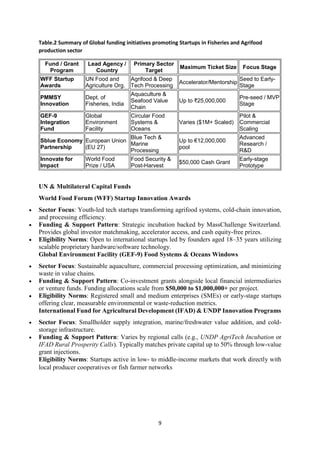
Table.2 Summary of Global funding initiatives promoting Startups in Fisheries and Agrifood
production sector
Fund / Grant
Program
Lead Agency /
Country
Primary Sector
Target
Maximum Ticket Size Focus Stage
WFF Startup
Awards
UN Food and
Agriculture Org.
Agrifood & Deep
Tech Processing
Accelerator/Mentorship
Seed to Early-
Stage
PMMSY
Innovation
Dept. of
Fisheries, India
Aquaculture &
Seafood Value
Chain
Up to ₹25,000,000
Pre-seed / MVP
Stage
GEF-9
Integration
Fund
Global
Environment
Facility
Circular Food
Systems &
Oceans
Varies ($1M+ Scaled)
Pilot &
Commercial
Scaling
Sblue Economy
Partnership
European Union
(EU 27)
Blue Tech &
Marine
Processing
Up to €12,000,000
pool
Advanced
Research /
R&D
Innovate for
Impact
World Food
Prize / USA
Food Security &
Post-Harvest
$50,000 Cash Grant
Early-stage
Prototype
UN & Multilateral Capital Funds
World Food Forum (WFF) Startup Innovation Awards
 Sector Focus: Youth-led tech startups transforming agrifood systems, cold-chain innovation,
and processing efficiency.
 Funding & Support Pattern: Strategic incubation backed by MassChallenge Switzerland.
Provides global investor matchmaking, accelerator access, and cash equity-free prizes.
 Eligibility Norms: Open to international startups led by founders aged 18–35 years utilizing
scalable proprietary hardware/software technology.
Global Environment Facility (GEF-9) Food Systems & Oceans Windows
 Sector Focus: Sustainable aquaculture, commercial processing optimization, and minimizing
waste in value chains.
 Funding & Support Pattern: Co-investment grants alongside local financial intermediaries
or venture funds. Funding allocations scale from $50,000 to $1,000,000+ per project.
 Eligibility Norms: Registered small and medium enterprises (SMEs) or early-stage startups
offering clear, measurable environmental or waste-reduction metrics.
International Fund for Agricultural Development (IFAD) & UNDP Innovation Programs
 Sector Focus: Smallholder supply integration, marine/freshwater value addition, and cold-
storage infrastructure.
 Funding & Support Pattern: Varies by regional calls (e.g., UNDP AgriTech Incubation or
IFAD Rural Prosperity Calls). Typically matches private capital up to 50% through low-value
grant injections.
Eligibility Norms: Startups active in low- to middle-income markets that work directly with
local producer cooperatives or fish farmer networks