Innovative Applications of Nanotechnology in Fisheries and Aquaculture Value Chain
Nanotechnology in fisheries value chain. Explore nanotech tools enhancing fish nutrition, health, water quality, disease management, and post-harvest safety in fisheries and aquaculture, including challenges and emerging alternatives.
Innovative Applications of Nanotechnology in Fisheries and Aquaculture Value Chain
1.
Application of Nanotechnology and its
tools in Fisheries and Aquaculture value
chain, challenges and emerging alternatives
By:
Bhukya Bhaskar
Fisheries
2.
Introduction
• Nanotechnology isthe application of nanoscience to create new materials,
devices, and systems with unique properties and functions due to their
nanoscale features.
• It encompasses the design, characterization, production, and application of
structures and devices by controlling shape and size at the nanometer scale.
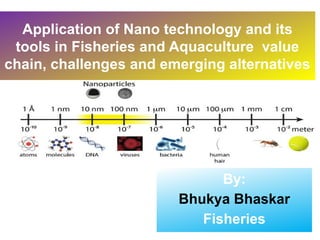
• Nanotechnology focus on manipulating matter at the nanoscale—
specifically in the range of 1 to 100 nanometers.
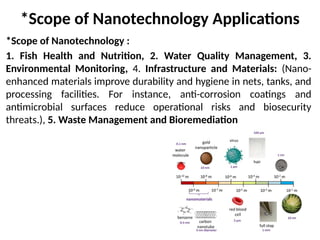
• Dimensional scale of nanotechnology can be visualized through a
comparison:
A human hair is approximately 80,000–100,000 nanometers wide.
A red blood cell is about 7,000–8,000 nanometers in diameter.
DNA has a diameter of about 2.5 nanometers.
Viruses typically range between 20 and 300 nanometers.
*Because of these tiny dimensions, nanoparticles can penetrate biological
barriers and interact with cellular structures in ways that larger particles cannot.
*Precise and targeted delivery of nutrients, vaccines, or antimicrobial agents can
greatly enhance fish health and productivity
3.
Cont…
• Nanoparticles canalso be designed to detect contaminants in water at very low
concentrations.
• nanomaterials such as carbon nanotubes (CNTs), graphene oxide, nanosilver,
nano-zinc oxide, nano-iron, and titanium dioxide (TiO₂) nanoparticles possess
excellent adsorptive, catalytic, and antimicrobial properties. These properties
allow them to bind, degrade, or neutralize harmful substances such as heavy
metals, organic pollutants, and microbial contaminants.
• Example: Nano sensors can monitor water quality in real-time, providing early
warnings for harmful conditions such as pH shifts, toxic algal blooms, or the
presence of pathogens.
• This enables proactive management, reducing fish mortality and improving
overall farm sustainability.
4.
• Nanotechnology toolsrevolutionize fisheries and aquaculture by offering
molecular-level solutions that enhance fish growth, water quality, disease
management, and product shelf life.
• While the implementation costs vary wildly based on the choice of nanomaterial
and setup scale, the economic benefits often outweigh the initial expenditures due
to improved feed conversion ratios and lower disease-related losses.
• Nanotech Tools
• Nanoparticles (NPs): Ultra-fine metallic particles like silver, selenium, iron, zinc,
and carbon-based variants used to fortify feeds or disinfect environment.
• Nanosensors: Tiny diagnostic chips capable of detecting real-time shifts in water
chemistry or identifying immediate pathogens.
• Nano-capsules / Nanomicelles: Biodegradable, microscopic polymer carriers
designed for targeted, timed delivery of essential nutrients, drugs, and hormones.
• Nanofiltration Membranes: Highly specialized, dense filters constructed to strain
out chemical impurities, toxic waste, and micro-pathogens at a molecular level.
5.
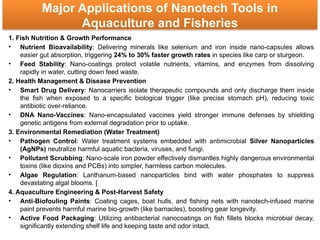
Major Applications ofNanotech Tools in
Aquaculture and Fisheries
1. Fish Nutrition & Growth Performance
• Nutrient Bioavailability: Delivering minerals like selenium and iron inside nano-capsules allows
easier gut absorption, triggering 24% to 30% faster growth rates in species like carp or sturgeon.
• Feed Stability: Nano-coatings protect volatile nutrients, vitamins, and enzymes from dissolving
rapidly in water, cutting down feed waste.
2. Health Management & Disease Prevention
• Smart Drug Delivery: Nanocarriers isolate therapeutic compounds and only discharge them inside
the fish when exposed to a specific biological trigger (like precise stomach pH), reducing toxic
antibiotic over-reliance.
• DNA Nano-Vaccines: Nano-encapsulated vaccines yield stronger immune defenses by shielding
genetic antigens from external degradation prior to uptake.
3. Environmental Remediation (Water Treatment)
• Pathogen Control: Water treatment systems embedded with antimicrobial Silver Nanoparticles
(AgNPs) neutralize harmful aquatic bacteria, viruses, and fungi.
• Pollutant Scrubbing: Nano-scale iron powder effectively dismantles highly dangerous environmental
toxins (like dioxins and PCBs) into simpler, harmless carbon molecules.
• Algae Regulation: Lanthanum-based nanoparticles bind with water phosphates to suppress
devastating algal blooms. [
4. Aquaculture Engineering & Post-Harvest Safety
• Anti-Biofouling Paints: Coating cages, boat hulls, and fishing nets with nanotech-infused marine
paint prevents harmful marine bio-growth (like barnacles), boosting gear longevity.
• Active Food Packaging: Utilizing antibacterial nanocoatings on fish fillets blocks microbial decay,
significantly extending shelf life and keeping taste and odor intact.
6.
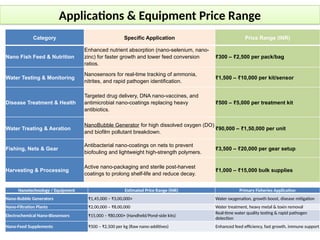
Applications & EquipmentPrice Range
Category Specific Application Price Range (INR)
Nano Fish Feed & Nutrition
Enhanced nutrient absorption (nano-selenium, nano-
zinc) for faster growth and lower feed conversion
ratios.
₹300 – 2,500 per pack/bag
₹
Water Testing & Monitoring
Nanosensors for real-time tracking of ammonia,
nitrites, and rapid pathogen identification.
₹1,500 – 10,000 per kit/sensor
₹
Disease Treatment & Health
Targeted drug delivery, DNA nano-vaccines, and
antimicrobial nano-coatings replacing heavy
antibiotics.
₹500 – 5,000 per treatment kit
₹
Water Treating & Aeration
NanoBubble Generator for high dissolved oxygen (DO)
and biofilm pollutant breakdown.
₹90,000 – 1,50,000 per unit
₹
Fishing, Nets & Gear
Antibacterial nano-coatings on nets to prevent
biofouling and lightweight high-strength polymers.
₹3,500 – 20,000 per gear setup
₹
Harvesting & Processing
Active nano-packaging and sterile post-harvest
coatings to prolong shelf-life and reduce decay.
₹1,000 – 15,000 bulk supplies
₹
Nanotechnology / Equipment Estimated Price Range (INR) Primary Fisheries Application
Nano-Bubble Generators ₹1,45,000 – ₹3,00,000+ Water oxygenation, growth boost, disease mitigation
Nano-Filtration Plants ₹2,00,000 – ₹8,00,000 Water treatment, heavy metal & toxin removal
Electrochemical Nano-Biosensors ₹15,000 – ₹80,000+ (Handheld/Pond-side kits)
Real-time water quality testing & rapid pathogen
detection
Nano-Feed Supplements ₹500 – ₹2,500 per kg (Raw nano-additives) Enhanced feed efficiency, fast growth, immune support
8.
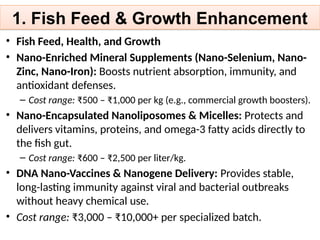
1. Fish Feed& Growth Enhancement
• Fish Feed, Health, and Growth
• Nano-Enriched Mineral Supplements (Nano-Selenium, Nano-
Zinc, Nano-Iron): Boosts nutrient absorption, immunity, and
antioxidant defenses.
– Cost range: ₹500 – ₹1,000 per kg (e.g., commercial growth boosters).
• Nano-Encapsulated Nanoliposomes & Micelles: Protects and
delivers vitamins, proteins, and omega-3 fatty acids directly to
the fish gut.
– Cost range: ₹600 – ₹2,500 per liter/kg.
• DNA Nano-Vaccines & Nanogene Delivery: Provides stable,
long-lasting immunity against viral and bacterial outbreaks
without heavy chemical use.
• Cost range: ₹3,000 – ₹10,000+ per specialized batch.
9.
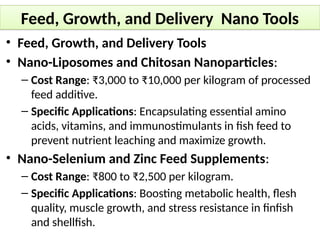
Feed, Growth, andDelivery Nano Tools
• Feed, Growth, and Delivery Tools
• Nano-Liposomes and Chitosan Nanoparticles:
– Cost Range: ₹3,000 to ₹10,000 per kilogram of processed
feed additive.
– Specific Applications: Encapsulating essential amino
acids, vitamins, and immunostimulants in fish feed to
prevent nutrient leaching and maximize growth.
• Nano-Selenium and Zinc Feed Supplements:
– Cost Range: ₹800 to ₹2,500 per kilogram.
– Specific Applications: Boosting metabolic health, flesh
quality, muscle growth, and stress resistance in finfish
and shellfish.
10.
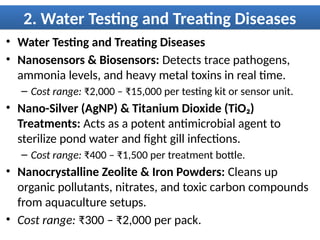
2. Water Testingand Treating Diseases
• Water Testing and Treating Diseases
• Nanosensors & Biosensors: Detects trace pathogens,
ammonia levels, and heavy metal toxins in real time.
– Cost range: ₹2,000 – ₹15,000 per testing kit or sensor unit.
• Nano-Silver (AgNP) & Titanium Dioxide (TiO₂)
Treatments: Acts as a potent antimicrobial agent to
sterilize pond water and fight gill infections.
– Cost range: ₹400 – ₹1,500 per treatment bottle.
• Nanocrystalline Zeolite & Iron Powders: Cleans up
organic pollutants, nitrates, and toxic carbon compounds
from aquaculture setups.
• Cost range: ₹300 – ₹2,000 per pack.
11.
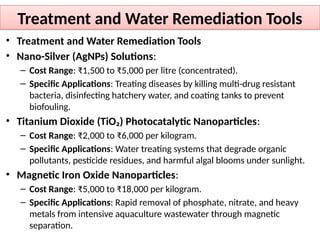
Treatment and WaterRemediation Tools
• Treatment and Water Remediation Tools
• Nano-Silver (AgNPs) Solutions:
– Cost Range: ₹1,500 to ₹5,000 per litre (concentrated).
– Specific Applications: Treating diseases by killing multi-drug resistant
bacteria, disinfecting hatchery water, and coating tanks to prevent
biofouling.
• Titanium Dioxide (TiO₂) Photocatalytic Nanoparticles:
– Cost Range: ₹2,000 to ₹6,000 per kilogram.
– Specific Applications: Water treating systems that degrade organic
pollutants, pesticide residues, and harmful algal blooms under sunlight.
• Magnetic Iron Oxide Nanoparticles:
– Cost Range: ₹5,000 to ₹18,000 per kilogram.
– Specific Applications: Rapid removal of phosphate, nitrate, and heavy
metals from intensive aquaculture wastewater through magnetic
separation.
12.
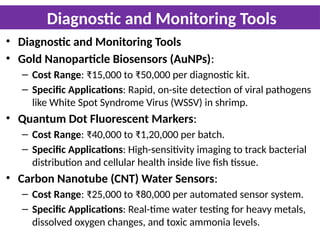
Diagnostic and MonitoringTools
• Diagnostic and Monitoring Tools
• Gold Nanoparticle Biosensors (AuNPs):
– Cost Range: ₹15,000 to ₹50,000 per diagnostic kit.
– Specific Applications: Rapid, on-site detection of viral pathogens
like White Spot Syndrome Virus (WSSV) in shrimp.
• Quantum Dot Fluorescent Markers:
– Cost Range: ₹40,000 to ₹1,20,000 per batch.
– Specific Applications: High-sensitivity imaging to track bacterial
distribution and cellular health inside live fish tissue.
• Carbon Nanotube (CNT) Water Sensors:
– Cost Range: ₹25,000 to ₹80,000 per automated sensor system.
– Specific Applications: Real-time water testing for heavy metals,
dissolved oxygen changes, and toxic ammonia levels.
13.
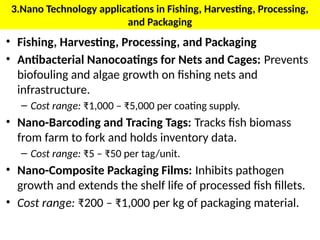
3.Nano Technology applicationsin Fishing, Harvesting, Processing,
and Packaging
• Fishing, Harvesting, Processing, and Packaging
• Antibacterial Nanocoatings for Nets and Cages: Prevents
biofouling and algae growth on fishing nets and
infrastructure.
– Cost range: ₹1,000 – ₹5,000 per coating supply.
• Nano-Barcoding and Tracing Tags: Tracks fish biomass
from farm to fork and holds inventory data.
– Cost range: ₹5 – ₹50 per tag/unit.
• Nano-Composite Packaging Films: Inhibits pathogen
growth and extends the shelf life of processed fish fillets.
• Cost range: ₹200 – ₹1,000 per kg of packaging material.
14.
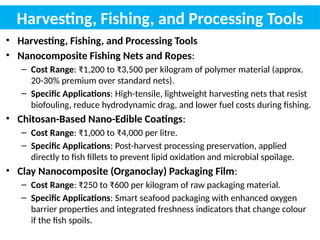
Harvesting, Fishing, andProcessing Tools
• Harvesting, Fishing, and Processing Tools
• Nanocomposite Fishing Nets and Ropes:
– Cost Range: ₹1,200 to ₹3,500 per kilogram of polymer material (approx.
20-30% premium over standard nets).
– Specific Applications: High-tensile, lightweight harvesting nets that resist
biofouling, reduce hydrodynamic drag, and lower fuel costs during fishing.
• Chitosan-Based Nano-Edible Coatings:
– Cost Range: ₹1,000 to ₹4,000 per litre.
– Specific Applications: Post-harvest processing preservation, applied
directly to fish fillets to prevent lipid oxidation and microbial spoilage.
• Clay Nanocomposite (Organoclay) Packaging Film:
– Cost Range: ₹250 to ₹600 per kilogram of raw packaging material.
– Specific Applications: Smart seafood packaging with enhanced oxygen
barrier properties and integrated freshness indicators that change colour
if the fish spoils.
15.
Challenges
• Challenges toConsider
• While powerful, the long-term environmental accumulation of
metal nanoparticles inside fish tissues presents ecotoxicity risks.
Strict dosage supervision is required to ensure both seafood safety
for consumers and sustainable environmental impacts
16.
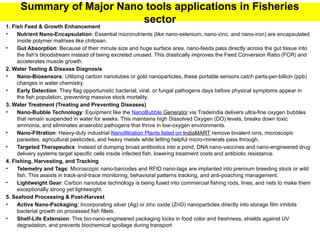
Summary of MajorNano tools applications in Fisheries
sector
1. Fish Feed & Growth Enhancement
• Nutrient Nano-Encapsulation: Essential micronutrients (like nano-selenium, nano-zinc, and nano-iron) are encapsulated
inside polymer matrixes like chitosan.
• Gut Absorption: Because of their minute size and huge surface area, nano-feeds pass directly across the gut tissue into
the fish's bloodstream instead of being excreted unused. This drastically improves the Feed Conversion Ratio (FCR) and
accelerates muscle growth.
2. Water Testing & Disease Diagnosis
• Nano-Biosensors: Utilizing carbon nanotubes or gold nanoparticles, these portable sensors catch parts-per-billion (ppb)
changes in water chemistry.
• Early Detection: They flag opportunistic bacterial, viral, or fungal pathogens days before physical symptoms appear in
the fish population, preventing massive stock mortality.
3. Water Treatment (Treating and Preventing Diseases)
• Nano-Bubble Technology: Equipment like the NanoBubble Generator via Tradeindia delivers ultra-fine oxygen bubbles
that remain suspended in water for weeks. This maintains high Dissolved Oxygen (DO) levels, breaks down toxic
ammonia, and eliminates anaerobic pathogens that thrive in low-oxygen environments.
• Nano-Filtration: Heavy-duty industrial Nanofiltration Plants listed on IndiaMART remove bivalent ions, microscopic
parasites, agricultural pesticides, and heavy metals while letting helpful micro-minerals pass through.
• Targeted Therapeutics: Instead of dumping broad antibiotics into a pond, DNA nano-vaccines and nano-engineered drug
delivery systems target specific cells inside infected fish, lowering treatment costs and antibiotic resistance.
4. Fishing, Harvesting, and Tracking
• Telemetry and Tags: Microscopic nano-barcodes and RFID nano-tags are implanted into premium breeding stock or wild
fish. This assists in track-and-trace monitoring, behavioral patterns tracking, and anti-poaching management.
• Lightweight Gear: Carbon nanotube technology is being fused into commercial fishing rods, lines, and nets to make them
exceptionally strong yet lightweight.
5. Seafood Processing & Post-Harvest
• Active Nano-Packaging: Incorporating silver (Ag) or zinc oxide (ZnO) nanoparticles directly into storage film inhibits
bacterial growth on processed fish fillets.
• Shelf-Life Extension: This bio-nano-engineered packaging locks in food color and freshness, shields against UV
degradation, and prevents biochemical spoilage during transport
17.
The Emergence ofNanotechnology in Aquaculture
*Potential Benefits and Applications of Nanotechnology in Aquaculture:
1. Improved Disease Detection and Control: Nanosensors and diagnostic
tools enable real-time monitoring of fish health and water quality. These
nanoscale devices can detect pathogens, toxins, or stress biomarkers at
early stages, allowing timely interventions and reducing the spread of
disease.
2. Targeted Drug and Vaccine Delivery: Nanoparticles can be engineered
to deliver drugs or vaccines directly to infected tissues or organs in fish,
ensuring high bioavailability and minimal side effects. These smart
delivery systems can release their contents in response to environmental
triggers, improving treatment outcomes and reducing waste.
3. Enhanced Nutrient Absorption: Nanoformulated feeds improve
nutrient solubility and uptake, boosting fish growth rates and feed
efficiency. By increasing the bioavailability of essential nutrients and
additives, nanofeeds contribute to healthier and more productive stocks.
18.
4. Water Purificationand Treatment: Nanomaterials such as
nanosilver, nano-iron, and carbon nanotubes have antimicrobial and
adsorptive properties, making them effective for removing pathogens,
heavy metals, and organic pollutants from aquaculture systems. These
materials help maintain optimal water quality and reduce
environmental discharge.
5. Surface Coatings and Antifouling Materials: Nanocoatings on
equipment and infrastructure can prevent biofouling and microbial
colonization, increasing durability, reducing maintenance costs, and
improving hygiene in aquaculture facilities.
19.
*Scope of NanotechnologyApplications
*Scope of Nanotechnology :
1. Fish Health and Nutrition, 2. Water Quality Management, 3.
Environmental Monitoring, 4. Infrastructure and Materials: (Nano-
enhanced materials improve durability and hygiene in nets, tanks, and
processing facilities. For instance, anti-corrosion coatings and
antimicrobial surfaces reduce operational risks and biosecurity
threats.), 5. Waste Management and Bioremediation
20.
Primary alternatives tonanotechnology in
Fisheries and Aquaculture
• Bio-molecular solutions, artificial intelligence and macro-
scale biotechnology serves as the Primary alternatives to
nanotechnology in Fisheries and Aquaculture.
1Bio-moleculary and microbial solutions:
i.Probiotics and prebiotics:
ii. Bacteriophages: Natural viruses target specific harmful
bacteria in fish populations without causing widespread
chemical or nano-scale pollution in Aquatic ecosystems.
iii. DNA and recombinant vaccines:
Standard injectable or immersion based molecular vaccines
protect fish against viral pathogens instead of relying on
engineered nano-capacity delivery mechanisms.
21.
Alternatives to nanotechnologyin fisheries
Cont…
2. Artificial Intelligence and IOT monitoring:
i.Smart sensors and Computer Visions
ii. Automated Feeding Systems
3. Advanced Biotechnology and Circular systems:
i. Microscopic Fungi: Eg; industrial waste is converted into
high quality fungal biomass feed, offering a sustainable
alternatives to processed or nano-enhanced diets.
ii. Biopolymer coagulants: Natural organic polymers clear
nitrogen & Phosphorous from farm water columns,
replacing synthetic or metal based nanoparticle water
treatments