Innovative Applications and Impact of Drones in Modern Agriculture
Explore how drones revolutionize agriculture through precision farming, crop monitoring, spraying, irrigation, pollination, and AI integration, enhancing efficiency, yield, and sustainability worldwide.
Innovative Applications and Impact of Drones in Modern Agriculture
1.
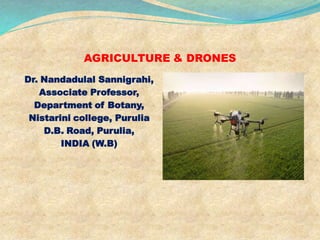
AGRICULTURE & DRONES
Dr.Nandadulal Sannigrahi,
Associate Professor,
Department of Botany,
Nistarini college, Purulia
D.B. Road, Purulia,
INDIA (W.B)
2.
DRONES IN AGRICULTURE
The use of drones in almost every sector is growing very fast particularly in
those areas where accession physically to collect data in almost impossible,
time consuming and question of accuracy,
Drones use in agricultural sector is booming day to day to address the
multiple needs,
As far recent report, the agricultural drone market is expected to grow 4.8
billion dollar industry and more in the coming days,
From scouting to security, drone use will become more ubiquitous on large
and small scale farms ,
Drones on farms is often used to better inform agronomic decisions as a
part of the precision agriculture,
The drones received by drones help farmers to plan their planting and
treatments to achieve the best possible yields,
The real data is to be obtained by the use of farm management software
integrated with the used drones for the same.
DRONES IN AGRICULTURE
Drones diffusion is enabling technological leapfrogging , helping to
equalize global inequalities in access to agricultural technology ,
Millions of farmers in Global South have at their disposal technology
equipment with extremely sophisticated capabilities , comparable to the
most,
Drones can perform two main types of agricultural tasks-
MECHANICAL- such as sowing seeds, spreading fertilizers and feeds,
spraying herbicides, pesticides, fungicides and airlifting loads,
INFORMATIONAL- such as counting livestock, mapping and monitoring
fields and generating data to assess crop health and expected yields,
Most drones are built either mechanical or informational tasks , but not the
both together,
They can’t automatically adjust the amount of seed, fertilizes or spray in
real time based on crop or field conditions,
Expected, this issue will be addressed shortly by the automated version.
5.
APPLICATION OF DRONESIN AGRICULTURE
The drones are used in agriculture in general and precision agriculture in
particular. The drones technology offer manifold utilities. These are stated
as follows:
SCOUTING/MONITORING PLANT HEALTH
Drones equipped with special imaging equipment called Normalized
Difference Vegetation Index (NDVI) to harvest color information to use as
indicator of plant health,
Drones us regular cameras to monitor crop health . Although the satellite
data is available but to harness information is not only difficult but very
costly and difficult in accession,
The closer images captured by drones of the target areas has high degree
accuracy at the millimeter level ,
Planting areas with standing crop can be easily accessed by the use of
drones very effectively and the use of drones becomes cheaper and time
saving.
6.
APPLICATION OF DRONESIN AGRICULTURE
MONITORING FIELD CONDITIONS
Drones field monitoring is also being used to monitor soil and field
conditions,
Accurate field mapping including elevation is useful in determining
drainage patterns and wet/dry spots which allow for more efficient irrigation
practices,
Nitrogen level long with soil fertility can also be monitored using the drones
technology in the crop field,
The precise application of fertilizers, eliminating poor growing spots and
improving soil health for years to come can also be monitored by using the
drone technology in the agriculture farm land.
PLANTING & SEEDING
Automated drone seeders are mostly used in the forest industries in large
scale forest regeneration,
One of the newer and less wide spread uses of drones in agriculture to plan
seeds with subsequent interval and gapping,
The inaccessible areas seed plantation can be easily done with the use of
drone and it is cost-effective.
APPLICATION OF DRONESIN AGRICULTURE
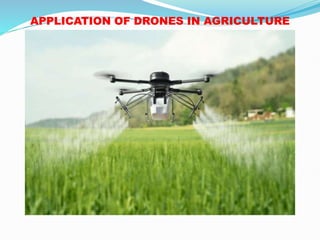
SPRAY APPLICATION
Any agriculture or man made ecosystem associated with productivity needs
the application of different types of insecticides, pesticides, fungicides,
herbicides and many more as a part of spray application system. Drones can
be used effectively in this regard.
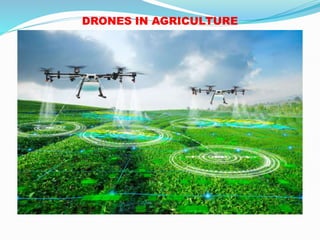
Drone sprayers can able to navigate very hard to reach areas such as steep
tea fields at high elevations. Drone sprayers are very cost effective in this
regard and can minimize the hazardous effect of the issue,
Drone sprayers delivery very fine spray applications that can be targeted to
specific areas to maximize efficiency and save on chemical costs,
It can also optimize the uses of the different hazardous chemicals at
optimum level without causing side effects due to indiscriminate uses of
those chemicals harmful to rest part of the ecosystem.
9.
APPLICATION OF DRONESIN AGRICULTURE
SECURITY
Drone security is extremely useful to farm management,
To monitor farm from far off without having get there, drones is the right
substitute and it allows to save valuable time and frequent monitoring of
hard to reach areas,
Drone cameras can provide overview of farm operations throughout the day
to ensure operations are running smoothly and to locate equipment being
used thereafter,
Security drones can be deployed to monitor fencing and other parameters
more valuable crops like cannabis, opium etc. instead of deploying more
security personnel,
Drone cameras are also being used in exciting ways to protect farm animals
by locating missing or injured herd animals in far off gazing areas,
Monitoring remote areas which may take several hours along with money
can be minimized and cost effective using drone technology.
10.
APPLICATION OF DRONESIN AGRICULTURE
DRONE POLLINATION
Pollination biology is essential biological process for the effective fruit and
seed formation and setting and these are mostly mediated by the different
kind of natural agents like wind, water, animals, insects etc. Due to climate
change and global warming patronized by the industrial issues, the
pollination biology is being hampered. Drones can be used in agriculture as
a part of pollinating drone technology.
Researchers in Netherlands and Japan are developing small drones that are
capable of pollinating plants without damaging as pollinator through
artificial pollination,
More the research is expecting to develop drones to create autonomous
pollinating drones that will work and monitor crop health without constant
instruction from operators.
APPLICATION OF DRONESIN AGRICULTURE
DRONE IRRIGATION
Irrigation is one of the pre-requisites of the agricultural practices,
The agriculture field needs proper irrigation practices with the minimum
wastage of the water in the context of the depletion of the fresh water due to
climate change and global arming,
As climate change increasingly affects drought conditions, creating more
efficient irrigation solutions is vital,
Drones can be the right instrument to combat this issue as well as to provide
irrigation practices for the same,
Drones are able to capture very accurate soil conditions along with the
related information of soil moisture levels without the plants getting in the
way,
Water can be distributed in a field in the most efficient way in an effort to
conserve resources.
13.
APPLICATION OF DRONESIN AGRICULTURE
DRONE AI
Drone technology in development also involves machine learning ,
improving Artificial Intelligence (AI) in drones is important to be able to
make them useful to smaller farmers in developing nations,
Current drone technologies are more effective in monitoring well known
crops which are planted even in the most inaccessible areas in a large
monoculture field patterns,
Drone monitoring have enough exposure recognizing areas with crop
diversity ,
Monitoring of crop health using drone sensors empowered with AI enabled
technology can offer effective data for vigilance and monitoring of the
standing crops,
Even, it can able to offer valuable data in diverse field regarding crop
management and practices.
14.
DRONES USED INCOUNTRIES
The use of drones are expanding at very fast rate and are used to apply
inputs to a wide range of crops like different staple grains, industrial crops
such as cotton, fruits like bananas, pineapples and vegetables,
China leads the world with an estimated 250,000 agricultural drones,
Japan(20000) and South Korea (8000) have some of the highest numbers ,
relative to their agricultural land,
Brazil (12000), Thailand (15000), Turkey (6000) , USA (5500) etc,
Use of drones are also expanding in the countries like India, Argentina,
Ukraine and other countries,
Two leading manufacturers are DJI and XAG in drone production,
The biggest model of agricultural drone can carry loads up to 100 kg,
The use of drones in agriculture is expanding along with the other fields.
15.
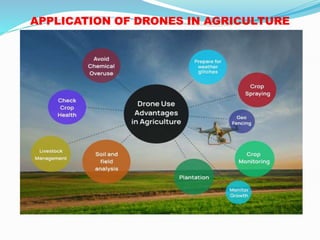
ADVANTAGES OF USEOF DRONES IN AGRICUTURE
Use of drones in agriculture offer a number of tangible and intangible
benefits as mentioned below:
Improve efficiency-It can reduce the amount needed per hectare in
agricultural practices irrespective of its nature,
Increase yields- By distributing seed, fertilizes and pesticides more evenly
and uniformly with high degree of precision , support better growth and
reducing crop damage from heavy ground machine and operation costs in a
very cost effective manner,
Energy use- It can reduce energy cost compared to large fossil-fuel-powered
machineries,
Lower production costs- Contribute to higher farm profitability,
Save time and labor- Easing drudgery, helping older farmers remain active,
making agriculture more effective to youth, and freeing farmers to pursue
other employment,
Improve worker safety- Can reduce direct exposure to hazardous chemicals
like pesticides and herbicides compared to hand spraying.
16.
DISADAVANTAGES OF DRONEUSES
The drones offer a number of advantages . Despite that, it also possesses a
number of threats as mentioned below:
Potential displacement of farm labors-Drones might potentially displace
the jobs of human farm workers,
Increased spray drift-Stray pesticides or herbicides are more likely to be
carried on wind to neighboring farms or bystanders compared to
conventional ground based spraying,
Data Security and Privacy- information collected by drones by the third
party and the data accession by them is an issue of data security and privacy.
Technological sovereignty- Global drone manufacturing create future
vulnerabilities to supply chain disruptions, and it can be affected by cyber
attacks,
Cost issue in under developed economy- It is threat to underdeveloped
economy as the machine is replacing the workers.
17.
DRONES AND FUTUREAGRICULTURE
The potential for drones only continues to grow. Predictions suggest the
global agricultural drone market will surge from $1.9 billion in 2020 to $8.4
billion in 2028, driven by the evolving capabilities of these drones.
Emerging technologies promise exciting advancements,
Modern innovations like automated image recognition, facilitating weed and
pest identification, will make farming even smarter and more efficient.
Drones will increasingly operate independently, requiring minimal human
intervention.
The adoption of regular crop mapping will provide new ways to assess and
manage farms. In combination with smart tractors and implements, gains in
input-use efficiency will open opportunities to increase yield, profitability,
and sustainability,
As with other digital agriculture technologies, such as smart tractors,
precision implements, autonomous ground-based robotics, and Autonomous
Underwater Vehicles (AUVs) for seabed mapping and industry inspections,
these technologies will continue to advance agriculture. Drones are poised
to play an even greater role in farming.
18.
THANKS FOR YOURVISIT
ACKNOWLEDGEMENTS:
Google for images,
Different websites for enriching the course content,
Science Direct pages,
Plant diseases, insects and pests- NCBI-NH,
https://www.dpi.qld.gov.au/news-media/campaigns/agtech/action/drones
https://www.croptracker.com/blog/drone-technology-in-agriculture.html
https://www.ifpri.org/blog/the-global-drone-revolution-in-agriculture/
Many more websites for references.
DISCLAIMER: This presentation has been designed to address the
academic fraternity without any financial interest. This is absolutely free
to use . The author does not claim any kind of financial benefits from this
content
 Most read