Innovations Summit 2026: The Future of AI in Healthcare Delivery and Ethics
1.
I N NO V AT I O N S U M M I T
2 0 2 6
The Future of
Artificial
Intelligence
in Healthcare
Transforming Healthcare Delivery Through Intelligent
Technology
Healthcare Innovation
Series
2.
AGENDA
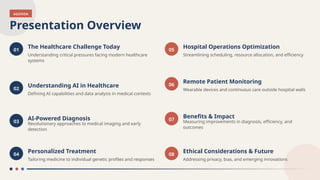
Presentation Overview
01
The HealthcareChallenge Today
Understanding critical pressures facing modern healthcare
systems
02
Understanding AI in Healthcare
Defining AI capabilities and data analysis in medical contexts
03
AI-Powered Diagnosis
Revolutionary approaches to medical imaging and early
detection
04
Personalized Treatment
Tailoring medicine to individual genetic profiles and responses
05
Hospital Operations Optimization
Streamlining scheduling, resource allocation, and efficiency
06
Remote Patient Monitoring
Wearable devices and continuous care outside hospital walls
07
Benefits & Impact
Measuring improvements in diagnosis, efficiency, and
outcomes
08
Ethical Considerations & Future
Addressing privacy, bias, and emerging innovations
3.
THE PROBLEM
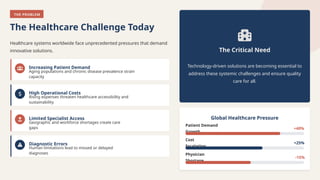
The HealthcareChallenge Today
Healthcare systems worldwide face unprecedented pressures that demand
innovative solutions.
Increasing Patient Demand
Aging populations and chronic disease prevalence strain
capacity
High Operational Costs
Rising expenses threaten healthcare accessibility and
sustainability
Limited Specialist Access
Geographic and workforce shortages create care
gaps
Diagnostic Errors
Human limitations lead to missed or delayed
diagnoses
The Critical Need
Technology-driven solutions are becoming essential to
address these systemic challenges and ensure quality
care for all.
Global Healthcare Pressure
Patient Demand
Growth
+40%
Cost
Escalation
+25%
Physician
Shortage
-15%
4.
THE SOLUTION
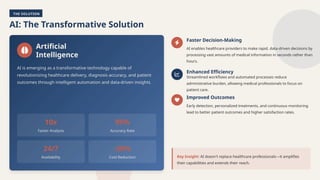
AI: TheTransformative Solution
Artificial
Intelligence
AI is emerging as a transformative technology capable of
revolutionizing healthcare delivery, diagnosis accuracy, and patient
outcomes through intelligent automation and data-driven insights.
10x
Faster Analysis
95%
Accuracy Rate
24/7
Availability
-30%
Cost Reduction
Faster Decision-Making
AI enables healthcare providers to make rapid, data-driven decisions by
processing vast amounts of medical information in seconds rather than
hours.
Enhanced Efficiency
Streamlined workflows and automated processes reduce
administrative burden, allowing medical professionals to focus on
patient care.
Improved Outcomes
Early detection, personalized treatments, and continuous monitoring
lead to better patient outcomes and higher satisfaction rates.
Key Insight: AI doesn't replace healthcare professionals—it amplifies
their capabilities and extends their reach.
5.
FOUNDATION
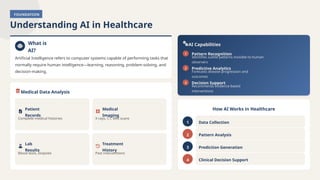
Understanding AI inHealthcare
What is
AI?
Artificial Intelligence refers to computer systems capable of performing tasks that
normally require human intelligence—learning, reasoning, problem-solving, and
decision-making.
Medical Data Analysis
Patient
Records
Complete medical histories
Medical
Imaging
X-rays, CT, MRI scans
Lab
Results
Blood tests, biopsies
Treatment
History
Past interventions
AI Capabilities
1 Pattern Recognition
Identifies subtle patterns invisible to human
observers
2 Predictive Analytics
Forecasts disease progression and
outcomes
3 Decision Support
Recommends evidence-based
interventions
How AI Works in Healthcare
1 Data Collection
2 Pattern Analysis
3 Prediction Generation
4 Clinical Decision Support
6.
APPLICATION
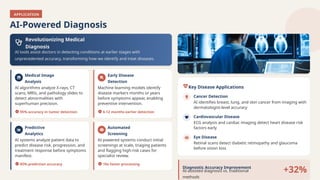
AI-Powered Diagnosis
Revolutionizing Medical
Diagnosis
AItools assist doctors in detecting conditions at earlier stages with
unprecedented accuracy, transforming how we identify and treat diseases.
Medical Image
Analysis
AI algorithms analyze X-rays, CT
scans, MRIs, and pathology slides to
detect abnormalities with
superhuman precision.
95% accuracy in tumor detection
Early Disease
Detection
Machine learning models identify
disease markers months or years
before symptoms appear, enabling
preventive intervention.
6-12 months earlier detection
Predictive
Analytics
AI systems analyze patient data to
predict disease risk, progression, and
treatment response before symptoms
manifest.
85% prediction accuracy
Automated
Screening
AI-powered systems conduct initial
screenings at scale, triaging patients
and flagging high-risk cases for
specialist review.
10x faster processing
Key Disease Applications
Cancer Detection
AI identifies breast, lung, and skin cancer from imaging with
dermatologist-level accuracy
Cardiovascular Disease
ECG analysis and cardiac imaging detect heart disease risk
factors early
Eye Disease
Retinal scans detect diabetic retinopathy and glaucoma
before vision loss
Diagnostic Accuracy Improvement
AI-assisted diagnosis vs. traditional
methods
+32%
7.
APPLICATION
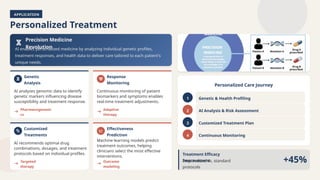
Personalized Treatment
Precision Medicine
Revolution
AIenables personalized medicine by analyzing individual genetic profiles,
treatment responses, and health data to deliver care tailored to each patient's
unique needs.
Genetic
Analysis
AI analyzes genomic data to identify
genetic markers influencing disease
susceptibility and treatment response.
Pharmacogenomi
cs
Response
Monitoring
Continuous monitoring of patient
biomarkers and symptoms enables
real-time treatment adjustments.
Adaptive
therapy
Customized
Treatments
AI recommends optimal drug
combinations, dosages, and treatment
protocols based on individual profiles.
Targeted
therapy
Effectiveness
Prediction
Machine learning models predict
treatment outcomes, helping
clinicians select the most effective
interventions.
Outcome
modeling
Personalized Care Journey
1 Genetic & Health Profiling
2 AI Analysis & Risk Assessment
3 Customized Treatment Plan
4 Continuous Monitoring
Treatment Efficacy
Improvement
Personalized vs. standard
protocols
+45%
8.
APPLICATION
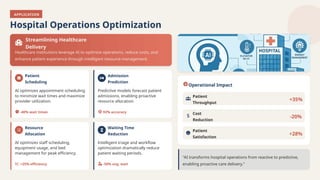
Hospital Operations Optimization
StreamliningHealthcare
Delivery
Healthcare institutions leverage AI to optimize operations, reduce costs, and
enhance patient experience through intelligent resource management.
Patient
Scheduling
AI optimizes appointment scheduling
to minimize wait times and maximize
provider utilization.
-40% wait times
Admission
Prediction
Predictive models forecast patient
admissions, enabling proactive
resource allocation.
92% accuracy
Resource
Allocation
AI optimizes staff scheduling,
equipment usage, and bed
management for peak efficiency.
+25% efficiency
Waiting Time
Reduction
Intelligent triage and workflow
optimization dramatically reduce
patient waiting periods.
-50% avg. wait
Operational Impact
Patient
Throughput
+35%
Cost
Reduction
-20%
Patient
Satisfaction
+28%
"AI transforms hospital operations from reactive to predictive,
enabling proactive care delivery."
9.
APPLICATION
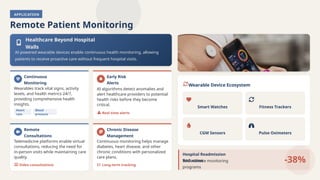
Remote Patient Monitoring
HealthcareBeyond Hospital
Walls
AI-powered wearable devices enable continuous health monitoring, allowing
patients to receive proactive care without frequent hospital visits.
Continuous
Monitoring
Wearables track vital signs, activity
levels, and health metrics 24/7,
providing comprehensive health
insights.
Heart
rate
Blood
pressure
Early Risk
Alerts
AI algorithms detect anomalies and
alert healthcare providers to potential
health risks before they become
critical.
Real-time alerts
Remote
Consultations
Telemedicine platforms enable virtual
consultations, reducing the need for
in-person visits while maintaining care
quality.
Video consultations
Chronic Disease
Management
Continuous monitoring helps manage
diabetes, heart disease, and other
chronic conditions with personalized
care plans.
Long-term tracking
Wearable Device Ecosystem
Smart Watches Fitness Trackers
CGM Sensors Pulse Oximeters
Hospital Readmission
Reduction
With remote monitoring
programs
-38%
10.
IMPACT
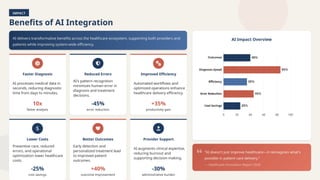
Benefits of AIIntegration
AI delivers transformative benefits across the healthcare ecosystem, supporting both providers and
patients while improving system-wide efficiency.
Faster Diagnosis
AI processes medical data in
seconds, reducing diagnostic
time from days to minutes.
10x
faster analysis
Reduced Errors
AI's pattern recognition
minimizes human error in
diagnosis and treatment
decisions.
-45%
error reduction
Improved Efficiency
Automated workflows and
optimized operations enhance
healthcare delivery efficiency.
+35%
productivity gain
Lower Costs
Preventive care, reduced
errors, and operational
optimization lower healthcare
costs.
-25%
cost savings
Better Outcomes
Early detection and
personalized treatment lead
to improved patient
outcomes.
+40%
outcome improvement
Provider Support
AI augments clinical expertise,
reducing burnout and
supporting decision-making.
-30%
administrative burden
AI Impact Overview
"AI doesn't just improve healthcare—it reimagines what's
possible in patient care delivery."
— Healthcare Innovation Report 2026
11.
CONSIDERATIONS
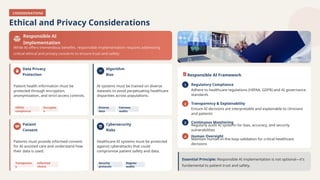
Ethical and PrivacyConsiderations
Responsible AI
Implementation
While AI offers tremendous benefits, responsible implementation requires addressing
critical ethical and privacy concerns to ensure trust and safety.
Data Privacy
Protection
Patient health information must be
protected through encryption,
anonymization, and strict access controls.
HIPAA
compliance
Encryptio
n
Algorithm
Bias
AI systems must be trained on diverse
datasets to avoid perpetuating healthcare
disparities across populations.
Diverse
data
Fairness
audits
Patient
Consent
Patients must provide informed consent
for AI-assisted care and understand how
their data is used.
Transparenc
y
Informed
choice
Cybersecurity
Risks
Healthcare AI systems must be protected
against cyberattacks that could
compromise patient safety and data.
Security
protocols
Regular
audits
Responsible AI Framework
1 Regulatory Compliance
Adhere to healthcare regulations (HIPAA, GDPR) and AI governance
standards
2 Transparency & Explainability
Ensure AI decisions are interpretable and explainable to clinicians
and patients
3 Continuous Monitoring
Regularly audit AI systems for bias, accuracy, and security
vulnerabilities
4 Human Oversight
Maintain human-in-the-loop validation for critical healthcare
decisions
Essential Principle: Responsible AI implementation is not optional—it's
fundamental to patient trust and safety.
12.
FUTURE
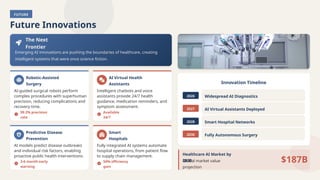
Future Innovations
The Next
Frontier
EmergingAI innovations are pushing the boundaries of healthcare, creating
intelligent systems that were once science fiction.
Robotic-Assisted
Surgery
AI-guided surgical robots perform
complex procedures with superhuman
precision, reducing complications and
recovery time.
99.2% precision
rate
AI Virtual Health
Assistants
Intelligent chatbots and voice
assistants provide 24/7 health
guidance, medication reminders, and
symptom assessment.
Available
24/7
Predictive Disease
Prevention
AI models predict disease outbreaks
and individual risk factors, enabling
proactive public health interventions.
3-6 month early
warning
Smart
Hospitals
Fully integrated AI systems automate
hospital operations, from patient flow
to supply chain management.
50% efficiency
gain
Innovation Timeline
2026 Widespread AI Diagnostics
2027 AI Virtual Assistants Deployed
2028 Smart Hospital Networks
2030 Fully Autonomous Surgery
Healthcare AI Market by
2030
Global market value
projection
$187B
13.
EVIDENCE
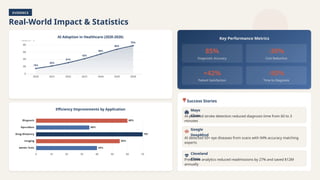
Real-World Impact &Statistics
AI Adoption in Healthcare (2020-2026)
Efficiency Improvements by Application
Key Performance Metrics
85%
Diagnostic Accuracy
-30%
Cost Reduction
+42%
Patient Satisfaction
-50%
Time to Diagnosis
Success Stories
Mayo
Clinic
AI-powered stroke detection reduced diagnosis time from 60 to 3
minutes
Google
DeepMind
AI detected 50+ eye diseases from scans with 94% accuracy matching
experts
Cleveland
Clinic
Predictive analytics reduced readmissions by 27% and saved $12M
annually
14.
STRATEGY
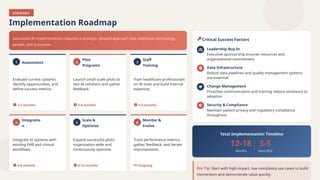
Implementation Roadmap
Successful AIimplementation requires a strategic, phased approach that addresses technology,
people, and processes.
1 Assessment
Evaluate current systems,
identify opportunities, and
define success metrics.
2-3 months
2
Pilot
Programs
Launch small-scale pilots to
test AI solutions and gather
feedback.
3-6 months
3
Staff
Training
Train healthcare professionals
on AI tools and build internal
expertise.
2-4 months
4
Integratio
n
Integrate AI systems with
existing EHR and clinical
workflows.
4-6 months
5
Scale &
Optimize
Expand successful pilots
organization-wide and
continuously optimize.
6-12 months
6
Monitor &
Evolve
Track performance metrics,
gather feedback, and iterate
improvements.
Ongoing
Critical Success Factors
Leadership Buy-In
Executive sponsorship ensures resources and
organizational commitment
Data Infrastructure
Robust data pipelines and quality management systems
are essential
Change Management
Proactive communication and training reduce resistance to
adoption
Security & Compliance
Maintain patient privacy and regulatory compliance
throughout
Total Implementation Timeline
12-18
Months
3-5
Years ROI
Pro Tip: Start with high-impact, low-complexity use cases to build
momentum and demonstrate value quickly.
15.
C O NC L U S I O N
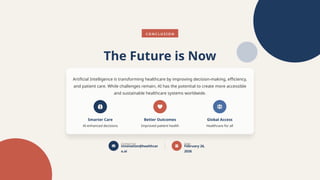
The Future is Now
Artificial Intelligence is transforming healthcare by improving decision-making, efficiency,
and patient care. While challenges remain, AI has the potential to create more accessible
and sustainable healthcare systems worldwide.
Smarter Care
AI-enhanced decisions
Better Outcomes
Improved patient health
Global Access
Healthcare for all
Contact Us
innovation@healthcar
e.ai
Date
February 26,
2026