Industry 4.0 and Its Impact on Manufacturing and Society
Explore Industry 4.0's key technologies, smart factories, energy and transportation innovations, social mobility effects, and strategies for digital transformation in manufacturing and beyond.
Industry 4.0 and Its Impact on Manufacturing and Society
1.
Unit 75: Industry4.0
Unit code : F/617/3949
Unit level : 4
Credit value : 15
Tutor: Mr P.M.SUBRAMANIAN
2.
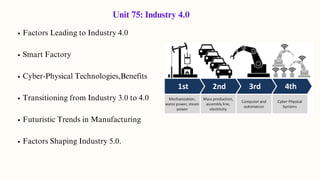
Factors Leading toIndustry 4.0
Smart Factory
Cyber-Physical Technologies,Benefits
Transitioning from Industry 3.0 to 4.0
Futuristic Trends in Manufacturing
Factors Shaping Industry 5.0.
Unit 75: Industry 4.0
3.
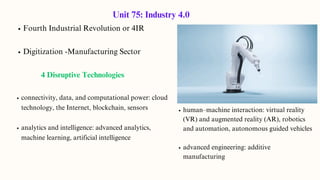
Fourth Industrial Revolutionor 4IR
Digitization -Manufacturing Sector
4 Disruptive Technologies
connectivity, data, and computational power: cloud
technology, the Internet, blockchain, sensors
analytics and intelligence: advanced analytics,
machine learning, artificial intelligence
Unit 75: Industry 4.0
human–machine interaction: virtual reality
(VR) and augmented reality (AR), robotics
and automation, autonomous guided vehicles
advanced engineering: additive
manufacturing
4.
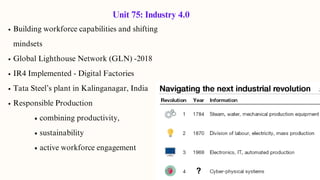
Building workforce capabilitiesand shifting
mindsets
Global Lighthouse Network (GLN) -2018
IR4 Implemented - Digital Factories
Tata Steel’s plant in Kalinganagar, India
Responsible Production
combining productivity,
sustainability
active workforce engagement
Unit 75: Industry 4.0
5.
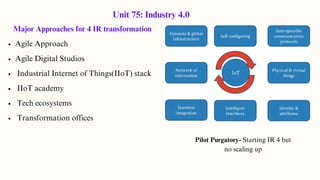
Major Approaches for4 IR transformation
Agile Approach
Agile Digital Studios
Industrial Internet of Things(IIoT) stack
IIoT academy
Tech ecosystems
Transformation offices
Unit 75: Industry 4.0
Pilot Purgatory- Starting IR 4 but
no scaling up
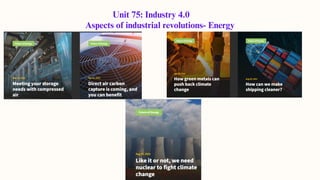
Aspects of industrialrevolutions- Energy
Modernise Energy Usage - Green Global
Energy,Climate Change
Amount of Wasted Energy and other Inefficiencies
Eco-Friendly Energy Sources
Smart Sensors
Digital home assistant-Alexa or Google Home
Turning
Real Time Connection - 5G
Unit 75: Industry 4.0
8.
Aspects of industrialrevolutions- Energy
Peak Energy Consumption - Response
Digital Gap - Demands for Autonomous
Operation
Industry accounts for 54% of global delivered
energy
carbon footprint
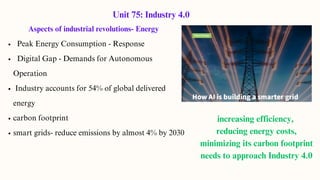
smart grids- reduce emissions by almost 4% by 2030
Unit 75: Industry 4.0
increasing efficiency,
reducing energy costs,
minimizing its carbon footprint
needs to approach Industry 4.0
Unit 75: Industry4.0
Aspects of industrial revolutions- Transportation
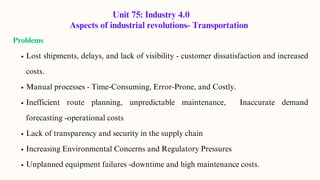
Problems
Lost shipments, delays, and lack of visibility - customer dissatisfaction and increased
costs.
Manual processes - Time-Consuming, Error-Prone, and Costly.
Inefficient route planning, unpredictable maintenance, Inaccurate demand
forecasting -operational costs
Lack of transparency and security in the supply chain
Increasing Environmental Concerns and Regulatory Pressures
Unplanned equipment failures -downtime and high maintenance costs.
11.
Unit 75: Industry4.0
Aspects of industrial revolutions- Transportation
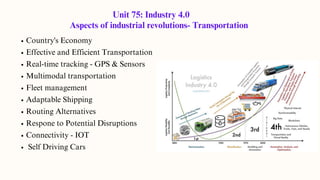
Country's Economy
Effective and Efficient Transportation
Real-time tracking - GPS & Sensors
Multimodal transportation
Fleet management
Adaptable Shipping
Routing Alternatives
Respone to Potential Disruptions
Connectivity - IOT
Self Driving Cars
12.
Unit 75: Industry4.0
Aspects of industrial revolutions- Transportation
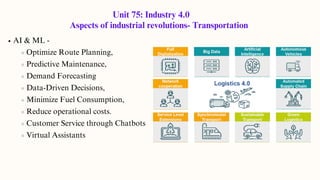
AI & ML -
Optimize Route Planning,
Predictive Maintenance,
Demand Forecasting
Data-Driven Decisions,
Minimize Fuel Consumption,
Reduce operational costs.
Customer Service through Chatbots
Virtual Assistants
13.
Unit 75: Industry4.0
Aspects of industrial revolutions- Transportation
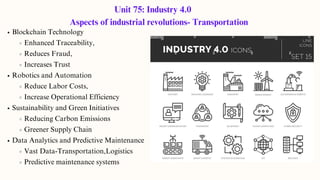
Blockchain Technology
Enhanced Traceability,
Reduces Fraud,
Increases Trust
Robotics and Automation
Reduce Labor Costs,
Increase Operational Efficiency
Sustainability and Green Initiatives
Reducing Carbon Emissions
Greener Supply Chain
Data Analytics and Predictive Maintenance
Vast Data-Transportation,Logistics
Predictive maintenance systems
14.
Unit 75: Industry4.0
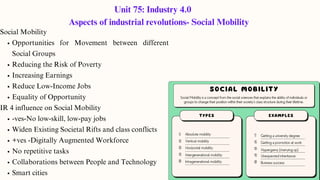
Aspects of industrial revolutions- Social Mobility
Social Mobility
Opportunities for Movement between different
Social Groups
Reducing the Risk of Poverty
Increasing Earnings
Reduce Low-Income Jobs
Equality of Opportunity
IR 4 influence on Social Mobility
-ves-No low-skill, low-pay jobs
Widen Existing Societal Rifts and class conflicts
+ves -Digitally Augmented Workforce
No repetitive tasks
Collaborations between People and Technology
Smart cities
15.
Unit 75: Industry4.0
Aspects of industrial revolutions- Social Mobility
Social Mobility
People Life Style - Mobile
Sharing Economy - Uber
Increase Social Tensions -Low pay jobs disappear
65% of Children - New Jobs
Adapt to New Job Requirements,Master New Job Skills
Routine,Reptitive, Predictable Jobs- High Risk
ML- Production Capacity- 20%, Reduce Raw Material Waste by 4 %
Amazon Robotic Shelves
WFH, Sharing Work Space
Gig Economy - No Permanent Job
Big Data, Machine Trainers, AI developers
Interpersonal Skills,Team Work, Leader Ship
Imaginary, Creativity, Strategetic Thinking
16.
Unit 75: Industry4.0
Aspects of industrial revolutions- Socio-Economics
Lack of skilled workforce
Aging society
Resource efficient and clean urban production
Mass customization
Increasing product variability
Shorter product life cycle
Dynamic value chain
Volatile markets
Cost reduction pressure
17.
Unit 75: Industry4.0
In Class Activity
Free Writing
Write How Industrial Revolution Transformed a Industry of Your Choice
from IR 1 to IR 4
2 Pages Maximum
Duration - 15 Mins