➢ Introduction
• Regulatory Affairs is a profession within the healthcare industry that ensures all
pharmaceutical products are developed, tested, manufactured, and marketed according to
the rules and regulations set by the government to ensure the safety, efficacy, and quality of
drugs before they reach the public.
• It helps companies comply with national and international laws related to drug approval and
marketing.
• It includes activities such as drug registration, licensing, clinical trial approvals, labelling, and
post-marketing surveillance.
➢ Aim of Regulatory Affairs
• The main aim is to protect public health by ensuring that only safe and effective medicines
are available in the market.
• Regulatory Affairs professionals act as a link between pharmaceutical companies and
regulatory authorities (such as CDSCO, USFDA, EMA, etc.).
• It ensures that a pharmaceutical product meets all legal and scientific requirements to obtain
market authorization.
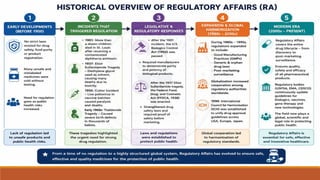
➢ Historical Overview Of Regulatory Affairs (RA)
1. Early Developments (Before 1900)
• In the early days, no strict laws existed for drug safety, food purity, or product registration.
• Many unsafe and mislabelled medicines were sold without proper testing.
• The need for drug regulation increased as public health risks became more common.
2. Incidents That Triggered Regulation
• 1901: More than a dozen children died in St. Louis after receiving a contaminated diphtheria
antitoxin.
• 1937 – Elixir Sulphanilamide Tragedy: A pharmaceutical company used diethylene glycol as a
solvent, resulting in many deaths due to its toxicity.
• 1955 – Cutter Incident: Live poliovirus remained in vaccine batches, causing paralysis and
deaths.
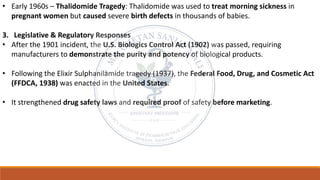
• Early 1960s – Thalidomide Tragedy: Thalidomide was used to treat morning sickness in
pregnant women but caused severe birth defects in thousands of babies.
3. Legislative & Regulatory Responses
• After the 1901 incident, the U.S. Biologics Control Act (1902) was passed, requiring
manufacturers to demonstrate the purity and potency of biological products.
• Following the Elixir Sulphanilamide tragedy (1937), the Federal Food, Drug, and Cosmetic Act
(FFDCA, 1938) was enacted in the United States.
• It strengthened drug safety laws and required proof of safety before marketing.
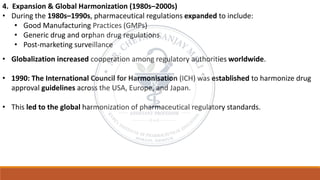
4. Expansion & Global Harmonization (1980s–2000s)
• During the 1980s–1990s, pharmaceutical regulations expanded to include:
• Good Manufacturing Practices (GMPs)
• Generic drug and orphan drug regulations
• Post-marketing surveillance
• Globalization increased cooperation among regulatory authorities worldwide.
• 1990: The International Council for Harmonisation (ICH) was established to harmonize drug
approval guidelines across the USA, Europe, and Japan.
• This led to the global harmonization of pharmaceutical regulatory standards.
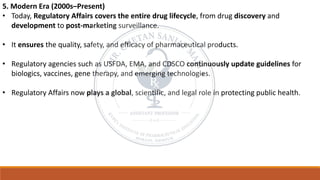
5. Modern Era (2000s–Present)
• Today, Regulatory Affairs covers the entire drug lifecycle, from drug discovery and
development to post-marketing surveillance.
• It ensures the quality, safety, and efficacy of pharmaceutical products.
• Regulatory agencies such as USFDA, EMA, and CDSCO continuously update guidelines for
biologics, vaccines, gene therapy, and emerging technologies.
• Regulatory Affairs now plays a global, scientific, and legal role in protecting public health.
➢ Regulatory Authorities
• Regulatory Authorities, such as the Food and Drug Administration (FDA) in the USA, are
responsible for deciding whether a drug can proceed to clinical trials and whether it should
be approved for marketing.
• These authorities evaluate the scientific and clinical data to ensure that the drug is
manufactured with consistent quality and purity, provides therapeutic benefits, and does not
produce unacceptable side effects.
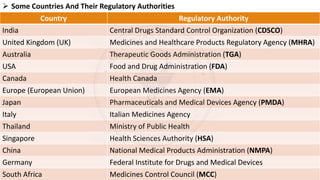
➢ Some Countries And Their Regulatory Authorities
Country Regulatory Authority
India Central Drugs Standard Control Organization (CDSCO)
United Kingdom (UK) Medicines and Healthcare Products Regulatory Agency (MHRA)
Australia Therapeutic Goods Administration (TGA)
USA Food and Drug Administration (FDA)
Canada Health Canada
Europe (European Union) European Medicines Agency (EMA)
Japan Pharmaceuticals and Medical Devices Agency (PMDA)
Italy Italian Medicines Agency
Thailand Ministry of Public Health
Singapore Health Sciences Authority (HSA)
China National Medical Products Administration (NMPA)
Germany Federal Institute for Drugs and Medical Devices
South Africa Medicines Control Council (MCC)
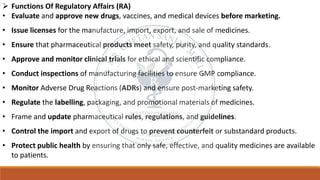
➢ Functions Of Regulatory Affairs (RA)
• Evaluate and approve new drugs, vaccines, and medical devices before marketing.
• Issue licenses for the manufacture, import, export, and sale of medicines.
• Ensure that pharmaceutical products meet safety, purity, and quality standards.
• Approve and monitor clinical trials for ethical and scientific compliance.
• Conduct inspections of manufacturing facilities to ensure GMP compliance.
• Monitor Adverse Drug Reactions (ADRs) and ensure post-marketing safety.
• Regulate the labelling, packaging, and promotional materials of medicines.
• Frame and update pharmaceutical rules, regulations, and guidelines.
• Control the import and export of drugs to prevent counterfeit or substandard products.
• Protect public health by ensuring that only safe, effective, and quality medicines are available
to patients.
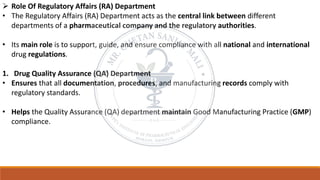
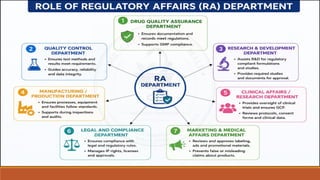
➢ Role Of Regulatory Affairs (RA) Department
• The Regulatory Affairs (RA) Department acts as the central link between different
departments of a pharmaceutical company and the regulatory authorities.
• Its main role is to support, guide, and ensure compliance with all national and international
drug regulations.
1. Drug Quality Assurance (QA) Department
• Ensures that all documentation, procedures, and manufacturing records comply with
regulatory standards.
• Helps the Quality Assurance (QA) department maintain Good Manufacturing Practice (GMP)
compliance.
2. Quality Control (Qc) Department
• Ensures that testing procedures, analytical methods, and test results meet regulatory
requirements.
• Guides the Quality Control (QC) department to maintain accuracy, reliability, and data
integrity.
3. Research & Development (R&D) Department
• Assists the Research & Development (R&D) team to ensure that new product formulations
and studies comply with regulatory requirements.
• Provides information on the required studies and documentation needed for drug approval.
4. Manufacturing / Production Department
• Ensures that manufacturing processes, equipment, and facilities comply with regulatory
standards.
• Supports the department during regulatory inspections and audits.
5. Clinical Affairs / Research Department
• Provides regulatory oversight of clinical trials and ensures compliance with Good Clinical
Practice (GCP).
• Reviews clinical trial protocols, informed consent forms, and clinical data before regulatory
submission.
6. Legal And Compliance Department
• Ensures that all company operations comply with legal and regulatory requirements.
• Helps manage intellectual property (IP) rights, product licenses, and regulatory approvals.
7. Marketing & Medical Affairs Department
• Reviews and approves advertisements, labelling, and promotional materials to ensure
compliance with regulatory laws.
• Prevents false or misleading claims about pharmaceutical products.
➢ Responsibilities of RA Professionals
• Prepare, compile and submit regulatory documents (like IND, NDA, ANDA, etc.) to authorities.
• Ensure that all pharmaceutical products comply with national and international regulations.
• Maintain up-to-date knowledge of changing regulatory laws and guidelines.
• Communicate with regulatory authorities during product approval and renewal.
• Review product labeling, packaging and promotional materials for legal compliance.
• Support R&D, QA, QC and manufacturing teams with regulatory guidance.
• Maintain proper documentation & records for audits & inspections.
• Monitor post-marketing safety & report ADRs.
• Ensure compliance during clinical trials and product development stages.
• Provide regulatory strategy to speed up approval & maintain market authorization.
REGULATORY REQUIREMENTS FOR DRUG APPROVAL
• Currently different nation's have to follow different requirements for the regulatory
approach of drug.
• Drug approval process is a regulatory procedure, through which a person/organization gets
approval to promote a drug in the market.
• Every new drug must undergo a systematic process to prove its safety, efficacy, and quality
before marketing.
• The process includes preclinical studies (animal testing) and clinical trials (human trials).
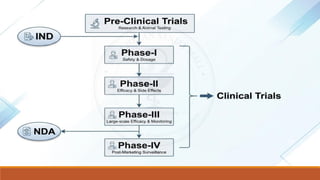
• A company must submit documentary like IND (Investigational New Drug) to start clinical
trials.
• After successful trials, an NDA (New Drug Application) is filed to get approval for sale.
• Regulatory authorities (like USFDA, CDSCO) review all data on safety, efficacy, and
manufacturing.
• Approval is granted only if the drug meets all legal, scientific, and quality requirements.
• Post-approval, pharmacovigilance is done to monitor the drug's safety in the market.
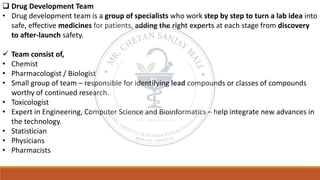
❑ Drug Development Team
• Drug development team is a group of specialists who work step by step to turn a lab idea into
safe, effective medicines for patients, adding the right experts at each stage from discovery
to after-launch safety.
✓ Team consist of,
• Chemist
• Pharmacologist / Biologist
• Small group of team – responsible for identifying lead compounds or classes of compounds
worthy of continued research.
• Toxicologist
• Expert in Engineering, Computer Science and Bioinformatics – help integrate new advances in
the technology.
• Statistician
• Physicians
• Pharmacists
➢ Classification Of Drug Development Team
The Drug Development Team is classified based on their function as follows:
1. Drug Discovery Project Team
2. Pre Clinical Drug Development Team
3. Clinical Drug Development Team
4. Marketing Team
5. Regulatory Affairs Team
6. Legal Team
7. Management Team
1. Drug Discovery Project Team
• Works to identify and design new chemical entities or lead compounds.
• Involves chemists, biologists and pharmacologists for target identification and screening.
• Selects promising drug candidates for further preclinical development.
2. Pre-clinical Drug Development Team
• Conducts laboratory and animal testing to study safety and biological activity.
• Develops suitable dosage forms and determines pharmacokinetic properties.
• Prepares documents like the Investigational New Drug (IND) application for submission.
3. Clinical Drug Development Team
• Conducts human trials (Phase I–III) to evaluate safety, efficacy and dosage.
• Includes doctors, clinical researchers, biostatisticians and coordinators.
• Collects clinical data to support New Drug Application (NDA) submission.
4. Marketing Team
• Studies market trends, target population, and product positioning.
• Plans promotional strategies before and after product launch.
• Conducts post-marketing (Phase IV) studies and monitors market performance.
5. Regulatory Affairs Team
• Ensures compliance with national and international drug laws.
• Prepares, submits, and maintains regulatory documents for approvals.
• Communicates with regulatory agencies like FDA, EMA, or CDSCO.
6. Legal Team
• Handles patent filing, intellectual property rights, and licensing issues.
• Reviews contracts and promotional materials for legal compliance.
• Protects the company from legal risks.
7. Management team
• Coordinate all department and ensure timely project completion.
• Allocated resources, budget, and sets development priorities
• Ensure that the drug development process meets company and regulatory team
❑ Non-Clinical Drug Development
• Non-Clinical (or Pre-clinical) drug development refers to the stage of research that occurs
before testing a new drug in humans (clinical trials).
• It is performed mainly in laboratory experiments and animal studies to evaluate the safety,
pharmacological activity, and metabolism of a new compound.
✓ STUDIES PERFORMED
• In Vitro: Perform outside of living organism.
• In Vivo: Perform inside living organism.
✓ Main Objectives
• To determine pharmacological activity (desired and undesired effects).
• To study ADME profile.
• To assess toxicity and establish a safe starting dose for humans.
• To provide scientific data for IND application.
➢ Components Of Non Clinical Drug Development
1. Pharmacological Studies
2. Pharmacokinetics & Metabolism
3. Toxicology Studies
1. Pharmacological Studies
• These evaluate how the drug acts on the body (Pharmacodynamics) and how the body acts
on the drug (Pharmacokinetics).
a) Primary Pharmacodynamics:
• Studies the MOA (Mechanism of Action) and therapeutic effects of the drug.
• Determines receptor binding, enzyme inhibition, or agonist/antagonist activity.
b) Secondary Pharmacodynamics:
• Studies other physiological effects not related to the main therapeutic effect.
• Helps identify potential side effects.
c) Safety Pharmacology:
• These studies are performed to identify potential safety risks.
• Establish safe dosage ranges.
It focuses on vital organ systems:
• Cardiovascular System
• Respiratory System
• CNS (Central Nervous System)
• Renal System
• GIT (Gastrointestinal Tract) System
2. Drug Metabolism (Pharmacokinetics)
• These studies describe how the drug is handled by the body.
a) Absorption:
• Determines rate and extent of absorption through various routes.
• Studies bioavailability & plasma concentration–time profile.
b) Distribution:
• Examines how the drug spreads into tissues and organs.
• Involves plasma protein binding & tissue partitioning studies.
c) Metabolism:
• Determines how the drug is chemically altered in the body, mainly by liver enzymes.
• Identifies metabolites (active or toxic).
d) Excretion:
• Studies routes of elimination (urine, faeces, bile).
• Determines half-life (t½) & clearance rate.
3. Toxicology Studies
• These evaluate potential harmful effects of a drug.
a) Acute Toxicity:
• Single high-dose studies in at least two animal species (rodent & non-rodent).
• Determines LD50 (dose causing death in 50% of animals).
b) Subacute / Subchronic Toxicity:
• Repeated dosing for 14–90 days to detect organ damage.
• Helps identify target organs of toxicity.
c) Chronic Toxicity:
• Long-term exposure (6 months to 2 years).
• Assesses safety for long-term therapeutic use.
❑ INVESTIGATIONAL NEW DRUG APPLICATION
• An IND (Investigational New Drug) application is a request submitted to the regulatory
authority (like the USFDA) for permission to start clinical trials of a new drug in humans.
• It ensures that the drug is safe enough to be tested on humans and that clinical trials are
scientifically sound and ethical.
• The IND is usually filed after successful preclinical (animal) studies showing safety and
biological activity.
➢ Classification Of IND
1. Commercial
• Permits sponsor to collect data on clinical safety and effectiveness needed for application for
marketing in the form of NDA (New Drug Application).
2. Research
• Permits the sponsor to use the drug in research to obtain advanced knowledge of the new
drug, with no plan to market the product.
➢ Contents of IND
• Animal Pharmacology & Toxicology Data: To show safety in animals.
• Manufacturing Information: To ensure purity, stability & quality of the drug.
• Clinical Protocols: Details of how clinical trials will be conducted.
• Investigator Information: Qualification of doctors conducting the study.
➢ Types Of Ind Applications
1. Investigator IND Application
• Submitted by a physician who both initiates and conducts the clinical investigation.
• The investigator is directly responsible for the administration & monitoring of the
investigational drug in subjects.
• Usually filed for academic or clinical research purposes rather than for commercial
development.
• Used when a doctor wants to study an unapproved drug or an approved drug for a new
indication, dose, or patient population.
2. Emergency Use IND Application
Allows the use of an investigational drug in an emergency situation where:
• The patient has a life-threatening condition.
• No standard treatment is available.
• There isn't enough time for standard IND submission & approval.
• Enables immediate access to potentially beneficial investigational drugs.
3. Treatment IND Application
• Also known as Treatment Use IND or Expanded Access IND.
• Permits the use of an investigational drug for serious or life-threatening disease outside
clinical trials.
Usually applicable when:
• The drug is in Phase III clinical trials or under active FDA review.
• Evidence suggests it may be effective & safe enough for widespread use.
• Allows patients who can't participate in trials to gain early access to promising therapies.
4. Screening IND Applications
• Used when a sponsor or investigator wants to screen a group of closely related compounds
(e.g., chemical analogs, salts, esters).
• Purpose: To identify the most promising candidate for further clinical development.
• Allows flexibility in testing multiple similar formulations under one IND, reducing
administrative burden.
➢ Forms & Regulatory Requirements
• Form 1571: The official IND application submission form.
• Form 1572: Statement of the Investigator (the Investigator's Undertaking).
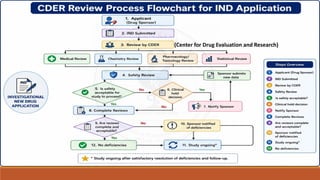
• Once submitted, the IND has a 30 calendar-day review period by the FDA.
• If no clinical hold is issued by day 30, the sponsor may initiate clinical trials.
(Center for Drug Evaluation and Research)
❑ INVESTIGATOR'S BROCHURE
• The Investigator's Brochure is a comprehensive document that provides all the clinical and
non-clinical information available about an investigational drug.
• It is designed to help investigators, ethics committees, and regulatory authorities understand
the background, safety, and proper use of the investigational product.
• The sponsor of the clinical trials (usually a pharmaceutical company) prepares & maintains
the Investigator's Brochure.
• It is updated regularly as new data becomes available from ongoing studies.
➢ Purpose
• To provide investigators with essential information about the drug.
• To ensure safe administration of the investigational product to participants.
• To help investigators understand the scientific rationale & potential risks of the study.
• To serve as a reference document for regulatory submissions & ethics approvals.
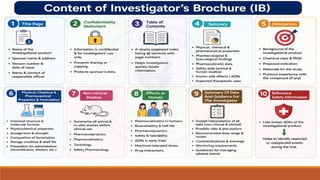
➢ Content Of Investigator's Brochure
1. Title Page
• Name of the investigational product
• Sponsor name & address
• Version number & date of issue
• Name & contact of responsible officer
2. Confidentiality Statement
• States that information is confidential & for investigators' use only.
• Prevents sharing or copying.
• Protects sponsor's data.
3. Table Of Contents
• A clearly organized index listing all sections with page numbers.
• Helps investigators quickly locate information.
4. Summary
A brief (2–3 page) summary of key information:
• Physical, chemical and pharmaceutical properties.
• Pharmacological & toxicological findings.
• Pharmacokinetic data.
• Safety data from animal & human studies.
• Known side effects or ADRs.
• Expected therapeutic uses.
5. Introduction
• Provides a background of the investigational products.
• Chemical class & MOA
• Proposed indication
• Rationale for the study
• Previous experience with the compound (if any)
6. Physical, Chemical And Pharmaceutical Properties And Formulation
Contains detail about:
• Chemical structure & molecular formula
• Physicochemical properties
• Dosage form & strength
• Composition of formulation
• Storage condition & shelf life
• Preparation for administration (reconstitution, dilution, etc.)
7. Non-clinical Studies
• Summarize all animal & in-vitro studies performed before clinical use.
Includes:
• Pharmacodynamics
• Pharmacokinetics
• Toxicology
• Safety Pharmacology
8. Effects In Human
Includes all available clinical information:
• Pharmacokinetics in humans
• Bioavailability & half-life
• Pharmacodynamics
• Safety & tolerability
• ADRs observed in early trials
• Maximum tolerated doses
• Drug interactions
9. Summary Of Data And Guidance For The Investigator
• This is one of the most important sections of the IB.
It provides:
• Overall interpretation of all data (non-clinical & clinical)
• Possible risks & precautions
• Recommended dose range & routes of administration
• Contraindications & warnings
• Monitoring requirements
• Guidelines for managing adverse events
10. Reference Safety Information
• A section that lists known ADRs of the investigational product.
• Used as a reference to determine if new events are expected or unexpected during the trial.
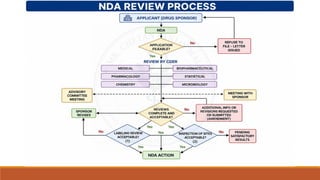
❑ NEW DRUG APPLICATION (NDA)
• NDA is the formal request submitted to a regulatory authority (like US-FDA or CDSCO in India)
to get approval to market a new drug.
• It contains complete data from preclinical & clinical studies, along with manufacturing,
labeling & safety information.
➢ Purpose of NDA
• To prove that new drug is safe and effective for its intended use.
• To ensure the quality & consistency of the product.
• To provide complete information for regulatory review & marketing.
➢ General Considerations
1. Review of Data
NDA must include data from:
• Non-clinical studies
• Clinical trials (Phase I–III)
• Pharmacokinetic & bioavailability data
• Data should be accurate, verifiable, & well-documented.
2. Drug Substance And Product Information
• Detailed chemical, manufacturing & control information
• Includes composition, formulation, stability, packaging & analytical methods.
• Must confirm that the product meets quality standards.
3. Safety And Efficacy Evaluation
Data from clinical trials must demonstrate:
• Therapeutic effectiveness for intended indication.
• Acceptable safety profile.
• Should include both adverse events and post-trial follow-up data.
4. Labeling Information
• Proposed dosage instructions, warnings & contraindications.
• Must be clear, accurate & approved by Regulatory Authority.
5. Statistical & Analytical Review
• Statistical methods used in trials must be appropriate & justified.
• Results should show significant efficacy.
6. Format And Presentation
• NDA must follow the common Technical Document format (as per ICH guidelines).
Organized into modules:
• Module 1: Administrative & Prescribing Information
• Module 2: Summary
• Module 3: Quality
• Module 4: Nonclinical Study Reports
• Module 5: Clinical Study Reports
7. Good manufacturing practice compliance
• Manufacturing sites must comply with GMP regulation
• Include inspection reports and quality certification
8. Ethical And Regulatory Compliance
• All studies must follow GMP and ethical guidelines.
• Proper informed consent and ethics committee approvals are required.
9. Risk–benefit Assessment
• The benefits of the drug must clearly outweigh the risks.
• Important for regulatory approval decision.
10. Post-marketing Considerations
• Plan for pharmacovigilance and post-marketing surveillance.
• Ensures continuous monitoring of safety in real-world use
❑ CLINICAL RESEARCH
• Clinical Research is the systematic study of drugs in human subjects to determine their safety,
efficacy, and appropriate dosage before they are approved for public use.
• It is one of the most important stages of drug development because it provides real evidence
on how a drug behaves in the human body.
➢ Objectives Of Clinical Research
• To determine the safe dose range of a new drug.
• To evaluate the efficacy (effectiveness) of the drug.
• To study the pharmacokinetics (PK) and pharmacodynamics (PD) in humans.
• To identify possible side effects or Adverse Drug Reactions (ADRs).
• To compare the new treatment with existing therapies.
➢ Phases of Clinical Research
Clinical research is divided into four phases (Phase I–IV).
1. Phase I
• In this phase, the drug is tested on 20–80 healthy volunteers.
• Main purpose To check safety, To check side effects (toxicity) of the drug Studies
• Conducted Pharmacokinetics, Pharmacodynamics Pharmacological effects, Side effects and
toxicity at different doses
2. Phase II (Therapeutic Exploration)
• In this phase, approximately 100–500 patients with the targeted disease are selected.
• To check the efficacy and side effects of the drug
• Finding the dose range
3. Phase III (Therapeutic Confirmatory)
• In this phase, approximately 1000–5000 patients are selected.
• Patients are selected with the targeted disease.
• Common side effects
• Drug interactions
• Assessment of safety and efficacy
4. Phase IV (Post-Marketing Therapeutic)
• Use In this phase, data is collected to check whether the drug is safe or not.
• Collection of long-term safety information
❑ CLINICAL RESEARCH PROTOCOL (CRP)
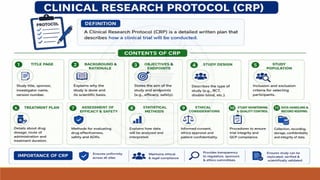
• A Clinical Research Protocol (CRP) is a detailed written plan that describes how a clinical trial
will be conducted, including its objectives, study design, methodology, statistical methods,
and organization.
➢ Purpose Of Clinical Research Protocol
• Acts as a blueprint for the entire clinical trial.
• Ensures that all investigators follow the same standardized procedures.
• Protects the safety, rights, and well-being of participants.
• Ensures the scientific validity and reliability of study results.
➢ Contents Of Clinical Research Protocol
A good clinical research protocol contains the following sections:
1. Title Page
• Includes the study title, sponsor name, investigator name, and version number.
2. Background and Rationale
• Explains why the study is being conducted and its scientific basis.
3. Objectives and Endpoints
• States the aim of the study and the primary/secondary endpoints (e.g., efficacy and safety).
4. Study Design
• Describes the type of study (e.g., randomized, double-blind, placebo-controlled).
5. Study Population
• Defines the inclusion and exclusion criteria for selecting participants.
6. Treatment Plan
• Provides details about the drug dosage, route of administration, and treatment duration.
7. Assessment of Efficacy and Safety
• Describes methods for evaluating drug effectiveness, safety, and adverse drug reactions
(ADRs).
8. Statistical Methods
• Explains how study data will be analysed and interpreted.
9. Ethical Considerations
• Includes informed consent, ethics committee approval, and patient confidentiality.
10. Study Monitoring and Quality Control
• Describes procedures to ensure trial integrity and compliance with Good Clinical Practice
(GCP).
11. Data handling and records keeping
• Details on how data will be stored, maintained and reported
➢ Importance Of Clinical Research Protocol (CRP)
• Ensures uniformity in the clinical trial process across all study sites.
• Maintains ethical and legal compliance.
• Provides transparency to regulatory authorities, sponsors, and ethics committees.
• Ensures that the study can be replicated, verified, and scientifically validated.
➢ Bioequivalent Studies
• Bioequivalence studies are conducted to compare the rate and extent of drug absorption
between a test (generic) product and a reference (brand) product.
Purpose
• To ensure that the generic drug produces the same therapeutic effects as the branded drug.
Requirement
• Essential for approval of generic drugs.
Outcome
• If pharmacokinetic parameters are within the 80–125% range, the products are considered
bioequivalent.
➢ Biostatistics In Pharmaceutical Product Development
• Biostatistics applies mathematical & statistical techniques to collect, analyze, and interpret
data during drug development.
• It helps in clinical trial design—for example, deciding how many patients are needed to test a
new cancer drug.
• Used to compare treatment effects, such as determining whether a new painkiller reduces
pain more effectively than an existing one.
• Ensures data accuracy and reliability, helping researchers confirm that results are not due to
chance.
• In bioequivalence studies, biostatistics helps compare the plasma concentration–time curves
of generic and branded drugs.
• It support regulatory submission (Like NDA and IND) by providing statistical evidence of drug
safety, efficacy and quality.
➢ Data Presentation For FDA Submission
• When a company submits data to the USFDA (for IND, NDA, or ANDA), it must follow a
specific format and structure to ensure clarity, accuracy, and easy review.
• All data must be presented scientifically, clearly, and consistently according to the FDA's
electronic Common Technical Document (eCTD) format.
• The following are some key considerations when presenting data for FDA submission.
1. Organize the Data
• Arrange all information in a logical & consistent order.
• Use tables & figures to make the data easier to read & interpret.
• Group related data together and use clear headings and labels for better understanding
2. Follow FDA Guidelines
• Present data according to FDA's standard formats (such as eCTD).
• Follow guidelines for the layout, labeling & style of tables, graphs, and figures.
• Use standard symbols, abbreviations, and avoid any non-standard notations.
3. Use Clear and Concise Language
• Use simple & direct language to describe data and study results.
• Avoid abbreviations unfamiliar to reviewers.
• Ensure the summary is easy to follow without confusion.
4. Present Data in Context
• Always present results in the context of the study design & objectives.
• Include short descriptions of study methods, treatment groups, & outcome measures to help
reviewers understand the relevance of the data.
5. Highlight Key Findings
• Emphasize statistically significant & clinically meaningful results.
• Clearly show differences between treatment groups.
• Use charts, graphs & tables to make key findings visually clear.
6. Be Transparent and Accurate
• Ensure data presentation is honest, accurate & complete.
• Mention all statistical methods used and note any limitations or special conditions.
• Avoid data manipulation or selective presentation.
➢ Management Of Clinical Studies
• Management of clinical studies involves a systematic approach to plan, conduct, monitor &
report clinical trials efficiently while ensuring patient safety, data accuracy & regulatory
compliance.
• It includes several key components that work together for successful execution of clinical
trials.
1. Study Design and Planning
• This is the foundation stage where the study objectives, methodology, endpoints & sample
size are defined.
• A Clinical Trial Protocol (CTP) is prepared that outlines how the study will be conducted.
• Proper planning ensures that the study is ethical, scientifically valid.
2. Budget and Financial Oversight
• Involves allocation & management of funds for trial activities such as site operations,
investigator fees, logistics & data management.
• Financial transparency is maintained to ensure efficient use of resources and prevent misuse.
3. Regulatory Compliance
• All clinical trials must follow regulatory guidelines (like ICH-GCP, FDA, or CDSCO rules).
• Necessary approvals from regulatory authorities & Ethics Committee must be obtained before
initiation.
• Compliance ensures the study is legal, ethical & credible.
4. Patient Recruitment and Management
• Involves identifying, screening & enrolling eligible participants according to inclusion/
exclusion criteria.
• Ensures informed consent and proper management of subjects throughout the trial.
5. Monitoring and Oversight
• Continuous supervision of trial activities to ensure adherence to the protocol & GCP
standards.
• Clinical Research Associates (CRAs) visit sites regularly to check data accuracy, documentation
& protocol compliance
6. Risk Management
• Identifies potential risks (safety, data errors, delays) & develops strategies to minimize them.
• Involves regular review of Adverse Events (AEs) & implementation of corrective actions.
7. Data Management
• Collection, entry, verification & storage of study data using secure databases.
• Ensures data integrity, confidentiality & accuracy of statistical evaluation.
8. Clinical Supply Management
• Includes procurement, storage, labeling & distribution of investigational drugs and materials.
• Ensures proper handling of supplies to maintain quality & traceability.
9. Statistical Analysis and Reporting
• Data is analyzed statistically to evaluate the safety & efficacy of the drug.
• Results are compiled in a Clinical Study Report (CSR), which summarizes findings for
regulatory submission.
10. Stakeholder Communication
• Continuous communication between sponsors, investigators, regulatory bodies, & Ethics
Committee is essential.
• Promotes transparency, quick decision-making & smooth trial progress.