This unit covers the formulation, manufacturing, filling, quality control, packaging, storage, and stability testing of hard and soft gelatin capsules, along with the formulation requirements, pelletization methods, and equipment used for pellet manufacture.
Industrial Pharmacy I(BP 502 T.)
UNIT-III
Chapter No. 1
Capsules
Presented by,
Mr. Chetan S. Mali
2.
❑ CAPSULES
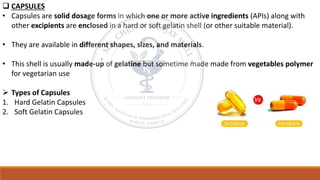
• Capsulesare solid dosage forms in which one or more active ingredients (APIs) along with
other excipients are enclosed in a hard or soft gelatin shell (or other suitable material).
• They are available in different shapes, sizes, and materials.
• This shell is usually made-up of gelatine but sometime made made from vegetables polymer
for vegetarian use
➢ Types of Capsules
1. Hard Gelatin Capsules
2. Soft Gelatin Capsules
3.
❑ Hard GelatinCapsules
• Hard gelatin capsules are capsules that consist of a hard gelatin shell enclosing a solid or
powdered active ingredient.
E.g. Paracetamol Caps, Amoxicillin Capsules
• A hard gelatine capsule consists of two parts:
1. Body
2. Cap
1. Body
• It is the main part of the capsule.
• It contains the active ingredient.
1. Cap
• It is the smaller part of the capsule.
• It fits over the body to enclose and protect the active ingredient.
4.
✓ Size andShape of Hard Gelatin Capsules
▪ Size
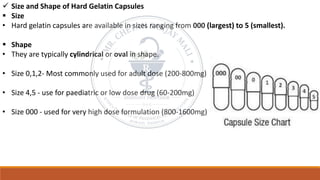
• Hard gelatin capsules are available in sizes ranging from 000 (largest) to 5 (smallest).
▪ Shape
• They are typically cylindrical or oval in shape.
• Size 0,1,2- Most commonly used for adult dose (200-800mg)
• Size 4,5 - use for paediatric or low dose drug (60-200mg)
• Size 000 - used for very high dose formulation (800-1600mg)
5.
✓ Advantages ofHard Gelatine Capsules
• Easy to swallow
• Mask unpleasant taste and odour
• Provide precise dosing
• Protect the drug and improve stability
• Faster drug release
• Good patient acceptability
• Cost-effective
✓ Disadvantages of Hard Gelatin Capsules
• Not suitable for hygroscopic or highly moisture-sensitive drugs without additional protection.
• Gelatine cell Incompatible with highly acidic or highly alkaline drugs.
• Gelatin may soften or melt at high temperatures.
• Slower production rate compared to some other dosage forms.
6.
➢ Gelatin
• Gelatinis a translucent, colourless, and flavourless substance obtained from collagen, a
protein found in the skin, bones, and connective tissues of animals.
✓ Types of Gelatin
1. Type A Gelatin
• Derived from pig skin
2. Type B Gelatin
• Derived from cow bones and connective tissues
3. Fish Gelatin
• Derived from fish skin and bones
7.
➢ Formulation ofCapsules
• Capsule formulation is the process of combining the active pharmaceutical ingredient (API)
with excipients and other necessary ingredients to prepare capsules that are stable, effective,
and easy for patients to administer (swallow).
✓ Key Ingredients Used in Capsule Formulation
1. Gelatin: The main component of the capsule shell, derived from animal collagen.
It provides structure and flexibility to the capsule.
2. Water: Essential for preparing the gelatin solution.
3. Colourants: Added to improve the appearance and identification of the capsule.
4. Opacifying Agents: Make the capsule shell opaque, protecting the contents from light.
5. Plasticizers: Increase the flexibility and elasticity of the capsule shell.
6. Preservatives: Prevent microbial growth and extend the shelf life of the capsules.
8.
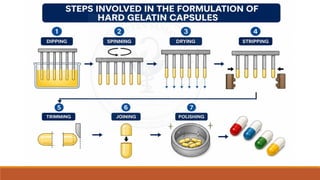
➢ Steps Involvedin the Formulation of Hard Gelatin Capsules shell
The production of hard gelatin capsules involves the following steps:
1. Dipping
2. Spinning
3. Drying
4. Stripping
5. Trimming
6. Joining
7. Polishing
9.
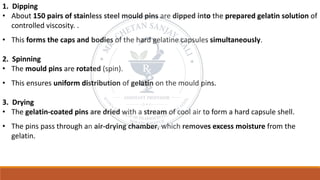
1. Dipping
• About150 pairs of stainless steel mould pins are dipped into the prepared gelatin solution of
controlled viscosity. .
• This forms the caps and bodies of the hard gelatine capsules simultaneously.
2. Spinning
• The mould pins are rotated (spin).
• This ensures uniform distribution of gelatin on the mould pins.
3. Drying
• The gelatin-coated pins are dried with a stream of cool air to form a hard capsule shell.
• The pins pass through an air-drying chamber, which removes excess moisture from the
gelatin.
10.
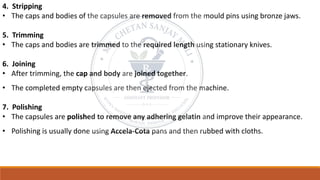
4. Stripping
• Thecaps and bodies of the capsules are removed from the mould pins using bronze jaws.
5. Trimming
• The caps and bodies are trimmed to the required length using stationary knives.
6. Joining
• After trimming, the cap and body are joined together.
• The completed empty capsules are then ejected from the machine.
7. Polishing
• The capsules are polished to remove any adhering gelatin and improve their appearance.
• Polishing is usually done using Accela-Cota pans and then rubbed with cloths.
12.
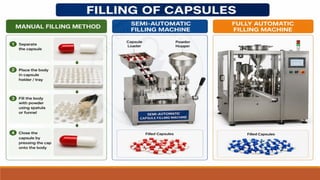
➢ Filling ofCapsules
• Capsule filling is the process of accurately filling capsules with powders, granules, liquids, or
semi-solid materials.
• The filling process depends on whether it is done manually or by machine.
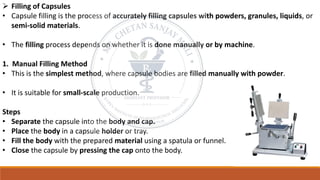
1. Manual Filling Method
• This is the simplest method, where capsule bodies are filled manually with powder.
• It is suitable for small-scale production.
Steps
• Separate the capsule into the body and cap.
• Place the body in a capsule holder or tray.
• Fill the body with the prepared material using a spatula or funnel.
• Close the capsule by pressing the cap onto the body.
13.
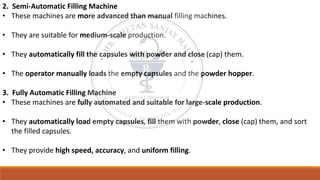
2. Semi-Automatic FillingMachine
• These machines are more advanced than manual filling machines.
• They are suitable for medium-scale production.
• They automatically fill the capsules with powder and close (cap) them.
• The operator manually loads the empty capsules and the powder hopper.
3. Fully Automatic Filling Machine
• These machines are fully automated and suitable for large-scale production.
• They automatically load empty capsules, fill them with powder, close (cap) them, and sort
the filled capsules.
• They provide high speed, accuracy, and uniform filling.
15.
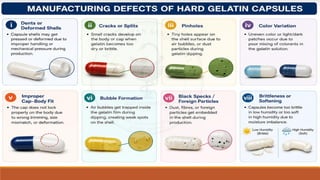
➢ Manufacturing Defectsof Hard Gelatin Capsules
i) Dents or Deformed Shells
• Capsule shells may get pressed or deformed due to improper handling or mechanical
pressure during production.
ii) Cracks or Splits
• Small cracks develop on the body or cap when gelatin becomes too dry or brittle.
iii) Pinholes
• Tiny holes appear on the shell surface due to air bubbles, or dust particles during gelatin
dipping.
iv) Color Variation
• Uneven color or light/dark patches occur due to poor mixing of colorants in the gelatin
solution.
16.
v) Improper Cap–BodyFit
• The cap does not lock properly on the body due to wrong trimming, size mismatch, or
deformation.
vi) Bubble Formation
• Air bubbles get trapped inside the gelatin film during dipping, creating weak spots on the
shell.
(vii) Black Specks / Foreign Particles
• Dust, fibres, or foreign particles get embedded in the shell during production.
(viii) Brittleness or Softening
• Capsules become too brittle in low humidity or too soft in high humidity due to moisture
imbalance.
18.
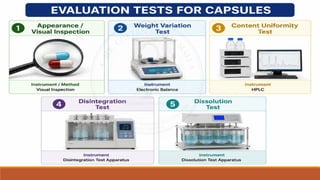
➢ Evaluation Testsfor Capsules
• Evaluation tests for capsules are performed to ensure their quality, safety, and efficacy.
• These tests are carried out during development and manufacturing to meet pharmacopoeia
standards and ensure proper drug delivery.
1. Appearance / Visual Inspection
• This test checks the capsule for uniform colour, smooth surface, and absence of dents,
cracks, spots, leakage, or deformation to ensure physical quality.
Procedure:
• Capsules are placed on a white background under good light.
• The inspector visually examines the capsules or uses an automatic camera system.
• Defective capsules are separated and rejected.
19.
2. Weight VariationTest
Purpose:
• To ensure that each capsule contains a uniform amount of fill material.
• It helps maintain dose uniformity.
Procedure:
• Take 20 tablets and weight each capsules (W1)
• Empty them and weigh empty shell (W2)
• The average weight is calculated.
• Calculate W1-W2
• The weight variation is compared with the acceptable pharmacopoeia limits.
20.
3. Content UniformityTest
• To ensure that each capsule contains the correct amount of Active Pharmaceutical
Ingredient (API).
Procedure:
• Randomly select capsules from the batch.
• Take 10 capsules
• Extract the contents of each capsule.
• Analyse the API using a suitable method, usually High-Performance Liquid Chromatography
(HPLC).
• Compare the amount of API with the labelled claim to ensure content uniformity.
21.
4. Disintegration Test
•To determine how quickly and completely the capsule disintegrates in the gastrointestinal
tract, ensuring proper drug release.
Procedure:
• Capsules are placed in a disintegration test apparatus containing a suitable dissolution
medium.
• The time taken for the capsule to completely disintegrate is recorded.
Acceptance Criteria:
• Hard gelatin capsules should generally disintegrate within 30 minutes, unless otherwise
specified in the pharmacopoeia or product formulation.
22.
5. Dissolution Test
•To determine the rate and extent of drug release from the capsule into a specified dissolution
medium, which simulates body conditions.
Procedure:
• Capsules are placed in a dissolution apparatus containing a dissolution medium under
controlled conditions.
• Samples are collected at specified time intervals.
• The drug concentration is measured using spectrophotometry or chromatography.
Acceptance Criteria:
• The amount of drug released should comply with pharmacopoeia specifications.
24.
❑ Soft GelatinCapsules
• Soft gelatin capsules are one-piece, sealed capsules used to contain liquids, semi-solids, or
suspensions.
• They are widely used in the pharmaceutical, nutraceutical, and cosmetic industries because
they are easy to swallow and can encapsulate various types of formulations.
E.g. Vitamin E soft gel, Omega 3 fish oil.
✓ Advantages of Soft Gelatin Capsules
• Easy to swallow
• Provide precise dosing
• Better bioavailability
• Mask unpleasant taste and odour
• Rapid drug absorption
25.
✓ Disadvantages ofSoft Gelatin Capsules
• Moisture sensitive – may be affected by humidity.
• Limited fill materials – not suitable for all types of drugs and formulations.
• Higher cost – more expensive to manufacture than hard gelatin capsules.
• Complex production process – requires specialized equipment and manufacturing
techniques.
26.
➢ Formulation ofSoft Gelatin Capsules shell
Soft-gelatin capsule shell contains:
1. Gelatin
2. Plasticizers
3. Water
4. Colorants / Opacifiers
5. Preservatives
6. Flavouring Agents
1. Gelatin:
• It forms the main structure of the soft gel shell.
• It gives strength, clarity, and elasticity.
• Soft-gelatin capsule: Single-piece capsule.
• Type A and Type B gelatine can be used.
2. Water
• It is required to dissolve gelatine and plasticizers and to maintain softness.
E.g. Purified water.
27.
3. Plasticizers
• Itmakes the capsule shell soft, flexible and elastic.
• More plasticizer = softer shell.
E.g. Glycerin, Sorbitol.
4. Colorants / Opacifiers
• Used to give color and protect light-sensitive products.
E.g. Titanium dioxide.
5. Preservatives
• Used to prevent microbial growth in the moist shell.
E.g. Methyl paraben, Propyl paraben.
6. Flavouring Agents
• Used in chewable soft gels for better taste.
E.g. Mint flavour, Fruit Flavors.
28.
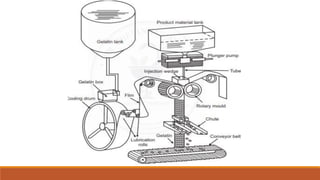
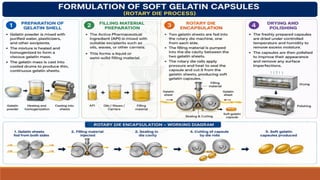
➢ Formulation ofSoft Gelatin Capsules
• The formulation of soft gelatin capsules is mainly carried out by the Rotary Die Process.
• It involves several steps, from preparing the gelatin shell to encapsulating the filling material.
1. Preparation of Gelatin Shell
• Gelatin powder is mixed with purified water, plasticizers, and other excipients.
• The mixture is heated and homogenized to form a viscous gelatin mass.
• The gelatin mass is then cast into cooled drums to produce thin, continuous gelatin sheets.
2. Filling Material Preparation
• The Active Pharmaceutical Ingredient (API) is mixed with suitable excipients such as oils,
waxes, or other carriers.
• This forms a liquid or semi-solid filling material.
29.
3. Rotary DieEncapsulation
• Two gelatin sheets are fed into the rotary die machine, one from each side.
• The filling material is pumped into the die cavity between the two gelatin sheets.
• The rotary die rolls apply pressure and heat to seal the capsule and cut it from the gelatin
sheets, producing soft gelatin capsules.
4. Drying and Polishing
• The freshly prepared capsules are dried under controlled temperature and humidity to
remove excess moisture.
• The capsules are then polished to improve their appearance and remove any surface
imperfections.
32.
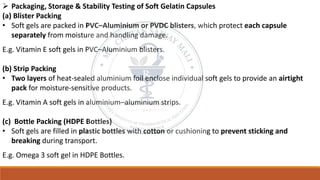
➢ Packaging, Storage& Stability Testing of Soft Gelatin Capsules
(a) Blister Packing
• Soft gels are packed in PVC–Aluminium or PVDC blisters, which protect each capsule
separately from moisture and handling damage.
E.g. Vitamin E soft gels in PVC–Aluminium blisters.
(b) Strip Packing
• Two layers of heat-sealed aluminium foil enclose individual soft gels to provide an airtight
pack for moisture-sensitive products.
E.g. Vitamin A soft gels in aluminium–aluminium strips.
(c) Bottle Packing (HDPE Bottles)
• Soft gels are filled in plastic bottles with cotton or cushioning to prevent sticking and
breaking during transport.
E.g. Omega 3 soft gel in HDPE Bottles.
33.
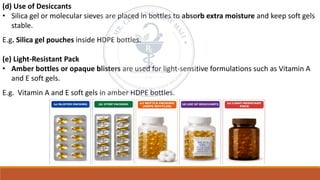
(d) Use ofDesiccants
• Silica gel or molecular sieves are placed in bottles to absorb extra moisture and keep soft gels
stable.
E.g. Silica gel pouches inside HDPE bottles.
(e) Light-Resistant Pack
• Amber bottles or opaque blisters are used for light-sensitive formulations such as Vitamin A
and E soft gels.
E.g. Vitamin A and E soft gels in amber HDPE bottles.
34.
➢ Storage Conditions
•Store at cool temperature (15–25°C) because heat softens the gelatin shell.
• Low humidity (around 35% RH) is required because soft gels contain more water and may
stick together in high humidity.
• Keep away from direct sunlight to avoid degradation of sensitive vitamins and oils.
• Airtight bottles prevent moisture exchange and protect the shell from becoming too soft or
too hard.
➢ Applications
• Used for Vitamin A, D, E, K, Omega-3 and fish oil.
• Soft gels help dissolve poorly soluble drugs, giving faster absorption.
• Ideal for drugs that cannot be made into tablets or hard capsules.
• Multiple oils, vitamins, or lipid-based drugs can be mixed together.
• The soft, smooth shell makes swallowing easier and improves patient acceptance.
35.
➢ Stability Testingof Soft Gelatin Capsules
• Stability testing checks how soft gelatin capsules maintain their quality, safety, and
performance over time when stored under different temperature and humidity conditions.
• It helps to decide the shelf-life and expiry date.
Parameters Tested
1. Physical Appearance
• Check for: Color change, Sticking, Leakage, Softening, Hardening of capsules
2. Assay (Drug Content)
• Tests if the drug amount remains within the specified limit during storage.
3. Dissolution / Disintegration
• Checks if the capsule still releases the drug properly after months of storage.
36.
4. Moisture Content
•Measures changes in moisture because soft gels can absorb and lose water easily.
5. Impurity/ Degradation study
• Check for new impurity or oxidation product
6. Microbial Stability
• Ensure microbial growth does not increase because soft gel content water
37.
➢ Evaluation Testsfor Soft Gelatin Capsules (Quality control test)
1. Leakage / Seal Integrity Test
• This test checks whether soft gelatin capsules are properly sealed.
• It ensures that no liquid leaks out of the capsule.
a. Visual Check
• Capsules are inspected for any wet spots or oil leakage on the surface.
b. Dye Test
• Capsules are dipped in a dye solution.
• If the dye enters the capsule, the seal is weak.
c. Vacuum / Pressure Test
• Sealed capsules are checked under vacuum or pressure conditions to determine whether
leakage occurs.
38.
• The evaluationtests for soft gelatin capsules are almost the same as those for hard gelatin
capsules.
1. General appearance
2. Weight variation
3. Content uniformity
4. Disintegration Test
5. Dissolution Test
6. Assay
39.
❑ PELLETS
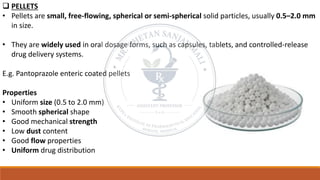
• Pelletsare small, free-flowing, spherical or semi-spherical solid particles, usually 0.5–2.0 mm
in size.
• They are widely used in oral dosage forms, such as capsules, tablets, and controlled-release
drug delivery systems.
E.g. Pantoprazole enteric coated pellets
Properties
• Uniform size (0.5 to 2.0 mm)
• Smooth spherical shape
• Good mechanical strength
• Low dust content
• Good flow properties
• Uniform drug distribution
40.
✓ Advantages ofPellets
• Uniformity of dose
• Easy storage and transportation
• Controlled drug release
• Reduced dose dumping
• Enhanced bioavailability
• Versatile dosage forms (can be filled into capsules or compressed into tablets)
• Excellent flow properties
✓ Disadvantages of Pellets
• Preparation is complicated and time-consuming.
• High manufacturing cost.
• Requires specialized equipment.
• Requires trained and skilled personnel for manufacturing.
41.
➢ Formulation Requirementsfor Pellets
• The formulation requirements for pelletization are important to produce high-quality pellets
with uniform size, good strength, and controlled drug release.
• The formulation involves selecting suitable materials, binders, and additives to ensure
successful pellet formation.
1. Active Ingredient (API)
• The Active Pharmaceutical Ingredient (API) is the main component to be delivered in the form
of pellets.
• The particle size of the API should be fine enough to ensure good agglomeration during
pelletization.
• A fine particle size helps produce uniform and stable pellets.
E.g. Omeprazole, Diclofenac.
42.
2. Binders
• Bindersare substances added to hold the particles together.
• They provide strength and structural integrity to the pellets.
• They help the particles stick together during pelletization and prevent the pellets from
breaking apart after formation.
E.g. Polyvinyl phosphate, hydroxypropyl methyl cellulose, Starch.
3. Fillers
• Fillers are inert substances added to increase the bulk (volume) of the pellets.
• They also help in obtaining the desired pellet size and weight.
E.g. Lactose, Microcrystalline cellulose.
43.
4. Lubricants
• Lubricantsare added to reduce friction between the pellets and the equipment during
manufacturing.
• They improve the flow of the material.
E.g. Glycerin, Polyethylene Glycol (PEG)
5. Additives
• Additives such as colouring agents and flavouring agents are added to:
• Improve the appearance of pellets.
• Mask unpleasant taste or odour.
6. Disintegrants
• Disintegrants help the pellets break apart quickly after administration.
• They promote rapid disintegration or dissolution of the pellets in the gastrointestinal (GI)
tract for effective drug release.
E.g. Crospovidone, sodium starch glycolate.
44.
➢ Equipment Usedfor Manufacturing of Pellets
The following equipment is commonly used for the manufacture of pellets:
• Supply Bins – Store and supply raw materials to the pelletizing process.
• Pellet Mills – Compress and form the material into pellets.
• Coolers – Cool the freshly prepared pellets and improve their hardness and stability.
• Crumble Rolls – Break large pellets into smaller, uniform-sized pellets, if required.
• Shaker (Sieve/Shaker Screen) – Separate pellets according to size and remove fines or
oversized pellets.
45.
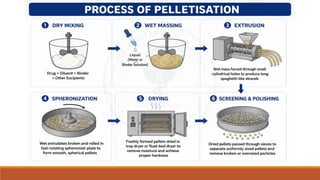
➢ Process ofPelletization
1. Dry mixing
2. Wet massing
3. Extrusion
4. Spheronization
5. Drying
6. Screening & Polishing
(i) Dry Mixing
• The process begins by mixing the drug with diluent, binder, and other excipients to form a
uniform dry powder blend.
(ii) Wet Massing (Granulation)
• A suitable liquid (water or binder solution) is added to the dry mix to form a soft, plastic, and
workable wet mass suitable for extrusion.
46.
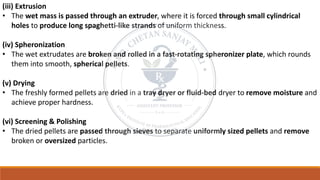
(iii) Extrusion
• Thewet mass is passed through an extruder, where it is forced through small cylindrical
holes to produce long spaghetti-like strands of uniform thickness.
(iv) Spheronization
• The wet extrudates are broken and rolled in a fast-rotating spheronizer plate, which rounds
them into smooth, spherical pellets.
(v) Drying
• The freshly formed pellets are dried in a tray dryer or fluid-bed dryer to remove moisture and
achieve proper hardness.
(vi) Screening & Polishing
• The dried pellets are passed through sieves to separate uniformly sized pellets and remove
broken or oversized particles.
48.
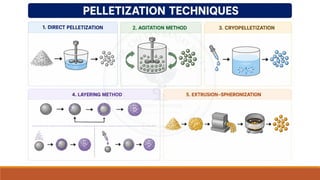
➢ Pelletization Techniques
•Pelletization is the process of converting fine powders or particles of bulk drugs and
excipients into small, free-flowing, and nearly spherical particles called pellets.
1. Direct Pelletization
• Direct pelletization is the process of forming pellets directly from the powder without using
intermediate steps such as extrusion or granulation.
• This method is suitable for materials that can naturally agglomerate or compact with the help
of binders, moisture, or pressure.
Purpose:
• To produce uniform, stable, and free-flowing pellets.
Applications:
• Pharmaceuticals
• Agriculture
• Other industrial products
49.
2. Agitation Method
•Agitation in pelletization is the mechanical mixing process used to agglomerate (clump
together) fine powder particles into larger, stable pellets.
• During this process, the material is continuously mixed, usually with the addition of moisture
or a binder, to form uniform-sized pellets.
Importance of Agitation
• Promotes agglomeration of particles.
• Produces uniform-sized pellets.
• Improves pellet quality and strength.
• Helps control pellet size and uniformity.
50.
3. Cryopelletization
• Cryopelletizationis a specialized pelletization technique in which liquid droplets are frozen to
produce uniform, spherical pellets.
• In this method, liquid nitrogen is used as the freezing medium to convert the droplets of a
liquid formulation into solid spherical pellets.
Uses
• Suitable for thermolabile (heat-sensitive) drugs.
• Used for formulations that require gentle handling.
Important Point
• The amount of liquid nitrogen required depends on the solid content and temperature of the
solution or suspension being processed.
51.
4. Layering Method
•Layering is a palletisation technique in which layers of drug and excipients are gradually
deposited on a core particle (nucleus) to form pellets.
➢ Types of Layering
a) Powder Layering
b) Suspension or Solution Layering
a) Powder Layering
• In this method, successive layers of drug powder and excipients are deposited on preformed
core pellets.
• A binding liquid is used to help the powder adhere to the core.
• The process is repeated until the required pellet size is obtained.
52.
b) Solution orSuspension Layering
• In this method, successive layers of a drug solution or suspension containing a binder are
deposited on starter nuclei (core pellets).
• The process is repeated until the desired pellet size is achieved.
5. Extrusion–Spheronization
• Extrusion–spherization is a multi-step pelletization process used to produce dense, uniform,
and spherical pellets.
• It produces pellets of about 1 mm diameter.
• It is mainly used to prepare pellets with high drug-loading capacity.
• The pellets are uniform in size and shape, making them suitable for pharmaceutical
formulations.