Industrial Microorganisms: Isolation, Screening, and Applications in Biotechnology
Overview of industrially important microbes, their isolation, screening, selection, and preservation methods for biotechnological applications in producing bio-based products and pharmaceuticals.
Industrial microorganismis the branch of biotechnology that applies in
industry for creating industrial products in mass quantities.
What is Industrial Microorganism?
Industrial uses biotechnology microorganisms to make bio-based products
such as chemicals food and feed detergents, paper and pulp, textile and
bioenergy with less waste generation & reduce energy consumption.
Properties of useful industrial microorganism:
- Produces spores can be easily inoculated.
- Grows rapidly on a large scale in inexpensive medium.
- Produces desired product quickly.
- Should not be pathogenic.
- Amenable to genetic manipulation
3.
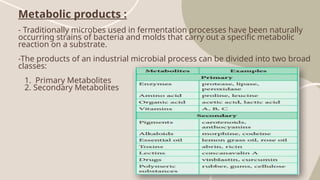
Metabolic products :
-Traditionally microbes used in fermentation processes have been naturally
occurring strains of bacteria and molds that carry out a specific metabolic
reaction on a substrate.
-The products of an industrial microbial process can be divided into two broad
classes:
1. Primary Metabolites
2. Secondary Metabolites
4.
MICROBE TYPE:
• BACTERIA
•ALGAE
• FUNGI
• YEASTS
• VIRUSES
4
1. INDUSTRIALLY IMPORTANT
BACTERIA :
• Lactobacillus species: Essential for fermenting
milk to produce yogurt, curd, and other dairy
products by creating lactic acid.
• Clostridium species: Used to produce acetone
and butanol (solvents), as well as butyric acid.
• Streptomyces: A genus of bacteria known for
producing antibiotics (like streptomycin),
vitamin B12, and other important compounds.
• Acetobacter aceti: Converts ethanol into acetic
acid for vinegar production.
• Agrobacterium tumefaciens: Used in genetic
engineering to insert genes into plants, creating
genetically modified crops.
5.
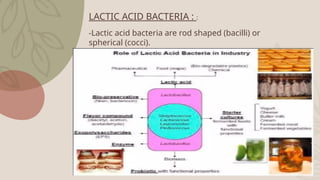
LACTIC ACID BACTERIA: :
-Lactic acid bacteria are rod shaped (bacilli) or
spherical (cocci).
6.
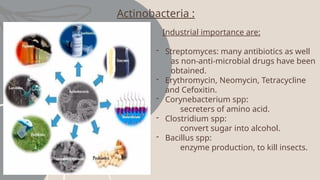
Industrial importance are:
-Streptomyces: many antibiotics as well
as non-anti-microbial drugs have been
obtained.
- Erythromycin, Neomycin, Tetracycline
and Cefoxitin.
- Corynebacterium spp:
secreters of amino acid.
- Clostridium spp:
convert sugar into alcohol.
- Bacillus spp:
enzyme production, to kill insects.
Actinobacteria :
8
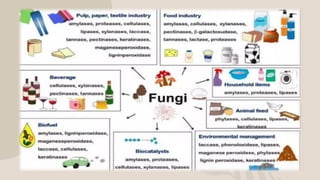
2. INDUSTRIALLY IMPORTANTFUNGI :
Fungi are used in industries for manufacturing various materials like metabolites,
enzymes and food.
Fungi in drug industry Penicillin :
-Derived from Penicillium chrysogenum was first used successfully to treat an
infection caused by a bacterium.
• Penicillium griseofulvin:
Griseofulvin is fungi static, rather than fungicidal. It is used for the treatment
of dermatophytes, as it accumulates in the hair and skin following topical
application
• Cephalosporin's :
The original fungus found to produce the compounds was a Cephalosporium
• Cyclosporine A
It is an important immunosuppressant, produced by fungi including
Trichoderma polysporum and Cylindrocarpon lucidum
• Gliotoxins
Produced by many fungi including Aspergillus fumigatus
10.
10
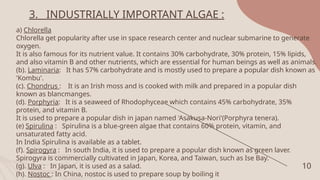
a) Chlorella
Chlorella getpopularity after use in space research center and nuclear submarine to generate
oxygen.
It is also famous for its nutrient value. It contains 30% carbohydrate, 30% protein, 15% lipids,
and also vitamin B and other nutrients, which are essential for human beings as well as animals.
(b). Laminaria: It has 57% carbohydrate and is mostly used to prepare a popular dish known as
'Kombu'.
(c). Chondrus : It is an Irish moss and is cooked with milk and prepared in a popular dish
known as blancmanges.
(d). Porphyria: It is a seaweed of Rhodophyceae which contains 45% carbohydrate, 35%
protein, and vitamin B.
It is used to prepare a popular dish in japan named 'Asakusa-Nori'(Porphyra tenera).
(e) Spirulina : Spirulina is a blue-green algae that contains 60% protein, vitamin, and
unsaturated fatty acid.
In India Spirulina is available as a tablet.
(f). Spirogyra : In south India, it is used to prepare a popular dish known as green laver.
Spirogyra is commercially cultivated in Japan, Korea, and Taiwan, such as Ise Bay.
(g). Ulva : In Japan, it is used as a salad.
(h). Nostoc : In China, nostoc is used to prepare soup by boiling it
3. INDUSTRIALLY IMPORTANT ALGAE :
12
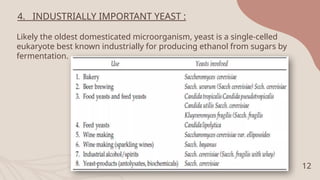
Likely the oldestdomesticated microorganism, yeast is a single-celled
eukaryote best known industrially for producing ethanol from sugars by
fermentation.
4. INDUSTRIALLY IMPORTANT YEAST :
13.
13
• Viruses canact as gene vectors for the useful production of useful
proteins such as interferons
• Viruses are employed in the production of different vaccines used
medically to prevent viral diseases or infections.
• Viruses are sources of important enzymes such as reverse
transcriptase used in molecular biology or biotechnology processes
for the production of important drugs and other pharmaceuticals
5. INDUSTRIALLY IMPORTANT VIRUS :
14.
Industrial microbes areisolated using methods like serial dilution followed by streak
plate, pour plate, or spread plate techniques, which separate individual cells onto agar plates to
grow into pure colonies. Other methods include enrichment culture to favor specific organisms
and specialized techniques like the micromanipulator method for single-cell isolation.
Common isolation methods :
• Serial Dilution: A sample is serially diluted in sterile water to reduce the microbial
concentration, making it easier to isolate individual colonies.
• Streak Plate Method: A small amount of diluted sample is spread across an agar plate in a
pattern that gradually thins the microbes, with isolated colonies forming in the later sections.
• Pour Plate Method: A diluted sample is mixed with molten agar before being poured into a
petri dish. Colonies grow both on the surface and within the agar, allowing for both aerobic
and anaerobic growth.
• Spread Plate Method: A small volume of a diluted sample is spread evenly across the surface
of a solidified agar plate using a sterile spreader, resulting in well-separated colonies.
Methods of isolation :
15.
• Swab Culture:A sterile swab is used to collect bacteria from a surface, which is then streaked
onto an agar plate.
• Filtration: Cells are separated based on size by passing the sample through a filter that traps
the larger cells.
• Micromanipulator Method: A micromanipulator is used to physically pick a single microbial
cell from a mixed culture
Specialized isolation techniques :
• Enrichment Culture: A selective growth medium is used that encourages the growth of a
desired microbe while inhibiting others. This is often the first step before more refined
methods are applied.
• Auxanographic Technique: Used to find microbes that produce growth-stimulating factors.
A test organism with specific nutritional requirements is flooded over a plate containing isolated
colonies, and the resulting increase in the test organism's growth indicates the presence of the
desired metabolite.
• Micromanipulator Method: A highly specialized technique used to physically pick up and
transfer a single cell to a fresh medium for isolation.
16.
16
Screening industrially importantmicrobes involves primary and secondary screening methods.
--Primary screening is the process for detection and isolation of microorganisms of our
interests.
-It identifies which organisms are able to produce compounds using techniques like
the crowded plate technique for antibiotics or enrichment culture to isolate microbes with
specific metabolic abilities.
--Secondary screening then confirms a microbe's commercial potential to isolate microorganism
by further testing its product yield, stability, and growth conditions through methods like
the giant colony technique and testing in liquid media.
Physical methods in Primary screening :
- Heat treatment: Exposing samples to heat to select for spore-forming bacteria.
- Incubation temperature: Incubating at specific temperatures (e.g., cold or hot) to isolate
psychrophiles or thermophiles.
- pH of the medium: Using a specific pH to isolate certain organisms like yeasts or molds.
- Filtration: Selecting based on cell size by using filters with different pore sizes.
Methods of
Screening :
17.
17
Primary screening methods:
• Crowded plate technique : Used for detecting antibiotic-producing microorganisms. A
plate is "crowded" with colonies, and colonies that produce an antibiotic will have a clear
zone around them where other bacteria cannot grow.
• Enrichment Culture Technique : Selects for microorganisms that can grow under
specific conditions or degrade a particular substance. This is achieved by providing a
specific substrate or growth condition, such as a limiting nutrient, which favors the desired
microbe.
• Indicator Dye Technique : Uses a dye that changes color in response to the metabolic
activity of the microbe. This helps to identify organisms that produce specific enzymes or
compounds, such as those that produce organic acids.
• Auxanographic Technique : Used for auxotrophic mutants that cannot synthesize a
specific nutrient. It involves placing the mutant on a medium lacking that nutrient, along
with disks of various compounds. The compound that promotes growth is identified by a
clear zone of growth around the disk.
• Supplementing volatile or organic substrates : Selects for microbes that can utilize or
18.
18
Secondary screening methods:
• Giant Colony Technique : Used to test a large number of isolates simultaneously for a
desired trait, such as antibiotic production. Isolates are streaked on a plate and test
organisms are then streaked from the edges. Growth inhibitory zones are measured to
compare the effectiveness of different isolates.
• Liquid Medium Method : Involves growing the isolated microbes in flasks or small
fermenters containing liquid media. This method provides a more accurate picture of
potential product yield and other production parameters compared to solid media.
• Filtration Method : Used to select or separate microorganisms based on size. For
example, filters with different pore sizes can be used to select for specific-sized microbes.
• Physical and Chemical Methods : Screening can also involve physical conditions such as
adjusting the temperature, pH, or salt concentration of the growth medium to favor certain
types of microbes. For example, high-temperature incubation can select for thermophiles.
19.
19
Industrially importantmicrobes are preserved through long-term and short-term methods.
Long-term methods include lyophilization (freeze-drying), which removes water under
vacuum, and cryopreservation in liquid nitrogen ( 196 ) with cryoprotectants.
− ∘𝐶
Short-term methods involve periodic sub-culturing onto fresh media, refrigeration to slow
metabolic activity, and storage under mineral oil to prevent dehydration and oxygen
exposure.
Other methods for long-term preservation include storage in sterile soil or on silica gel.
Short-term preservation methods :
• Periodic sub-culturing: Transferring the culture to fresh, sterile medium at regular intervals to
maintain viability. This is inexpensive but time-consuming.
• Refrigeration: Storing cultures at around 4 to slow down metabolic activity without killing
∘𝐶
the microbes.
• Mineral oil overlay: Covering a slant culture with a layer of sterile mineral oil to create an
anaerobic environment, which prevents dehydration and oxygen exposure.
Methods of
preservation :
20.
20
Long-term preservation methods:
• Cryopreservation : Freezing cultures in a cryoprotective agent, such as glycerol or
dimethyl sulfoxide (DMSO), and storing them in liquid nitrogen ( 196 ) or an ultra-
− ∘𝐶
low temperature freezer ( 70 to 80 ). This is one of the most effective methods
− ∘𝐶 − ∘𝐶
for long-term storage (decades).
• Lyophilization (Freeze-drying) : Freezing the culture and then drying it under a high
vacuum, which causes the water to sublimate. The dehydrated cells are then sealed in
vials. This method is very effective and can preserve cultures for many years.
• Silica gel : Mixing a thick suspension of cells with heat-sterilized silica gel. The microbes
are dried at room temperature and stored in sealed containers. This method can preserve
bacteria and yeast for one to two years.
• Sterile soil : Used for spore-forming bacteria and fungi, where the organisms are mixed
with sterile soil to remain dormant. This method can preserve cultures for five
to ten years.