Skip to main content
Recommended
PPTX
Chapter_6_The_Age_of_Reorganisation.pptx
PPTX
PPT-for-Cl-VI-Ch-5-INDIA-THAT-IS-BHARAT_.pptx
PDF
7.Infrastructure-Engine-of-Indias-Development ppt.pdf
PDF
Sacred-Geography-of-India.pdf/Samyans Academy/7th social/8th chapter pdf note...
PDF
How-the-Land-Becomes-Sacred PPT.pdf/7TH CLASS NEW NCERT SOCIAL PPT/BY K SANDE...
PDF
Journey of money from barter to trade.pdf
PDF
The-Geography-of-India-A-Mini-Continent.pdf/7th class new ncert /social notes...
PDF
4.Turning-Tides-The-11th-and-12th-Centuries.pdf/Social science Grade 7 part -...
PDF
The-Rise-of-Empires-for-Class-VII chapter 5 cbse
PDF
9.From-the-Rulers-to-the-Ruled.pdf/7th class new ncert social/9th chapter/BY:...
PDF
New-Beginnings-Cities-and-States.pdf7th class/social exploring society India ...
PDF
Ch 7 Tribes, Nomads and Settled Communities 1.pptx.pdf
PPTX
PPTs-The Rise of Empiresghhhhhhhh (1).pptx
PPTX
Geographical-Diversity-of-India.pptx/7th class /new ncert /samyans academy
PDF
Chapter 3 — The Rise Of Marathas NCERT PPT
PPTX
The first empire the mauryas
PDF
7.The-Gupta-Era-An-Age-of-Tireless-Creativity.pdf
PPTX
CLASS 7 HISTORY-DEVOTIONAL PATH TO THE DIVINE.pptx
PDF
How-the-Land-Becomes-Sacred .pdf/7th class/8th chapter ppt by k Sandeep swamy
PDF
2.Understanding-the-Weather ppt.pdf/7th class/social exploring society India ...
PDF
The-Age-of-Reorganisation-Post-Mauryan-India.pdf
PDF
Beginning of civilisation Class 9 NCERT 2026-27 latest detailed history ch1
PDF
7.Factors-of-Production.pdf/ppt/pdf/8th class social science Exploring Societ...
PDF
6.The-Parliamentary-System-Legislature-and-Executive.pdfppt/pdf/8th class soc...
PDF
Understanding Secularism (Class 8 | Civics)
PDF
PPTs-Geographical Diversity of India.pdf
PDF
Indias-Cultural-Roots.pdf 6th class samyans academy
PDF
Local-Government-in-Urban-Areas.pdf/6th Social Science notes
PPTX
PDF
Introduction to Indian Constitution
More Related Content
PPTX
Chapter_6_The_Age_of_Reorganisation.pptx
PPTX
PPT-for-Cl-VI-Ch-5-INDIA-THAT-IS-BHARAT_.pptx
PDF
7.Infrastructure-Engine-of-Indias-Development ppt.pdf
PDF
Sacred-Geography-of-India.pdf/Samyans Academy/7th social/8th chapter pdf note...
PDF
How-the-Land-Becomes-Sacred PPT.pdf/7TH CLASS NEW NCERT SOCIAL PPT/BY K SANDE...
PDF
Journey of money from barter to trade.pdf
PDF
The-Geography-of-India-A-Mini-Continent.pdf/7th class new ncert /social notes...
PDF
4.Turning-Tides-The-11th-and-12th-Centuries.pdf/Social science Grade 7 part -...
What's hot
PDF
The-Rise-of-Empires-for-Class-VII chapter 5 cbse
PDF
9.From-the-Rulers-to-the-Ruled.pdf/7th class new ncert social/9th chapter/BY:...
PDF
New-Beginnings-Cities-and-States.pdf7th class/social exploring society India ...
PDF
Ch 7 Tribes, Nomads and Settled Communities 1.pptx.pdf
PPTX
PPTs-The Rise of Empiresghhhhhhhh (1).pptx
PPTX
Geographical-Diversity-of-India.pptx/7th class /new ncert /samyans academy
PDF
Chapter 3 — The Rise Of Marathas NCERT PPT
PPTX
The first empire the mauryas
PDF
7.The-Gupta-Era-An-Age-of-Tireless-Creativity.pdf
PPTX
CLASS 7 HISTORY-DEVOTIONAL PATH TO THE DIVINE.pptx
PDF
How-the-Land-Becomes-Sacred .pdf/7th class/8th chapter ppt by k Sandeep swamy
PDF
2.Understanding-the-Weather ppt.pdf/7th class/social exploring society India ...
PDF
The-Age-of-Reorganisation-Post-Mauryan-India.pdf
PDF
Beginning of civilisation Class 9 NCERT 2026-27 latest detailed history ch1
PDF
7.Factors-of-Production.pdf/ppt/pdf/8th class social science Exploring Societ...
PDF
6.The-Parliamentary-System-Legislature-and-Executive.pdfppt/pdf/8th class soc...
PDF
Understanding Secularism (Class 8 | Civics)
PDF
PPTs-Geographical Diversity of India.pdf
PDF
Indias-Cultural-Roots.pdf 6th class samyans academy
PDF
Local-Government-in-Urban-Areas.pdf/6th Social Science notes
Similar to Indian_Constitution_Introduction_NCERT_Class7.pptx
PPTX
PDF
Introduction to Indian Constitution
PPTX
The Indian Constitution ppt
PDF
The Constitution of India: A Comprehensive Framework
PPTX
Key Features of Indian Constitution (31)
PPTX
Comprehensive Overview of the Constitution of India: History, Principles, and...
PPTX
The Indian Constitution_ A Comprehensive Study.pptx
PPTX
CHAPTER-10THE CONSTITUTION OF INDIA.pptx
PPT
Basics of Indian Constitution Unit II ppt
PPTX
Introduction-to-the-Indian-Constitution.pptx
PPTX
Comprehensive Overview of the Indian Constitution: Structure, Features, and I...
PDF
Indian constitution and educational provisions
PPTX
PPTX
Improved_Indian_Constitution_Presentation_Class_8.pptx
PPTX
forensic Introduction of the Indian Constitution.pptx
PPT
Comprehensive Overview of the Indian Constitution: History, Structure, and Si...
PPTX
Class9_PolSci_Ch2_Constitutional_Design.pptx
PPTX
Class9_PolSci_Ch2_Constitutional_Design.pptx
PPTX
Class9_PolSci_Ch2_Constitutional_Design.pptx
PPT
Indian Constitution unit I.ppt for students
Recently uploaded
PDF
MBA Business Statistics Unit 1 Handwritten Notes with Solved Examples | CA Su...
DOCX
Bulk Buying of Verified Cash App Accounts Safely in 2026: Digital Finance and...
PPTX
Comprehensive Guide to Journals and Ledgers in Accounting
PDF
7 Best Ways to Get a Verified Cash App Account Safely and Securely
PDF
Buy OnlyFans Account With Loaded Balance | Fast & Ready for Sale.pdf
DOCX
Where Can I Buy a Cash App Account Verified 4k
PDF
Comprehensive 9-Step Guide to SBLC Funding Process for Structured Business Fi...
PPTX
Comprehensive Analysis of Zambia's Economic Trends and Policy Reforms
PPTX
Comprehensive Overview of Trial Balance Advantages and Limitations in Accounting
PDF
Securely Purchase Verified Cleanora Accounts Online in 2026: Comprehensive Guide
PPTX
Comprehensive Overview of Vietnam's Value Added Tax (VAT) System and Regulations
DOCX
Top 11 Sites to Buy Verified Chase Bank Accounts in 2026.docx
PDF
SBLC Financing for Business: Accessing Capital with Standby Letters of Credit
PDF
Top 203 Sites to Buy old Gmail Accounts PVA Bulk in 2026.pdf
PDF
Step-by-Step Guide to Personal Loans in Delhi NCR
PPTX
Narayana Health Case Study. Presented at Alphawealth Mumbai Summit
DOCX
Trusted 21 Sites For Buy Binance Accounts (Aged & VA)
PPTX
Comprehensive Guide to Simple Annuities: Terminologies, Types, and Problem So...
PDF
2026-07 LIO Presentation.pdf august 2026
PDF
Weekly Finance Newsletter: IPOs, Business News, Market Insights & Finance Qui...
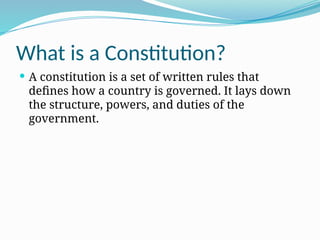
Indian_Constitution_Introduction_NCERT_Class7.pptx 1. 2. What is a Constitution?
A constitution is a set of written rules that
defines how a country is governed. It lays down
the structure, powers, and duties of the
government.
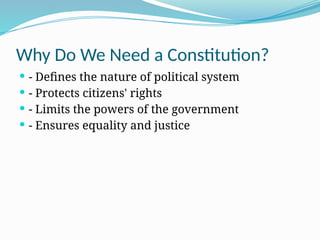
3. Why Do We Need a Constitution?
- Defines the nature of political system
- Protects citizens' rights
- Limits the powers of the government
- Ensures equality and justice
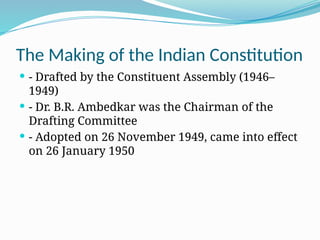
4. The Making of the Indian Constitution
- Drafted by the Constituent Assembly (1946–
1949)
- Dr. B.R. Ambedkar was the Chairman of the
Drafting Committee
- Adopted on 26 November 1949, came into effect
on 26 January 1950
5. Key Features of the Indian Constitution
1. Federalism
2. Parliamentary Form of Government
3. Separation of Powers
4. Fundamental Rights
5. Secularism
6. Fundamental Rights
- Right to Equality
- Right to Freedom
- Right against Exploitation
- Right to Freedom of Religion
- Cultural and Educational Rights
- Right to Constitutional Remedies
7. Secularism
The State treats all religions equally. No religion
is given preference by the government. Citizens
have the right to follow any religion.
8. Parliamentary Democracy
The people elect their representatives. The
government is formed by the majority party. The
Prime Minister leads the executive.
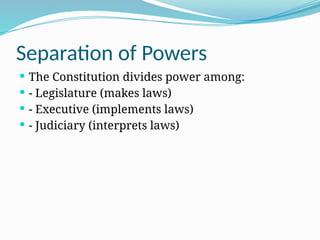
9. Separation of Powers
The Constitution divides power among:
- Legislature (makes laws)
- Executive (implements laws)
- Judiciary (interprets laws)
10.