Title of theCourse:
Indian Knowledge in Civilization
Sciences and Engineering
One Hour Lecture
B.Tech 3rd Year
2.
Slide 1: Title
IndianKnowledge System (IKS):
An Overview
One Hour Lecture
B.Tech 3rd Year
3.
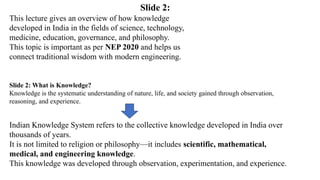
Slide 2: Whatis Knowledge?
Knowledge is the systematic understanding of nature, life, and society gained through observation,
reasoning, and experience.
This lecture gives an overview of how knowledge
developed in India in the fields of science, technology,
medicine, education, governance, and philosophy.
This topic is important as per NEP 2020 and helps us
connect traditional wisdom with modern engineering.
Indian Knowledge System refers to the collective knowledge developed in India over
thousands of years.
It is not limited to religion or philosophy—it includes scientific, mathematical,
medical, and engineering knowledge.
This knowledge was developed through observation, experimentation, and experience.
Slide 2:
4.
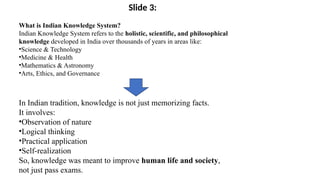
What is IndianKnowledge System?
Indian Knowledge System refers to the holistic, scientific, and philosophical
knowledge developed in India over thousands of years in areas like:
•Science & Technology
•Medicine & Health
•Mathematics & Astronomy
•Arts, Ethics, and Governance
In Indian tradition, knowledge is not just memorizing facts.
It involves:
•Observation of nature
•Logical thinking
•Practical application
•Self-realization
So, knowledge was meant to improve human life and society,
not just pass exams.
Slide 3:
5.
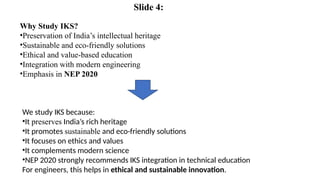
Why Study IKS?
•Preservationof India’s intellectual heritage
•Sustainable and eco-friendly solutions
•Ethical and value-based education
•Integration with modern engineering
•Emphasis in NEP 2020
We study IKS because:
•It preserves India’s rich heritage
•It promotes sustainable and eco-friendly solutions
•It focuses on ethics and values
•It complements modern science
•NEP 2020 strongly recommends IKS integration in technical education
For engineers, this helps in ethical and sustainable innovation.
Slide 4:
6.
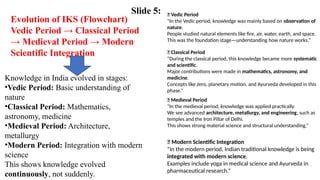
Evolution of IKS(Flowchart)
Vedic Period → Classical Period
→ Medieval Period → Modern
Scientific Integration
Knowledge in India evolved in stages:
•Vedic Period: Basic understanding of
nature
•Classical Period: Mathematics,
astronomy, medicine
•Medieval Period: Architecture,
metallurgy
•Modern Period: Integration with modern
science
This shows knowledge evolved
continuously, not suddenly.
Slide 5: 🔹 Vedic Period
“In the Vedic period, knowledge was mainly based on observation of
nature.
People studied natural elements like fire, air, water, earth, and space.
This was the foundation stage—understanding how nature works.”
🔹 Classical Period
“During the classical period, this knowledge became more systematic
and scientific.
Major contributions were made in mathematics, astronomy, and
medicine.
Concepts like zero, planetary motion, and Ayurveda developed in this
phase.”
🔹 Medieval Period
“In the medieval period, knowledge was applied practically.
We see advanced architecture, metallurgy, and engineering, such as
temples and the Iron Pillar of Delhi.
This shows strong material science and structural understanding.”
🔹 Modern Scientific Integration
“In the modern period, Indian traditional knowledge is being
integrated with modern science.
Examples include yoga in medical science and Ayurveda in
pharmaceutical research.”
7.
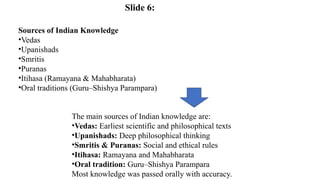
Sources of IndianKnowledge
•Vedas
•Upanishads
•Smritis
•Puranas
•Itihasa (Ramayana & Mahabharata)
•Oral traditions (Guru–Shishya Parampara)
The main sources of Indian knowledge are:
•Vedas: Earliest scientific and philosophical texts
•Upanishads: Deep philosophical thinking
•Smritis & Puranas: Social and ethical rules
•Itihasa: Ramayana and Mahabharata
•Oral tradition: Guru–Shishya Parampara
Most knowledge was passed orally with accuracy.
Slide 6:
8.
🔹 1. Vedas
“Letus start with the Vedas, which are the earliest and most fundamental sources of Indian knowledge.
There are four Vedas—Rig, Yajur, Sama, and Atharva.
They are not only religious texts but also contain early scientific thinking, such as ideas about nature, energy, time, sound, health, and cosmic order.
The Vedas show how ancient Indians tried to understand the universe through systematic observation and reasoning.”
🔹 2. Upanishads
“The Upanishads represent the philosophical depth of Indian knowledge.
They focus on questions like: Who am I? What is reality? What is the nature of consciousness?
These texts introduced deep concepts such as Atman, Brahman, and self-realization, which influenced Indian philosophy, psychology, and ethics.
So, Upanishads emphasize thinking, questioning, and inquiry, which is the basis of scientific attitude.”
🔹 3. Smritis
“The Smritis deal mainly with social laws, duties, and ethical conduct.
They explain how knowledge should be applied in daily life, including family, society, and governance.
Smritis helped in maintaining social order and discipline, showing that Indian knowledge was not only theoretical but also practical.”
🔹 4. Puranas
“The Puranas communicate knowledge through stories and narratives.
They preserve history, cosmology, moral values, and cultural traditions in a form that is easy to understand for common people.
Through stories, complex ideas were transmitted across generations in a very effective way.”
🔹 5. Itihasa – Ramayana & Mahabharata
“The Itihasas, mainly the Ramayana and Mahabharata, are historical epics that teach values like dharma, duty, leadership, and decision-making.
They also contain discussions on war ethics, politics, psychology, and human behavior, which are still relevant today.
These texts show how knowledge was applied in real-life situations.”
🔹 6. Oral Traditions – Guru–Shishya Parampara
“One of the most unique features of Indian knowledge is its oral transmission system, known as the Guru–Shishya Parampara.
Knowledge was passed directly from teacher to student through memorization, repetition, and practice.
Despite being oral, the system was extremely accurate and disciplined, which ensured knowledge preservation for thousands of years.”
9.
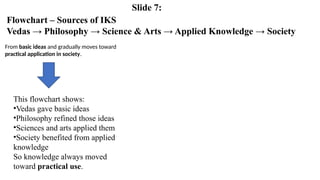
Flowchart – Sourcesof IKS
Vedas → Philosophy → Science & Arts → Applied Knowledge → Society
This flowchart shows:
•Vedas gave basic ideas
•Philosophy refined those ideas
•Sciences and arts applied them
•Society benefited from applied
knowledge
So knowledge always moved
toward practical use.
Slide 7:
From basic ideas and gradually moves toward
practical application in society.
10.
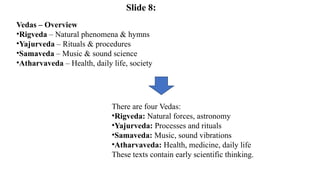
Vedas – Overview
•Rigveda– Natural phenomena & hymns
•Yajurveda – Rituals & procedures
•Samaveda – Music & sound science
•Atharvaveda – Health, daily life, society
There are four Vedas:
•Rigveda: Natural forces, astronomy
•Yajurveda: Processes and rituals
•Samaveda: Music, sound vibrations
•Atharvaveda: Health, medicine, daily life
These texts contain early scientific thinking.
Slide 8:
11.
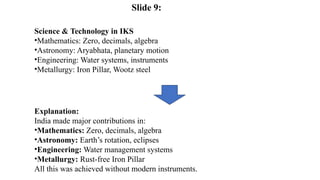
Science & Technologyin IKS
•Mathematics: Zero, decimals, algebra
•Astronomy: Aryabhata, planetary motion
•Engineering: Water systems, instruments
•Metallurgy: Iron Pillar, Wootz steel
Explanation:
India made major contributions in:
•Mathematics: Zero, decimals, algebra
•Astronomy: Earth’s rotation, eclipses
•Engineering: Water management systems
•Metallurgy: Rust-free Iron Pillar
All this was achieved without modern instruments.
Slide 9:
12.
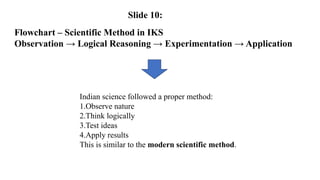
Flowchart – ScientificMethod in IKS
Observation → Logical Reasoning → Experimentation → Application
Indian science followed a proper method:
1.Observe nature
2.Think logically
3.Test ideas
4.Apply results
This is similar to the modern scientific method.
Slide 10:
13.
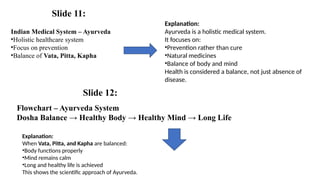
Indian Medical System– Ayurveda
•Holistic healthcare system
•Focus on prevention
•Balance of Vata, Pitta, Kapha
Flowchart – Ayurveda System
Dosha Balance → Healthy Body → Healthy Mind → Long Life
Explanation:
Ayurveda is a holistic medical system.
It focuses on:
•Prevention rather than cure
•Natural medicines
•Balance of body and mind
Health is considered a balance, not just absence of
disease.
Explanation:
When Vata, Pitta, and Kapha are balanced:
•Body functions properly
•Mind remains calm
•Long and healthy life is achieved
This shows the scientific approach of Ayurveda.
Slide 11:
Slide 12:
14.
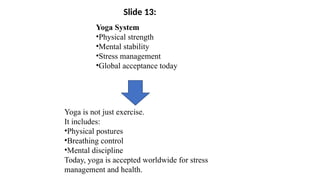
Yoga System
•Physical strength
•Mentalstability
•Stress management
•Global acceptance today
Yoga is not just exercise.
It includes:
•Physical postures
•Breathing control
•Mental discipline
Today, yoga is accepted worldwide for stress
management and health.
Slide 13:
15.
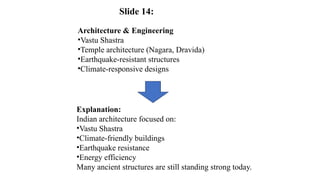
Architecture & Engineering
•VastuShastra
•Temple architecture (Nagara, Dravida)
•Earthquake-resistant structures
•Climate-responsive designs
Explanation:
Indian architecture focused on:
•Vastu Shastra
•Climate-friendly buildings
•Earthquake resistance
•Energy efficiency
Many ancient structures are still standing strong today.
Slide 14:
16.
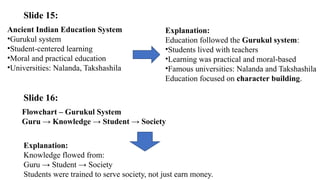
Ancient Indian EducationSystem
•Gurukul system
•Student-centered learning
•Moral and practical education
•Universities: Nalanda, Takshashila
Flowchart – Gurukul System
Guru → Knowledge → Student → Society
Explanation:
Education followed the Gurukul system:
•Students lived with teachers
•Learning was practical and moral-based
•Famous universities: Nalanda and Takshashila
Education focused on character building.
Explanation:
Knowledge flowed from:
Guru → Student → Society
Students were trained to serve society, not just earn money.
Slide 15:
Slide 16:
17.
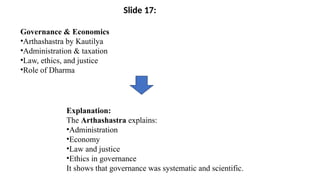
Governance & Economics
•Arthashastraby Kautilya
•Administration & taxation
•Law, ethics, and justice
•Role of Dharma
Explanation:
The Arthashastra explains:
•Administration
•Economy
•Law and justice
•Ethics in governance
It shows that governance was systematic and scientific.
Slide 17:
18.
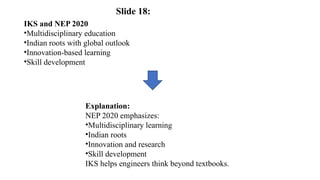
IKS and NEP2020
•Multidisciplinary education
•Indian roots with global outlook
•Innovation-based learning
•Skill development
Explanation:
NEP 2020 emphasizes:
•Multidisciplinary learning
•Indian roots
•Innovation and research
•Skill development
IKS helps engineers think beyond textbooks.
Slide 18:
19.
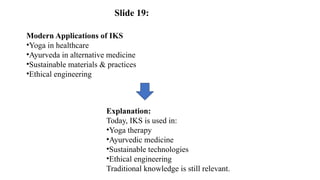
Modern Applications ofIKS
•Yoga in healthcare
•Ayurveda in alternative medicine
•Sustainable materials & practices
•Ethical engineering
Explanation:
Today, IKS is used in:
•Yoga therapy
•Ayurvedic medicine
•Sustainable technologies
•Ethical engineering
Traditional knowledge is still relevant.
Slide 19:
20.
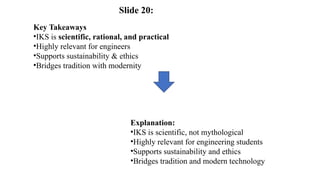
Key Takeaways
•IKS isscientific, rational, and practical
•Highly relevant for engineers
•Supports sustainability & ethics
•Bridges tradition with modernity
Explanation:
•IKS is scientific, not mythological
•Highly relevant for engineering students
•Supports sustainability and ethics
•Bridges tradition and modern technology
Slide 20:
21.
Conclusion
Indian Knowledge Systemprovides a strong foundation for innovation,
sustainability, and ethical engineering in the modern world.
Explanation:
Indian Knowledge System provides a strong foundation for:
•Innovation
•Sustainability
•Ethical development
Integrating IKS with engineering education creates responsible
engineers.
Slide 21:
 Most read
 Most read
 Most read