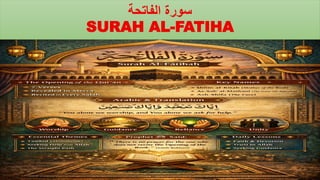
In-Depth Exegesis and Linguistic Miracles of Surah Al-Fātiha
Comprehensive analysis of Surah Al-Fātiha covering its names, importance, themes, linguistic miracles, psychological effects, and lessons in Islamic prayer and theology.
القرآن جواهر
“JEWELS OFTHE QUR’AN”
Dr. ABDUL RASHEED MUH’D QASIM
Deputy Imam Aonullah Mosque, Teachers Estate, Ogun
State, Nigeria
Founder Ma’had Qiraat Institute for Arabic and Islamic
Civilization
+234 - 8051700164, +234 - 7066867887
kazeemrasheed1440@gmail.com
4.
CONTENT
1. OVERVIEW OFSURAH AL-FĀTIHA
2. OTHER NAMES OF SURAH AL-FĀTIHA
3. IMPORTANCE OF SURAH AL-FĀTIHA
4. MAIN THEMES OF SURAH AL-FĀTIHA
5. RHETORICAL AND LINGUISTIC MIRACLES OF SURAH AL-
FĀTIHA
6. PHRASES IN SURAH AL-FĀTIHA
7. DEEP REFLECTIONS FROM SURAH AL-FĀTIHA
8. WORD-BY-WORD SECRETS OF SURAH AL-FĀTHA
9. PSYCHOLOGICAL EFFECTS OF SURAH AL-FĀTIHA
10. LESSONS FROM SURAH AL-FĀTIHA
5.
OVERVIEW OF SURAHAL-FĀTIHA
Surah Al-Fātiḥah ( سورة
الفاتحة ) is the first chapter of the Qur'an and one
of the most important chapters in Islam. It is recited in every unit
(rakʿah) of the daily prayer (Ṣalāh). Because of its significance, it has
several names and deep meanings. Full explanation shall be presented
on this.
BASIC INFORMATION
➢Number of verses: 7
➢Revelation: Mecca and Medina
➢Position in Qur’an: Chapter 1
➢Meaning of the name: Al-Fātiḥa means “The Opening” because it
opens the Qur’an and all prayers.
6.
Arabic Text andEnglish Meaning
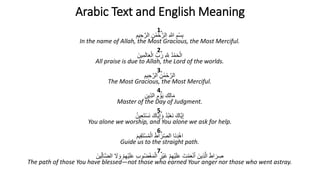
1.
ِيم ِحهالر ِن َٰمْحهالر ِ ه
َّللا ِمْسِب
In the name of Allah, the Most Gracious, the Most Merciful.
2.
ينِمالعْال ِبر ِ ه ِ
ّلِل ُدْمحْال
All praise is due to Allah, the Lord of the worlds.
3.
ِيم ِحهالر ِن َٰمْحهالر
The Most Gracious, the Most Merciful.
4.
ِِينالد ِم ْوي ِكِلام
Master of the Day of Judgment.
5.
ُينِعتْسن هاكيِإو ُدُبْعن هاكيِإ
You alone we worship, and You alone we ask for help.
6.
يمِقتْسُمْال اطر ِ
الص اِندْها
Guide us to the straight path.
7.
ينِهالضال َلو ْمِهْيلع ِبوُضْغمْال ِ
ْريغ ْمِهْيلع تْمعْنأ ِينذهال اطر ِ
ص
The path of those You have blessed—not those who earned Your anger nor those who went astray.
7.
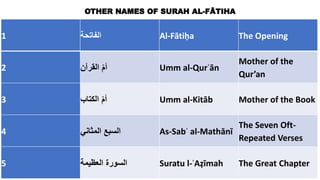
OTHER NAMES OFSURAH AL-FĀTIHA
1 الفاتحة Al-Fātiḥa The Opening
2 القرآن ّمأ Umm al-Qurʾān
Mother of the
Qur’an
3 الكتاب ّمأ Umm al-Kitāb Mother of the Book
4 المثاني السبع As-Sabʿ al-Mathānī
The Seven Oft-
Repeated Verses
5 السورة
العظيمة Suratu l-ʿAẓīmah The Great Chapter
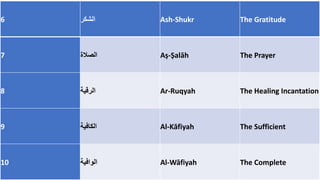
8.
6 الشكر Ash-ShukrThe Gratitude
7 الصالة Aṣ-Ṣalāh The Prayer
8 الرقية Ar-Ruqyah The Healing Incantation
9 الكافية Al-Kāfiyah The Sufficient
10 الوافية Al-Wāfiyah The Complete
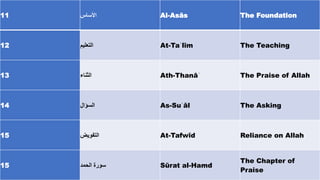
9.
11 األساس Al-AsāsThe Foundation
12 التعليم At-Taʿlīm The Teaching
13 الثناء Ath-Thanāʾ The Praise of Allah
14 السؤال As-Suʾāl The Asking
15 التفويض At-Tafwīd Reliance on Allah
15 الحمد سورة Sūrat al-Hamd
The Chapter of
Praise
10.
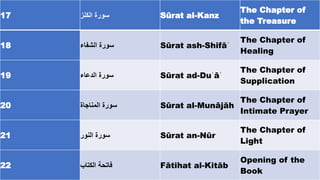
17 الكنز سورةSūrat al-Kanz
The Chapter of
the Treasure
18 الشفاء سورة Sūrat ash-Shifāʾ
The Chapter of
Healing
19 الدعاء سورة Sūrat ad-Duʿāʾ
The Chapter of
Supplication
20 المناجاة سورة Sūrat al-Munājāh
The Chapter of
Intimate Prayer
21 النور سورة Sūrat an-Nūr
The Chapter of
Light
22 الكتاب فاتحة Fātihat al-Kitāb
Opening of the
Book
11.
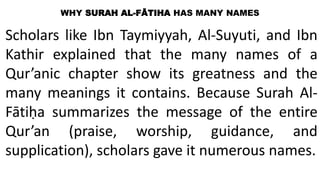
WHY SURAH AL-FĀTIHAHAS MANY NAMES
Scholars like Ibn Taymiyyah, Al-Suyuti, and Ibn
Kathir explained that the many names of a
Qur’anic chapter show its greatness and the
many meanings it contains. Because Surah Al-
Fātiḥa summarizes the message of the entire
Qur’an (praise, worship, guidance, and
supplication), scholars gave it numerous names.
12.
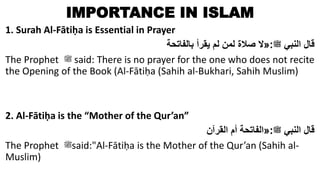
IMPORTANCE IN ISLAM
1.Surah Al-Fātiḥa is Essential in Prayer
النبي قال
ﷺ
:
«
بالفاتحة يقرأ لم لمن صالة ال
The Prophet ﷺ said: There is no prayer for the one who does not recite
the Opening of the Book (Al-Fātiḥa (Sahih al-Bukhari, Sahih Muslim)
2. Al-Fātiḥa is the “Mother of the Qur’an”
النبي قال
ﷺ
:
«
القرآن أم الفاتحة
The Prophet ﷺsaid:"Al-Fātiḥa is the Mother of the Qur’an (Sahih al-
Muslim)
13.
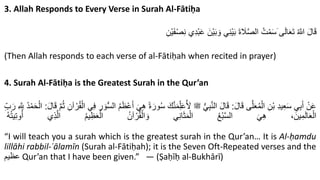
3. Allah Respondsto Every Verse in Surah Al-Fātiḥa
ِْنيفْصِن يِدْبع ْنيبو يِنْيب ةَلهصال ُتْمس ىالعت ُ ه
َّللا الق
(Then Allah responds to each verse of al-Fātiḥah when recited in prayer)
4. Surah Al-Fātiḥa is the Greatest Surah in the Qur’an
ْنع
يِبأ
ِديِعس
ِْنب
ىهلعُمْال
الق
:
الق
يِبهنال
ﷺ
كهنمِلعَُل
ورُس
ة
يِه
ُمْظعأ
ِ
روالس
يِف
ِآن ْرُقْال
همُث
الق
:
حْال
ُدْم
ِ ه ِ
ّلِل
ِبر
،ينِمالعْال
يِه
ُعْبهسال
يِناثمْال
ُآن ْرُقْالو
ُميِظعْال
يِذهال
ُهُتيِتوُأ
“I will teach you a surah which is the greatest surah in the Qur’an… It is Al-ḥamdu
lillāhi rabbil-ʿālamīn (Surah al-Fātiḥah); it is the Seven Oft-Repeated verses and the
عظيم Qur’an that I have been given.” — (Ṣaḥīḥ al-Bukhārī)
14.
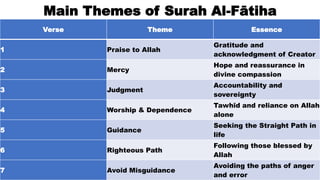
Main Themes ofSurah Al-Fātiha
Verse Theme Essence
1 Praise to Allah
Gratitude and
acknowledgment of Creator
2 Mercy
Hope and reassurance in
divine compassion
3 Judgment
Accountability and
sovereignty
4 Worship & Dependence
Tawhīd and reliance on Allah
alone
5 Guidance
Seeking the Straight Path in
life
6 Righteous Path
Following those blessed by
Allah
7 Avoid Misguidance
Avoiding the paths of anger
and error
15.
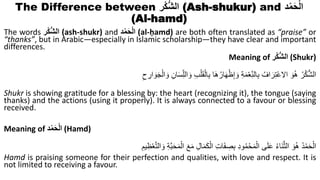
The Difference betweenرْكُّشال (Ash-shukur) and دْمَحْلا
(Al-hamd)
The words رْكُّشال (ash-shukr) and دْمَحْلا (al-ḥamd) are both often translated as “praise” or
“thanks”, but in Arabic—especially in Islamic scholarship—they have clear and important
differences.
Meaning of رْكُّشال (Shukr)
ِ
اروجْالو ِانسِاللو ِبْلقْالِب اهُارهْظِإو ِةمْعِالنِب ُافرِتْعِاَل وُه ُرْكالش
ِح
Shukr is showing gratitude for a blessing by: the heart (recognizing it), the tongue (saying
thanks) and the actions (using it properly). It is always connected to a favour or blessing
received.
Meaning of دْمَحْلا (Hamd)
ْعهتالو ِةهبحمْال عم ِلامكْال ِتاف ِ
صِب ِدوُمْحمْال ىلع ُءانهثال وُه ُدْمحْال
ِيمِظ
Hamd is praising someone for their perfection and qualities, with love and respect. It is
not limited to receiving a favour.
16.
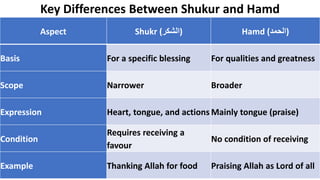
Key Differences BetweenShukur and Hamd
Aspect Shukr ()الشكر Hamd ()الحمد
Basis For a specific blessing For qualities and greatness
Scope Narrower Broader
Expression Heart, tongue, and actions Mainly tongue (praise)
Condition
Requires receiving a
favour
No condition of receiving
Example Thanking Allah for food Praising Allah as Lord of all
17.
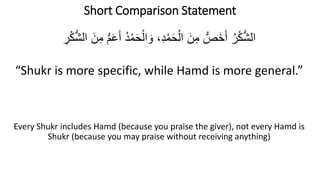
Short Comparison Statement
انِم معأ ُدْمحْالو ،ِدْمحْال نِم صخأ ُرْكالش
ِ
رْكلش
“Shukr is more specific, while Hamd is more general.”
Every Shukr includes Hamd (because you praise the giver), not every Hamd is
Shukr (because you may praise without receiving anything)
18.
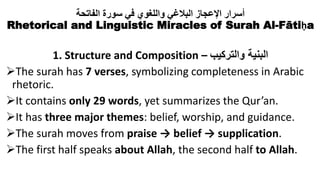
الفاتحة سورة فيواللغوي البالغي اإلعجاز أسرار
Rhetorical and Linguistic Miracles of Surah Al-Fātiḥa
1. Structure and Composition – والتركيب البنية
➢The surah has 7 verses, symbolizing completeness in Arabic
rhetoric.
➢It contains only 29 words, yet summarizes the Qur’an.
➢It has three major themes: belief, worship, and guidance.
➢The surah moves from praise → belief → supplication.
➢The first half speaks about Allah, the second half to Allah.
19.
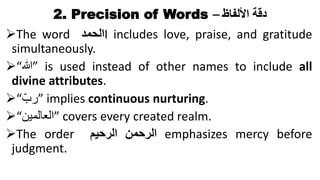
2. Precision ofWords – األلفاظ دقة
➢The word الحمدI includes love, praise, and gratitude
simultaneously.
➢“”هللا is used instead of other names to include all
divine attributes.
➢“”رب implies continuous nurturing.
➢“”العالمين covers every created realm.
➢The order الرحمن
الرحيم emphasizes mercy before
judgment.
20.
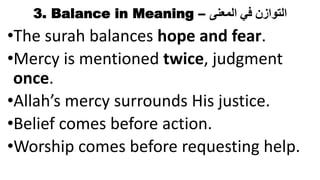
3. Balance inMeaning – المعنى في التوازن
•The surah balances hope and fear.
•Mercy is mentioned twice, judgment
once.
•Allah’s mercy surrounds His justice.
•Belief comes before action.
•Worship comes before requesting help.
21.
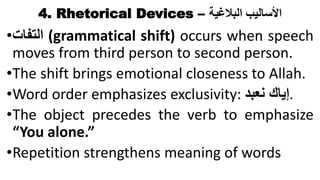
4. Rhetorical Devices– البالغية األساليب
•التفات (grammatical shift) occurs when speech
moves from third person to second person.
•The shift brings emotional closeness to Allah.
•Word order emphasizes exclusivity: إياك
نعبد .
•The object precedes the verb to emphasize
“You alone.”
•Repetition strengthens meaning of words
22.
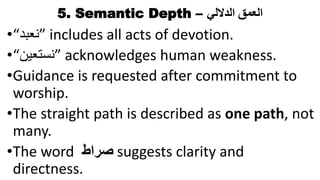
5. Semantic Depth– الداللي العمق
•“”نعبد includes all acts of devotion.
•“”نستعين acknowledges human weakness.
•Guidance is requested after commitment to
worship.
•The straight path is described as one path, not
many.
•The word صراط suggests clarity and
directness.
23.
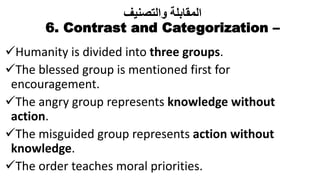
والتصنيف المقابلة
6. Contrastand Categorization –
✓Humanity is divided into three groups.
✓The blessed group is mentioned first for
encouragement.
✓The angry group represents knowledge without
action.
✓The misguided group represents action without
knowledge.
✓The order teaches moral priorities.
24.
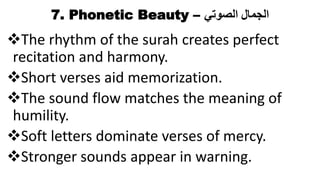
7. Phonetic Beauty– الصوتي الجمال
❖The rhythm of the surah creates perfect
recitation and harmony.
❖Short verses aid memorization.
❖The sound flow matches the meaning of
humility.
❖Soft letters dominate verses of mercy.
❖Stronger sounds appear in warning.
25.
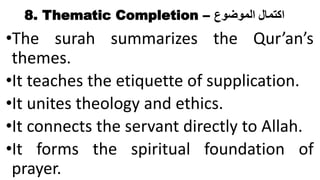
8. Thematic Completion– الموضوع اكتمال
•The surah summarizes the Qur’an’s
themes.
•It teaches the etiquette of supplication.
•It unites theology and ethics.
•It connects the servant directly to Allah.
•It forms the spiritual foundation of
prayer.
26.
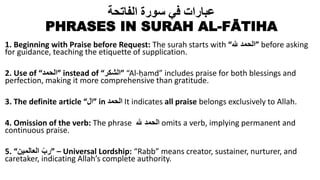
الفاتحة سورة فيعبارات
PHRASES IN SURAH AL-FĀTIHA
1. Beginning with Praise before Request: The surah starts with “هلل ”الحمد before asking
for guidance, teaching the etiquette of supplication.
2. Use of “”الحمد instead of “”الشكر “Al-ḥamd” includes praise for both blessings and
perfection, making it more comprehensive than gratitude.
3. The definite article “”ال in الحمد It indicates all praise belongs exclusively to Allah.
4. Omission of the verb: The phrase هلل الحمد omits a verb, implying permanent and
continuous praise.
5. “العالمين ّ”رب – Universal Lordship: “Rabb” means creator, sustainer, nurturer, and
caretaker, indicating Allah’s complete authority.
27.
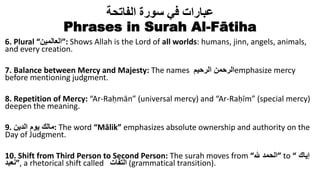
الفاتحة سورة فيعبارات
Phrases in Surah Al-Fātiha
6. Plural “”العالمين: Shows Allah is the Lord of all worlds: humans, jinn, angels, animals,
and every creation.
7. Balance between Mercy and Majesty: The names الرحيم الرحمنemphasize mercy
before mentioning judgment.
8. Repetition of Mercy: “Ar-Raḥmān” (universal mercy) and “Ar-Raḥīm” (special mercy)
deepen the meaning.
9. الدين يوم مالك: The word “Mālik” emphasizes absolute ownership and authority on the
Day of Judgment.
10. Shift from Third Person to Second Person: The surah moves from “هلل ”الحمد to “ إياك
”نعبد, a rhetorical shift called التفات (grammatical transition).
28.
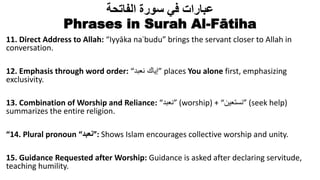
الفاتحة سورة فيعبارات
Phrases in Surah Al-Fātiha
11. Direct Address to Allah: “Iyyāka naʿbudu” brings the servant closer to Allah in
conversation.
12. Emphasis through word order: “نعبد ”إياك places You alone first, emphasizing
exclusivity.
13. Combination of Worship and Reliance: “”نعبد (worship) + “”نستعين (seek help)
summarizes the entire religion.
“14. Plural pronoun “”نعبد: Shows Islam encourages collective worship and unity.
15. Guidance Requested after Worship: Guidance is asked after declaring servitude,
teaching humility.
29.
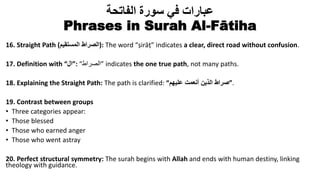
الفاتحة سورة فيعبارات
Phrases in Surah Al-Fātiha
16. Straight Path (المستقيم )الصراط: The word “ṣirāṭ” indicates a clear, direct road without confusion.
17. Definition with “”ال: “”الصراط indicates the one true path, not many paths.
18. Explaining the Straight Path: The path is clarified: “عليهم أنعمت الذين ”صراط.
19. Contrast between groups
• Three categories appear:
• Those blessed
• Those who earned anger
• Those who went astray
20. Perfect structural symmetry: The surah begins with Allah and ends with human destiny, linking
theology with guidance.
30.
الفاتحة سورة منتأمالت
Deep Reflections from Surah Al-Fātiha
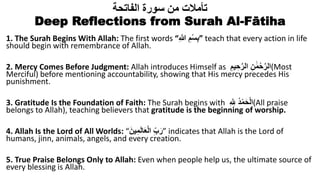
1. The Surah Begins With Allah: The first words “ِ َ
ّللا ِمْسِب” teach that every action in life
should begin with remembrance of Allah.
2. Mercy Comes Before Judgment: Allah introduces Himself as ِيم ِحَالر ِن ََٰمْحَ(الرMost
Merciful) before mentioning accountability, showing that His mercy precedes His
punishment.
3. Gratitude Is the Foundation of Faith: The Surah begins with ِ َ ِ
لِل ُدْمَحْل(اAll praise
belongs to Allah), teaching believers that gratitude is the beginning of worship.
4. Allah Is the Lord of All Worlds: “َينِمَلاَعْلا ِّبَ”ر indicates that Allah is the Lord of
humans, jinn, animals, angels, and every creation.
5. True Praise Belongs Only to Allah: Even when people help us, the ultimate source of
every blessing is Allah.
31.
الفاتحة سورة منتأمالت
Deep Reflections from Surah Al-Fātiha
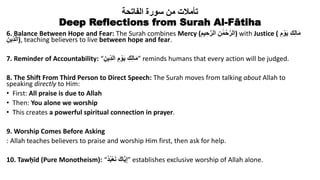
6. Balance Between Hope and Fear: The Surah combines Mercy (ِيم ِحَالر ِن ََٰمْحَ)الر with Justice ( ِم ْوَي ِكِلاَم
ِِينّد)ال, teaching believers to live between hope and fear.
7. Reminder of Accountability: “ِِينّدال ِم ْوَي ِكِلاَم” reminds humans that every action will be judged.
8. The Shift From Third Person to Direct Speech: The Surah moves from talking about Allah to
speaking directly to Him:
• First: All praise is due to Allah
• Then: You alone we worship
• This creates a powerful spiritual connection in prayer.
9. Worship Comes Before Asking
: Allah teaches believers to praise and worship Him first, then ask for help.
10. Tawḥīd (Pure Monotheism): “ُدُبْعَن َاكَيِإ” establishes exclusive worship of Allah alone.
32.
الفاتحة سورة منتأمالت
Deep Reflections from Surah Al-Fātiha
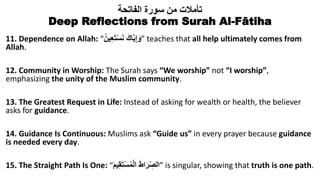
11. Dependence on Allah: “ُينِعَتْسَن َاكَيِإَ”و teaches that all help ultimately comes from
Allah.
12. Community in Worship: The Surah says “We worship” not “I worship”,
emphasizing the unity of the Muslim community.
13. The Greatest Request in Life: Instead of asking for wealth or health, the believer
asks for guidance.
14. Guidance Is Continuous: Muslims ask “Guide us” in every prayer because guidance
is needed every day.
15. The Straight Path Is One: “َميِقَتْسُمْلا َطاَر ِ
ّص”ال is singular, showing that truth is one path.
33.
الفاتحة سورة منتأمالت
Deep Reflections from Surah Al-Fātiha
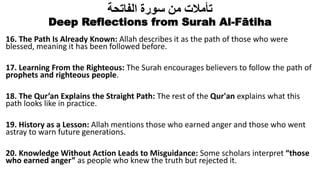
16. The Path Is Already Known: Allah describes it as the path of those who were
blessed, meaning it has been followed before.
17. Learning From the Righteous: The Surah encourages believers to follow the path of
prophets and righteous people.
18. The Qur’an Explains the Straight Path: The rest of the Qur'an explains what this
path looks like in practice.
19. History as a Lesson: Allah mentions those who earned anger and those who went
astray to warn future generations.
20. Knowledge Without Action Leads to Misguidance: Some scholars interpret “those
who earned anger” as people who knew the truth but rejected it.
34.
الفاتحة سورة منتأمالت
Deep Reflections from Surah Al-Fātiha
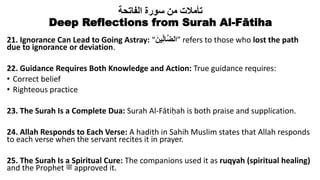
21. Ignorance Can Lead to Going Astray: “َينِّلاَض”ال refers to those who lost the path
due to ignorance or deviation.
22. Guidance Requires Both Knowledge and Action: True guidance requires:
• Correct belief
• Righteous practice
23. The Surah Is a Complete Dua: Surah Al-Fātiḥah is both praise and supplication.
24. Allah Responds to Each Verse: A hadith in Sahih Muslim states that Allah responds
to each verse when the servant recites it in prayer.
25. The Surah Is a Spiritual Cure: The companions used it as ruqyah (spiritual healing)
and the Prophet ﷺ approved it.
35.
الفاتحة سورة منتأمالت
Deep Reflections from Surah Al-Fātiha
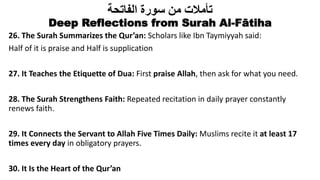
26. The Surah Summarizes the Qur’an: Scholars like Ibn Taymiyyah said:
Half of it is praise and Half is supplication
27. It Teaches the Etiquette of Dua: First praise Allah, then ask for what you need.
28. The Surah Strengthens Faith: Repeated recitation in daily prayer constantly
renews faith.
29. It Connects the Servant to Allah Five Times Daily: Muslims recite it at least 17
times every day in obligatory prayers.
30. It Is the Heart of the Qur’an
36.
الفاتحة سورة فيكلمة لكل ألسرار
Word-by-Word Secrets of Surah Al-Fātiha
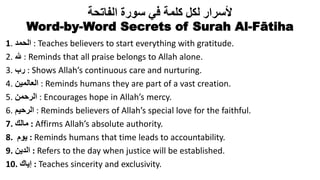
1. الحمد : Teaches believers to start everything with gratitude.
2. هلل : Reminds that all praise belongs to Allah alone.
3. رب : Shows Allah’s continuous care and nurturing.
4. العالمين : Reminds humans they are part of a vast creation.
5. الرحمن : Encourages hope in Allah’s mercy.
6. الرحيم : Reminds believers of Allah’s special love for the faithful.
7. مالك : Affirms Allah’s absolute authority.
8. يوم : Reminds humans that time leads to accountability.
9. الدين : Refers to the day when justice will be established.
10. إياك : Teaches sincerity and exclusivity.
37.
الفاتحة سورة فيكلمة لكل ألسرار
Word-by-Word Secrets of Surah Al-Fātiha
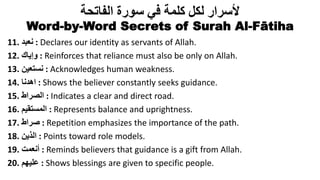
11. نعبد : Declares our identity as servants of Allah.
12. وإياك : Reinforces that reliance must also be only on Allah.
13. نستعين : Acknowledges human weakness.
14. اهدنا : Shows the believer constantly seeks guidance.
15. الصراط : Indicates a clear and direct road.
16. المستقيم : Represents balance and uprightness.
17. صراط : Repetition emphasizes the importance of the path.
18. الذين : Points toward role models.
19. أنعمت : Reminds believers that guidance is a gift from Allah.
20. عليهم : Shows blessings are given to specific people.
38.
الفاتحة سورة فيكلمة لكل ألسرار
Word-by-Word Secrets of Surah Al-Fātiha
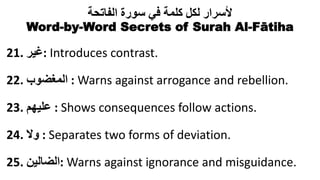
21. غير: Introduces contrast.
22. المغضوب : Warns against arrogance and rebellion.
23. عليهم : Shows consequences follow actions.
24. وال : Separates two forms of deviation.
25. الضالين: Warns against ignorance and misguidance.
39.
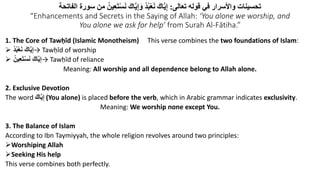
تعالى قوله فيواألسرار تحسينات
:
الفا سورة من ُينِعَتْسَن َاكَّيِإَو ُدُبْعَن َاكَّيِإ
تحة
“Enhancements and Secrets in the Saying of Allah: ‘You alone we worship, and
You alone we ask for help’ from Surah Al-Fātiha.”
1. The Core of Tawḥīd (Islamic Monotheism) This verse combines the two foundations of Islam:
➢ ُدُبْعَن َاكَيِإ→ Tawḥīd of worship
➢ ُينِعَتْسَن َاكَيِإ→ Tawḥīd of reliance
Meaning: All worship and all dependence belong to Allah alone.
2. Exclusive Devotion
The word َاكَيِإ (You alone) is placed before the verb, which in Arabic grammar indicates exclusivity.
Meaning: We worship none except You.
3. The Balance of Islam
According to Ibn Taymiyyah, the whole religion revolves around two principles:
➢Worshiping Allah
➢Seeking His help
This verse combines both perfectly.
40.
تعالى قوله فيواألسرار تحسينات
:
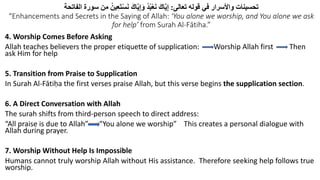
الفاتحة سورة من ُينِعَتْسَن َاكَّيِإَو ُدُبْعَن َاكَّيِإ
“Enhancements and Secrets in the Saying of Allah: ‘You alone we worship, and You alone we ask
for help’ from Surah Al-Fātiha.”
4. Worship Comes Before Asking
Allah teaches believers the proper etiquette of supplication: Worship Allah first Then
ask Him for help
5. Transition from Praise to Supplication
In Surah Al-Fātiḥa the first verses praise Allah, but this verse begins the supplication section.
6. A Direct Conversation with Allah
The surah shifts from third-person speech to direct address:
“All praise is due to Allah” “You alone we worship” This creates a personal dialogue with
Allah during prayer.
7. Worship Without Help Is Impossible
Humans cannot truly worship Allah without His assistance. Therefore seeking help follows true
worship.
41.
تعالى قوله فيواألسرار تحسينات
:
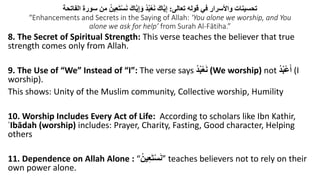
الفاتحة سورة من ُينِعَتْسَن َاكَّيِإَو ُدُبْعَن َاكَّيِإ
“Enhancements and Secrets in the Saying of Allah: ‘You alone we worship, and You
alone we ask for help’ from Surah Al-Fātiha.”
8. The Secret of Spiritual Strength: This verse teaches the believer that true
strength comes only from Allah.
9. The Use of “We” Instead of “I”: The verse says ُدُبْعَن (We worship) not ُدُبْعَأ (I
worship).
This shows: Unity of the Muslim community, Collective worship, Humility
10. Worship Includes Every Act of Life: According to scholars like Ibn Kathir,
ʿIbādah (worship) includes: Prayer, Charity, Fasting, Good character, Helping
others
11. Dependence on Allah Alone : “ُينِعَتْسَن” teaches believers not to rely on their
own power alone.
42.
تعالى قوله فيواألسرار تحسينات
:
الفاتحة سورة من ُينِعَتْسَن َاكَّيِإَو ُدُبْعَن َاكَّيِإ
“Enhancements and Secrets in the Saying of Allah: ‘You alone we worship, and You
alone we ask for help’ from Surah Al-Fātiha”
12. Protection from Arrogance: When a person realizes they need Allah’s help,
arrogance disappears.
13. Protection from Despair: At the same time, reliance on Allah removes
hopelessness.
14. The Perfect Relationship with Allah: This verse defines the believer’s
relationship with Allah: Servant (worship) Dependent (seeking help)
15. The Center of the Qur’an’s Message: According to many scholars, this verse
summarizes the purpose of the Qur'an.
43.
تعالى قوله فيواألسرار تحسينات
:
الفاتحة سورة من ُينِعَتْسَن َاكَّيِإَو ُدُبْعَن َاكَّيِإ
“Enhancements and Secrets in the Saying of Allah: ‘You alone we worship, and You
alone we ask for help’ from Surah Al-Fātiha”
16. The Secret of Success in Life: A believer succeeds when two things combine: Sincere
worship and Trust in Allah
17. The Heart of Prayer: Because of its importance, this verse is recited in every rakʿah of
ṣalāh.
18. The Key to Guidance: Immediately after this verse comes the supplication:
َميِقَتْسُمْلا َطاَر ِ
ّصال اَنِدْها Guide us to the straight path.
Therefore, true guidance comes only after sincere worship and reliance on Allah.
19. The Essence of Servanthood: The verse defines the essence of being a servant of Allah:
Worship Him alone and Seek help from Him alone
20. A Daily Renewal of Faith: Muslims repeat this verse many times every day, renewing their
commitment to Allah.
44.
الفاتحة لسورة النفسيةالتأثيرات
PSYCHOLOGICAL EFFECTS OF SURAH AL-FĀTIHA
Effects on Awareness and Consciousness واإلدراك الوعي على أثيرات
1. Heightened mindfulness – Reciting the chapter focuses the mind solely on
Allah without any distraction.
2. Self-awareness – The verse “نعبد إياك” reminds the worshipper of their
servitude and purpose of living.
3. Present-moment focus – The surah encourages attention to each word and
meaning.
4. Recognition of divine authority – “العالمين رب” fosters an awareness of being
part of a vast creation.
5. Sense of accountability – “الدين يوم مالك” reminds the believer of moral
responsibility to their Creator.
45.
واإلدراك الوعي علىأثيرات
Effects on Awareness and Consciousness
6. Gratitude activation – “هلل الحمد” primes the brain for thankfulness.
7. Recognition of mercy – “الرحيم الرحمن” evokes comfort and security whenever its
mentioned.
8. Contrast awareness – Differentiating between guidance and misguidance sharpens
moral cognition.
9. Ethical reflection – Phrases about the path of the righteous trigger reflection on
personal ethics.
10. Spiritual prioritization – The surah places worship and guidance above worldly
concerns.
46.
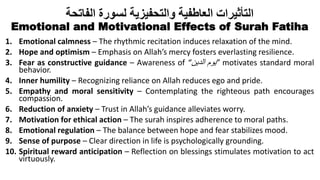
الفاتحة لسورة والتحفيزيةالعاطفية التأثيرات
Emotional and Motivational Effects of Surah Fatiha
1. Emotional calmness – The rhythmic recitation induces relaxation of the mind.
2. Hope and optimism – Emphasis on Allah’s mercy fosters everlasting resilience.
3. Fear as constructive guidance – Awareness of “ يوم
الدين ” motivates standard moral
behavior.
4. Inner humility – Recognizing reliance on Allah reduces ego and pride.
5. Empathy and moral sensitivity – Contemplating the righteous path encourages
compassion.
6. Reduction of anxiety – Trust in Allah’s guidance alleviates worry.
7. Motivation for ethical action – The surah inspires adherence to moral paths.
8. Emotional regulation – The balance between hope and fear stabilizes mood.
9. Sense of purpose – Clear direction in life is psychologically grounding.
10. Spiritual reward anticipation – Reflection on blessings stimulates motivation to act
virtuously.
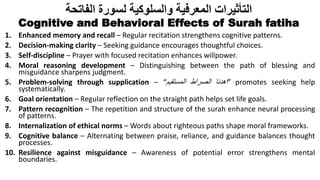
47.
الفاتحة لسورة والسلوكيةالمعرفية التأثيرات
Cognitive and Behavioral Effects of Surah fatiha
1. Enhanced memory and recall – Regular recitation strengthens cognitive patterns.
2. Decision-making clarity – Seeking guidance encourages thoughtful choices.
3. Self-discipline – Prayer with focused recitation enhances willpower.
4. Moral reasoning development – Distinguishing between the path of blessing and
misguidance sharpens judgment.
5. Problem-solving through supplication – “ اهدنا
الصراط
المستقيم ” promotes seeking help
systematically.
6. Goal orientation – Regular reflection on the straight path helps set life goals.
7. Pattern recognition – The repetition and structure of the surah enhance neural processing
of patterns.
8. Internalization of ethical norms – Words about righteous paths shape moral frameworks.
9. Cognitive balance – Alternating between praise, reliance, and guidance balances thought
processes.
10. Resilience against misguidance – Awareness of potential error strengthens mental
boundaries.
48.
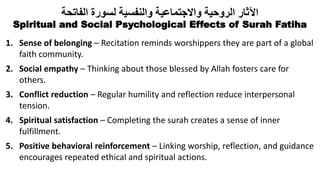
الفاتحة لسورة والنفسيةواالجتماعية الروحية اآلثار
Spiritual and Social Psychological Effects of Surah Fatiha
1. Sense of belonging – Recitation reminds worshippers they are part of a global
faith community.
2. Social empathy – Thinking about those blessed by Allah fosters care for
others.
3. Conflict reduction – Regular humility and reflection reduce interpersonal
tension.
4. Spiritual satisfaction – Completing the surah creates a sense of inner
fulfillment.
5. Positive behavioral reinforcement – Linking worship, reflection, and guidance
encourages repeated ethical and spiritual actions.
49.
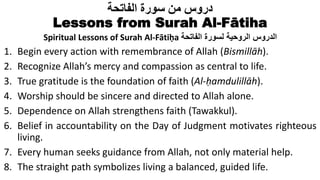
الفاتحة سورة مندروس
Lessons from Surah Al-Fātiha
Spiritual Lessons of Surah Al-Fātiḥa الفاتحة لسورة الروحية الدروس
1. Begin every action with remembrance of Allah (Bismillāh).
2. Recognize Allah’s mercy and compassion as central to life.
3. True gratitude is the foundation of faith (Al-ḥamdulillāh).
4. Worship should be sincere and directed to Allah alone.
5. Dependence on Allah strengthens faith (Tawakkul).
6. Belief in accountability on the Day of Judgment motivates righteous
living.
7. Every human seeks guidance from Allah, not only material help.
8. The straight path symbolizes living a balanced, guided life.
50.
الفاتحة لسورة الروحيةالدروس
Spiritual Lessons of Surah Al-Fātiha
9. Recognize the difference between right guidance and misguidance.
10. Prayer is a dialogue with Allah, not just ritual repetition.
11. Reciting the Surah frequently renews spiritual connection.
12. Hope and fear must coexist in a believer’s life.
13. Worship is holistic—covering ritual, ethics, and social action.
14. Allah’s mercy precedes His judgment; rely on it for spiritual growth.
15. Life’s ultimate success is spiritual, not material.
51.
الفاتحة سورة مناألخالقية الدروس
Moral Lessons of Surah Al-Fātiha
1. Honesty in worship and action mirrors sincerity to Allah.
2. Recognize that all blessings come from Allah, therefore avoid arrogance.
3. Avoid resentment toward those who have strayed or earned wrath.
4. Treat others with mercy and compassion, reflecting Allah’s qualities.
5. Justice and accountability on the Day of Judgment is certain.
6. Avoid misguiding others; guidance is a responsibility.
7. Gratitude shapes moral character and preventing selfishness.
8. Relying solely on Allah prevents moral despair.
9. Humility is essential, as humans are dependent on divine help.
10. Recognize the value of collective responsibility (“We worship”), promoting
communal ethics.
52.
الفاتحة سورة فياالجتماعية الدروس
Social Lessons of Surah Al-Fātiha
1. Unity and Collective Identity The use of “we” (ُدُبْعن – we worship, ُينِعتْسن –
we seek help) teaches cooperation and unity in society rather than individualism.
2. Recognition of One Universal Lord “Lord of all worlds” (ينِملَٰعْٱل ِبر)
promotes equality of all humans—no race, tribe, or class is superior and all
humans are subjected to a superior
3. Mercy as a Social Principle The repeated attributes “Most Merciful, Most
Compassionate” (ِيم ِحهٱلر ِن َٰمْحه)ٱلر emphasize kindness, empathy, and forgiveness in
dealing with others. In the society
4. Accountability in Human Dealings “Master of the Day of Judgment” ( ِكِل َٰ
م
ِنيِدٱل ِم ْوي) reminds people that all actions—social, economic, or moral—have
consequences.
5. Dependence on God, Not Oppression of Others “You alone we ask for
help” teaches reliance on Allah rather than exploiting or oppressing fellow
humans.
53.
الفاتحة سورة فياالجتماعية الدروس
Social Lessons of Surah Al-Fātiha
6. Guidance Toward the Right Path “Guide us to the straight path”
encourages seeking moral and ethical direction in personal and social conduct.
7. Following Righteous Role Models “The path of those You have blessed”
teaches learning from upright individuals and communities who embody justice
and integrity.
8. Avoidance of Corrupt Lifestyles “Not the path of those who earned
Your anger or went astray” warns against adopting harmful social behaviors and
unjust systems.
9. Gratitude and Positive Social Attitude “All praise is due to Allah” fosters
gratitude, which leads to contentment and reduces envy and social conflict.
10. Balance Between Hope and Fear The combination of mercy (Ar-
Raḥmān) and accountability (Day of Judgment) creates balanced individuals—
neither arrogant nor hopeless—leading to stable societies.
54.
الفاتحة سورة مناالقتصادية الدروس
Economic Lessons of Surah Al-Fātiha
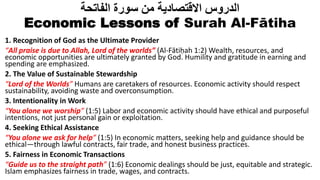
1. Recognition of God as the Ultimate Provider
“All praise is due to Allah, Lord of the worlds” (Al-Fātiḥah 1:2) Wealth, resources, and
economic opportunities are ultimately granted by God. Humility and gratitude in earning and
spending are emphasized.
2. The Value of Sustainable Stewardship
“Lord of the Worlds” Humans are caretakers of resources. Economic activity should respect
sustainability, avoiding waste and overconsumption.
3. Intentionality in Work
“You alone we worship” (1:5) Labor and economic activity should have ethical and purposeful
intentions, not just personal gain or exploitation.
4. Seeking Ethical Assistance
“You alone we ask for help” (1:5) In economic matters, seeking help and guidance should be
ethical—through lawful contracts, fair trade, and honest business practices.
5. Fairness in Economic Transactions
“Guide us to the straight path” (1:6) Economic dealings should be just, equitable and strategic.
Islam emphasizes fairness in trade, wages, and contracts.
55.
الفاتحة سورة مناالقتصادية الدروس
Economic Lessons of Surah Al-Fātiha
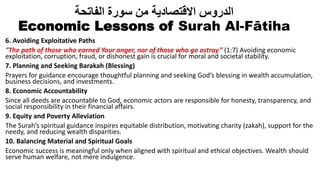
6. Avoiding Exploitative Paths
“The path of those who earned Your anger, nor of those who go astray” (1:7) Avoiding economic
exploitation, corruption, fraud, or dishonest gain is crucial for moral and societal stability.
7. Planning and Seeking Barakah (Blessing)
Prayers for guidance encourage thoughtful planning and seeking God’s blessing in wealth accumulation,
business decisions, and investments.
8. Economic Accountability
Since all deeds are accountable to God, economic actors are responsible for honesty, transparency, and
social responsibility in their financial affairs.
9. Equity and Poverty Alleviation
The Surah’s spiritual guidance inspires equitable distribution, motivating charity (zakah), support for the
needy, and reducing wealth disparities.
10. Balancing Material and Spiritual Goals
Economic success is meaningful only when aligned with spiritual and ethical objectives. Wealth should
serve human welfare, not mere indulgence.
56.
الفاتحة سورة منالسياسية الدروس
Political Lessons of Surah Al-Fātiha
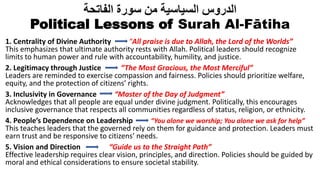
1. Centrality of Divine Authority “All praise is due to Allah, the Lord of the Worlds”
This emphasizes that ultimate authority rests with Allah. Political leaders should recognize
limits to human power and rule with accountability, humility, and justice.
2. Legitimacy through Justice “The Most Gracious, the Most Merciful”
Leaders are reminded to exercise compassion and fairness. Policies should prioritize welfare,
equity, and the protection of citizens’ rights.
3. Inclusivity in Governance “Master of the Day of Judgment”
Acknowledges that all people are equal under divine judgment. Politically, this encourages
inclusive governance that respects all communities regardless of status, religion, or ethnicity.
4. People’s Dependence on Leadership “You alone we worship; You alone we ask for help”
This teaches leaders that the governed rely on them for guidance and protection. Leaders must
earn trust and be responsive to citizens’ needs.
5. Vision and Direction “Guide us to the Straight Path”
Effective leadership requires clear vision, principles, and direction. Policies should be guided by
moral and ethical considerations to ensure societal stability.
57.
الفاتحة سورة منالسياسية الدروس
Political Lessons of Surah Al-Fātiha
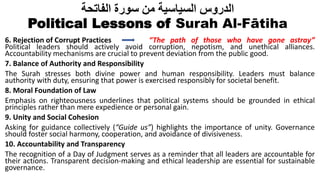
6. Rejection of Corrupt Practices “The path of those who have gone astray”
Political leaders should actively avoid corruption, nepotism, and unethical alliances.
Accountability mechanisms are crucial to prevent deviation from the public good.
7. Balance of Authority and Responsibility
The Surah stresses both divine power and human responsibility. Leaders must balance
authority with duty, ensuring that power is exercised responsibly for societal benefit.
8. Moral Foundation of Law
Emphasis on righteousness underlines that political systems should be grounded in ethical
principles rather than mere expedience or personal gain.
9. Unity and Social Cohesion
Asking for guidance collectively (“Guide us”) highlights the importance of unity. Governance
should foster social harmony, cooperation, and avoidance of divisiveness.
10. Accountability and Transparency
The recognition of a Day of Judgment serves as a reminder that all leaders are accountable for
their actions. Transparent decision-making and ethical leadership are essential for sustainable
governance.
58.
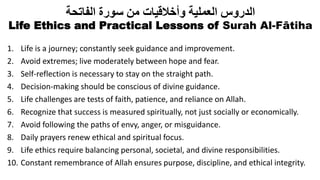
الفاتحة سورة منوأخالقيات العملية الدروس
Life Ethics and Practical Lessons of Surah Al-Fātiha
1. Life is a journey; constantly seek guidance and improvement.
2. Avoid extremes; live moderately between hope and fear.
3. Self-reflection is necessary to stay on the straight path.
4. Decision-making should be conscious of divine guidance.
5. Life challenges are tests of faith, patience, and reliance on Allah.
6. Recognize that success is measured spiritually, not just socially or economically.
7. Avoid following the paths of envy, anger, or misguidance.
8. Daily prayers renew ethical and spiritual focus.
9. Life ethics require balancing personal, societal, and divine responsibilities.
10. Constant remembrance of Allah ensures purpose, discipline, and ethical integrity.
59.
العالمين رب هللالحمد أن دعوانا وآخر
“And our last prayer is: All praise is due to Allah, the Lord of all worlds.”