UNIT II
Improving SoftwareEconomics:
Reducing Software product size, improving software processes, improving team
effectiveness, improving automation, Achieving required quality, peer inspections.
The old way and the new:
The principles of conventional software engineering, principles of modern software
management, transitioning to an iterative process.
3.
Improving Software Economics
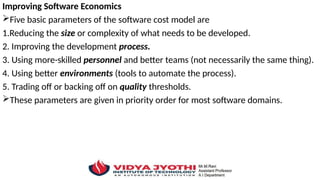
Fivebasic parameters of the software cost model are
1.Reducing the size or complexity of what needs to be developed.
2. Improving the development process.
3. Using more-skilled personnel and better teams (not necessarily the same thing).
4. Using better environments (tools to automate the process).
5. Trading off or backing off on quality thresholds.
These parameters are given in priority order for most software domains.
4.
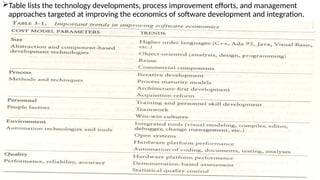
Table lists thetechnology developments, process improvement efforts, and management
approaches targeted at improving the economics of software development and integration.
5.
REDUCING SOFTWARE PRODUCTSIZE
The most significant way to improve affordability and return on investment (ROI)
is usually to produce a product that achieves the design goals with the minimum
amount of human-generated source material. Component-based development is
introduced as the general term for reducing the "source" language size to achieve
a software solution.
Reuse, object-oriented technology, automatic code production, and higher order
programming languages are all focused on achieving a given system with fewer
lines of human-specified source directives (statements).
size reduction is the primary motivation behind improvements in higher order
languages (such as C++, Ada 95, Java, Visual Basic), automatic code generators
(CASE tools, visual modeling tools, GUI builders), reuse of commercial
components (operating systems, windowing environments, database
management systems, middleware, networks), and object-oriented technologies
(Unified Modeling Language, visual modeling tools, architecture frameworks).
6.
OBJECT-ORIENTED METHODS ANDVISUAL MODELING
Object-oriented technology is not germane to most of the software management
topics discussed here, and books on object-oriented technology abound. Object-
oriented programming languages appear to benefit both software productivity
and software quality. The fundamental impact of object-oriented technology is in
reducing the overall size of what needs to be developed.
People like drawing pictures to explain something to others or to themselves.
When they do it for software system design, they call these pictures diagrams or
diagrammatic models and the very notation for them a modeling language.
7.
These are interestingexamples of the interrelationships among the dimensions of
improving software economics.
1. An object-oriented model of the problem and its solution encourages a common
vocabulary between the end users of a system and its developers, thus creating a
shared understanding of the problem being solved.
2. The use of continuous integration creates opportunities to recognize risk early
and make incremental corrections without destabilizing the entire development
effort.
3. An object-oriented architecture provides a clear separation of concerns among
disparate elements of a system, creating firewalls that prevent a change in one part
of the system from rending the fabric of the entire architecture.
8.
IMPROVING SOFTWARE PROCESSES
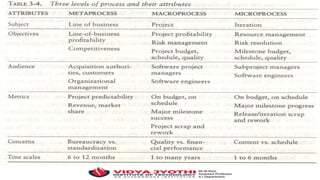
Processis an overloaded term. Three distinct process perspectives are.
Metaprocess: an organization's policies, procedures, and practices for pursuing a
software-intensive line of business. The focus of this process is on organizational
economics, long-term strategies, and software ROI.
Macroprocess: a project's policies, procedures, and practices for producing a
complete software product within certain cost, schedule, and quality constraints.
The focus of the macro process is on creating an adequate instance of the Meta
process for a specific set of constraints.
Microprocess: a project team's policies, procedures, and practices for achieving
an artifact of the software process. The focus of the micro process is on achieving
an intermediate product baseline with adequate quality and adequate
functionality as economically and rapidly as practical.
10.
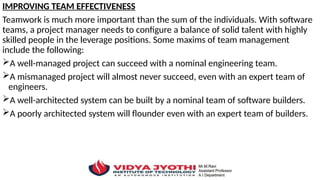
IMPROVING TEAM EFFECTIVENESS
Teamworkis much more important than the sum of the individuals. With software
teams, a project manager needs to configure a balance of solid talent with highly
skilled people in the leverage positions. Some maxims of team management
include the following:
A well-managed project can succeed with a nominal engineering team.
A mismanaged project will almost never succeed, even with an expert team of
engineers.
A well-architected system can be built by a nominal team of software builders.
A poorly architected system will flounder even with an expert team of builders.
11.
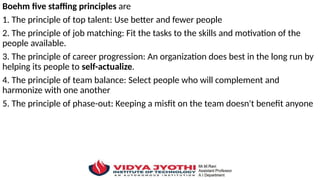
Boehm five staffingprinciples are
1. The principle of top talent: Use better and fewer people
2. The principle of job matching: Fit the tasks to the skills and motivation of the
people available.
3. The principle of career progression: An organization does best in the long run by
helping its people to self-actualize.
4. The principle of team balance: Select people who will complement and
harmonize with one another
5. The principle of phase-out: Keeping a misfit on the team doesn't benefit anyone
12.
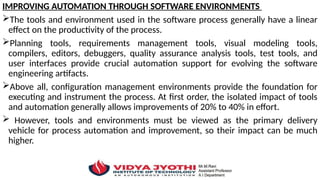
IMPROVING AUTOMATION THROUGHSOFTWARE ENVIRONMENTS
The tools and environment used in the software process generally have a linear
effect on the productivity of the process.
Planning tools, requirements management tools, visual modeling tools,
compilers, editors, debuggers, quality assurance analysis tools, test tools, and
user interfaces provide crucial automation support for evolving the software
engineering artifacts.
Above all, configuration management environments provide the foundation for
executing and instrument the process. At first order, the isolated impact of tools
and automation generally allows improvements of 20% to 40% in effort.
However, tools and environments must be viewed as the primary delivery
vehicle for process automation and improvement, so their impact can be much
higher.
13.
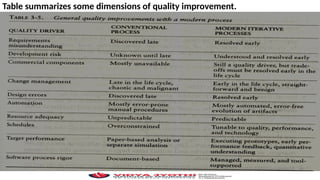
ACHIEVING REQUIRED QUALITY
Softwarebest practices are derived from the development process and technologies.
Key practices that improve overall software quality include the following:
Focusing on driving requirements and critical use cases early in the life cycle, focusing
on requirements completeness and traceability late in the life cycle, and focusing
throughout the life cycle on a balance between requirements evolution, design
evolution, and plan evolution
Using metrics and indicators to measure the progress and quality of an architecture as
it evolves from a high-level prototype into a fully compliant product
Providing integrated life-cycle environments that support early and continuous
configuration control, change management, rigorous design methods, document
automation, and regression test automation
Using visual modeling and higher level languages that support architectural control,
abstraction, reliable programming, reuse, and self-documentation
Early and continuous insight into performance issues through demonstration-based
evaluations
PEER INSPECTIONS: APRAGMATIC VIEW
Peer inspections are frequently over hyped as the key aspect of a quality system. In my
experience, peer reviews are valuable as secondary mechanisms, but they are rarely
significant contributors to quality compared with the following primary quality
mechanisms and indicators, which should be emphasized in the management process:
Transitioning engineering information from one artifact set to another, thereby
assessing the consistency, feasibility, understandability, and technology constraints
inherent in the engineering artifacts
Major milestone demonstrations that force the artifacts to be assessed against
tangible criteria in the context of relevant use cases
Environment tools (compilers, debuggers, analyzers, automated test suites) that
ensure representation rigor, consistency, completeness, and change control
Life-cycle testing for detailed insight into critical trade-offs, acceptance criteria, and
requirements compliance
Change management metrics for objective insight into multiple-perspective change
trends and convergence or divergence from quality and progress goals