1


      The Impact of Local Cinema
                        Overview
                         November 05


This report was produced with the support of:


Contents
2


Executive Summary                                                          3

Foreword                                                                   6

1. Introduction                                                            7

2. Outline of Study                                                    10
2.1 Overview of five case study cinemas                                10
2.2 Issues to be explored at each case study cinema                    13
2.3 Structure of this report                                           13

3. The social, cultural and environmental impact of local cinema       14
3.1 Who visits the cinema?                                             14
3.2 What impact do the cinemas have on their visitors and the wider    20
community?

4. The impact of local cinema on the local economy                     45
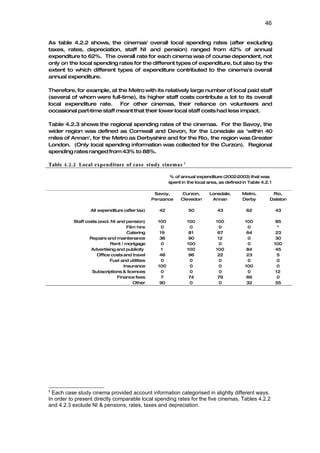
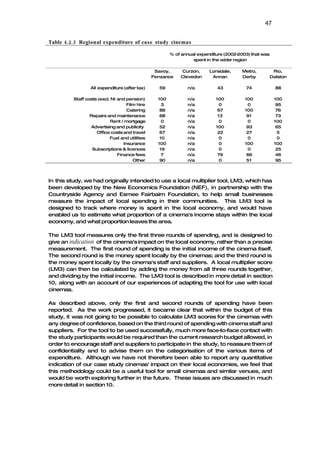
4.1 Overview of income and expenditure                                 45
4.2 Measuring local money flows: cinemas local spending in their
                                           ’                           46
communities
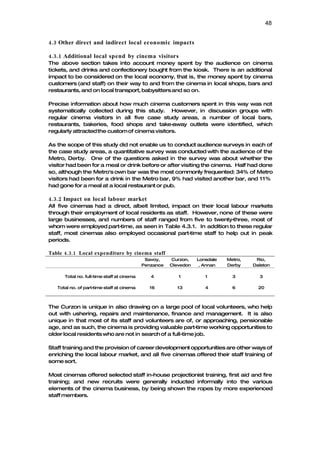
4.3 Other direct and indirect local economic impacts                   50

Acknowledgements                                                      53

Appendix                                                               54
3


Executive Summary
1.0 Summary
    • This overview demonstrates the wide range of positive impacts local cinemas
       have on their communities. The venues foster a sense of place and provide a
       focus for the local community, whilst enhancing local cultural life through the
       provision of mainstream and/or specialised film. The cinemas play an
       important social inclusion role, reaching out to otherwise underserved
       elements of the local population. They enhance learning opportunities
       through links with local schools and colleges, improving the skills and
       knowledge base of the community.
   •   Cinemas also contribute to the vitality and vibrancy of town centres,
       encouraging the evening economy and increasing footfall. This often has a
       positive impact on safety and security.
   •   Cinemas contribute to the local economy through audience and visitor spend,
       the use of local suppliers, and their (albeit limited) impact on the local labour
       market

1.1 Background to report
    • In 2003, the British Film Institute and the UK Film Council commissioned a
       study to measure and assess the impact of local cinemas on the social,
       cultural and economic life of their communities. Two Regional Screen
       Agencies, EM Media and Film London, also funded case study elements of
       the project.
   •   This report is aimed at cinema exhibitors, local authorities, development
       agencies and those interested in cinema provision and/or the vitality of
       smaller towns.

1.2 Measuring impact
The study had two aims:
   • To investigate and describe the impact of local cinemas on their communities
   • To develop a package of “impact measurement”tools that could be used by
       other research teams to assess the impact of other small venues

2.1 Methodology
To meet the aims of the study, a multi-method approach was adopted with the
following elements:
     • initial desk research to explore existing literature on impact measurement
        methodologies
     • selection of five case study cinemas

Then for each of the five cinemas:
   • a site visit
   • depth interviews (and regular follow-ups) with cinema manager and staff
   • focus group with cinema audience
   • telephone interviews with some of the cinema's local suppliers, community
       groups or educational organisations with links to the cinema, the local council
       and the local press

Additional fieldwork was conducted for certain case studies, including interviews and
a postal survey with local residents, a focus group with educational programme
participants and a cinema audience survey.
4


2.2 Selection of case studies
    • Five independent, locally owned and operated cinemas were selected (The
        Savoy, Penzance; The Curzon, Clevedon; The Lonsdale, Annan; The Rio,
        Dalston; and The Metro, Derby).
    •   The cinemas are located across the UK, and were selected to cover a range
        of characteristics - both urban and rural settings, mainstream and specialised
        programmes, single screen and multiple screen cinemas, and private, trust
        and public funding.

3.1 Local social and cultural impacts
All five case study cinemas enhance the social and cultural lives of their local
communities in the following ways:
    • Local cinemas play a crucial part in fostering a “sense of place” for their
        communities as key venues with a community focus. They provide a strong
        social function as a meeting place and centre in which to socialise.
    • The venues widen the range of cinema-going opportunities for local residents,
        enhancing local cultural life. They either provide a mainstream programme
        where no other cinemas exist in the locality, or a specialised alternative in
        those areas with multiplex provision.
    • The opportunity to see mainstream films in a non-multiplex atmosphere is
        attractive to some sections of the audience.
    • Moreover, the cinemas play an important social inclusion role, particularly for
        elderly people who would otherwise not have the opportunity to watch films
        “for them” in an easily accessible “traditional” environment, and for other
        excluded groups such as young parents with babies. The cinemas are “re-
        introducing”people to film.
    • Special events and activities target various community groups which would
        otherwise be excluded. Film festivals, special screenings and educational
        initiatives often reach underserved subgroups of the population. For example,
        The Metro, Derby holds special screenings for children with autism and with
        hearing impairments. Two of the case study cinemas also enhance access
        and participation among otherwise excluded local minority ethnic groups
        through film festivals and special screenings of world cinema.
    • Cinemas enhance local learning opportunities through links with local
        schools, screenings and courses, although lack of funding often restricts the
        range of educational activities.
    • The case study cinemas are also involved in the delivery of “lifelong learning”
        opportunities through courses around film. Their role in improving the skills
        and knowledge base of the community is recognised by participants and
        practitioners alike.
    • Cinemas also make an important social contribution to their local communities
        through the provision of volunteering opportunities.
    • Links with Film Societies have a strong impact on local film culture, with the
        cinemas providing a venue, and often taking the lead in booking films.
    • Local cinemas are seen in general as affordable leisure options for families,
        with fewer concerns over travel and food costs than other activities. The
        cinemas are seen as safe, secure venues fostering independence among
        young people.

3.2 Local environmental impacts
The local cinemas make a positive contribution to the built environment and town
centre vitality:
5


   •   Most of the cinemas retain a traditional façade, creating a positive
       architectural ambience and providing a strong focal point in the town centres.
   •   Their presence has a positive knock-on effect for other traders in the vicinity.
       The cinemas encourage footfall, particularly in the evening, and make the
       local area feel safer.

3.3 Local economic impacts
The case study cinemas contribute to the local economy in terms of audience/visitor
spend, the sourcing of local suppliers, and the local labour market.
   • The cinema audiences generate money for the local economy through visits
       to local bars, restaurants, bakeries, food shops and take-aways as part of
       their cinema trip.
   • All five cinema managers, where the market allows it, try to seek out local
       suppliers in favour of more distant alternatives. There is a feeling that, as
       small businesses themselves, they should try to help sustain the local
       economy.
   • The cinemas have a direct, albeit limited, positive impact on their local labour
       markets through the employment of local residents as staff.
   • The cinemas also provide valuable job opportunities to otherwise excluded
       groups. For example, The Curzon makes part-time jobs available to older
       residents not in search of a full-time job.
   • Staff training and provisions of career development opportunities enrich local
       labour markets.
   • Association with the cinema, with its prominent local image, creates important
       marketing opportunities for other businesses.
6


Foreword
Film has the power to inspire us. It allows us to inhabit new identities, hear new
voices and to see the world from many different perspectives. Film brings us news of
other cultures, other mores, other values. The apparently universal ability of film to
excite and enthral audiences, to make them think, to encourage empathy and
compassion, to provoke laughter and tears, makes it the most pungent, mysterious
and international of art forms.

Such a significant and popular medium should be accessible to all communities in its
most potent form, which is the cinema. The magic of cinema in the cinema is
connected to two unique conditions – the sharing of an experience in an audience
and the contemplation of images projected on a scale beyond the perspective of
normal perception. A face in an average television screen approximates to our
sense of the human head. On a cinema screen, eyes, mouths, smiles, kisses, guns
are amplified, pulling us into their power, for good or bad.

This document aims to draw attention to the many benefits of local cinema provision.
Of course, providing access to this most democratic and popular cultural pursuit of
our times is at the heart of the argument but it’salso evident that a well-supported
local cinema can make less obvious contributions to small communities, providing
economic benefit, confronting social exclusion, enhancing tourism. It’salso clear
from the report that such advantages are often forgotten; local cinema is not perhaps
as celebrated as it might be. It is my real hope that this report will act as a valuable
resource to those who support and champion local cinema.

Anthony Minghella
7


1. Introduction
In 2003, the British Film Institute (bfi) and the UK Film Council commissioned a study
to measure and assess the impact of local cinemas on the social, cultural and
economic life of their communities. Joining the two national bodies were the
Regional Screen Agencies EM Media and Film London, funding case studies in
Derby and Hackney respectively.

The background to this study lies in the dramatic changes that have taken place in
the cinema landscape over the last two decades which has seen the rise of multiplex
cinemas and the consequent decline of town centre or ‘traditional’    cinemas. This has
resulted in an increase of 232% between 1995-2004 of multiplexes from 730 to 2426
and a decline of 28% in traditional cinemas from 1275 to 916 in the same period. The
Dodona Cinemagoing report of 2000 noted that multiplexes were increasingly being
planned in towns with a population catchment area of 50,000 whereas a few years
previously double this population would have been required.1 This is actually a
relatively low figure and reflects a level of screen density which has increasingly lead
operators to explore these ‘smaller population areas. Nevertheless, the majority of
                                       ’
multiplexes remain in higher population areas – for example in 2002 only 1% of
multiplexes were in populations of less than 55,000. Many smaller communities or
areas with low population densities have therefore lost access to cinema through the
closure of so many traditional sites and the inability/reluctance of larger operators to
take their place. In the last 3-4 years, the arrival of newly built multinationally-owned
town and city centre midi and multiplexes has had an additional but more complex
impact on existing local cinemas (e.g. Scunthorpe and Nottingham). Furthermore, the
mainstream programming of the vast majority of multiplexes has restricted the
breadth of the cinemagoing experience for audiences outside the major metropolitan
areas wishing to see more specialised films2.

The prevalence of out of town developments was a particular feature of the multiplex
transformation which has paralleled a general decline in town centres. Recent years
have seen a concerted policy effort by local and central government to address this
decline and arrest the development move away from the centre. Two Policy
Planning Guidances were of particular note here. PPG13 had its background in the
mounting concern at the increased reliance on the private car to support out of town
developments with its consequent environmental, transport and social exclusion
impacts. The Guidance meant that accessibility by public transport should now be a
key feature in drawing up development plans.

The decline of shops and services in town centres was seen to have a negative
impact both on the town itself and on the surrounding area. PPG6 stated that
wherever possible, new developments should take place in the town centre. This is
part of a general trend which has also manifested itself in other ways. Local
authorities and central government have increasingly recognised the importance of
revitalising small towns – market towns in particular have been the focus of attention
in recognition of their hub role for the surrounding catchment area. The need for a
vibrant evening economy (or indeed any evening economy) and the role of leisure in
this has been at the heart of small town initiatives. The Rural White Paper which was
presented to Parliament in 2000 focused on sustainability of local communities and

1
   Dodona - Cinemagoing 8, p. 61
2
   The UK Film Council defines a specialised film as one which engages current political, social
and cultural issues; challenging English language films; UK minority indigenous language
films; Foreign language films; Films where ethnicity, disability or sexual orientation are key
themes; Classic films; Archive films, and films which appeal to underserved audiences.
8


on the issues of quality of life in areas of smaller population. Using work done by the
East Midlands Development Agency, the white paper proposed a set of facilities that
should be available in a market town of a given size. For a community with a
population of 2,000-10,000 weekly cinema provision was required; for a larger town
with a population of 10,000-25,000 it proposed a full time local cinema as desirable.
This template of provision was used as the basis for Government policy of ‘asking
                                                                     ’s
public service providers to make Market Town provision a key element in their
strategies 3
          ’

1.1 Background to the report
This report is aimed at cinema exhibitors, local authorities, development agencies
and those interested in cinema provision and/or the vitality of smaller towns. It seeks
to build on previous work in the field by establishing a more robust evidence base
upon which to support the case for local cinema provision.

The interest of the bfi in the area of local cinema goes back many years. The
establishment of the regional film theatre network was overseen and developed by
the bfi throughout the 1960s and 1970s and many of these were in smaller
communities (often part time). During the 1990s the bfi was involved in various early
initiatives to create enhance the provision of cinema in rural areas including the
CineLincs consortium project and the Cinemobile touring cinema.

In 1999, along with East Midlands Arts and Eastern Arts, the bfi commissioned a
report, The Case for Rural Cinema , which considered the issues around rural cinema
exhibition and various models of provision and was followed up in 2000 with a
conference, Delivering Local Cinema, aimed at local authorities in particular. Most
recently, the bfi publication At a Cinema Near You: Strategies for sustainable local
cinema (2002) has been widely distributed and offers practical advice and guidance
to those wishing to set up a cinema in their area.

The UK Film Council supports distribution, exhibition (theatrical and non-threatrical)
and audience development through a variety of funds. Diversity is key to all UK Film
Council strategy, and the role of local cinema in terms of social inclusion and
community cohesion is directly relevant to its ambition for a vibrant UK film culture.

The National and Regional Screen Agencies also perform a vital role at a local level
in terms of supporting regional and national distribution and exhibition, and this
research will directly inform future initiatives.

1.2 Measuring impact
The research team were clear from the outset of the study that the local impact of
cinema would be by no means a simple thing to measure, and that ultimately it would
be impossible to prove a cause and effect relationship between cinema services or
characteristics and a measured outcome in individuals or the local area, given the
complexities of the context in which the cinema is operating. It would be impossible,
within the constraints of a research project with a limited budget, to measure and
take account of all circumstances in individuals’lives and in the local area.

However, in this study, we have attempted to build on the best methodologies
currently being used in impact measurement. One of the aims of the study was to
develop an ‘impact measurement package which could be used by local venues
                                        ’
wishing to measure their own local data. So our aim was to develop a simple
methodology which can be used to give an indication of the likely impact, and to

3
    Rural white paper p. 76
9


provide a greater understanding of the value of cinema to the social and cultural lives
of the community, the local economy, and the environment.

Previous impact measurement studies have been criticised for lack of conceptual
clarity, lack of methodological transparency, over-reliance on data from small
unrepresentative samples, and over-claiming conclusions.       Throughout the
development of this project, the research team made efforts to avoid these
shortcomings.
10


2. Outline of study
The study had two aims:

a) To investigate and describe the impact of local cinemas on their communities

b) To develop a package of 'impact measurement' tools that could be used by other
research teams to assess the impact of other small venues


To meet these aims, the study involved the following elements:
• initial desk research to explore existing literature on impact measurement
   methodologies
• selection of five case study cinemas

Then for each of the five cinemas:
• a site visit
• depth interviews (and regular follow-ups) with cinema manager and staff
• focus group with cinema audience
• telephone interviews with some of the cinema's local suppliers
• telephone interviews with some of the community groups or educational
   organisations with links to the cinema
• telephone interviews with the local council
• telephone interviews with the local press

In two of the case study areas, local residents (who were not necessarily regular
visitors to the case study cinemas) were also interviewed.

And in one of the case study areas, a focus group with participants in the cinema's
educational programme was conducted, together with a quantitative survey of the
cinema audience and a small-scale local resident postal survey.

2.1 Overview of the five case study cinemas
The research team decided to focus on independent, locally owned and operated
cinemas, and the five case studies selected were:

•   The Savoy, Penzance
•   The Curzon, Clevedon
•   The Lonsdale, Annan
•   The Rio, Dalston
•   The Metro, Derby

The cinemas were located across the UK, and were selected to cover a range of
characteristics - both urban and rural settings, mainstream and specialised
programmes, single screen and multiple screen cinemas, and private, trust and
public funding.

While three of the cinemas were offering the only significant film-screening service in
the local area, two - the Metro in Derby and the Rio in Hackney - were presenting a
more specialised programme alongside other more mainstream multiplex cinemas.

A brief overview of each case study cinema is given below. A full report on each
individual case study is available separately in sections 5-9.
11


The Savoy Cinema, Causewayhead, Penzance
www.merlincinemas.co.uk/penzance.php
The Savoy cinema is the only cinema in Penzance, which is a small coastal town in
West Cornwall with a population of about 17,000. It is one of a chain of five cinemas
run by the Merlin group: four cinemas in West Cornwall (Penzance, Redruth, St Ives
and Helston) and one in Torquay, Devon. The Savoy offers a predominantly first-run
mainstream programme, with most major releases secured on date. It is a three-
screen cinema with 273 seats, purpose-       built in 1912 and claims to be the longest
continuous running cinema in England (a claim also made by another case study
cinema - the Curzon in Clevedon!). The Savoy sells more than 90,000 tickets a year.
The Merlin group has little cinema competition in West Cornwall, and the Savoy's
nearest non-Merlin cinema is a 50 minute drive away in Truro. The Savoy differs
from the other case study cinemas in that it has an on-site restaurant, take-away
pizza and ice-cream kiosk, all of which are available to non-cinema goers. This
added dimension clearly makes an important contribution to the town as a place to
meet and socialise. As a result of this additional provision, the Savoy has a larger,
more diverse group of staff than some of the other cinemas in the study, employing
four regular full-time staff, and 16 regular part-time staff. It is also unique in the study
in that its audience profile varies considerably with the time of year, due to a
seasonal influx of visiting tourists during the summer months.

The Curzon Cinema, Old Church Road, Clevedon
www.curzon.org.uk
Clevedon is a seaside town in Somerset, with a population of about 22,000. The
Curzon cinema is a purpose-   built cinema dating from 1912 with an art deco facade,
and proudly claims to be the longest continuously running cinema in England. The
cinema has one screen, with a capacity for seating 380 people. It is located in the
centre of the town and offers a largely mainstream programme, with monthly Film
Club screenings of more specialised films. The cinema sells about 55,000 tickets
every year. It is the only cinema in the town, and its nearest competitors are more
than 12 miles away. The manager is the only member of full-time staff at the cinema,
and he is supported by a small group of part-time staff who work in the projection
room and front of house.

The cinema was threatened with closure in the mid-nineties, but was saved as a
result of a successful 'Save the Curzon' campaign run by Jon Webber, a local
resident and the ex-manager of the Rio cinema in Dalston, another of the cinemas
taking part in this study. Jon had successfully led a campaign in the 1970's to
purchase the Rio cinema, and to operate it as a community business; and he put
together a similar business plan to buy and run the Curzon. As a community cinema,
local people are now involved in all aspects of the Curzon's operation: there is an
elected management body, and a substantial pool of local volunteers who help out
with day-to-day ushering, maintenance, stock control and so on, providing an
important social function in the town.

The cinema is currently working with the local community to raise £1.2 million as
"match funding" as part of a Lottery bid for £5.2 million to restore the cinema to its
former Art Deco glory.

The Lonsdale Cinema, Moat Road, Annan
www.lonsdalecitycinemas.co.uk
Annan is a small (population: 8,000) Scottish market town near the English border.
The Lonsdale cinema in Annan is linked to a sister cinema in Carlisle, both run by the
same family-owned company. The same, predominantly mainstream, programme is
12


screened at both cinemas, with a world cinema screening every week. The building's
use has varied over the years, but it has been used as a cinema since early in the
20th century. The recently refurbished Annan cinema has two screens, seating a
total of 150 people, and sells about 30,000 tickets a year. Although it is the only
cinema in Annan, there are competing cinemas, both specialised and mainstream, in
nearby Carlisle and Dumfries. The cinema has two permanent full-time staff, and
four part-time staff, with an additional six casual staff working as projectionists or
front of house.

The Rio Cinema, Kingsland Street, Dalston
www.riocinema.ndirect.co.uk
The Rio cinema is located in Dalston, Hackney. The Rio is a purpose-    built cinema
dating from 1915 and is an English Heritage Grade II listed building, with 1930s art
deco facade. It is a one-screen cinema with 402 seats, offering a mainly specialised
programme, although in recent years, also showing an increasing number of popular
mainstream films. The Rio sells about 70,000 - 80,000 tickets every year. It is the
only cinema in Hackney, although there are a number of both mainstream and more
specialised cinemas within the neighbouring wards of Islington and Tower Hamlets.
There are 23 members of staff on the pay roll, mostly part-time, and the cinema is
supported by a voluntary board of 13 directors, who help with marketing, finance and
other operational matters. Film London provided extra funding to the Rio cinema in
order to conduct a resident discussion group and widen the scope of the study.
                          ’s

The Metro Cinema, Green Lane, Derby
www.derby.ac.uk/metro-cinema
Metro cinema in Derby, established in 1981, is the only cinema in the study that
receives significant amounts of public funding from a variety of sources. It offers a
mainly specialised programme and offers a range of educational activities from pre-
screening talks to courses in film studies and screen-    writing. It is a single screen
cinema, seating 126 people. It sells about 25,000 tickets a year. While it is the only
specialist cinema in Derby, there are two mainstream competitors within the city.
Metro employs nine permanent members of staff (3 full-time, 6 part-time), with a
further 12 or so part-time staff working front of house. The cinema is currently
housed in a Grade II listed building, owned by the University, and although within
walking distance of Derby City Centre, its location is in a residential area and not well
sign-posted.

The Metro is currently working with Q Arts - a Derby based contemporary visual arts
organisation - on the planning of a major building and relocation project. This will
result in a purpose- built, accessible building in the centre of Derby, and will include
three additional screens for an expanded Metro programme and audience.

The Derby case study received additional funding from EM-Media, which gave the
research team scope to collect more detailed data. This was the only cinema for
which separate audience and local resident surveys were conducted. We also held
an additional discussion group in this area, with participants in the Metro's
educational programme.

2.2 Issues to be explored at each case study cinema
At the outset of the study, the research team put together an initial checklist of the
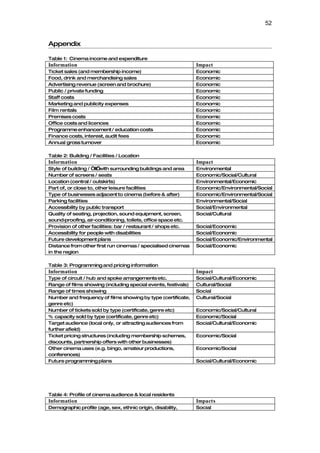
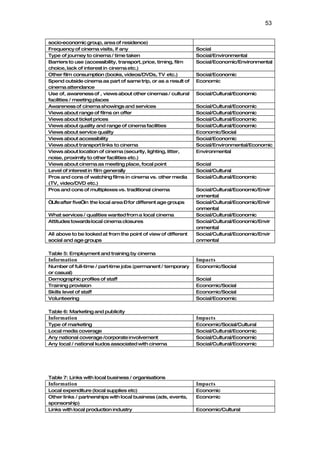
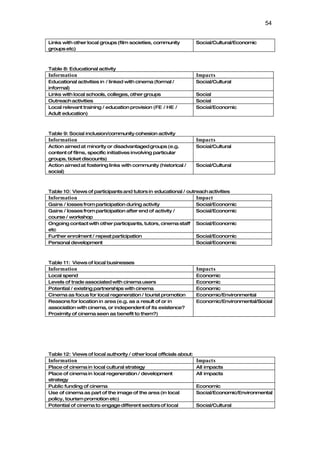
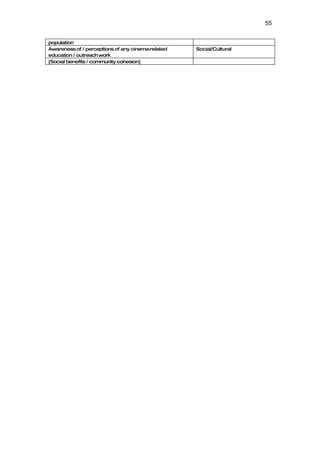
sorts of issues to be explored. This list is presented in the appendix as a series of
tables, along with the intended purpose behind collecting each piece of data, i.e.
whether it was of potential use in informing an assessment of the social, cultural,
economic or environmental impact of the cinema.
13


In many cases, data items have been identified as potentially informing more than
one of these three impact types. For example, a good range of films offered by the
case study cinema could be assessed in terms of its social and cultural impact, i.e.
provision of access to film for local residents. This in turn affects the cinema's local
economic impact - if residents are impressed with the range of films on offer, ticket
sales are likely to be high, bringing more money into the cinema, which can then in
turn spend it on the salaries of local staff, and buying services from local suppliers,
and so on.

These issue checklists were then converted into a number of topic guides and
questionnaires, which were used for the interviews with cinema managers, suppliers,
audience, local residents, council staff and so on. The research tools are all included
in section 11, the methodological toolkit, published separately.

2.3 Structure of this report
The rest of this report is structured as follows. Section 3 looks at the social, cultural
and environmental impact of local cinema, followed by section 4 which examines the
impact of local cinema on the local economy.

Sections 5 to 9 present the findings of individual case studies in full, and are
published separately.

Also available separately are sections 10 and 11, which provide a methodological
discussion and a set of impact measurement tools for use in similar projects.

All documents relating to this project are available from the UK Film Council website
(www.ukfilmcouncil.org.uk/statistics/localcinema).
Note :
Where tables in this report present percentages, figures have usually been rounded to whole numbers. This may
mean that on occasion, percentages do not sum to 100%. In addition, * is used to indicate a value that is less than
0.5%.
14


3. The social, cultural and environmental impact of local
cinema
As described earlier, the five case study cinemas were located across the UK, and
were selected to cover a range of characteristics - both urban and rural settings,
mainstream and specialised programmes, single screen and multiple screen
cinemas, and private, trust and public funding.

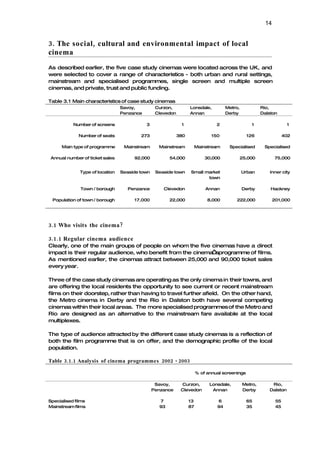
Table 3.1 Main characteristics of case study cinemas
                                 Savoy,          Curzon,          Lonsdale,          Metro,            Rio,
                                 Penzance        Clevedon         Annan              Derby             Dalston

           Number of screens                3                1                  2                 1                  1

             Number of seats             273                380               150               126                 402

      Main type of programme      Mainstream      Mainstream           Mainstream     Specialised       Specialised

 Annual number of ticket sales        92,000           54,000              30,000             25,000           75,000


              Type of location   Seaside town    Seaside town     Small market                Urban       Inner city
                                                                         town

              Town / borough        Penzance        Clevedon               Annan              Derby        Hackney

 Population of town / borough         17,000           22,000               8,000        222,000              201,000


3.1 Who visits the cinema ?

3.1.1 Regular cinema audience
Clearly, one of the main groups of people on whom the five cinemas have a direct
impact is their regular audience, who benefit from the cinema’sprogramme of films.
As mentioned earlier, the cinemas attract between 25,000 and 90,000 ticket sales
every year.

Three of the case study cinemas are operating as the only cinema in their towns, and
are offering the local residents the opportunity to see current or recent mainstream
films on their doorstep, rather than having to travel further afield. On the other hand,
the Metro cinema in Derby and the Rio in Dalston both have several competing
cinemas within their local areas. The more specialised programmes of the Metro and
Rio are designed as an alternative to the mainstream fare available at the local
multiplexes.

The type of audience attracted by the different case study cinemas is a reflection of
both the film programme that is on offer, and the demographic profile of the local
population.

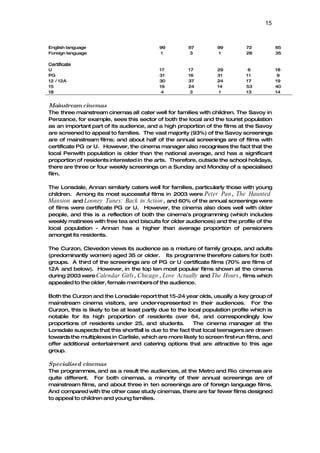
Table 3.1.1 Analysis of cinema programmes 2002 - 2003

                                                                       % of annual screenings

                                                 Savoy,      Curzon,         Lonsdale,        Metro,       Rio,
                                                Penzance     Clevedon         Annan           Derby       Dalston

Specialised films                                 7               13            6               65             55
Mainstream films                                  93              87            94              35             45
15


English language                            99         97          99         72            65
Foreign language                            1          3           1          28            35

Certificate
U                                           17         17          29          6            18
PG                                          31         16          31         11             9
12 / 12A                                    30         37          24         17            19
15                                          19         24          14         53            40
18                                           4          3           1         13            14


Mainstream cinemas
The three mainstream cinemas all cater well for families with children. The Savoy in
Penzance, for example, sees this sector of both the local and the tourist population
as an important part of its audience, and a high proportion of the films at the Savoy
are screened to appeal to families. The vast majority (93%) of the Savoy screenings
are of mainstream films; and about half of the annual screenings are of films with
certificate PG or U. However, the cinema manager also recognises the fact that the
local Penwith population is older than the national average, and has a significant
proportion of residents interested in the arts. Therefore, outside the school holidays,
there are three or four weekly screenings on a Sunday and Monday of a specialised
film.

The Lonsdale, Annan similarly caters well for families, particularly those with young
children. Among its most successful films in 2003 were Peter Pan , The Haunted
Mansion and Looney Tunes: Back in Action , and 60% of the annual screenings were
of films were certificate PG or U. However, the cinema also does well with older
people, and this is a reflection of both the cinema's programming (which includes
weekly matinees with free tea and biscuits for older audiences) and the profile of the
local population - Annan has a higher than average proportion of pensioners
amongst its residents.

The Curzon, Clevedon views its audience as a mixture of family groups, and adults
(predominantly women) aged 35 or older. Its programme therefore caters for both
groups. A third of the screenings are of PG or U certificate films (70% are films of
12A and below). However, in the top ten most popular films shown at the cinema
during 2003 were Calendar Girls , Chicago , Love Actually and The Hours , films which
appealed to the older, female members of the audience.

Both the Curzon and the Lonsdale report that 15-24 year olds, usually a key group of
mainstream cinema visitors, are under-represented in their audiences. For the
Curzon, this is likely to be at least partly due to the local population profile which is
notable for its high proportion of residents over 64, and correspondingly low
proportions of residents under 25, and students.          The cinema manager at the
Lonsdale suspects that this shortfall is due to the fact that local teenagers are drawn
towards the multiplexes in Carlisle, which are more likely to screen first-run films, and
offer additional entertainment and catering options that are attractive to this age
group.

Specialised cinemas
The programmes, and as a result the audiences, at the Metro and Rio cinemas are
quite different. For both cinemas, a minority of their annual screenings are of
mainstream films, and about three in ten screenings are of foreign language films.
And compared with the other case study cinemas, there are far fewer films designed
to appeal to children and young families.
16


Both cinemas have specific programme aims. The Rio aims "to bring the best of
world cinema to north and east London" , and the Metro aims "to offer choice beyond
the commercial mainstream, bringing to Derby a diverse selection of titles which
would otherwise never reach the city" . As a result, both cinemas tend to attract a
particular sub-group of the local population - typically described by the cinemas as
predominantly middle class, middle aged, well-educated and interested in
independent film.

However, both specialised cinemas also actively seek to complement this niche film
enthusiast audience by scheduling films and events to appeal to otherwise excluded
groups of the local community such as the minority ethnic population.

The Rio, although predominantly specialised, is also the only cinema in Hackney,
and therefore tries to ensure that a substantial proportion of its screenings are of
popular films of wide enough appeal to attract a mainstream audience from Hackney.

While the Metro does not try to compete directly with the multiplex cinemas in Derby
by showing popular mainstream films, it also has a varied programme of events and
activities targeted at specific local community groups, as detailed in the next section.


3.1.2 Additional cinema visitors targeted by special events
As well as their main programme of films, all five cinemas sought to engage
particular sub-groups of the local population through a series of specific screenings
and events. Examples of these types of event are detailed in the following table.

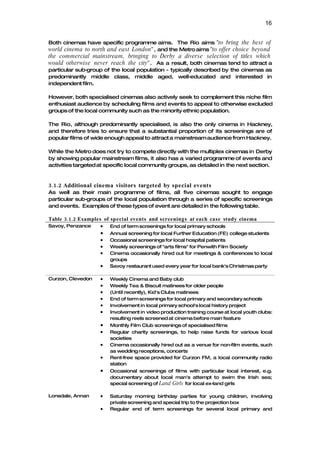
Table 3.1.2 Examples of special events and screenings at each case study cinema
Savoy, Penzance     • End of term screenings for local primary schools
                    •   Annual screening for local Further Education (FE) college students
                    •   Occasional screenings for local hospital patients
                    •   Weekly screenings of "arts films" for Penwith Film Society
                    •   Cinema occasionally hired out for meetings & conferences to local
                        groups
                    •   Savoy restaurant used every year for local bank's Christmas party

Curzon, Clevedon    •   Weekly Cinema and Baby club
                    •   Weekly Tea & Biscuit matinees for older people
                    •   (Until recently), Kid's Clubs matinees
                    •   End of term screenings for local primary and secondary schools
                    •   Involvement in local primary school's local history project
                    •   Involvement in video production training course at local youth clubs:
                        resulting reels screened at cinema before main feature
                    •   Monthly Film Club screenings of specialised films
                    •   Regular charity screenings, to help raise funds for various local
                        societies
                    •   Cinema occasionally hired out as a venue for non-film events, such
                        as wedding receptions, concerts
                    •   Rent-free space provided for Curzon FM, a local community radio
                        station
                    •   Occasional screenings of films with particular local interest, e.g.
                        documentary about local man's attempt to swim the Irish sea;
                        special screening of Land Girls for local ex-land girls

Lonsdale, Annan     •   Saturday morning birthday parties for young children, involving
                        private screening and special trip to the projection box
                    •   Regular end of term screenings for several local primary and
17


                   secondary schools
               •   Regular private screenings for local youth groups, such as Girls'
                   Brigade, Scouts and Beavers
               •   Weekly Tea & Biscuit matinees for older people
               •   Weekly world cinema screenings
               •   Cinema occasionally hired by local groups for special fund-raising
                   events

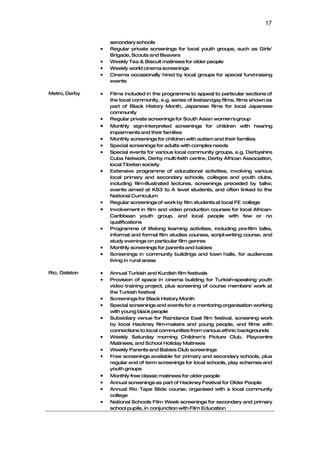
Metro, Derby   •   Films included in the programme to appeal to particular sections of
                   the local community, e.g. series of lesbian/gay films, films shown as
                   part of Black History Month, Japanese films for local Japanese
                   community
               •   Regular private screenings for South Asian women's group
               •   Monthly sign-interpreted screenings for children with hearing
                   impairments and their families
               •   Monthly screenings for children with autism and their families
               •   Special screenings for adults with complex needs
               •   Special events for various local community groups, e.g. Derbyshire
                   Cuba Network, Derby multi-faith centre, Derby African Association,
                   local Tibetan society
               •   Extensive programme of educational activities, involving various
                   local primary and secondary schools, colleges and youth clubs,
                   including film-illustrated lectures, screenings preceded by talks;
                   events aimed at KS3 to A level students, and often linked to the
                   National Curriculum
               •   Regular screenings of work by film students at local FE college
               •   Involvement in film and video production courses for local African-
                   Caribbean youth group, and local people with few or no
                   qualifications
               •   Programme of lifelong learning activities, including pre-film talks,
                   informal and formal film studies courses, script-writing course, and
                   study evenings on particular film genres
               •   Monthly screenings for parents and babies
               •   Screenings in community buildings and town halls, for audiences
                   living in rural areas

Rio, Dalston   •   Annual Turkish and Kurdish film festivals
               •   Provision of space in cinema building for Turkish-speaking youth
                   video training project, plus screening of course members' work at
                   the Turkish festival
               •   Screenings for Black History Month
               •   Special screenings and events for a mentoring organisation working
                   with young black people
               •   Subsidiary venue for Raindance East film festival, screening work
                   by local Hackney film-makers and young people, and films with
                   connections to local communities from various ethnic backgrounds
               •   Weekly Saturday morning Children's Picture Club, Playcentre
                   Matinees, and School Holiday Matinees
               •   Weekly Parents and Babies Club screenings
               •   Free screenings available for primary and secondary schools, plus
                   regular end of term screenings for local schools, play schemes and
                   youth groups
               •   Monthly free classic matinees for older people
               •   Annual screenings as part of Hackney Festival for Older People
               •   Annual Rio Tape Slide course, organised with a local community
                   college
               •   National Schools Film Week screenings for secondary and primary
                   school pupils, in conjunction with Film Education
18


                    •   One-off events for local community groups and organisations, e.g.
                        local African dance group, special film show organised by Learning
                        Difficulties Service in Hackney, event organised in collaboration
                        with a local yoga group, workshops on black visual artists.


As the above table shows, the case study cinemas are involved in a range of
initiatives targeted at various local communities and groups.

Local minority ethnic communities
Both the Metro and Rio cinemas are located in areas with significant proportions of
residents from minority ethnic backgrounds. Both cinemas schedule events and
activities to appeal to their local minority ethnic communities. For example, the Metro
often actively promotes films from particular countries to appeal to local minority
ethnic communities, as well as incorporating direct requests for particular films from
local ethnic groups. The cinema has a well-established link with a local group of
South Asian women, and holds regular private screenings of Indian films for them.
The main Metro programme has also recently included Japanese films to appeal to
the significant Japanese community living in the area (Toyota is a major employer in
Derby), films screened as part of Black History Month films; as well as one-off events
or series of events in conjunction with local Cuban, Tibetan, African, Jewish,
Congolese and Bosnian-Herzegovnian societies.

The Rio has established good links with the Turkish and Kurdish communities in
Hackney, and two key annual events for the Rio are the Turkish film festival, now in
its 12th year, and the Kurdish Film Festival, now in its third year. Given that about a
quarter of the population of Hackney are Black or Black British, the Rio is also
involved in various events and collaborations designed to appeal to and promote the
work and issues of this section of the community. For instance, in recent years, the
Rio has screened films as part of Black History month, and as part of the Black
Filmmakers International Film Festival. It has also worked with a number of
organisations that run training courses or activities for young African-Caribbean
people.

Local school pupils, college students and lifelong learners
All five cinemas have established links with local schools. The extent of these links
varies between the case studies. The Savoy, Curzon, Lonsdale and Rio all hold
regular end-of-term screenings for pupils at local schools, and several cinemas also
hold special screenings for local youth groups and FE college students. Both the
Curzon and Rio have been involved in the delivery of video and film production
training courses to young people, and screening of course members' work.

The Metro is the only one of the five cinemas to have a dedicated education officer,
who organises an extensive educational programme, targeted at local primary and
secondary school pupils, colleges and youth clubs. Activities such as film-illustrated
lectures, and screenings preceded by talks, are aimed at local children from Key
Stage 3 to A level, and screenings are also programmed to coincide with books being
studied on the National Curriculum. The cinema regularly screens the work of
students at two local FE colleges, and is planning to extend this kind of event to local
secondary schools. The Metro also regularly works with a local African-Caribbean
group who run after school video-making clubs. The cinema helps with editing and
screening their work.

In addition to this educational work with school pupils and students, the Metro also
offers its older visitors a range of 'lifelong learning' options. Some of the screenings
are preceded by introductory talks by academics, film makers, screen writers and
19


other industry practitioners. There is also an informal ‘Talk Cinema’course, and a
more formal ‘Introduction to Film Course’every year. Other Metro courses include
an amateur script-writing course, and study evenings on particular film genres such
as film noir or Japanese animation.

The Rio also offers a regular course open to all ages in tape slide production. This
course is run in conjunction with Shoreditch Community College, and leads to a
qualification accredited by the London Open College Network.

Children and families
Several of the case study cinemas have recently introduced Parent and Baby
screenings, the purpose of which is to enable parents or carers with babies under
one year old to visit the cinema without having to find a baby sitter, or worry about
their babies causing a disturbance.

As well as the regular programme of films, two of the cinemas are involved in
additional initiatives targeted directly at young children. The Lonsdale arranges on
request Saturday morning birthday parties for young children, involving a private
screening and a special trip into the projection room for the birthday child. The Rio
runs a weekly Saturday Morning Children's Picture Club, as well as weekly
Playcentre matinees and School Holiday Matinees of films to appeal to children.

The Metro has recently successfully applied for support from the charity Children in
Need for an officer to organise screenings, events and outreach activities for deaf
and autistic children and their families. The officer works two days a week,
organising special events for them every few weeks, including regular BSL-
interpreted screenings of children's films. Derby has become an important city for
deaf people: the local population has about three times the national average of
people with hearing impairments, in part due to the location in Derby of the Royal
School for the Deaf and the Derby College for Deaf People.         In addition to the
Children in Need work, the Metro holds special events directed at this community: for
example, a recent screening of work produced by deaf people.

Older people
Three of the case study cinemas hold regular (weekly or monthly) matinees for older
people, often preceded or followed by tea and biscuits. In addition to this, the Rio
also holds an annual screening as part of the Hackney Festival for Older People, and
the Curzon holds special screenings for the residents of local nursing and retirement
homes.

Independent film enthusiasts
The three mainstream case study cinemas all cater, to varying extents, to local
residents who are interested in viewing films outside the popular mainstream. Both
the Savoy and the Curzon schedule regular Film Club or Film Society screenings,
which are also open to the public. The Savoy holds several screenings per week of
a film selected by the Penwith Film Society; the Curzon's Film Club screenings are
held monthly. The Lonsdale also programmes weekly world cinema screenings.

Other cinema visitors
As table 3.1.2 shows, there are a variety of other occasional users of the case study
cinemas. These include local charities that hire the cinemas' auditoria or meeting
rooms for fund-raising events, local dance or theatre groups who hire the venue as
performance space, and local societies for which the cinemas hold special private
screenings.
20


The Curzon also provides rent-free space to a local community cinema, Curzon FM.
The Metro reaches additional audiences in rural areas by screening films in
community buildings and town halls across Derbyshire. The Savoy, in addition to its
film-watching visitors, attracts customers to its first floor bar and restaurant, and the
street-front pizza and ice-cream outlets.

3.2 What impact do the cinemas have on their visitors , and the wider
community ?
In the previous section, we described the type of people that visit the case study
cinemas. In this section, we explore the type of impact that the cinemas have on
their visitors, and the local community as a whole. This section draws on the views
expressed by regular audience members, the cinemas' suppliers, local schools and
youth groups, and representatives from the local press and councils.

3.2.1 Local acce s s to a cinema
As the only cinema in Hackney, the Rio is seen by local residents as an important
resource, enabling them to see films without having to travel further afield. Although
there are other cinemas within a few miles, travel across London to these for Dalston
residents can be costly and time-consuming. For some in the local community
participation can also be inhibited by a lack access to affordable tickets in addition to
the travel costs.

Similarly, as the only cinemas in their towns, local residents in Penzance, Clevedon
and Annan see their cinemas as important local venues. Although there are
alternative cinemas in each area, these are ten to fifteen miles away and local public
transport to and from the towns is generally regarded as inadequate, particularly in
the evenings. So the case study cinemas are seen as providing a valuable service
to residents without cars, who would be unable to access cinemas in other towns.

All five case study cinemas are centrally located, on or near the high street. This,
together with nearby or adjacent car parking for most of the cinemas, helps to ensure
good access for residents living in the immediate vicinity. Several of the cinemas
reported that a significant proportion of their audience walked from home.

       "Me and my friends come here because it is just a ten minute walk, and you
       can see films in the evenings. Whereas if you want to go to a Warner Village,
       there is a bus there and it takes up a whole Saturday to go and come back.
       This is much more convenient"

                                                                 Regular Curzon visitor

Poor public transport, particularly in the evening, was cited by cinema visitors in all
five areas as a barrier to access for some local residents living further afield. For
instance, the lack of good public transport to outlying villages in the Penwith district,
and the distance of the cinema from Penzance bus or train station, meant that rural
residents without cars were under-represented in the Savoy audience. And in
Dalston, it was thought that the lack of a tube station in the area put off some
potential visitors from other parts of Hackney or adjacent boroughs, although the
cinema is served by numerous bus routes and Dalston Kingsland train station is a
five minute walk away.

Although the central location of each cinema is seen as positive, there are some
aspects of the cinemas' neighbourhoods that were identified as possible problems for
the cinemas. The perceived safety of the area is an issue for the Metro, Rio and
Savoy. The Metro and Rio are both located in areas of their cities that are slightly
21


run-down and have reputations for crime; and the Savoy is located on a
pedestrianised street, the southern end of which has been a meeting place for rough
sleepers and drinkers. While most of the visitors to these three venues felt safe
when visiting the cinemas, it was acknowledged that some potential audience might
find the areas a little intimidating and stay away as a result.

In the Lonsdale audience discussion group, it was felt that the scarcity of good eating
and drinking places near the cinema made it difficult for the cinema to generate good
audiences. For people who wanted to "make an occasion" of a trip to the cinema,
bars and restaurants were a key factor in their decision about which cinema to
choose.

3.2.2 Local acce s s to varied programme of films
All the case study venues, to varying extents, were screening both mainstream (i.e.
big budget “Hollywood”films) and specialised cinema (i.e. independent, challenging,
sometimes foreign language films). In focus groups with regular cinema visitors, this
access to a mixed programme of films was welcomed. Importantly, both the Savoy
and Curzon were seen as offering access to unusually varied programmes for such
small towns. In interviews and discussion groups with regular audience members, all
were impressed at both the number and range of films on offer every week, and
appreciated the opportunity to see interesting films on their doorstep, for which they
might otherwise have to travel to Bristol or London. This suggested a clear cultural
impact on members of the community who would not otherwise have access to such
a variety of film.

Similarly, in a focus group of local Rio audience members, the cinema's programme
variety - again ranging from blockbusters to lesser known foreign films - was greatly
welcomed, and was compared favourably both with the nearby multiplexes which
offered only mainstream films, and with some other independent cinemas in London
that tended to show only one or two films all week.

There were a few Rio regulars who would prefer a more predominantly specialised
programme. However, they also recognised the need for the Rio, as the only
Hackney cinema, to screen popular films in order to attract the custom of a wider
range of Dalston residents.

       "The programming is surprisingly diverse: I have the opportunity to see films
       here that I might have expected to have to go to London for"

                                                                 Regular Savoy visitor

       "I think it's wonderful because you do get to see a whole range of films from
       the blockbusters like Lord of the Rings, down to small films you wouldn't
       normally see in Clevedon"
                                                               Regular Curzon visitor

       "My partner and I come to quite a range of films here, from blockbusters to
       quite a good selection of foreign films, which are not as easy to find
       elsewhere"
                                                                   Regular Rio visitor

Although the weekly world cinema screenings at the Lonsdale were also recognised
by local residents as an unusual programme for such a small cinema, they were fairly
poorly attended with average audiences of only six or seven. This is likely to be in
part due to the size of the town - only 8,000 residents - and possibly also the Sunday
22


evening screenings. Several people in the Lonsdale audience focus group felt that
Sunday night was a time for the family, and that the screenings might be more
successful if they were shown on a weekday evening.

As discussed earlier, the Metro's programme was predominantly specialised, aiming
to offer a choice of films beyond the commercial mainstream; and the regular Metro
audience welcomed the opportunity to see films that were not available at local
multiplexes. In a survey of the Metro audience, 70% said that the main reason they
had chosen to visit the Metro that day was because "the particular film was showing
only at the Metro".

       "We come to see the sort of films that you can't see at other cinemas"

       "Knowing there is something else, knowing there is really good cinema to be
       seen, if only you can find it. And cinemas like this offer that. You would
       never get that from mainstream multiplexes"

                                                                 Regular Metro visitors

As well as the regular programme of specialised cinema, the Metro also screens a
number of mainstream films, several weeks after their first release. Although some
Metro visitors found it frustrating that the Metro didn't show more first run mainstream
films, many appreciated the opportunity to see these more popular films in a non-
multiplex atmosphere, and when they had missed their initial run.

The varied programmes at the case study cinemas were seen as helping to expand
people's horizons, introducing them to films they might not otherwise consider. And
world cinema screenings were recognised as an opportunity to learn about different
societies and ways of life:

       "I have found that I have come to see films that I thought I wouldn't enjoy. So
       it's actually made me step outside of what I thought I would enjoy"

                                                                Regular Curzon visitor

       "The Rio is good if you want to learn something about other cultures"

                                                                    Regular Rio visitor

In Penzance, the link between the cinema and the Film Society was highly valued.
Society members felt very fortunate that they were able to select their own films, and
then view them in a "real" cinema, unlike their counterparts in most other film
societies who had to meet in church halls and other community buildings.

3.2.3 Acces s to film for families , children and teenagers
Films and events targeted at families and children were welcomed by regular visitors
to all five case study cinemas. Parents welcomed the opportunity to take their
children to a local cinema. The combination of the cinemas' convenient town centre
locations, and the cheap ticket and confectionery prices, meant that a trip to the
cinema was an affordable option for local families.

Family trips to the multiplexes further afield were sometimes seen as prohibitively
expensive, once the travel costs, higher ticket prices and expensive confectionery on
offer at multiplexes were taken into account.
23


       "The price has to be a consideration. I mean, where we lived before, when
       we had our three boys at home, we used to think twice about going to the
       cinema. I mean a fiver for each child, well, we just couldn't do it. But here it's
       so cheap"
                                                               Regular Lonsdale visitor

The Savoy's weekly bargain price screenings of family films, at which a £1.99 ticket
covered admission, a small carton of popcorn and a drink, were seen as a very
important way of increasing cinema access for families. Keeping ticket prices low
was a way of ensuring that films were accessible to as many local residents as
possible, particularly important in locations like Penzance and Dalston, some areas
of which are among the more deprived in England and Wales.

The time involved in such a trip to neighbouring towns or districts was also seen as a
problem that cinema visitors were delighted not to have to contend with. As a regular
Curzon visitor explained, it meant that for families with very small children, they could
eat their tea at home, pop out to the cinema to see the film, and then be back at
home very quickly, which made the trip much more manageable for everyone.

The safe, friendly environment of these small independent cinemas, compared to
bigger more impersonal establishments, was also an important draw for family
audiences. As one Rio regular explained:

       "I come on a Saturday morning to the Picture Club, which is brilliant with my
       two children.... they love it, and they come week after week. It's a really nice
       atmosphere, and they feel a strong sense of loyalty to the cinema"

The more personal atmosphere in small cinemas meant that on family trips to the
cinema, the parents or guardians could be more relaxed about keeping an eye on
their charges at all times; but it also meant that local parents were happy for the older
children to go to the cinema on their own. This demonstrated the social value of the
cinema as a safe place for the children to exert some independence. For example,
the following quotes were typical of the discussion among audience members in
Annan:

       "You know maybe in a big cinema, you might not even let them go to the
       toilet on their own, whereas here you know it's OK. In the city, I would
       probably be waiting outside for them"

       "Parents are probably more willing for them to come here on their own than
       travel to Carlisle. And so they can have their bit of independence by coming
       here without mum and dad"

                                                              Regular Lonsdale visitors

This view of small cinemas as offering a safer, more personal environment than
multiplexes was repeated in Derby during a discussion group with local residents. All
of the residents in this group were multiplex visitors rather than Metro visitors, and
they explained that a key driver behind cinema choice for them was the desire of
their children to see the latest family films. Although the Metro gave special
screenings of these type of films for children with hearing impairments and autism, it
did not appear to be offering this service to all families. Within the focus group, there
was a shared view that the Metro would be an attractive cinema to which to bring
their children if there was a more family-oriented programme, because it was seen as
24


a safer place to take children than the large multiplexes, and several members of the
group fondly recalled trips to another local independent cinema (now closed).

       "I was sad when we lost Long Eaton's [cinema] as I always used that, always
       took a group of kids... It was a family run cinema. We were always there. It
       was where the old fashioned sweetie shop was, it was ever such a little place
       and the kids loved it... because it was easy to get to, small"

       "With the smaller cinema, I could take a group of ten kids, and I knew people
       well enough so they would keep an eye on them while you took the others to
       the toilet. So having that personal touch does make you feel better"

                                                                   Local Derby residents

The central location of the Metro, and its nearness to the shops and eating places,
would also make it an attractive option for families at the weekends, if it were to show
more family films.

In Annan, it was suggested that as there were not that many options for family
entertainment in the town, the cinema was providing an important opportunity for
families to do something together that they could all enjoy.

       "It's a family thing.   You enjoy it together and talk about it when you get
       home"

                                                                 Regular Lonsdale visitor

As mentioned earlier, three of the case study cinemas had recently introduced
Parents & Babies clubs. These were proving very popular, enabling parents, who
were keen movie-goers before becoming parents, to continue enjoying trips to the
cinema, without having to find a babysitter or worrying about their baby disturbing
other cinema-goers. As one mother was recently quoted in the Hackney Gazette:

       "I thought I'd have to wait for the latest films to come out on DVD before I saw
       them, but now I go to the cinema more than my partner"

These weekly or monthly screenings were also a social occasion for new parents,
and had led to new friendships being made.

In Clevedon, these screenings were particularly welcomed by local authority youth
workers as a good way of including mothers under 21, who can otherwise be an
excluded group.

While most of the cinemas were doing well with young children, and parents of young
babies, the cinemas were not always engaging so well with older children and young
people. This issue was discussed with various participants in the study, and it was
felt that the modern multiplexes were more of a draw for this age group for various
reasons - the bigger screens and sound, the less "old-fashioned" image, the
opportunity to choose from a number of mainstream films on any one day, cafes in
which to "hang out", and the food on offer at the cinema.

       "If I go with a group of friends, the food is a big factor - they all want the whole
       experience. The hotdogs, the popcorn, the massive drinks... Cakes [at the
       Rio] don't attract the junk food loving youth of today"
25


The fact that the smaller cinemas were not always able to secure mainstream films
on the date of their release could also be a deterrent for this age group. For some
major blockbuster films, such as Lord of the Rings and Harry Potter , the two week
wait before the film was screened at the local cinema was just too long for some
people to wait, particularly children and teenagers.

       "A film like that, especially for the kids, they want to see it straight away, so
       you feel you have to go and see it somewhere else. That's a shame"

                                                                Regular Lonsdale visitor

       "Here, you do sometimes have to wait for the big films, so the youth market
       probably go to the Warner Village to see those films"

                                                                  Regular Curzon visitor

Ticket price was also an issue for young people: one young Dalston resident
explained that although she was interested in going to the cinema, most of her
contemporaries were not, and that many preferred to hire videos or DVDs because it
was cheaper. This is an important point when considering the potential social and
cultural value of the local cinema for some young people who may be excluded by
unfavourable ticket price structures.

3.2.4 Acces s to film for children with autism & hearing impairments
At the Metro in Derby, although the main programme was not very family-oriented,
there were frequent screenings for children with autism and hearing impairments.
Telephone interviews were conducted with representatives of local support groups
for deaf and autistic children, and both were strongly supportive of the Metro's work.

The representative of the Derbyshire Autistic Support Group sees these screenings
as a "godsend" for autistic children and their families. It's often the only opportunity
that these children have of experiencing a trip to the cinema. Because the screening
is exclusively for autistic children and their families, it means that parents and siblings
can accompany the autistic child, without worrying about his/her behaviour, knowing
that they are in the company of understanding people.

Sometimes, this is the only opportunity that families have to go out together.
Families with autistic children often lead very fragmented lives, with parents taking
turns to care for the autistic child while the other parent takes out the siblings, or
does the supermarket shopping.

There is also some indication that this opportunity to visit the cinema has increased
some of the older children's interest in cinema, with two young people expressing
interest in taking drama lessons and a third wanting to get involved in film making.

As well as increasing access to film and cinema for these children and their families,
other benefits were mentioned such as introducing the children to new experiences,
giving them the opportunity to learn basic skills such as how to sit still, how to behave
in a cinema, and learning to be flexible about the choice of film. The content of the
films themselves was also seen as having an impact: even for children who didn't
understand the plot, they often came out of the films talking about the colours, or
particular characters.

And there were benefits for the families too - the screenings could be a social
occasion, at which families could meet other people in similar situations,
26


experiencing similar difficulties. And where children were taken to the screenings by
the Support Group, this could be a welcome break for the families.

A representative of the Derby Deaf Children's Society reported similar sorts of
benefits to hearing impaired children and their families. Again, the Metro was seen
as providing a unique opportunity for hearing impaired children and their families to
see sign-interpreted films at the cinema. It was an opportunity for families with
hearing impaired children to access cinema in the same way that hearing families are
able to do. It was also seen as a social occasion for the children and their families,
an event where they could socialise with people in a similar situation. In this case, the
cinema is having a clear positive social and cultural impact for those families who
may otherwise be excluded from such activity.

3.2.5 Acces s to film for older people
As mentioned earlier, the local populations of Annan and Clevedon were older than
the national average, and the older residents were seen as an important part of both
cinemas' audiences. The matinees for older people were seen as a "godsend",
particularly for those who did not like going out in the evenings. At a Curzon
audience discussion group, it was pointed out that without a local cinema, many of
the older Clevedon residents who were currently enjoying this service would not
dream of travelling for miles to visit the cinemas further afield.

       "They wouldn't go to the cinema at all if it wasn't here"

Members of the Lonsdale audience focus groups felt that these screenings were a
valuable service for this section of the population, and a way of re-introducing people
to the cinema, who might not have attended for years:

       "My mother came to see Calendar Girls, and she hadn't been to the cinema
       in 30 years... that's great, because my mother now may come back again.
       They enjoy it when they get there, they just need the push"


The screenings were seen as a real social occasion for the audience:

       "They're a god send... you come here, have a hot drink and a biscuit, sit
       down and watch it in a great atmosphere, and have a wonderful experience".

                                                                    Regular Curzon visitor

       "We make a point of keeping Tuesday afternoon free... it's really sociable.
       Everybody says hello"
                                                                   Regular Lonsdale visitor

These matinees were also an opportunity for carers to come to the cinema with their
charges.

An interview was conducted with one of the organisers of the Hackney Festival for
Older People. She had been heavily involved in setting up the annual Rio
screenings, and had received a lot of very positive feedback from the audience at
these events. In the first of these screenings, it became clear that for many of the
older people in the audience, who came from across the borough of Hackney, it was
the first time they had been to the cinema for 20 or 30 years. Lack of independence
or mobility, lack of money, poor access to transport, no partners or friends to go with,
and also fears about the safety of going out (particularly at night time) were common
27


barriers to people visiting the cinema. A significant proportion of the audience at
these screenings were living in old people's homes, or sheltered housing, so were
often reliant on others to organise outings for them.

These special screenings, initially wholly funded by Hackney Council, had provided
them with an opportunity to see films in a safe environment, with no worries about
transport to and from the cinema, or paying for the tickets. The events, at which
refreshments were served and entertainment provided were seen as a welcome
social occasion for older people of all ethnic backgrounds, and a positive way of
increasing the quality of life of older people in Hackney.

Attendance at these events had dropped off since the Council withdrew some of the
funding. A small charge is now made for each ticket, transport now has to be
organised by the various nursing homes and other community organisations
involved, and refreshments are no longer provided. However, the Rio reduces the
prices of its own refreshments for these screenings to keep costs manageable for the
audience and helpers. New funding arrangements are currently being explored, in
order to keep these events running.

3.2.6 Acces s to film for particular local minority ethnic groups
As described earlier, both the Rio and the Metro were located in multicultural areas,
and were engaged in programmes and events designed to appeal to particular local
minority ethnic groups.

The Rio's various festivals and special screenings of world cinema were welcomed
as a very positive way of engaging the local minority ethnic communities in Hackney.
For instance, in an interview with one of the organisers of the Kurdish festival, he felt
strongly that the festival was giving the East London Kurdish community access to
films that would not otherwise have an outlet in this country. He pointed out that the
festival would have been impossible without the Rio's agreement not to charge an
up-front fee for obtaining the films, and hiring the cinema. The fee is taken out of the
ticket sale income. The Rio's practical help with organising the festival, and raising
funding has also been invaluable.

The festival representative also felt that the festival was a service to the community,
in that it drew people into the cinema who would not normally attend. He felt sure
that some people who had attended the Rio for the first time at the festival had gone
on to become regular Rio audience members.

Feedback was also extremely positive following the 100 Black Men of London
screenings for young people and their parents (in 2003). The following comments
were received after screenings of films about Rosa Parks and Marcus Garvey, both
important figures in Black history:

       "This is an ideal opportunity to teach our children about someone so
       prominent in our history"

       "I found the showing of Rosa Parks amazing. Not just the film, but being in a
       room with black women and men and most importantly children"

       "Can I just say how much we enjoyed the screening on Sunday. We all felt
       that we came away better informed and enlightened, and proud to be part of
       such a rich and diverse community - thank you"
28


While these festivals and special events were welcomed, both audience and local
residents felt that more could be done within the main year-long film programme to
engage the various minority ethnic groups living in Hackney: including more films
which would appeal directly to the sizeable African-Caribbean population in Dalston,
the local Vietnamese and Chinese communities, and the Turkish and Kurdish
communities.

This was a view supported by other participants in the study, including members of
both the Kurdish and Turkish Festival committees, a local Turkish newspaper, and
the director of Kush Promotions, who promote the work of black filmmakers, and
have used the Rio's basement to run a digital video production training course for
socially disadvantaged young people.

The shared view was that, while the festivals and special events were a good way of
making links with the various local minority ethnic communities, these links were not
being maintained outside these special events, and there were not enough films in
the main year-round programme to appeal directly to these local residents. It was
particularly noticeable that in a borough in which one in four residents were Black or
Black British, the regular cinema audience fewer than one in ten of the regular Rio
audience came from this ethnic background.

Interviewees suggested two ways of tackling the problem: firstly, a change in
programming, to include regular screenings of films throughout the year that appeal
to these different communities, would generate a year-round audience for the
cinema. Secondly, a change in the marketing strategy was recommended. For
instance, there was felt to be scope for better targeting of advertising of such films,
for example in Turkish newspapers, restaurants and kebab shops. Local community
organisations could also be enlisted to help with spreading the word about films or
events of particular interest to them.

In Derby, the local population was not as ethnically diverse as in Hackney. However,
13% of the local population were from minority ethnic backgrounds, and as discussed
earlier, the Metro sought to programme a diverse range of films designed to appeal
to the various local minority ethnic communities. In an audience survey conducted
as part of this study, like the Rio, the Metro appeared to be attracting a
disproportionately high percentage of residents from a white ethnic background.
However, one initiative that is worth noting is the well-established link with a local
group of South Asian women. In response to an initial request from the group, the
Metro agreed to set up private screenings of Indian films for the group. By doing this,
the Metro is enabling this group not only to see Indian films which might not be
screened elsewhere in Derby, but also to view them in a female-only setting. For
cultural reasons, these women would probably not feel comfortable attending regular
cinema screenings.

3.2.7 Acces s to film for people with disabilities
The case study cinemas varied in the level of access they provided for people with
disabilities. The Curzon, Lonsdale, Savoy and Rio all offered wheelchair access to
their screens and toilets. The Metro's ability to offer access to people with mobility
problems is limited by its current building, which is owned and run by the University
of Derby. There are no dedicated toilets for disabled customers, and no unassisted
access to the cinema. However, when the cinema relocates to the new QUAD
development, disabled access will be improved.

The Metro is fully equipped to screen films for people with hearing impairments, and
is equipped with an infra-red system. It also provides sign-interpreted screenings, as
29


described in an earlier section. The Curzon and Rio also have infra-red assisted
hearing systems or induction loops for the hard of hearing. The Curzon also offers
audio description facilities on selected films, through Dolby screentalk. There are no
facilities in the Savoy for induction loops or subtitling.

The Savoy does not currently offer wheelchair access to its restaurant and bar.
However, the Merlin Cinema group is in the process of adapting some of its other
cinemas in West Cornwall for disabled users. The Regal cinema in Redruth is the
most accessible.

3.2.8 Opportunity to learn new skills or knowledge
As discussed earlier, all five case study cinemas have established links with local
schools or colleges. To illustrate the sort of benefit that these links can have,
interviews were conducted with a teacher from a local primary school in Annan, and
a media studies teacher at an FE College in Derby.

The Annan primary school teacher explained that her school had been organising
twice- yearly screenings for its pupils for the last four years, and found that children
really benefited from the experience, both socially and educationally. She described
the purpose of the screenings as "educational pleasure". Children who might go to
the cinema with their parents got a particular pleasure out of going with a group of
peers. The school, wherever possible, tried to link the trips to literacy skills,
organising discussions of the content of the film in class before and after the
screenings. It was also suggested that the screenings were a particularly important
provision for children from poorer families and those living outside Annan, who were
isolated by lack of transport. These children might otherwise not get the opportunity
to visit the cinema.

Several cinemas tried to accommodate school requests to screen particular films with
links to subjects being studied by pupils. These screenings were of clear educational
benefit to the pupils: for example, a special screening at the Lonsdale of The Pianist
for local secondary school pupils to coincide with the school's Remembrance Day
lessons about the holocaust.

The Curzon provided another example of direct involvement in local pupils' studies.
The cinema had recently been the focus of a local history project (organised by the
Watershed in Bristol) for pupils at a local primary school. And the Savoy cinema
manager, in his role as a local businessman, had given presentations to the college's
tourism and media students about how to market services to the local community.

An interview was conducted with a media studies teacher at an FE college in Derby.
The teacher was herself sometimes a guest lecturer at Metro, and often took her A
level students to Metro screenings. She saw the links with the Metro as having many
benefits for her students. At the simplest level, their attendance at regular
screenings was a valuable way of introducing them to a wider range of films than
they would see at the multiplexes; and served to increase their interest in cinema-
going. The screenings also helped to illuminate particular issues being studied on
the A level course. And the trips to the cinema were a good social occasion for the
students.

The links with the Metro were also valuable in providing students with career
information. Recently, the Metro had held a media careers day at which students
were able to learn more about various different sectors of the industry, including
journalism, television and film making. The education officer at the Metro was also
proactive in organising behind-the-scenes tours of Metro for interested students; and
30


arranged end of year screenings of the work of student film-makers. The good two-
way communication between the college and Metro was much appreciated; in
particular, Metro was very open to suggestions about programming that would fit in
with specific aspects of the college course.

The Curzon, Rio and Metro were all involved in the delivery of training programmes
in video and film production to local young people and other residents. Interviews
were conducted with a number of the tutors, course directors and youth workers, to
explore the impact of such programmes on the participants.

The Curzon has ongoing links with various local authority-run youth clubs. One
recent project involved a group of about seven 15-16 year olds, who were selected
because of attention problems at school. They made local news reels, working under
the guidance of a local production company, and a local film editor who is on the
cinema's management committee. The resulting reels were screened at the cinema
before the main feature.

An interview was conducted with a Clevedon youth worker who had been involved in
various projects with links to the Curzon, including this news reel project. She very
much welcomed the links with the Curzon and the enthusiasm of the cinema
manager, who attends monthly youth forum meetings; and she could see clear
benefits for the young participants. As a result of the newsreel project, some of the
participants had decided to change their career ideas, and pursue work in film
production and other media-related sectors. She also felt that the project had been
important in giving "a voice to the community, particularly the younger people" .
Following this project, the youth group had been inspired to start a new project,
making a "scary movie", and together with "Calling the Shots", a production company
in Bristol, successfully applied for a First Light grant. The resulting film will be shown
at the Curzon, and will be attended by other schools and youth groups in the area.
There are also plans to start another newsreel project, to be screened monthly in the
cinema. As well as motivating the young people, and introducing them to new career
ideas, the link with the cinema is create new younger audiences for the Curzon.
Clearly, links between the local cinema and young people in the community can be
enhanced by the First Light scheme.

The long-running tape slide course at the Rio is the only such course on offer in
London, and is unique in its direct association with a working cinema. As part of this
study, an interview was conducted with the course tutor to discuss what sort of
benefits were gained by course participants.

The course attracts up to ten students a year from a range of backgrounds - women
who wanted to come back to learning after raising families; photography, fine art or
film students seeking to expand their technical skills, and their portfolios; and Rio
visitors and local residents simply interested in learning a new skill. Completion of
the course quite often led students towards further training courses, or opened up
potential new career opportunities.

The association with the Rio was felt to be invaluable for the course, and meant that
the students were able not only to view screenings of their work in progress, but also
to promote their finished product in a public arena. It took the course out of a purely
academic environment and placed it in a professional work environment, making it
much more clearly vocational and career-  enhancing.
31


It was also a good social network for course participants, and for some had helped to
reduce feelings of isolation - for example, for people new to the area, or for mothers
who had felt excluded from work or learning networks while raising their families.

Similar benefits for participants were reported by the director of 'Bridge to Normal
Living: a digital video production course', run by Kush Promotions in the basement of
the Rio from 2000 until December 2003. As well as helping to engage a group of
socially excluded young people, who had been having problems with substance
misuse and offending, the course enabled participants to learn new film-making
skills, and introduced them to the joys of film-watching. Many of the course
participants became regular Rio visitors after the course. The director of Kush
Promotions also felt that having the course based at the Rio made the cinema
appear more accessible to the wider local community.

About 24-30 students per year participate in the Balik Arts Video Projects, which are
based at the Rio. Most of the students are local young people from Turkish, Kurdish
and Turkish Cypriot backgrounds. And some of the projects are targeted at specific
groups, such as young offenders. The course leader reports similar benefits to those
highlighted for the above courses: increased confidence, ideas for future training and
careers, enhanced social networks and an increased appreciation of film-watching
(enhanced by the provision of free tickets to selected Rio screenings).

As mentioned earlier, Metro offers its visitors a range of 'lifelong learning' options,
such as introductory talks before screenings of films, an informal Talk Cinema
course, a more formal Introduction to Film course, and various study evenings on
particular film genres.

In the audience focus group, it was clear that these courses and events were seen as
a real selling point for the Metro, and an opportunity for people interested in cinema
to expand their film knowledge:

       "It's different, and you wouldn't get that in a multiplex. That's why you come
       here ...I come to learn stuff"
                                                                 Regular Metro visitor

A discussion group was held with people who were currently attending, or had
recently attended, the Introduction to Film or Talk Cinema courses. They were asked
what they felt they had gained from attending the courses, and one of the main
benefits was felt to be an introduction to new films and film genres. The following
quotes are typical:

       "I have certainly seem films that I wouldn't have done. We saw one that was
       advertised as a film about two teenage boys in Spain, and that would just not
       have appealed to me. But it was one of the best films I have ever seen".

       "It motivates me to go out and see films that I probably wouldn't see
       otherwise".

       "Now I have come in and seen things that I never would have thought of
       seeing. It has broadened my horizons; it's been really good"

                                Talk Cinema / Introduction to Film course participants

Taking part in the courses and study evenings was also seen as an opportunity to
meet like-minded people:
32


       "It doesn't feel like a course - it feels like a night out and a chance to talk...
       There is an image of people coming out of a cinema animatedly discussing
       what they have just seen, and it's become part of the culture. I think to give
       people the opportunity to do that in some sort of organised but fairly flexible
       way is great. It can be a way to meet people with like-minded interests"

Other reported benefits were an increased interest and motivation to read more
books about film, see more films of particular genres, or by particular directors; and
perhaps investigate more advanced film studies courses.

As mentioned earlier, the Metro is the only case study cinema with a dedicated
education officer. During the study, several of the other cinema managers explained
that they were very keen to expand their educational activities and links with schools,
but struggled to make any progress with this within the constraints of their budget
and without additional staff.

The Rio manager, for example, is very keen to expand the educational work of the
cinema, but had felt unable to make progress on this, with the current level of
staffing. Hackney Council also acknowledged the huge untapped potential for the Rio
to work with local schools, and has recently provided funding to enable the Rio to
offer free screening events to local schools. The manager reports a high level of
interest from local schools so far. The funding is only for a 3-month trial, and for the
Rio to continue this level of educational activities may require the appointment of an
outreach and education post.

The Curzon manager has met with local school teachers to discuss the possibilities
or establishing more school links and educational projects, and one of the cinema's
future plans is to apply for funding for a part-time education officer.

In Annan, another potential problem was raised. Although some local schools are
still clearly supportive of the cinema trips, the manager feels that the demand for
school screenings may be decreasing. This is due in part to the increasing
requirements for schools to carry out risk assessments and send out consent forms,
even for simple trips to the cinema; and also to the increasing technical ability of
schools to project their films themselves from DVDs on the school site, providing the
appropriate licences are in place.

3.2.9 Specialised cinemas : Drawing in local audience s
For the two specialised cinemas, a key issue that was raised during the study was
their ability to attract a wide range of local residents. Both cinemas were successful
in attracting niche groups of film enthusiasts, and also had good links with specific
local minority ethnic communities, schools, youth groups and so on, as described
earlier.

However, it became clear during the study that both cinemas were less well engaged
with the more general local population.

The perception of the cinemas as offering only a specialised programme appears to
be one of the main deterrents for the wider local population. In a focus group of local
multiplex visitors in Derby, none had been attracted to the Metro by the listings in the
local press, mainly because they did not recognise the film titles, directors or stars.
When deciding to go the cinema, they tended to be drawn to multiplexes as a result
of the national advertising campaigns for the big budget blockbuster movies.
33


Similarly, in a focus group of Dalston residents who were not regular Rio visitors,
they felt that the Rio has had a rather specialised image, only catering to those who
were interested in "intellectual", out-of-the-ordinary and subtitled films; and despite
the increasing numbers of mainstream films being screened at the cinema, this
specialised image endures for many, and puts people off. As one local resident put
it:

       "No matter how good it looks on the outside, if the films don't appeal to
       certain people, they are not going to come"

In both the local resident groups, the cinemas' marketing and advertising strategies
were highlighted as possible problems. In the Dalston resident group, several people
mentioned that they were often not aware of what was showing at the Rio, and would
like to see more prominent advertising on the outside of the building about current
and forthcoming films, and wider and more frequent distribution of brochures. None
of the local Derby resident group had seen the Metro brochures, despite the 22,000
brochures distributed locally every two months.

The residents in these two discussion groups were regular multiplex visitors, and one
of the features of multiplex cinemas that attracted them was the quality of the
facilities, including the screen and sound quality, the comfort of the seats and the
range of confectionery on offer. Multiple screen cinemas are also able to screen
films for longer. Small cinemas like the Rio and Metro would struggle to compete
with the multiplexes on these terms.

However, the idea of a community cinema was certainly something that appealed to
the local Derby residents. As explained earlier, there was some interest in the idea
of the Metro being a safe, friendly, central cinema, particularly appealing to local
families. The group were also impressed with the links the Metro had with
community groups. They had not seen any press coverage of this, and felt that the
Metro could do more to promote itself as a community cinema.

Whether the specialised cinemas, in particular the Metro, should be casting their nets
wider to appeal to more of the local population is an issue for debate. Both Hackney
and Derby City Councils were supportive of the cinemas' current work, but felt that
both the Rio and Metro could do more to create a stronger local image for the
cinema, build up a wider audience base, and extend their outreach activities.

Among the regular Rio and Metro visitors, there were mixed views about whether the
cinemas should attempt to appeal to a wider audience. Some were of the view that
the cinemas should reach out to a more diverse audience from all sections of the
local population. Others felt that in order to attract a wider audience, the cinemas
would need to change the balance of their programmes between specialised and
mainstream, which would reduce their appeal to the current committed audience.

3.2.10 Opportunity to see films in a "traditional " local cinema setting
In interviews and discussion groups with the audience for all five case study cinemas,
the cosy, friendly atmosphere of the cinemas was repeatedly praised. The cinemas
were seen as providing the opportunity to see films in an intimate local setting, rather
than in a large “impersonal”out-of-town cinema. There were repeated references
throughout the study to the real "sense of community" that was part of the traditional
cinema experience, and was not in evidence in the modern multiplex cinemas.

The following quotes are typical of the discussions:
34


       "It's a charming little cinema, with a personal touch"

       "People get to know you - they recognise you, and have a chat. You meet
       other people and there is a real community thing"

       "The atmosphere is wonderful, and it's very much a community in the
       afternoon. We've been welcomed with open arms"

       "I like to come here because it's very local, very cosy and very intimate... the
       atmosphere is better"

       "In the multiplex, it's just not the same sort of experience at all. It's very big
       and impersonal"

                        Regular visitors at the Savoy, Curzon, Lonsdale, Metro and Rio

For the audiences at the Rio and Curzon, the historic nature of the cinema building
itself also contributed to the experience of watching films in a traditional setting, as
the following quotes illustrate.

       "I think the Rio has a very nice personality. It's quite cuddly. It has this nice
       building with the Art Deco feel"

       "It's smaller, different, it has a bit of history to it"
                                                                    Regular Rio visitors

       "When you come here, you really do come for the cinema experience.
       Anywhere else, you are just going to watch the film. Here, you appreciate
       everything... it's friendly, it's nostalgic, going up the stairs, the kiosk in the
       corner..."
                                                                  Regular Curzon visitor


It was recognised that the case study cinemas' facilities sometimes compared
unfavourably with those of some multiplexes. For instance, the seats at the Metro
were felt to be rather uncomfortable, and the quality of the sound and screen were
not always as good as other Derby cinemas. However, the slightly dated, well-worn
nature of the facilities had its own appeal for the audience, as illustrated by these
quotes from Metro regulars:

       "It's quirky"

       "I quite like the ticket office and the till. It's cute"

For some regular visitors at the Rio and Metro, part of the appeal of the cinemas over
the more commercial cinemas was the type of audience they attracted:

       "You do not get the kids here so often: that puts me off going to a mainstream
       cinema, with kids screaming. You often can't hear anything, and I can't watch
       the film properly... that's why I come here. Because you know that people
       generally are going to be avid film fans"
                                                                   Regular Metro visitor

       "I think that is what independent cinema is all about... it's not for the young
       people to hang out. It's to appreciate the movie"
35


                                                                    Regular Rio visitor


But even for the committed Rio and Metro regulars, multiplexes were sometimes the
cinema of choice. For watching big action movies, the multiplexes' bigger screens
and higher sound quality were attractive. The greater viewing opportunities available
on any one day at multiple screen cinemas were also a draw, and for younger
people, the food available at the multiplexes was a more attractive option than the
Rio or Metro refreshments.

3.2.11 Contribution to a sense of place / Focus for pride in the local area
Participants in the study were asked what sort of wider role the cinemas played in
their local areas, and in improving the image of the locality.

Role as local venue
In all five areas, the cinema was regarded by local residents and the local press as a
key entertainment venue. In Penzance, Clevedon and Annan, there were not felt to
be many other entertainment options in the towns: for example, the Clevedon
Mercury described the Curzon as Clevedon's "only venue of note in the town". And
the cinemas were seen as providing a vital service for local residents, particularly the
young people. One regular Curzon visitor highlighted a potential negative social
impact arising from cinema closure:

       "There would be a lot less for young people to do here if it closed down, and
       there would be many more kids hanging around on the streets"

Savoy, Curzon and Lonsdale visitors shared the view that small towns like theirs
were "lucky" to have a cinema that showed such a variety of films every week. It was
recognised that local cinemas had closed down in many other areas in recent years,
and their towns were unusual in this regard.

In Derby too, although local residents were not always fully aware of the Metro, its
committed regulars and the local press felt that the cinema was providing an
important cultural service in Derby:

       "It helps to keep it [cultural life] ticking over in Derby, because the cultural
       pulse of Derby is very weak"

       "I think if the Metro was to close tomorrow, it would be a huge cultural loss to
       Derby"

When lists of "places of interest" in Hackney were being compiled by the local paper,
the Rio always featured as one of the key entertainment venues in the borough along
with the Empire and Ocean. It was seen as a vital resource for local residents, given
there were no other cinemas in the borough.

Local press coverage
One indicator of a cinema's place in the local area is the level of prominence it
achieves in the local press. The extent of local press coverage varied among the five
case study cinemas. Press support was strong for the Curzon and Rio, reasonably
good for the Metro and Lonsdale, but less so for the Savoy.

In Clevedon and Hackney, the local press has been actively involved in campaigns to
support their local cinemas. The Clevedon Mercury, a free newspaper distributed
throughout North Somerset, has adopted the Curzon cinema as "its big campaign" .
36


In the nineties, when the cinema was threatened with closure, the Mercury covered
the story and fund-raising efforts, and contributed £3,000 of its own money to help
the community buy the cinema. Since then, regular coverage is given both to the
cinema's programme of films, but also to the many fund-raising activities that have
taken place, and the cinema logo features prominently above the paper's masthead
logo. The cinema has also been featured on local television news programmes.

In May 2003, an article in the Hackney Gazette alerted the Rio and its audience to a
proposed development for Dalston which included a four-screen multiplex in its
plans. The Rio management sought public support to oppose planning permission
being granted, and features appeared in both the Hackney Gazette and Time Out,
which led to the voicing of much local support.

The Lonsdale is reasonably prominent in local newspapers, largely due to the
cinema's weekly adverts. However, in the film reviews, because prominence is
usually given to the "big titles", the local papers do tend to favour the Odeon cinemas
over the Lonsdale. The cinema manager is also fairly proactive in getting editorial
coverage of the cinema's community initiatives. For instance, the Annandale
Observer had recently published articles about school visits to the cinema, and a

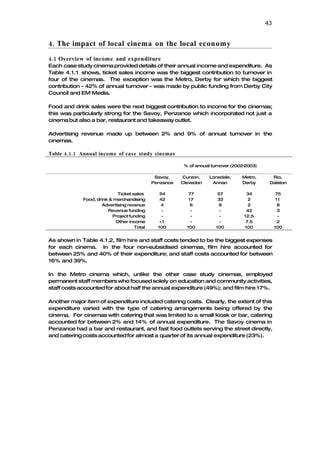
recent initiative with young mothers. The Observer was also quick to produce a
substantial piece, with colour photographs, about the participation of the cinema in
this study, with a prominent reference to the article on the front page of the paper.

In Derby, the Metro was regularly covered by the local press, both in terms of
programme listings and more substantial stories about the films or news stories.
Both local papers tried to provide more coverage to the Metro than other cinemas in
Derby. They recognised that as a specialised cinema, it needed more local press
coverage than multiplexes which benefit from the big national advertising campaigns
associated with individual mainstream films. The local papers also provided regular
coverage of Metro news stories, such as its screenings for deaf children, links with
local schools, and its place in the QUAD development; these stories were often
written in response to Metro press releases.

Although the Savoy cinema has received good press coverage in the past (in 2002
the magazine Cornwall Today ran a feature about the history of the cinema, and its
recent refurbishment by the current owner), its coverage is now limited to basic
cinema listings in the local newspapers. The cinema itself rarely receives additional
press coverage. This was confirmed in an interview with a representative from The
Cornishman newspaper, who felt that beyond weekly advertisements of the film
programme, the cinema was not very proactive in getting press coverage for its
events.

Local council support
Another indication of a cinema's place in the local area is the level of Council support
and recognition it receives. The Curzon, Metro and Rio were well supported by their
local councils, but there was not much Council recognition of the Lonsdale or Savoy
cinemas.

The Curzon, Metro and Rio have all received both financial and practical support
from their local Councils. North Somerset District Council provided a financial
contribution to the community purchase of the cinema in the nineties, and further
grants for the purchase or maintenance of equipment at the cinema. The Council
also make a practical contribution to the running of the Curzon through the presence
on the management committee of two town councillors, and practical advice from
37


Council staff in funding applications, and facilitating links between the cinema and
other local events and organisations, such as the local museum.

Derby City Council is the principal funder of the Metro, and there are close day-to-
day links between the Metro and Council staff. There is a member of the council on
the Cinema Board, and council staff advise and assist the cinema on various aspects
of local authority policy and funding. The Council actively supported the Metro
several years ago in its appointment of a permanent education officer.

The Rio has received revenue support in the past from Hackney Council, and is now
in receipt of Neighbourhood Renewal Funding, which supports specific programming
such as the Turkish and Kurdish Film Festivals and a recently launched trial
education programme. The Council have been working closely with the Rio's board
and management in recent months, to expand the cinema's programming and
organisational development and ensure that the cinema's future is secure.

The Curzon and Metro cinemas were both identified as a key part of their Councils'
cultural strategies. The Metro, in particular, had a central place in the QUAD project:
Derby's future visual arts and media centre, a project which the Council was part
funding. The Metro manager is involved in the Arts Community Forum, and is a
member of the steering group for the Council's Arts Strategy. While the Rio did not
feature explicitly in Hackney Council's cultural strategy, the cultural development
officer at the Council recognised the Rio as one of the three best known cultural
institutions in Hackney, and its importance as the only cinema in the borough.

Both the Metro and Rio were also recognised by their local Councils as key
community-based organisations. Derby City Council felt that the Metro was doing
very important work through its links with various community groups such as children
with hearing impairments, and its educational work with schools and colleges. The
Council saw this as the Metro's unique selling point, and was very keen that this work
continue when the cinema relocated to its new building. Hackney Council recognised
the Rio as "a strong and vibrant community- focused institution" .

All three of these cinemas also featured in Council tourism materials. In Clevedon,
the Council Tourism Committee were seeking to promote the cinema in a number of
ways, including on brown signs from the major roads, and via a North Somerset
regional heritage and tourism information centre. The Rio is featured in Hackney
Council's "Discover Hackney" brochures, which are distributed throughout the
borough; and the Council also displays the Rio's brochures in council offices,
buildings and libraries. And the Metro was briefly referred to in Derby tourism print
and web publicity, and is marked on the Tourist Office city map.

In Penzance and Annan, there was much less evidence of local council support for
the cinemas. Neither cinema was mentioned in their council's cultural or tourism
strategy, although there was some promotion of the Savoy as a rainy day attraction
by the local Penzance tourist office, and the Savoy also features as one of twenty
sites of historical interest on the local authority's "Penzance Trail", and is marked as
such by a plaque on the front of the building.

In Annan, neither the cinema nor its visitors felt that the Council recognised the value
of the Lonsdale. The cinema, despite applying, had not benefited from the council's
"high street facelift fund", and had had to fund the installation of brown street signs to
the cinema itself. And unlike the nearby towns of Moffat and Gretna, the council in
Annan had not funded a town map, marking key sites such as the cinema and
swimming pool. The Lonsdale audience focus group participants were not sure that
38


the council would necessarily step in to help if the Annan cinema was threatened with
closure. The local council was viewed as generally rather neglectful of Annan, letting
some of the historic buildings fall into disrepair.

Place within local community
It became clear during the study that all five case study cinemas enjoyed strong
support among local residents. This was particularly strong in Clevedon, where the
cinema had been the focus of a major fund-raising campaign. The high regard in
which the Curzon is held locally is demonstrated by the significant and ongoing
involvement of local residents and businesses in fund-raising efforts for the Curzon
Restoration Fund. Recent fund-raising activities include sponsored parachute jumps
and cycle rides, annual open-air concerts, seat sponsorship and black-tie events to
celebrate the cinema's 90th birthday. To date, £150,000 has been raised.

Both the Savoy and the Rio had also enjoyed demonstrations of local support when
they were threatened with closure. The Savoy had been saved from almost certain
closure in the early nineties by the current owner who had bought the cinema in 1990
and embarked on a five-year programme of improvements. By transforming it into a
three-screen cinema and incorporating a bar, restaurant and take-away units, he had
successfully turned the failing single-screen cinema into a financially viable
operation. During the renovations, owner Geoff Greaves received a considerable
amount of local support for his efforts, and Cornwall Today described him as a
"knight in shining armour".

In 2003, when the Rio was threatened with a potential multiple screen cinema
development in Dalston, the cinema sought public support to oppose planning
permission being granted. The Rio supporters, both local and London-wide rose to
the challenge. A flurry of emails and letters were received by the Planning
department supporting the Rio's position, and planning permission for the new
cinema was refused.

In interviews and discussions in all five areas, the cinemas' regular visitors expressed
feelings of loyalty, pride and protectiveness towards their cinemas, which they saw
as vital amenities for the local communities, as the following quotes illustrate.

       "I think people feel very protective towards the Rio because we don't want to
       lose it"

       "If it [the Savoy] were to close, there would be an outcry... it would be a
       disaster"

       "It's [Curzon] our cinema, it's the whole community's, not just a particular
       group, but everybody's... That's something to be really proud of"

       "I don't know what the community would do if we lost the cinema [Lonsdale]"


In Derby, the Metro was highly valued by its regular audience of film enthusiasts, and
the various local organisations and schools that were linked to the Metro. However,
the cinema did not have a consistently strong image across the wider community.
The City Council hopes that Metro's new visible, central location in QUAD, and its
expansion to two screens will enable the cinema, in its main film programme, to
reach out to a wider local audience, rather than its current limited appeal to a certain
type of film enthusiast. As one Metro visitor put it:
39


       "If the Metro were to close, it would be a tragedy for us, but for the community
       as a whole, they would not really notice what had happened"

This suspicion was given weight during interviews with local Derby residents who
were not regular Metro visitors. A focus group was conducted with residents who
had been recruited in local streets and shopping centres. Several of those attending
the group had not even heard of the Metro cinema, and those who were aware of its
existence tended to be unclear about where the cinema was, or what sort of films
were being shown:

       "People don't have a clue as to where it is. It's not in a prominent position, is
       it? If you don't know Derby town centre, then you don't know how to get
       there"

       "If it's a local community cinema, it's not really going to have the funding to
       push big on the marketing like the Showcase and the UCI. So people don't
       get to know that it's here, and if they do know it's here, they don't know what
       films are on, or what they are about"

As has already been discussed in various sections of this report, all the cinemas
were seen as playing a part in the local community to a greater or lesser extent. The
Curzon was a community-owned cinema, and the local community were actively
involved in supporting the cinema through their fund-raising activities and working as
volunteers at the cinema itself. The Metro and Rio were well established as
community-focused institutions through their work with various community
organisations and schools. The Savoy was perhaps rather less community-focused
than the other four cinemas in terms of outreach work. However, it was recognised
as a key local business in the area, and regularly supported local charities and fund-
raising events. In Annan, local perceptions of the cinema were inextricably linked to
perceptions of the cinema owner, and his commitment to the local community was
highly valued. The owner's teaching background meant that he was well known
among local children, and he was often personally involved in local school events,
Girls Brigade award ceremonies as well as working as a local swimming coach. The
Lonsdale cinema was also a regular sponsor of local events and organisations.

Effect on local migration
In three of the case studies, the cinema's regular visitors felt that the presence of the
cinema in the town affected people's decisions to move into or out of the area. In
Annan, the Lonsdale had been a factor in attracting some of the newer residents to
the town, as the following quotes from members of the audience group indicates:

       "It's just over a year since we moved here from Glasgow, and the cinema was
       one of the considerations we took into account when we moved here. We
       lost our local cinema on the south side of Glasgow, and that was quite an
       event, having fought for it twice over ten years. So to come here, and find
       one that has very up to date films was a great bonus"

       "We moved up from London about three years ago, and one of the reasons
       we chose Annan was because it had such a good range of facilities, which
       included a cinema"

While the Curzon regulars did not believe that the presence of the cinema in the town
would necessarily attract people to move to the area, they did feel that the cinema
was "a very good reason to stay once you're here" .
40


These sentiments were echoed by one of the regular Savoy visitors in Penzance:

       "I would move back to London if it closed"

Environmental impact on immediate vicinity
Another way in which cinemas can contribute to the sense of a local place is via their
environmental impact on their immediate vicinities. This issue was discussed with
study participants.

The Lonsdale, Savoy and Rio were all recognised as having played an important part
in raising the image of the local area. With several of the older buildings in Annan
falling into disrepair, regular Lonsdale visitors were impressed with the "real effort"
that the cinema management had made with the upkeep of the cinema. Several
commented on how well-kept the building was, the quality of the sound and screen,
and the toilets were described as "immaculate". The cinema was seen as setting a
good example in a town that was looking rather neglected, with an increasing number
of empty shops on the high street, and a big site near the Town Hall that has been
derelict for several years.

The manager of the Savoy plays an active part in the local Trader Association, and
hosts the association's meetings in the Savoy bar. In this role, he has been directly
involved in working with other local businesses to regenerate Causewayhead, the
pedestrianised street on which the cinema is located. In the early nineties, the street
was largely derelict, with many shop windows boarded up. The subsequent
renovation of the cinema and the rest of the street has significantly improved the
ambience of the area, and the level of trade, both for the cinema and other adjacent
businesses, has risen as a result. The regular cinema-goers appreciated the
cinema's interior and exterior renovations, but some still described the cinema as "a
bit tatty", particularly the foyer and toilets, and felt that this needed to be improved in
order for the Savoy to properly create an impression of being an important building in
Penzance.

A representative of the Hackney Gazette described the Rio as "a local landmark -
most people know of it", with its Art Deco frontage and being situated in the main
shopping area. Both Rio regulars and other local residents agreed that it created a
focus for the high street, which was important for generating passing trade for other
businesses, in an otherwise fairly deprived area:

       "I think it is a symbol of the fact that Dalston is not a dump... we have a lot
       there - there's the Rio, the jazz bar, a lot of excellent Turkish restaurants, the
       theatre. And I always think of the Rio first, as it is in a prominent position"

       "Without the cinema, I could imagine that a lot of the cafes and restaurants
       wouldn't be here as they would lose the passing trade. People wouldn't
       probably hang out in the high road"


At the time of this study, the Metro was looking forward to its relocation to a more
visible location in Derby, as part of a new visual arts and media centre being planned
for the City Centre. In its present location, within a University building on a mainly
residential street within five minutes walk of the city centre, the cinema's presence
was fairly unobtrusive. However, it was felt that its presence on Green Lane had
benefited the immediate local area. The cinema is located on the edges of the City
Centre and Normanton, in an area which has a poor reputation, and has been
associated with prostitution, drugs and car crime. The nearby dwellings are largely
41


flats and hostels, with a fairly transient population. The cinema had helped to
improve feelings of safety in the area. The comings and goings of the Metro
audience increased "footfall" in the area considerably, and the neon signage of the
cinema added considerably to the street and pavement lighting.

       "It brings life to Green Lane, and when it goes from here, in the evening there
       will be nothing up here"
                                                                   Regular Metro visitor

Similarly, the Lonsdale was felt to have improved security in its immediate vicinity
through the building of a fence around the car park, and improved street lighting.

In Clevedon, all those interviewed during the study were keen to see a successful
outcome to the cinema's Lottery bid, and felt that the cinema, once restored to its
former glory, would be an enormous benefit to the image of the town:

       "I think if they did the building up maybe back to its original look, then people
       would come from miles around to see it"

       "It could become like a national treasure, and then pull in a wider audience"

Generating regional or national interest in the local area
We have already mentioned a number of ways in which the case study cinemas were
seen as enhancing the image of the area: making it a more attractive place to live,
contributing to the overall cultural image of the area, and enhancing the built
environment.

Some of the cinemas had also generated some regional or national interest in the
local area. For instance, the Curzon's historical claim to be the "oldest, purpose-built,
continuously operated cinema in the world" is well marketed by the cinema via its
website and annual Open Days. As a result, the cinema has attracted the support of
a number of well-known film makers based in the West of England who recognise the
Curzon's importance in cinematic history. Aardman founders, David Sproxton and
Peter Lord, and director Nick Park, have all become patrons of the Restoration Fund
appeal. Other patrons include Terry Gilliam, Alan Rickman, Tony Robinson and Sir
Charles Elton who has lived in Clevedon all his life. This historical claim, and these
associations with senior figures in the film industry, give the Curzon some national as
well as local kudos. The cinema has received some national press coverage as a
result, on the BBC 6 o'clock news, and on Sky television.

The Savoy also claims to be the longest continually open cinema in the country, but it
was widely felt among those interviewed in Penzance that this historical claim was
not well promoted beyond the plaque on the foyer wall about the 1912 opening. The
cinema had received some regional attention in 2002 when it was the subject of an
article in the magazine 'Cornwall Today'. This article had outlined the history of the
cinema from its 1912 opening, through its various changes of ownership and fortune,
and its recent refurbishment. However, there was very little ongoing promotion of the
historical aspects of the cinema, and this was felt by many to be a missed
opportunity, and that it should be seen as a selling point for both the cinema and the
town.

The Rio was recognised not only as a key entertainment venue for Hackney, but also
as one of the key London art-house cinemas. Time Out, which has an estimated
readership of 280,000 and is distributed throughout London and the rest of the UK,
always has listings for the Rio cinema, and will often include a review of the film in its
42


'repertory and special screenings' section, and special coverage is always given to
the Turkish and Kurdish Festivals. In a poll of Time Out readers a few years ago, the
Rio appeared as one of their top 15 London cinemas.
43


4. The impact of local cinema on the local economy
4.1 Overview of income and expenditure
Each case study cinema provided details of their annual income and expenditure. As
Table 4.1.1 shows, ticket sales income was the biggest contribution to turnover in
four of the cinemas. The exception was the Metro, Derby for which the biggest
contribution - 42% of annual turnover - was made by public funding from Derby City
Council and EM Media.

Food and drink sales were the next biggest contribution to income for the cinemas;
this was particularly strong for the Savoy, Penzance which incorporated not just a
cinema but also a bar, restaurant and takeaway outlet.

Advertising revenue made up between 2% and 9% of annual turnover in the
cinemas.

Table 4.1.1 Annual income of case study cinemas

                                                         % of annual turnover (2002-2003)

                                              Savoy,    Curzon,     Lonsdale,     Metro,      Rio,
                                             Penzance   Clevedon     Annan        Derby      Dalston

                             Ticket sales       54         77           57          34            75
             Food, drink & merchandising        42         17           33           2            11
                     Advertising revenue         4          6           9            2             8
                        Revenue funding          -          -            -          42             3
                          Project funding        -          -            -         12.5            -
                            Other income        <1          -            -          7.5            2
                                     Total     100        100          100         100           100


As shown in Table 4.1.2, film hire and staff costs tended to be the biggest expenses
for each cinema. In the four non-subsidised cinemas, film hire accounted for
between 25% and 40% of their expenditure; and staff costs accounted for between
16% and 39%.

In the Metro cinema which, unlike the other case study cinemas, employed
permanent staff members who focused solely on education and community activities,
staff costs accounted for about half the annual expenditure (49%); and film hire 17%.

Another major item of expenditure included catering costs. Clearly, the extent of this
expenditure varied with the type of catering arrangements being offered by the
cinema. For cinemas with catering that was limited to a small kiosk or bar, catering
accounted for between 2% and 14% of annual expenditure. The Savoy cinema in
Penzance had a bar and restaurant, and fast food outlets serving the street directly,
and catering costs accounted for almost a quarter of its annual expenditure (23%).
44


Table 4.1.2 Annual expenditure of case study cinemas 4

                                                           % of annual expenditure (2002-2003)

                                                 Savoy,    Curzon,     Lonsdale,     Metro,        Rio,
                                                Penzance   Clevedon     Annan        Derby        Dalston

                                 Staff costs      29          16           24          49             39
                                    Film hire     30          40           25          17             31
                                    Catering      23          13           14           2             5
                 Repairs and maintenance          3            7           22          11             5
                           Rent / mortgage        6            9            -           -             3
                  Advertising and publicity       2            4            4           8             5
                     Office costs and travel      3            4            1           5             2
                           Fuel and utilities     2            5            2           -             3
                                  Insurance       1            *            2           2             2
                   Subscriptions & licences        *           1            3           1             1
              Bank charges & finance fees         1            1            4           1             2
                         Other expenditure
                                                   *           -            -           4             2
                (inc. educational activities)


4.2 Measuring local money flows : cinemas ' local spending in their communities
As part of this study, we wanted to look at the place of cinemas in their local
economies. In this section, we discuss the extent to which the cinemas' expenditure
stayed within the local area.

As stated in the Government's National Strategy for Neighbourhood Renewal (2000):

          "the problem is not necessarily that too little money flows into a
        neighbourhood.     Rather, it is what consumers, public services and
        business es do with that money. Too often, it is spent on services with no
        local presence, and so immediately leaves the area".

In order to measure what proportion of cinemas' income immediately left their local
areas, the researchers and cinema manager first needed to agree a definition of
"local", in order to calculate what constituted "local spending".

In making these decisions, the main criterion was the catchment area for the cinema
audience. Other criteria were the geography, transport links and travel patterns of
the area; and the location of, and pattern of business between, suppliers in the area.

This was inevitably a rather subjective decision in each case, but on the whole,
"local" was defined as within a 10-20 mile radius of the cinema. Table 4.2.1 gives a
description of the local area for each cinema.

One of the most difficult definitions to agree was the local area for the Rio in Dalston.
As the cinema was the only one in Hackney, the borough of Hackney may have
seemed the obvious choice. However, this would not have reflected the fact that the
Rio's specialised programme attracts a more London-wide audience, or the unique
nature of the London economy and distribution of businesses. The four-borough
definition which was agreed was an attempt to explore the cinema's relationship with
geographically close businesses, but any such definition is somewhat artificial in
such a highly concentrated area as London.


4
  Each case study cinema provided account information categorised in slightly different ways.
In order to present directly comparable expenditure breakdowns for the five cinemas, Table
4.1.2 excludes NI & pensions, rates, taxes and depreciation.
45


Table 4.2.1 Definition of "local area " for each case study cinema

Savoy, Penzance     Penwith district - an area of West Cornwall that stretches from Lands
                    End to Hayle

Curzon, Clevedon    Within a ten mile radius of Clevedon

Lonsdale, Annan     Within a twenty mile radius of Annan

Metro, Derby        Derby

Rio, Dalston        The four neighbouring London boroughs of Hackney, Tower Hamlets,
                    Islington and Haringey


Cinemas were then asked to estimate how much of their annual expenditure was
"local". The five case study cinemas, on the whole, reported broadly similar patterns
of local spending, in that each cinema reported that most or all of their staff lived in
the local area, so all or the vast majority of staff costs (excluding NI and pension)
could be classified as local expenditure.

And all five cinema managers, where the market allowed it, tried to seek out local
suppliers in favour of more distant suppliers. There was a feeling that, as small
businesses themselves, they should try to support other small local businesses
where possible, in order to help sustain the local economy.

However, one of the major expenses for all cinemas is film hire, and as most film
distributors are based in central London, or abroad, this money automatically left the
locality of each cinema.

But for services such as building upkeep, printing and advertising, supply of
confectionery and other catering stock, vehicle hire and accountancy, a significant
proportion of the suppliers were located in the cinemas' localities.

This proportion of local supplies did vary between the cinemas, and this was often for
geographical boundary reasons. For instance, the Savoy was very successful in
using suppliers from Cornwall and Devon. 88% of the money spent on catering
supplies and equipment went to businesses located within these two counties.
However, only 19% went to businesses located within the Penwith district, the "local
area" definition agreed on initially.

The Rio also reported a low local spending rate for its confectionery supplies, as very
few suppliers were based in the boroughs of Hackney, Tower Hamlets, Islington or
Haringey. The artificial nature of this "local area" definition was discussed earlier;
and if we look at the wider region, the Rio spent 76% of its confectionery budget
within Greater London.

Other factors came into cinemas' decisions not to use local suppliers, and these were
often simple business decisions about saving money. For instance, sometimes local
suppliers were simply not offering value for money, when compared to more distant
competitors; and sometimes the cinema wanted to maintain a long-standing contract
with a particular supplier, with whom they had developed a good working
relationship, despite their geographical distance.
46


As table 4.2.2 shows, the cinemas' overall local spending rates (after excluding
taxes, rates, depreciation, staff NI and pension) ranged from 42% of annual
expenditure to 62%. The overall rate for each cinema was of course dependent, not
only on the local spending rates for the different types of expenditure, but also by the
extent to which different types of expenditure contributed to the cinema's overall
annual expenditure.

Therefore, for example, at the Metro with its relatively large number of local paid staff
(several of whom were full-time), its higher staff costs contribute a lot to its overall
local expenditure rate.     For other cinemas, their reliance on volunteers and
occasional part-time staff meant that their lower local staff costs had less impact.

Table 4.2.3 shows the regional spending rates of the cinemas. For the Savoy, the
wider region was defined as Cornwall and Devon, for the Lonsdale as 'within 40
miles of Annan', for the Metro as Derbyshire and for the Rio, the region was Greater
London. (Only local spending information was collected for the Curzon). Regional
spending rates ranged from 43% to 88%.

Table 4.2.2 Local expenditure of case study cinemas 5

                                                         % of annual expenditure (2002-    2003) that was
                                                         spent in the local area, as defined in Table 4.2.1

                                                  Savoy,       Curzon,      Lonsdale,       Metro,         Rio,
                                                 Penzance      Clevedon      Annan          Derby         Dalston

                  All expenditure (after tax)      42             50            43            62              43

          Staff costs (excl. NI and pension)       100            100           100           100              85
                                     Film hire       0              0             0            0                *
                                     Catering       19             81            67            64              23
                  Repairs and maintenance           36             90            12            0               30
                            Rent / mortgage          0            100             0            0              100
                  Advertising and publicity          1            100           100            84              45
                     Office costs and travel        48             96            22            23               5
                            Fuel and utilities       0              0             0            0                0
                                   Insurance       100              0             0           100               0
                   Subscriptions & licences          0              0             0            0               12
                                Finance fees         7             74            79            66               0
                                        Other       90              0             0            32              55


5
  Each case study cinema provided account information categorised in slightly different ways.
In order to present directly comparable local spending rates for the five cinemas, Tables 4.2.2
and 4.2.3 exclude NI & pensions, rates, taxes and depreciation.
47


Table 4.2.3 Regional expenditure of case study cinemas

                                                        % of annual expenditure (2002- 2003) that was
                                                                  spent in the wider region

                                                 Savoy,      Curzon,     Lonsdale,      Metro,           Rio,
                                                Penzance     Clevedon     Annan         Derby           Dalston

                 All expenditure (after tax)      59            n/a          43           74              88

         Staff costs (excl. NI and pension)       100           n/a         100          100             100
                                    Film hire       3           n/a           0           0               95
                                    Catering       88           n/a          67          100              76
                 Repairs and maintenance           68           n/a          13           91              73
                           Rent / mortgage          0           n/a           0           0              100
                 Advertising and publicity         52           n/a         100           93              65
                    Office costs and travel        67           n/a          22           27               5
                           Fuel and utilities      10           n/a           0           0                0
                                  Insurance       100           n/a           0          100             100
                  Subscriptions & licences         19           n/a           0           0               25
                               Finance fees         7           n/a          79           66              46
                                       Other       90           n/a           0           51              95


In this study, we had originally intended to use a local multiplier tool, LM3, which has
been developed by the New Economics Foundation (NEF), in partnership with the
Countryside Agency and Esmee Fairbairn Foundation, to help small businesses
measure the impact of local spending in their communities. This LM3 tool is
designed to track where money is spent in the local economy, and would have
enabled us to estimate what proportion of a cinema's income stays within the local
economy, and what proportion leaves the area.

The LM3 tool measures only the first three rounds of spending, and is designed to
give an indication of the cinema's impact on the local economy, rather than a precise
measurement. The first round of spending is the initial income of the cinema itself.
The second round is the money spent locally by the cinemas; and the third round is
the money spent locally by the cinema's staff and suppliers. A local multiplier score
(LM3) can then be calculated by adding the money from all three rounds together,
and dividing by the initial income. The LM3 tool is described in more detail in section
10, along with an account of our experiences of adapting the tool for use with local
cinemas.

As described above, only the first and second rounds of spending have been
reported. As the work progressed, it became clear that within the budget of this
study, it was not going to be possible to calculate LM3 scores for the cinemas with
any degree of confidence, based on the third round of spending with cinema staff and
suppliers. For the tool to be used successfully, much more face-to-face contact with
the study participants would be required than the current research budget allowed, in
order to encourage staff and suppliers to participate in the study, to reassure them of
confidentiality and to advise them on the categorisation of the various items of
expenditure. Although we have not therefore been able to report any quantitative
indication of our case study cinemas' impact on their local economies, we feel that
this methodology could be a useful tool for small cinemas and similar venues, and
would be worth exploring further in the future. These issues are discussed in much
more detail in section 10.
48


4.3 Other direct and indirect local economic impacts

4.3.1 Additional local spend by cinema visitors
The above section takes into account money spent by the audience on cinema
tickets, and drinks and confectionery bought from the kiosk. There is an additional
impact to be considered on the local economy, that is, the money spent by cinema
customers (and staff) on their way to and from the cinema in local shops, bars and
restaurants, and on local transport, babysitters and so on.

Precise information about how much cinema customers spent in this way was not
systematically collected during this study. However, in discussion groups with
regular cinema visitors in all five case study areas, a number of local bars,
restaurants, bakeries, food shops and take-away outlets were identified, which
regularly attracted the custom of cinema visitors.

As the scope of this study did not enable us to conduct audience surveys in each of
the case study areas, a quantitative survey was conducted with the audience of the
Metro, Derby. One of the questions asked in the survey was about whether the
visitor had been for a meal or drink before or after visiting the cinema. Half had done
so, although the Metro's own bar was the most commonly frequented: 34% of Metro
visitors had been for a drink in the Metro bar, 9% had visited another bar, and 11%
had gone for a meal at a local restaurant or pub.

4.3.2 Impact on local labour market
All five cinemas had a direct, albeit limited, impact on their local labour markets
through their employment of local residents as staff. However, none of these were
large businesses, and numbers of staff ranged from five to twenty-three, most of
whom were employed part-time, as seen in Table 4.3.1. In addition to these regular
staff, most cinemas also employed occasional part-time staff to help out in peak
periods.

Table 4.3.1 Local expenditure by cinema staff
                                             Savoy,    Curzon,    Lonsdale   Metro,    Rio,
                                            Penzance   Clevedon    , Annan   Derby    Dalston

      Total no. full-time staff at cinema      4          1          1         3        3

   Total no. of part-time staff at cinema     16         13          4         6        20


The Curzon is unique in also drawing on a large pool of local volunteers, who help
out with ushering, repairs and maintenance, finance and management. It is also
unique in that most of its staff and volunteers are of, or approaching, pensionable
age, and as such, the cinema is providing valuable part-time working opportunities to
older local residents who are not in search of a full-time job.

Staff training and the provision of career development opportunities are other ways of
enriching the local labour market, and all five cinemas offered their staff training of
some sort.

Most cinemas offered selected staff in-house projectionist training, first aid and fire
training; and new recruits were generally inducted informally into the various
elements of the cinema business, by being shown the ropes by more experienced
staff members.
49


However, some cinemas - the ones with the largest, most diverse staff base - offered
more training and development opportunities than others. The Savoy cinema in
Penzance with its on-site bar, restaurant and take-away outlets, and its links to other
cinemas in the Merlin group, was able to provide its staff with good opportunities for
progressing within the company. For example, one long-standing staff member had
moved from cleaner to chef to accounts. All Savoy staff are expected to "multi-task",
moving from cinema to catering as necessary; thus, a job at the Savoy was seen as
offering work experience in a number of different roles. The cinema also sent its
office staff on occasional externally-run Business Link courses.

The Savoy was also fulfilling an important role in the seaside town of Penzance, in
that it was one of the few businesses that had been able to offer local people
permanent year-round employment. Because of the large influx of summer tourists,
traditionally much of the work in Penzance has been seasonal, although this situation
is now improving with the recent opening of the nearby Eden Project and the Tate at
St Ives which has extended the tourist season by several months.

The Metro in Derby was another cinema that offered its staff good training and
development opportunities. Recent training had included externally-run computer
courses for office staff, deaf awareness training to help staff work with deaf people,
and courses on marketing via the internet. Key staff were also regularly sent to
various film festivals, in order to keep up to date with industry developments and
contacts. Staff also reported opportunities to learn skills from each other within the
Metro office, mainly related to computer software, such as Photoshop.

The Metro also liked to enable collaborations between members of its staff and local
film-makers, in which both the staff and the film-makers are able to learn new skills.
For example, in a recent project, a film-making course was jointly run by a member of
Metro staff and a local film-maker. Through the running of this course, the Metro
staff member learned new film-making skills and knowledge, while the local film-
maker (previously inexperienced in teaching) learned new teaching skills. He has
since gone onto use these teaching skills on other courses.

A number of staff at the Metro are themselves keen film-makers, and the Metro
sometimes provides them with opportunities to screen their own short films or trailers
before the main feature.

4.3.3 Cinemas ' links with other local busines s e s
As well as the cinemas' direct expenditure on local supplies and local staff wages, all
the cinemas, to varying extents, had links with other local businesses, which helped
to embed them within their local economies.

Association with the cinemas, some of which have fairly prominent local images, can
be a marketing opportunity for local businesses, and four out of the five cinema
managers reported this kind of relationship with local businesses. For example,
numerous Clevedon businesses have sponsored fund-raising events at the cinema,
or contributed funds or goods in kind; in turn they are acknowledged in the Curzon
brochures and website. In Dalston, the Turkish and Kurdish film festivals are part-
sponsored by local Turkish restaurants and bakers, who are then listed in the festival
programmes. Rolls Royce and Derbyshire Building Society sponsor the screenings
for hearing impaired children at the Metro cinema in Derby, in return for free
advertising in the cinema brochure. In Penzance, local businesses tend not to
advertise in the regular Savoy leaflets. However, when the Merlin Cinema group
launches a new venture, such as a refurbished bar in one of its West Cornwall
cinemas, local businesses often take out support advertising in the local paper,
50


wishing the company well. It was clear from talking to local suppliers in Penzance
that the manager of the Savoy was held in high regard as a key local businessman,
and had established good long-standing relationships with numerous local suppliers.
One of the Savoy's suppliers, a sign designer who had installed the new signage at
the cinema, used it as an illustration for potential clients of the sort of work he could
provide.

Some of the case study cinemas had engaged in occasional collaborations with local
businesses, to the benefit of both organisations. For example, the Metro had
organised a special Thai-themed event, for which the cinema had screened a Thai
film and a nearby Thai restaurant had provided the food and drinks. The Rio had set
up an occasional link with nearby cafes or restaurants, which had offered discounted
meals to cinema users on production of a cinema ticket. Both the Curzon and the
Lonsdale in Annan had engaged in similar discount deals with local restaurants.

The Rio had made very good links with local Turkish and Kurdish businesses in
Hackney through its annual screenings of Turkish and Kurdish film festivals. In
interviews with the organisers of these festivals, both highlighted a number of ways in
which the festivals were important for the local economy. The festivals brought in
Turkish and Kurdish audiences from all over London and beyond, who visited many
of Dalston's Turkish bars and restaurants. The international guests were put up at
local hotels (sometimes in Dalston, and increasingly since its refurbishment, in the
Islington Hilton). Receptions were held in local Turkish restaurants. And local
businesses were used by the festival organisers: for example, to design the festival
posters, or to drive VIP guests around.

Several of the cinemas also had links with local film industry practitioners. In fact, the
Metro cinema saw one of its key roles to provide a meeting place and networking
opportunities for local film-makers and film-making teachers. For example, the
cinema has provided free meeting and working space for various local industry
organisations such as Script Engine and Derby Scriptwriters. It has also screened
work for Mediaworks, a Derby organisation that runs film-making courses, and has
collaborated directly with local film makers in the delivery of such courses.

For the other cinemas, links with film industry practitioners were not as central. The
Rio recently held an event to celebrate the work of local Hackney-born film director,
Asif Kapadia; as well as the occasional screening of less well-known film makers
such as a short film about the anti-war rallies. The cinema also occasionally
organises out of hours screenings for cast and crew of low budget films. The cinema
also screened the work of a number of short film and video production making
courses, that were run from the cinema basement.

The Lonsdale in Annan had organised an event recently for local students, promoting
the work of screenwriter Frank Cottrell-Boyce, who has a holiday home nearby.

The Curzon cinema had high profile patrons who were locally based, including
Aardman Animations and Sir Charles Elton. Also, one of the cinema's management
committee was also a film editor, who got involved with the day-to-day running of the
cinema and educational events at the cinema.

The Savoy occasionally screens rushes for local shoots, has sometimes been the
location for TV productions, and is also involved from time to time in offering training
to local media and tourism students in how to market services to local communities.
51


Further reading

   •   For details of the case studies see sections 5-9.
   •   For a full account of the methodology see section 10.
   •   For the impact measurement toolkit see section 11.


Acknowledgments
This report was managed and steered by:

Ann Griffiths, bfi;
Sean Perkins, UK Film Council;
Sarah Beinart, independent consultant;
Ana Tovey, Film London;

Report author: Sarah Beinart.

We would like to thank all those who kindly assisted us in this research project by
either filling in a questionnaire survey, providing key local data, participating in a
telephone interview or a discussion group. In particular, our grateful thanks go to the
managers and staff of the Metro Cinema, Derby; Rio Cinema, Dalston; Curzon
Cinema, Clevedon; Lonsdale Cinema, Annan and Savoy Cinema, Penzance.
52


Appendix

Table 1: Cinema income and expenditure
Information                                                    Impact
Ticket sales (and membership income)                           Economic
Food, drink and merchandising sales                            Economic
Advertising revenue (screen and brochure)                      Economic
Public / private funding                                       Economic
Staff costs                                                    Economic
Marketing and publicity expenses                               Economic
Film rentals                                                   Economic
Premises costs                                                 Economic
Office costs and licences                                      Economic
Programme enhancement / education costs                        Economic
Finance costs, interest, audit fees                            Economic
Annual gross turnover                                          Economic

Table 2: Building / Facilities / Location
Information                                                    Impact
Style of building / ‘fit with surrounding buildings and area
                       ’                                       Environmental
Number of screens / seats                                      Economic/Social/Cultural
Location (central / outskirts)                                 Environmental/Economic
Part of, or close to, other leisure facilities                 Economic/Environmental/Social
Type of businesses adjacent to cinema (before & after)         Economic/Environmental/Social
Parking facilities                                             Environmental/Social
Accessibility by public transport                              Social/Environmental
Quality of seating, projection, sound equipment, screen,       Social/Cultural
sound-proofing, air-conditioning, toilets, office space etc.
Provision of other facilities: bar / restaurant / shops etc.   Social/Economic
Accessibility for people with disabilities                     Social/Economic
Future development plans                                       Social/Economic/Environmental
Distance from other first run cinemas / specialised cinemas    Social/Economic
in the region

Table 3: Programming and pricing information
Information                                                    Impact
Type of circuit / hub and spoke arrangements etc.              Social/Cultural/Economic
Range of films showing (including special events, festivals)   Cultural/Social
Range of times showing                                         Social
Number and frequency of films showing by type (certificate,    Cultural/Social
genre etc)
Number of tickets sold by type (certificate, genre etc)        Economic/Social/Cultural
% capacity sold by type (certificate, genre etc)               Economic/Social
Target audience (local only, or attracting audiences from      Social/Cultural/Economic
further afield)
Ticket pricing structures (including membership schemes,       Economic/Social
discounts, partnership offers with other businesses)
Other cinema uses (e.g. bingo, amateur productions,            Economic/Social
conferences)
Future programming plans                                       Social/Cultural/Economic


Table 4: Profile of cinema audience & local residents
Information                                                    Impacts
Demographic profile (age, sex, ethnic origin, disability,      Social
53


socio-economic group, area of residence)
Frequency of cinema visits, if any                               Social
Type of journey to cinema / time taken                           Social/Environmental
Barriers to use (accessibility, transport, price, timing, film   Social/Economic/Environmental
choice, lack of interest in cinema etc.)
Other film consumption (books, videos/DVDs, TV etc.)             Social/Economic
Spend outside cinema as part of same trip, or as a result of     Economic
cinema attendance
Use of, awareness of , views about other cinemas / cultural      Social/Cultural/Economic
facilities / meeting places
Awareness of cinema showings and services                        Social/Cultural/Economic
Views about range of films on offer                              Social/Cultural/Economic
Views about ticket prices                                        Social/Cultural/Economic
Views about quality and range of cinema facilities               Social/Cultural/Economic
Views about service quality                                      Economic/Social
Views about accessibility                                        Social/Economic
Views about transport links to cinema                            Social/Environmental/Economic
Views about location of cinema (security, lighting, litter,      Environmental
noise, proximity to other facilities etc.)
Views about cinema as meeting place, focal point                 Social
Level of interest in film generally                              Social/Cultural
Pros and cons of watching films in cinema vs. other media        Social/Cultural/Economic
(TV, video/DVD etc.)
Pros and cons of multiplexes vs. traditional cinema              Social/Cultural/Economic/Envir
                                                                 onmental
“Life after five”in the local area – for different age groups    Social/Cultural/Economic/Envir
                                                                 onmental
What services / qualities wanted from a local cinema             Social/Cultural/Economic
Attitudes towards local cinema closures                          Social/Cultural/Economic/Envir
                                                                 onmental
All above to be looked at from the point of view of different    Social/Cultural/Economic/Envir
social and age groups                                            onmental

Table 5: Employment and training by cinema
Information                                                      Impacts
Number of full-time / part-time jobs (permanent / temporary      Economic/Social
or casual)
Demographic profiles of staff                                    Social
Training provision                                               Economic/Social
Skills level of staff                                            Economic/Social
Volunteering                                                     Social/Economic

Table 6: Marketing and publicity
Information                                                      Impacts
Type of marketing                                                Economic/Social/Cultural
Local media coverage                                             Social/Cultural/Economic
Any national coverage /corporate involvement                     Social/Cultural/Economic
Any local / national kudos associated with cinema                Social/Cultural/Economic


Table 7: Links with local business / organisations
Information                                                      Impacts
Local expenditure (local supplies etc)                           Economic
Other links / partnerships with local business (ads, events,     Economic
sponsorship)
Links with local production industry                             Economic/Cultural
54


Links with other local groups (film societies, community            Social/Cultural/Economic
groups etc)


Table 8: Educational activity
Information                                                         Impacts
Educational activities in / linked with cinema (formal /            Social/Cultural
informal)
Links with local schools, colleges, other groups                    Social
Outreach activities                                                 Social
Local relevant training / education provision (FE / HE /            Social/Economic
Adult education)


Table 9: Social inclusion/community cohesion activity
Information                                                         Impacts
Action aimed at minority or disadvantaged groups (e.g.              Social/Cultural
content of films, specific initiatives involving particular
groups, ticket discounts)
Action aimed at fostering links with community (historical /        Social/Cultural
social)


Table 10: Views of participants and tutors in educational / outreach activities
Information                                                         Impact
Gains / losses from participation during activity                   Social/Economic
Gains / losses from participation after end of activity /           Social/Economic
course / workshop
Ongoing contact with other participants, tutors, cinema staff       Social/Economic
etc
Further enrolment / repeat participation                            Social/Economic
Personal development                                                Social/Economic


Table 11: Views of local businesses
Information                                                         Impacts
Local spend                                                         Economic
Levels of trade associated with cinema users                        Economic
Potential / existing partnerships with cinema                       Economic
Cinema as focus for local regeneration / tourist promotion          Economic/Environmental
Reasons for location in area (e.g. as a result of or in             Economic/Environmental/Social
association with cinema, or independent of its existence?
Proximity of cinema seen as benefit to them?)


Table 12: Views of local authority / other local officials about:
Information                                                         Impacts
Place of cinema in local cultural strategy                          All impacts
Place of cinema in local regeneration / development                 All impacts
strategy
Public funding of cinema                                            Economic
Use of cinema as part of the image of the area (in local            Social/Economic/Environmental
policy, tourism promotion etc)
Potential of cinema to engage different sectors of local            Social/Cultural
55


population
Awareness of / perceptions of any cinema-related   Social/Cultural
education / outreach work
[Social benefits / community cohesion]