Impact of Climate Change on Plant Health and Agricultural Sustainability
Explores how climate change affects plant health, pest dynamics, and agricultural productivity, highlighting causes, consequences, and adaptive strategies for sustainable farming and environmental protection.
Impact of Climate Change on Plant Health and Agricultural Sustainability
1.
Plant Health andClimate Change
Dr. N.Sannigrahi,
Associate Professor,
Department of Botany,
Nistarini college, Purulia
D.B. Road, Purulia,
INDIA (W.B)
2.
PLANT HEALTH
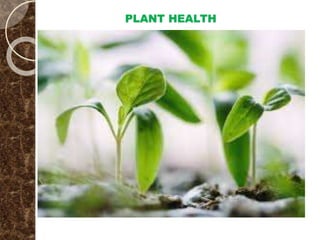
Healthyplants are able to grow and produce in the face of
environmental stress, pests, and competition. The nation’s food
supply relies upon sufficient sources of healthy plants. A range of
variables affect plant health, including the surrounding environment
and the extent to which they are protected from pests and disease.
Healthy plants are vital to sustainable and profitable crop production
and to the quality and cost of the nation’s supply of food, fuel, and
fiber. Health is also critical to plants used for ornamentals, natural
resources, and animal feed.
Scientists are using innovative methods to breed more productive and
nutritious crops. Advances in breeding and genetics are allowing
farmers to grow plant varieties that are healthier and more resilient to
drought and losses from pests and diseases.
Research and innovation on plant health are key to keeping crops
healthy in a challenging environment while aiming for a sustainable,
climate-neutral and biodiversity-friendly farming system.
PLANT HEALTH
Moreover,climate change is altering pests’ behavior and geographical
distribution, which may further increase the risk of introducing pests
to new areas and the severity of the impact.
These factors can cause significant damage to crops, native plants and
the environment. Risks to plant health are on the rise, threatening
agricultural sustainability, biodiversity and food security.
The introduction and spread of plant pests are serious threats with far-
reaching economic, social and environmental consequences.
Tackling numerous and highly dynamic biotic and abiotic changes
requires integrated approaches and the development of a wide range of
solutions for the prevention, early detection, monitoring, control and
management of pests and diseases, along with risk management
strategies.
Reducing pesticides in the management of plant pests protects the
environment, pollinators, natural pest enemies, beneficial organisms,
animals and people.
5.
PLANT HEALTH &CLIMATE CHANGE
Across the world, climate change is shifting the delicate balance that
keeps plants – and everything they support - healthy.
As temperatures rise, rains become less predictable, and extreme
weather strikes more often, plant pests and diseases are spreading in
ways not seen before.
The consequences reach far beyond crops.
In a world where human, animal, plant and environmental health are
deeply connected, protecting plant health has never been more
critical.
Climate change not only affects the prevalence and severity of plant
diseases but also influences the effectiveness of disease management
strategies, necessitating adaptive approaches in agricultural practices.
Climate change significantly alters the dynamics of plant pathogens,
primarily through changes in temperature, humidity, and precipitation
patterns, which can enhance the virulence and spread of various plant
diseases.
6.
PLANT HEALTH &CLIMATE CHANGE
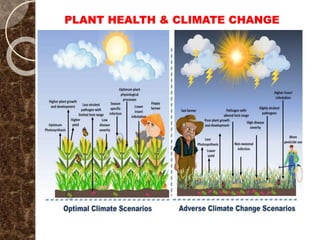
Indeed, the increased frequency of extreme weather events, which is a
direct consequence of climate change, creates favorable conditions for
outbreaks of plant diseases.
As global temperatures rise, the geographic range of many plant
pathogens is expanding, exposing new regions and species to diseases
previously limited to warmer climates.
Thus, the climate change and its hidden issues for long time
unexploration has aggravated the issues in a very serious manner.
The biotic communities in general and the higher plants health in
particular has become a matter of serious concern in this regard for its
magnitude of impact in large scale has developed million dollar
question.
CLIMATE CHANGE
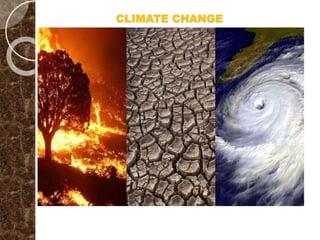
Climatechange refers to long-term shifts in temperatures and
weather patterns. Such shifts can be natural, due to changes in the
sun’s activity or large volcanic eruptions.
But since the 1800s, human activities have been the main driver of
climate change, primarily due to the burning of fossil fuels like coal,
oil and gas.
Burning fossil fuels generates greenhouse gas emissions that act like
a blanket wrapped around the Earth, trapping the sun’s heat and
raising temperatures.
The main greenhouse gases that are causing climate change include
carbon dioxide and methane. These come from using gasoline for
driving a car or coal for heating a building, for example.
Clearing land and cutting down forests can also release carbon
dioxide. Agriculture, oil and gas operations are major sources of
methane emissions. Energy, industry, transport, buildings,
agriculture and land use are among the main sectors causing
greenhouse gases.
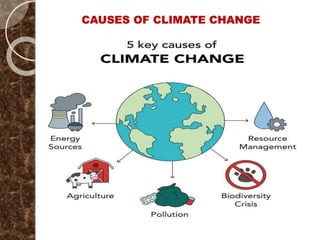
CAUSES OF CLIMATECHANGE
In the natural system, climate variability and fluctuations have always
been observed in Earth’s 4.6 billion year history. However, over the past
century changes in concentrations of greenhouse gases in the
atmosphere are of an unprecedented rate and magnitude.
The climate changes that have occurred since the start of the industrial
revolution are due to a complex mixture of mainly human and up to
small extent natural causes.
ANTHROPOGENIC & NATURALCAUSES
i. Fossil fuel uses foe energy ,
ii. Industry and its associative bi-products,
iii. Agriculture and animal husbandry,
iv. Deforestation,
v. Earths tilt,
vi. Ocean currents,
vii. Volcanoes,
viii. Forest Fires and many more behind this disaster.
11.
CAUSES OF CLIMATECHANGE
GENERATING POWERS
A large chunk of global emissions comes from burning fossil fuels to
produce electricity and heat.
Most electricity is still generated by burning coal, oil, or gas, which
produces carbon dioxide and nitrous oxide – powerful greenhouse gases
that blanket the Earth and trap the sun’s heat.
The trapping of heat is not radiated back due to shield over the upper
atmosphere due to diverse reasons- increasing the global mean
temperature.
MANUFACTURING GOODS
Manufacturing and industry produce emissions, mostly from burning
fossil fuels to generate the energy needed to make things like cement,
iron, steel, electronics, plastics, clothes, and other goods.
Mining and other industrial processes also release gases, as does the
construction industry. Machines used in the manufacturing process often
run on coal, oil, or gas.
Some materials, like plastics, are made from chemicals sourced from
fossil fuels. The manufacturing industry is one of the largest contributors
to greenhouse gas emissions worldwide.
12.
CAUSES OF CLIMATECHANGE
USING TRANSPORTATION
Most cars, trucks, ships, and planes run on fossil fuels. This makes
transportation a major contributor of greenhouse gases, especially
carbon-dioxide emissions.
Road vehicles produce the largest part, due to the combustion of
petroleum-based products, like gasoline, in internal combustion
engines. But emissions from ships and planes continue to grow.
Transport accounts for nearly one quarter of global energy-related
carbon-dioxide emissions. And trends point to a significant increase
in energy use for transport over the coming years.
CUTTING DOWN FORESTS
Cutting down forests to create farms or pastures, or for other reasons,
generates emissions, since trees, when they are cut, release the carbon
they had been storing.
Each year approximately 10 million hectares of forest are destroyed.
Since forests absorb carbon dioxide, destroying them also limits
nature’s ability.
CAUSES OF CLIMATECHANGE
to keep emissions out of the atmosphere.
Deforestation, together with agriculture and other land use changes,
is responsible for roughly a third of global greenhouse gas emissions.
POWERING BUILDINGS
Globally, residential and commercial buildings consume nearly 60
per cent of all electricity.
As they continue to draw on coal, oil, and natural gas for heating and
cooling, they emit significant quantities of greenhouse gas emissions.
Growing energy demand for heating and cooling, with rising air-
conditioner ownership, as well as increased electricity consumption
for lighting, appliances, and connected devices, has contributed to a
rise in carbon-dioxide emissions from buildings in recent years.
RESPIRCE MANAGEMENT
Process of identifying, allocating and utilizing of the resources in the
most efficient and strategic means to ensure efficiency and maximum
value,
15.
CAUSES OF CLIMATECHANGE
Resource planning, resource allocation, resource scheduling,
resource utilization, resource revealing and resource forecasting are
very important in this regard.
Anyone can become the threats to the climate change.
PRODUCING FOOD
Producing food causes emissions of carbon dioxide, methane, and
other greenhouse gases.
This is due, for instance, to deforestation and clearing of land for
agriculture and grazing, digestion by cows and sheep, the production
and use of fertilizers and manure for growing crops, and the use of
fossil fuels to run farm equipment or fishing boats.
All this makes food production a major contributor to climate
change. Greenhouse gas emissions also come from packaging and
distributing food.
CONSUMING TOO MUCH
Our lifestyles can have a profound impact on our planet. Our use of
power at home, how we move around, what and how much we throw
16.
CAUSES OF CLIMATECHANGE
contribute to greenhouse gas emissions.
So does the consumption of goods such as clothing, electronics, and
plastics. The wealthiest bear the greatest responsibility: the 20 largest
economies are responsible for almost 80 per cent of global emissions.
Mahatma Gandhi stated “ Earth provides enough to satisfy every
man’s needs but not every man’s greed”.
Besides the aforesaid issues, the other factors aggravated the climate
changes like
Long term orbital changes- warmer interglacial periods & Earth’s tilt
along with precision
Volcanic eruptions- release of aerosols from lava and Carbon di oxide
Solar activity- 11 year sun spot cycles causing sun’s energy output,
Ocean currents or circulation- El Nino. La Nina and variations in
ocean circulation
Continental drifts or Plate Tectonics movement-Movement of
continental changes.
17.
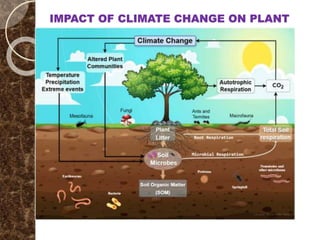
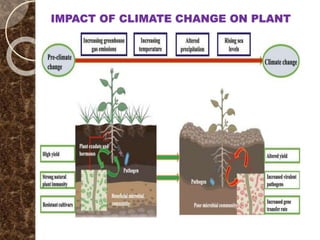
IMPACT OF CLIMATECHANGE ON PLANT
Across the world, climate change is shifting the delicate balance that
keeps plants – and everything they support - healthy.
As temperatures rise, rains become less predictable, and extreme
weather strikes more often, plant pests and diseases are spreading in
ways not seen before. The consequences reach far beyond crops.
In a world where human, animal, plant and environmental health are
deeply connected, protecting plant health has never been more
critical.
Increasing temperatures, shifts in humidity, and cycles of drought and
flooding affect crops and provide the perfect conditions for fungi to
grow and contaminate food. Some of these fungi can then produce
mycotoxins - potent toxins that are invisible and survive cooking and
processing.
These are not distant risks. Changes in climate are already affecting
the behavior, severity and spread of plant pests and pathogens, and
these changes are accelerating.
When plant health suffers, the effects ripple across the web of life and
into human and animal health.
IMPACT OF CLIMATECHANGE ON PLANT
Plants provide vital ecosystem services - they stabilize soils, filter water,
store carbon, regulate local climates, and sustain wildlife.
But when plant pests and diseases, including invasive species, weaken
plant health, these services begin to break down.
This loss of plant health impacts ecosystem stability affects animals
directly. Invasive plants like Parthenium hysterophorus and Prosopis
juliflora outcompete native vegetation, reducing forage quality and
quantity for livestock. Locust outbreaks, driven by favorable climatic
conditions, can strip landscapes bare, leaving herders without grazing
lands. And when animals consume contaminated feed containing
aflatoxins or other mycotoxins, their growth, fertility, and immunity are
compromised.
For people, plant health decline can mean reduced food availability and
greater food insecurity. Like with animals, it can also increase exposure
to harmful substances such as toxins in contaminated staple crops like
maize, groundnuts and sorghum, that can cause serious health issues.
Beyond this, degraded ecosystems with poor plant life leave communities
less able to cope with climate shocks like floods, droughts, and heat
waves.
20.
IMPACT OF CLIMATECHANGE ON PLANT
Climate change accelerates the decline of plant health, and this unravels
the ecosystem services that support human, animal and environmental
health.
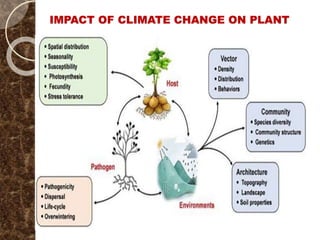
IMPACT ON PESTS, PATHOGEN AND PLANT PHYSIOLOGY-
The life cycle, epidemiological characteristics and spread of plant pests
and diseases are determined by climatic factors such as solar radiation,
temperature and rainfall.
Slow onset events such as increasing temperature are usually easier to
predict than rapid onset events such as shifts in rainfall patterns.
Global warming and extreme changes in weather events will likely affect
the life cycle, epidemiological characteristics and spread of plant pests
and diseases.
Rising temperatures may for instance increase the fertility of pests, and
thus accelerate their population development and threaten food security.
Global warming also allows pests to better survive winters and may thus
reduce pest dormancy.
In addition, changes in wind patterns may affect the distribution of pests;
for instance, hurricanes and other extreme weather events can disperse
pests and diseases more widely.
21.
IMPACT OF CLIMATECHANGE ON PLANT
On the other hand, pests and diseases can contribute to climate
change by causing tree mortality, which may consequently reduce net
carbon sinks, since trees can either sequester carbon or release it into
the atmosphere. Increased carbon dioxide and ozone levels in the
atmosphere and intensified rainfall may also have an impact on plant
physiology and structure, which could lead to a greater plant
vulnerability towards pests and diseases.
Rising temperatures may cause breakdown of resistance mechanisms
in plants and increase their lignifications, i.e. hardening of the cell
walls, which can reduce possibilities to process the plant biomass in
food production.
Storms and increased amount of rainfall may weaken plants and
cause an increased fungal and bacterial infectivity.
The increased virulence of plant diseases may enlarge the
geographical range within which pests spread. In the case of
droughts, stressed plants risk losing their natural ability to resist pests
and diseases.
IMPACT OF CLIMATECHANGE ON PLANT
to find favorable climate conditions in areas previously uninhabitable to
them and consequently spread to these areas.
Newly introduced crops may further facilitate the pest and disease
distribution in such areas.
The impacts of pests and diseases may even be boosted if their
interactions with prevalent hosts lack resistance mechanisms developed
in their area of origin through co-evolution. Increased focus on
analyzing the impact of climate change when conducting pest risk
analysis can therefore help to protect plant health, biodiversity and food
security.
In response to the increased spread of plant pests, the global use and
demand of some potentially harmful synthetic toxic agrochemicals
might proliferate with negative consequences for plant health, human
health, biodiversity and the environment.
Agricultural and forestry activities may require shifts in plant breeding
and modifications in pest control practices in order to adapt to climate
change, which demand renewed technical know-how, in particular with
regard to prevention of the international spread of pests and diseases and
the disciplines to surveil pest occurrence.
IMPACT OF CLIMATECHANGE ON PLANT
GENETIC EROSION MAKES PLANT MORE VULNERABLE
TO CLIMATE CHANGE-
Plant genetic diversity provides an important reservoir of heritable
traits that can help crop production systems to better adapt to climate
change, and reduce the need for external outputs, such as certain
hazardous pesticides or fertilizers, that may cause damage to the
environment.
Besides domesticated plants, climate change can also affect the
ability of many crop wild relatives to survive in their current
locations.
Therefore, promoting the conservation, exchange and use of plant
biodiversity across the globe is crucial to ensure crop resilience and
adaptation to climate change.
It is important to always ensure that plants and plant products meet
phyto-sanitary requirements when they move across borders.
The genetic erosion also accelerates the loss of plant and animal
diversity that has severe impact on global biodiversity.
26.
IMPACT OF CLIMATECHANGE ON PLANT
CLIMATE CHANGE THREATENS THE SAFE TRADE OF
PLANT PRODUCTS-
Trade offers a way to resolve climate-change-induced food shortages
regionally, but international trade also provides a pathway for plant
pests and pest vectors to spread into new, warmer areas of the world
that were previously not hospitable to them.
Increased plant pests may cause significant economic losses and
reduce yields and the quality of the harvest, thus resulting in
potentially considerable food losses.
Countries should consider the implementation and enforcement of
sanitary and phyto-sanitary measures to achieve the benefits of safe
international trade in plants and plant products.
27.
THANKS FOR YOURVISIT
ACKNOWLEDGEMENTS:
a. Google for images,
b. Different websites for enriching the course content,
c. Science Direct pages,
d. Plant diseases, insects and pests- NCBI-NH,
e. www.nature.com
f. www.spruce.com
g. www.aphis.usda.gov
h. Puregreensaz.com
i. https://www.un.org/en/climatechange/science/causes-effects-climate-
change
j. www.fao.org
k. https://ccd.gujarat.gov.in/causes-of-climate-change.htm
l. Many more websites for references.
This presentation has been designed to address the academic fraternity
without any financial interest. This is absolutely free to use . The
author does not claim any kind of financial benefits from this content
 Most read
 Most read