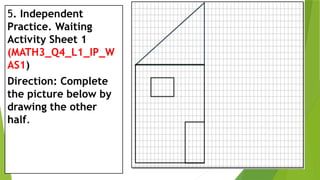
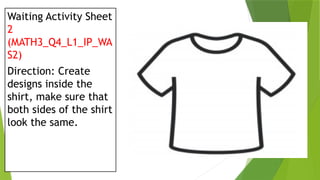
MATHEMATICS
Learning Competencies:
• Identifyshapes or figures that show line
symmetry by drawing the line of symmetry.
• Complete a figure that is symmetric with
respect to a line.
• Describe and draw the effect of a two-
direction multi-step (or translation) in basic
shapes and figures.
3.
Integrated Learning Area:Good Manners and Right Conduct
(GMRC)
Integrated Learning Competency (ies):
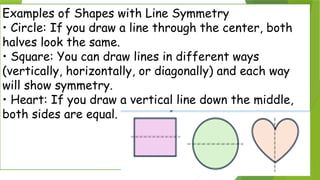
Nakapagsasanay sa pagiging responsable sa pamamagitan ng
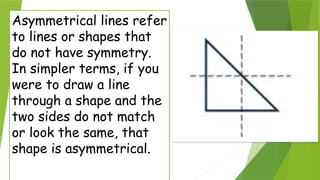
panghihikayat sa kapuwa-bata na gampanan ang mga tungkulin
bilang kasapi
ng barangay na kinabibilangan
a. Naiisa-isa ang tungkulin ng mga taong nakatira sa barangay.
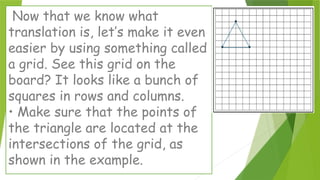
b. Naipaliliwanag na ang mga tungkulin ng mga taong nakatira
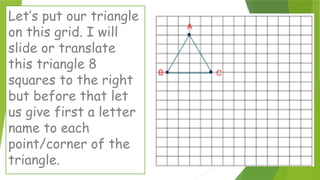
sa barangay ay kailangang gampanan ng lahat bilang
pagtataguyod ng kanilang
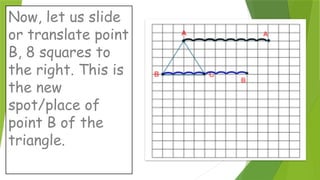
kabutihan.
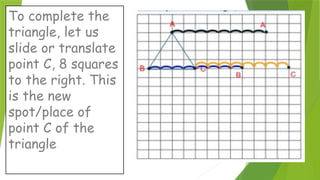
5.
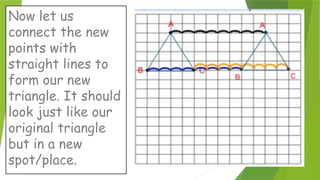
WHAT WILL ILEARN?
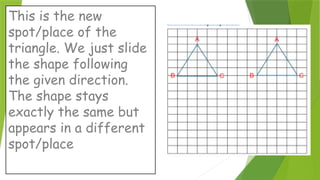
Learning about line symmetry and how to create symmetric
figures is an exciting way to explore shapes! When we
identify shapes that have line symmetry, we discover how
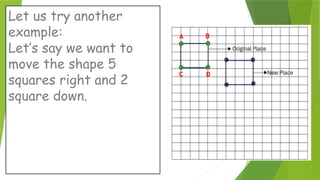
they can be divided into two equal halves that look the
same. Drawing the line of symmetry helps us understand
this concept better and makes it easier to complete figures
that are symmetric. Additionally, when we learn about
translations, we see how shapes can move in different
directions while still keeping their original form. This skill
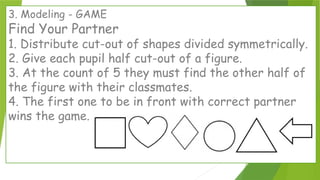
allows us to create interesting designs and patterns.
6.
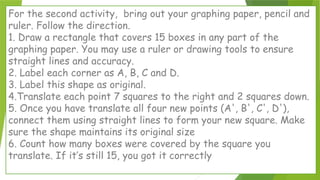
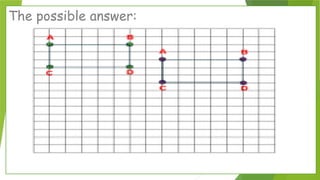
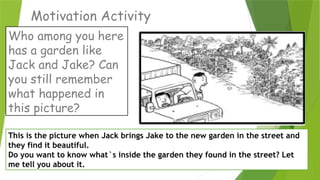
I. Motivation Activity
Whoamong you here
has a garden like
Jack and Jake? Can
you still remember
what happened in
this picture?
This is the picture when Jack brings Jake to the new garden in the street and
they find it beautiful.
Do you want to know what`s inside the garden they found in the street? Let
me tell you about it.
7.
When you enterthe garden, you will see a lot of
colorful flowers blooming everywhere. There are
red roses, yellow daisies, and purple tulips
swaying in the gentle breeze. As you walk closer, you
might spot a beautiful butterfly flying around. Its
wings are bright yellow, pink and purple.The
butterfly dances from flower to flower, landing
softly to sip sweet nectar. Watching it makes you
smile and feel excited about nature. The garden
is a magical place where flowers and butterflies
come together!
8.
• What doyou see when you enter the
garden?
• Name three types of flowers mentioned in
the paragraph.
• What colors are the butterfly's wings?
• What do you think the butterfly might
feel while flying around the garden? Why?
9.
This is thepicture of the butterfly you can find
inside the garden that Jack and Jake discovered
in the street.
10.
Look I willfold the cut-out butterfly into
two.
What happened to the cut-out? (It was
divided into two)
What can you say about the two sides?
(Equally the same)
That’s right! The two sides are equally the
same. This is what we call symmetry.
11.
Line symmetry meansthat a shape can
be divided into two equal parts that are
mirror images of each other. If you
fold the shape along a line, both sides
will match perfectly.
12.
How to drawLine of Symmetry?
• Find the Middle: Look for the center of the
shape. This is where you will draw your
line.This can be vertical (up and down),
horizontal (side to side), or diagonal (corner
to corner).
• Draw the Line: Use a ruler or a straight
edge to draw a line through the middle. This
line is called the line of symmetry
13.
Examples of Shapeswith Line Symmetry
• Circle: If you draw a line through the center, both
halves look the same.
• Square: You can draw lines in different ways
(vertically, horizontally, or diagonally) and each way
will show symmetry.
• Heart: If you draw a vertical line down the middle,
both sides are equal.
14.
Asymmetrical lines refer
tolines or shapes that
do not have symmetry.
In simpler terms, if you
were to draw a line
through a shape and the
two sides do not match
or look the same, that
shape is asymmetrical.
15.
What shape isthis? Is this symmetrical or
asymmetrical? Yes this is symmetrical. Why do
you say so?
Now, let’s think about what would happen if I
move this triangle from one spot to another on
the board. Watch as I slide the triangle
over here. Look! The triangle is now in a new
place, did the triangle change its shape or size?
It looks exactly the same, it`s still symmetrical.
This movement is called translation.
16.
Translation means weare sliding a shape in a
direction without flipping it, changing its size, or
turning it. When we slide it, it stays exactly
the same. We can move it in a straight line in any
direction—up, down, left, or right. The shape
remains the same but appears in a different
position.
17.
Now, let’s tryit together with different shapes.
I have here a square and a circle on the board,
and I will translate or slide the shapes
to a new spot. After I slide or translate it, let’s
check if the shapes look the same as before.
Does the shape and size change? How about
the position of the shape, does it change?
18.
Now that weknow what
translation is, let’s make it even
easier by using something called
a grid. See this grid on the
board? It looks like a bunch of
squares in rows and columns.
• Make sure that the points of
the triangle are located at the
intersections of the grid, as
shown in the example.
19.
Let’s put ourtriangle
on this grid. I will
slide or translate
this triangle 8
squares to the right
but before that let
us give first a letter
name to each
point/corner of the
triangle.
20.
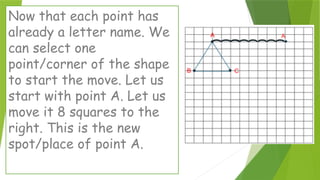
Now that eachpoint has
already a letter name. We
can select one
point/corner of the shape
to start the move. Let us
start with point A. Let us
move it 8 squares to the
right. This is the new
spot/place of point A.
21.
Now, let usslide
or translate point
B, 8 squares to
the right. This is
the new
spot/place of
point B of the
triangle.
22.
To complete the
triangle,let us
slide or translate
point C, 8 squares
to the right. This
is the new
spot/place of
point C of the
triangle
23.
Now let us
connectthe new
points with
straight lines to
form our new
triangle. It should
look just like our
original triangle
but in a new
spot/place.
24.
This is thenew
spot/place of the
triangle. We just slide
the shape following
the given direction.
The shape stays
exactly the same but
appears in a different
spot/place
25.
To translate shapes,follow these simple steps:
1. Choose a Shape: Start with any shape like a triangle or square.
2. Decide the Move: Determine how far to move the shape. You
can move it: Up,Down,Left,Right. For example: move 2 squares up
and 3 squares right.
3. Pick a Point: Select one corner of the shape to start the move.
4. Move Each Point: For every corner of the shape:
• Move it the same distance in the same direction.
• If you moved one point up and right, do this for all points.
5. Draw the New Shape: Connect the new points to form the
translated shape.
This keeps the shape's size and angles unchanged!
26.
How to Describea Translation?
When we describe a translation, we say
how far and in which direction we moved.
For example: "Move 3 squares to the
right.", "Move 2 squares up."
27.
Let us tryanother
example:
Let’s say we want to
move the shape 5
squares right and 2
square down.
28.
For each point,follow these steps:
For Point A:
Move Right: Count 5 squares to the right from
Point A.
Move Down: From this new position, count 2
squares down.
Mark the New Position: This is the new location
for Point A. Label it as Point A'.
29.
For Point B:
MoveRight: Count 5 squares to the right from
Point B.
Move Down: From this new position, count 2
squares down.
Mark the New Position: This is the new location
for Point B. Label it as Point B'.
30.
For Point C:
MoveRight: Count 5 squares to the right from
Point C.
Move Down: From this new position, count 2
squares down.
Mark the New Position: This is the new location
for Point C. Label it as Point C'.
31.
For Point D:
MoveRight: Count 5 squares to the right from
Point D.
Move Down: From this new position, count 2
squares down.
Mark the New Position: This is the new location
for Point D. Label it as Point D'.
32.
Draw the TranslatedSquare
Once you have marked all four new points (A',
B', C', D'), connect them using straight lines to
form your new square. Ensure that the sides of
your new square are equal in length and parallel
to those of the original square.
33.
3. Modeling -GAME
Find Your Partner
1. Distribute cut-out of shapes divided symmetrically.
2. Give each pupil half cut-out of a figure.
3. At the count of 5 they must find the other half of
the figure with their classmates.
4. The first one to be in front with correct partner
wins the game.
34.
What did younotice on the 2 sides
of the cut-outs? (the same)
What do you call those
figures/objects that can be divided
equally? Cannot be divided equally?
35.
For the secondactivity, bring out your graphing paper, pencil and
ruler. Follow the direction.
1. Draw a rectangle that covers 15 boxes in any part of the
graphing paper. You may use a ruler or drawing tools to ensure
straight lines and accuracy.
2. Label each corner as A, B, C and D.
3. Label this shape as original.
4.Translate each point 7 squares to the right and 2 squares down.
5. Once you have translate all four new points (A', B', C', D'),
connect them using straight lines to form your new square. Make
sure the shape maintains its original size
6. Count how many boxes were covered by the square you
translate. If it’s still 15, you got it correctly
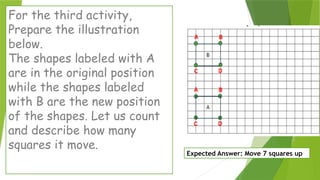
For the thirdactivity,
Prepare the illustration
below.
The shapes labeled with A
are in the original position
while the shapes labeled
with B are the new position
of the shapes. Let us count
and describe how many
squares it move.
Expected Answer: Move 7 squares up
38.
4. Guided Practice
WaitingActivity
Sheet 1
(MATH3_Q4_L1_G
P_WAS1)
Direction: Draw a
house using at least
5 different shapes.
39.
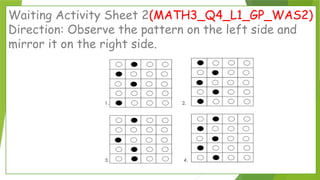
Waiting Activity Sheet2(MATH3_Q4_L1_GP_WAS2)
Direction: Observe the pattern on the left side and
mirror it on the right side.
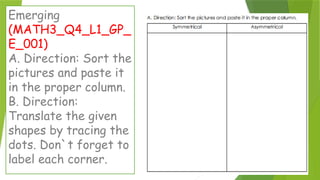
Developing (MATH3_Q4_L1_GP_D_002)
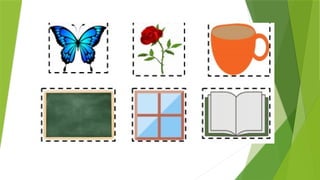
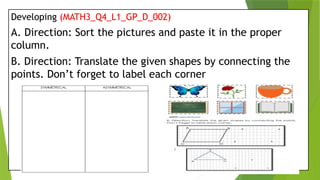
A. Direction:Sort the pictures and paste it in the proper
column.
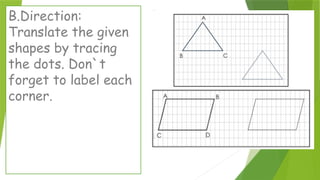
B. Direction: Translate the given shapes by connecting the
points. Don’t forget to label each corner
44.
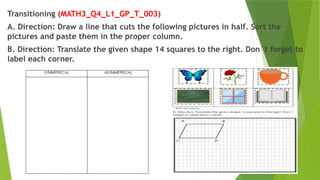
Transitioning (MATH3_Q4_L1_GP_T_003)
A. Direction:Draw a line that cuts the following pictures in half. Sort the
pictures and paste them in the proper column.
B. Direction: Translate the given shape 14 squares to the right. Don`t forget to
label each corner.
45.
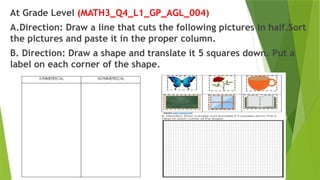
At Grade Level(MATH3_Q4_L1_GP_AGL_004)
A.Direction: Draw a line that cuts the following pictures in half.Sort
the pictures and paste it in the proper column.
B. Direction: Draw a shape and translate it 5 squares down. Put a
label on each corner of the shape.
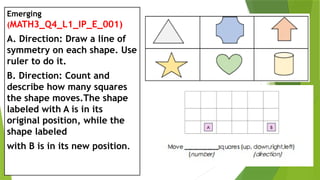
Emerging
(MATH3_Q4_L1_IP_E_001)
A. Direction: Drawa line of
symmetry on each shape. Use
ruler to do it.
B. Direction: Count and
describe how many squares
the shape moves.The shape
labeled with A is in its
original position, while the
shape labeled
with B is in its new position.
49.
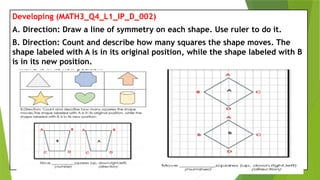
Developing (MATH3_Q4_L1_IP_D_002)
A. Direction:Draw a line of symmetry on each shape. Use ruler to do it.
B. Direction: Count and describe how many squares the shape moves. The
shape labeled with A is in its original position, while the shape labeled with B
is in its new position.
50.
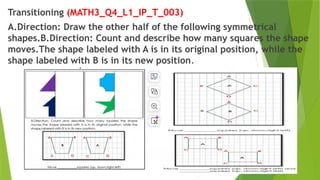
Transitioning (MATH3_Q4_L1_IP_T_003)
A.Direction: Drawthe other half of the following symmetrical
shapes.B.Direction: Count and describe how many squares the shape
moves.The shape labeled with A is in its original position, while the
shape labeled with B is in its new position.
51.
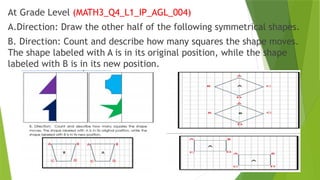
At Grade Level(MATH3_Q4_L1_IP_AGL_004)
A.Direction: Draw the other half of the following symmetrical shapes.
B. Direction: Count and describe how many squares the shape moves.
The shape labeled with A is in its original position, while the shape
labeled with B is in its new position.



 Most read