ICSSR Mini/Major ProjectProposal
Principal Investigator: Dr. R. Santhoshkumar
Professor and Head
Department of CSE
Sree Dattha Group of Institutions
2.
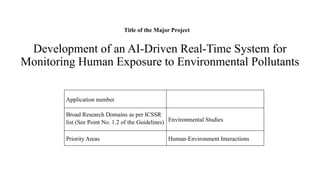
Development of anAI-Driven Real-Time System for
Monitoring Human Exposure to Environmental Pollutants
Application number
Broad Research Domains as per ICSSR
list (See Point No. 1.2 of the Guidelines) Environmental Studies
Priority Areas Human-Environment Interactions
Title of the Major Project
3.
Abstract
• Human exposureto environmental pollutants has emerged as a critical public health and
developmental challenge, particularly in rapidly urbanizing regions of India. Existing
monitoring systems, predominantly based on fixed-location stations and intermittent
manual sampling, offer limited spatial and temporal resolution. As a result, real exposure
levels experienced by individuals and communities often remain poorly understood. To
address this gap, the proposed project aims to develop an AI-driven real-time system for
monitoring human exposure to environmental pollutants, integrating advanced sensing
technologies, machine learning analytics, and socio-environmental data.
• The system will utilize IoT-enabled multi-pollutant sensors to collect continuous data on
key air and water contaminants, including particulate matter (PM2.5, PM10), NO , CO,
₂
VOCs, and heavy metal indicators. Complementary datasets—from satellite observations,
meteorological stations, and human activity logs—will be combined to create a
multidimensional exposure profile. Artificial intelligence algorithms, including deep
learning models and spatio-temporal analytics, will be employed for pollutant forecasting,
hotspot detection, anomaly identification, and exposure risk assessment across diverse
micro-environments.
4.
Abstract
• The projectalso incorporates a strong social science component by capturing behavioural,
demographic, and occupational factors that influence individual exposure patterns. The
resulting dataset will feed into a cloud-based analytics platform and an interactive
dashboard designed for policymakers, researchers, and local governance bodies. This
system will enable timely alerts, personalized exposure insights, and evidence-based
environmental decision-making.
• The outcome of this research project will be a scalable, cost-effective, and community-
centric monitoring framework that strengthens environmental governance and public
health surveillance. Beyond generating scientific insights, the project aims to empower
urban planners, health officials, and vulnerable communities with actionable information,
contributing directly to sustainable cities, climate resilience, and improved environmental
health outcomes.
5.
Introduction, Theoretical Frameworkand Scope of the Proposed Research
• Human exposure to environmental pollutants has intensified over the past decade due to
rapid urbanization, industrial growth, increased vehicular emissions, and deteriorating
ecological systems. India, in particular, faces a disproportionate burden of pollution-
related diseases, with several metropolitan regions ranking among the world’s most
polluted cities. Traditional monitoring frameworks based on fixed air quality stations and
periodic sampling offer valuable but limited insights, failing to capture micro-level
variability and dynamic exposure patterns that individuals experience throughout the day.
• Advancements in artificial intelligence (AI), Internet of Things (IoT), and spatial
analytics have created new possibilities for real-time environmental monitoring. AI-
driven systems can integrate large, complex datasets, detect hidden patterns, and generate
predictive insights far beyond the capabilities of conventional methods. By merging
environmental science with computational modelling and social behavioural research,
this project aims to develop a comprehensive AI-enabled system that accurately monitors
and interprets human exposure to key pollutants, supporting public health strategies and
environmental governance.
6.
Introduction, Theoretical Frameworkand Scope of the Proposed Research
• The proposed research is grounded in a multidisciplinary theoretical framework combining
Human–Environment Interaction Theory, Environmental Exposure Assessment
Models, and AI-based Predictive Analytics.
• Human–Environment Interaction Theory explains how environmental conditions
influence health, behaviour, and well-being, while human activities simultaneously alter
environmental quality. This reciprocal relationship forms the foundation for understanding
individual exposure variability.
• Environmental Exposure Assessment Models—including microenvironment models,
time-activity patterns, and pollutant dispersion theories—provide scientific methods for
quantifying pollutant levels across indoor and outdoor settings. These models guide sensor
placement, data interpretation, and exposure calibration.
• AI and Predictive Analytics introduce machine learning, deep neural networks, and
spatio-temporal modelling techniques to process continuous sensor data, predict future
exposure risks, and identify pollution hotspots. Integrating these computational approaches
enhances the system’s ability to provide real-time decision support.
7.
Introduction, Theoretical Frameworkand Scope of the Proposed Research
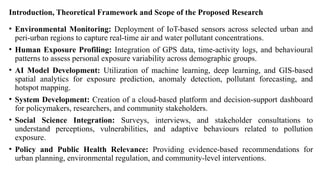
• Environmental Monitoring: Deployment of IoT-based sensors across selected urban and
peri-urban regions to capture real-time air and water pollutant concentrations.
• Human Exposure Profiling: Integration of GPS data, time-activity logs, and behavioural
patterns to assess personal exposure variability across demographic groups.
• AI Model Development: Utilization of machine learning, deep learning, and GIS-based
spatial analytics for exposure prediction, anomaly detection, pollutant forecasting, and
hotspot mapping.
• System Development: Creation of a cloud-based platform and decision-support dashboard
for policymakers, researchers, and community stakeholders.
• Social Science Integration: Surveys, interviews, and stakeholder consultations to
understand perceptions, vulnerabilities, and adaptive behaviours related to pollution
exposure.
• Policy and Public Health Relevance: Providing evidence-based recommendations for
urban planning, environmental regulation, and community-level interventions.
8.
Review of KeyResearch Works for the Proposed Research
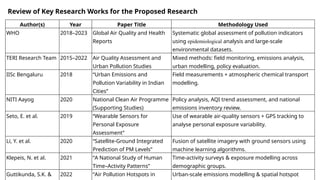
Author(s) Year Paper Title Methodology Used
WHO 2018–2023 Global Air Quality and Health
Reports
Systematic global assessment of pollution indicators
using epidemiological analysis and large-scale
environmental datasets.
TERI Research Team 2015–2022 Air Quality Assessment and
Urban Pollution Studies
Mixed methods: field monitoring, emissions analysis,
urban modelling, policy evaluation.
IISc Bengaluru 2018 “Urban Emissions and
Pollution Variability in Indian
Cities”
Field measurements + atmospheric chemical transport
modelling.
NITI Aayog 2020 National Clean Air Programme
(Supporting Studies)
Policy analysis, AQI trend assessment, and national
emissions inventory review.
Seto, E. et al. 2019 “Wearable Sensors for
Personal Exposure
Assessment”
Use of wearable air-quality sensors + GPS tracking to
analyse personal exposure variability.
Li, Y. et al. 2020 “Satellite-Ground Integrated
Prediction of PM Levels”
Fusion of satellite imagery with ground sensors using
machine learning algorithms.
Klepeis, N. et al. 2021 “A National Study of Human
Time–Activity Patterns”
Time-activity surveys & exposure modelling across
demographic groups.
Guttikunda, S.K. & 2022 “Air Pollution Hotspots in Urban-scale emissions modelling & spatial hotspot
9.
Identification of ResearchGap
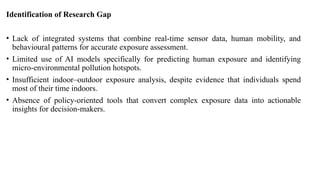
• Lack of integrated systems that combine real-time sensor data, human mobility, and
behavioural patterns for accurate exposure assessment.
• Limited use of AI models specifically for predicting human exposure and identifying
micro-environmental pollution hotspots.
• Insufficient indoor–outdoor exposure analysis, despite evidence that individuals spend
most of their time indoors.
• Absence of policy-oriented tools that convert complex exposure data into actionable
insights for decision-makers.
10.
Objectives of theProposed Research
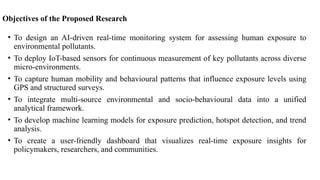
• To design an AI-driven real-time monitoring system for assessing human exposure to
environmental pollutants.
• To deploy IoT-based sensors for continuous measurement of key pollutants across diverse
micro-environments.
• To capture human mobility and behavioural patterns that influence exposure levels using
GPS and structured surveys.
• To integrate multi-source environmental and socio-behavioural data into a unified
analytical framework.
• To develop machine learning models for exposure prediction, hotspot detection, and trend
analysis.
• To create a user-friendly dashboard that visualizes real-time exposure insights for
policymakers, researchers, and communities.
11.
Major Research Questionsand, If Applicable Hypotheses
• How do pollutant levels vary across different micro-environments (indoor, outdoor,
transit) in the selected study regions?
• To what extent do human mobility patterns and daily activities influence real-time
exposure to environmental pollutants?
• Can AI and machine learning models accurately predict exposure risks and identify
pollution hotspots?
• How can real-time exposure data be transformed into actionable insights for
policymakers, health officials, and communities?
12.
Proposed Methodology forthe Research Work
• Deploy IoT-based multi-pollutant sensors across selected study locations to collect
continuous indoor and outdoor environmental data.
• Collect human mobility and time-activity information using GPS-enabled devices and
structured questionnaires.
• Conduct socio-demographic and behavioural surveys to understand factors influencing
individual exposure patterns.
• Integrate environmental, behavioural, and secondary datasets into a centralized cloud-based
database for unified analysis.
• Develop AI/ML models for exposure prediction, anomaly detection, and spatio-temporal
hotspot identification.
• Use GIS mapping and dashboard visualization tools to present real-time exposure insights
for policymakers and community stakeholders.
13.
Innovation/Path-Breaking Aspects ofthe Proposed Research
• Integrates AI, IoT sensors, and GIS into a unified framework for real-time human exposure
assessment.
• Combines indoor–outdoor pollutant monitoring to capture micro-environmental variations
usually missed by traditional systems.
• Uses wearable/mobile tracking technologies to link human mobility and behaviour with
actual pollutant exposure.
• Employs advanced machine learning models for exposure prediction, hotspot detection, and
temporal forecasting.
• Develops a cloud-based interactive dashboard for instant visualization and decision-making
support.
• Creates an open-access exposure dataset enabling future research, policy planning, and
innovation in environmental health.
14.
Expected Output
• AI-DrivenReal-Time Monitoring System capable of continuous exposure
measurement.
• Spatial exposure maps useful for city planners and health departments.
• Predictive analytics models to forecast pollution risks.
• Identification of vulnerable groups and high-risk hotspots.
• Policy recommendations and mitigation strategies for local administrations.
• Research papers, datasets, and knowledge resources for academic use.
• A scalable prototype that can be adopted by municipalities, NGOs, and urban
governance bodies.
15.
Relevance of theProposed Research for Policy
•Supports SDG 3 (Good Health), SDG 11 (Sustainable Cities), and SDG 13 (Climate Action).
•Enables evidence-based environmental governance.
•Provides insights for health departments, urban local bodies, and disaster management
authorities.
•Enhances public awareness and behaviour modification.
•Supports environmental justice for low-income and vulnerable populations.
16.
Relevance of theProposed Research for Society
• Improves Community Health and Well-Being:
• The real-time monitoring system helps people understand and reduce their exposure to
harmful pollutants, lowering risks of respiratory, cardiovascular, and long-term health
issues.
• Empowers Citizens with Actionable Environmental Information:
• Real-time alerts and exposure insights enable individuals and families to make safer
daily decisions regarding commuting, outdoor activities, and indoor air management.
• Supports Vulnerable and At-Risk Populations:
• Identifies pollution hotspots and high-risk groups such as children, elderly people,
outdoor workers, and low-income communities, leading to targeted interventions and
support.
• Promotes Environmentally Responsible Behaviour and Awareness:
• Enhances public understanding of pollution sources, encourages sustainable lifestyle
choices, and strengthens community participation in environmental protection efforts.
17.
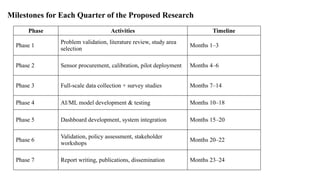
Milestones for EachQuarter of the Proposed Research
Phase Activities Timeline
Phase 1
Problem validation, literature review, study area
selection
Months 1–3
Phase 2 Sensor procurement, calibration, pilot deployment Months 4–6
Phase 3 Full-scale data collection + survey studies Months 7–14
Phase 4 AI/ML model development & testing Months 10–18
Phase 5 Dashboard development, system integration Months 15–20
Phase 6
Validation, policy assessment, stakeholder
workshops
Months 20–22
Phase 7 Report writing, publications, dissemination Months 23–24
18.
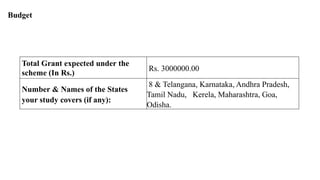
Budget
Total Grant expectedunder the
scheme (In Rs.)
Rs. 3000000.00
Number & Names of the States
your study covers (if any):
8 & Telangana, Karnataka, Andhra Pradesh,
Tamil Nadu, Kerela, Maharashtra, Goa,
Odisha.
19.
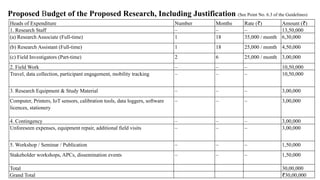
Proposed Budget ofthe Proposed Research, Including Justification (See Point No. 6.3 of the Guidelines)
Heads of Expenditure Number Months Rate ( )
₹ Amount ( )
₹
1. Research Staff – – – 13,50,000
(a) Research Associate (Full-time) 1 18 35,000 / month 6,30,000
(b) Research Assistant (Full-time) 1 18 25,000 / month 4,50,000
(c) Field Investigators (Part-time) 2 6 25,000 / month 3,00,000
2. Field Work – – – 10,50,000
Travel, data collection, participant engagement, mobility tracking – – – 10,50,000
3. Research Equipment & Study Material – – – 3,00,000
Computer, Printers, IoT sensors, calibration tools, data loggers, software
licences, stationery
– – – 3,00,000
4. Contingency – – – 3,00,000
Unforeseen expenses, equipment repair, additional field visits – – – 3,00,000
5. Workshop / Seminar / Publication – – – 1,50,000
Stakeholder workshops, APCs, dissemination events – – – 1,50,000
Total 30,00,000
Grand Total ₹30,00,000
20.
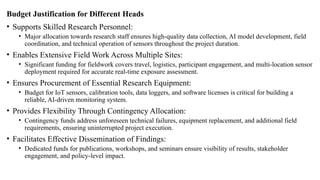
Budget Justification forDifferent Heads
• Supports Skilled Research Personnel:
• Major allocation towards research staff ensures high-quality data collection, AI model development, field
coordination, and technical operation of sensors throughout the project duration.
• Enables Extensive Field Work Across Multiple Sites:
• Significant funding for fieldwork covers travel, logistics, participant engagement, and multi-location sensor
deployment required for accurate real-time exposure assessment.
• Ensures Procurement of Essential Research Equipment:
• Budget for IoT sensors, calibration tools, data loggers, and software licenses is critical for building a
reliable, AI-driven monitoring system.
• Provides Flexibility Through Contingency Allocation:
• Contingency funds address unforeseen technical failures, equipment replacement, and additional field
requirements, ensuring uninterrupted project execution.
• Facilitates Effective Dissemination of Findings:
• Dedicated funds for publications, workshops, and seminars ensure visibility of results, stakeholder
engagement, and policy-level impact.

 Most read