HYPERTENSION – NURSING NOTES
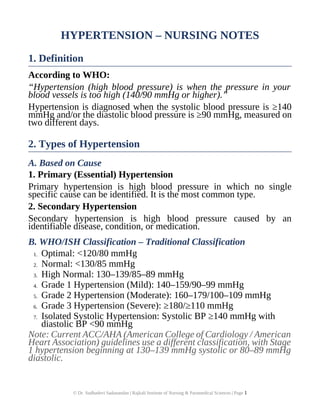
1. Definition
According to WHO:
“Hypertension (high blood pressure) is when the pressure in your
blood vessels is too high (140/90 mmHg or higher).”
Hypertension is diagnosed when the systolic blood pressure is ≥140
mmHg and/or the diastolic blood pressure is ≥90 mmHg, measured on
two different days.
2. Types of Hypertension
A. Based on Cause
1. Primary (Essential) Hypertension
Primary hypertension is high blood pressure in which no single
specific cause can be identified. It is the most common type.
2. Secondary Hypertension
Secondary hypertension is high blood pressure caused by an
identifiable disease, condition, or medication.
B. WHO/ISH Classification – Traditional Classification
1. Optimal: <120/80 mmHg
2. Normal: <130/85 mmHg
3. High Normal: 130–139/85–89 mmHg
4. Grade 1 Hypertension (Mild): 140–159/90–99 mmHg
5. Grade 2 Hypertension (Moderate): 160–179/100–109 mmHg
6. Grade 3 Hypertension (Severe): ≥180/≥110 mmHg
7. Isolated Systolic Hypertension: Systolic BP ≥140 mmHg with
diastolic BP <90 mmHg
Note: Current ACC/AHA (American College of Cardiology / American
Heart Association) guidelines use a different classification, with Stage
1 hypertension beginning at 130–139 mmHg systolic or 80–89 mmHg
diastolic.
© Dr. Sudhadevi Sadanandan | Rajkali Institute of Nursing & Paramedical Sciences | Page 1
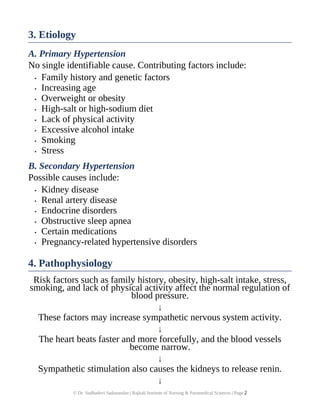
3. Etiology
A. Primary Hypertension
No single identifiable cause. Contributing factors include:
• Family history and genetic factors
• Increasing age
• Overweight or obesity
• High-salt or high-sodium diet
• Lack of physical activity
• Excessive alcohol intake
• Smoking
• Stress
B. Secondary Hypertension
Possible causes include:
• Kidney disease
• Renal artery disease
• Endocrine disorders
• Obstructive sleep apnea
• Certain medications
• Pregnancy-related hypertensive disorders
4. Pathophysiology
Risk factors such as family history, obesity, high-salt intake, stress,
smoking, and lack of physical activity affect the normal regulation of
blood pressure.
↓
These factors may increase sympathetic nervous system activity.
↓
The heart beats faster and more forcefully, and the blood vessels
become narrow.
↓
Sympathetic stimulation also causes the kidneys to release renin.
↓
© Dr. Sudhadevi Sadanandan | Rajkali Institute of Nursing & Paramedical Sciences | Page 2
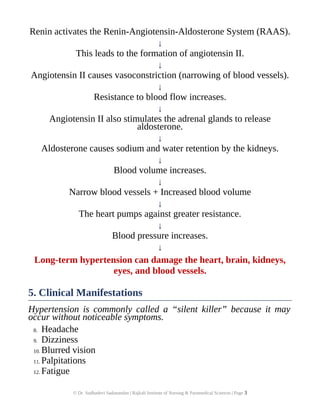
Renin activates the Renin-Angiotensin-Aldosterone System (RAAS).
↓
This leads to the formation of angiotensin II.
↓
Angiotensin II causes vasoconstriction (narrowing of blood vessels).
↓
Resistance to blood flow increases.
↓
Angiotensin II also stimulates the adrenal glands to release
aldosterone.
↓
Aldosterone causes sodium and water retention by the kidneys.
↓
Blood volume increases.
↓
Narrow blood vessels + Increased blood volume
↓
The heart pumps against greater resistance.
↓
Blood pressure increases.
↓
Long-term hypertension can damage the heart, brain, kidneys,
eyes, and blood vessels.
5. Clinical Manifestations
Hypertension is commonly called a “silent killer” because it may
occur without noticeable symptoms.
8. Headache
9. Dizziness
10. Blurred vision
11. Palpitations
12. Fatigue
© Dr. Sudhadevi Sadanandan | Rajkali Institute of Nursing & Paramedical Sciences | Page 3
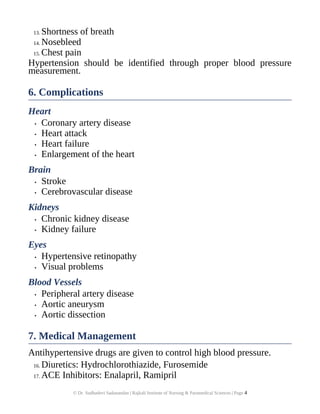
13. Shortness of breath
14. Nosebleed
15. Chest pain
Hypertension should be identified through proper blood pressure
measurement.
6. Complications
Heart
• Coronary artery disease
• Heart attack
• Heart failure
• Enlargement of the heart
Brain
• Stroke
• Cerebrovascular disease
Kidneys
• Chronic kidney disease
• Kidney failure
Eyes
• Hypertensive retinopathy
• Visual problems
Blood Vessels
• Peripheral artery disease
• Aortic aneurysm
• Aortic dissection
7. Medical Management
Antihypertensive drugs are given to control high blood pressure.
16. Diuretics: Hydrochlorothiazide, Furosemide
17. ACE Inhibitors: Enalapril, Ramipril
© Dr. Sudhadevi Sadanandan | Rajkali Institute of Nursing & Paramedical Sciences | Page 4
18. Angiotensin II Receptor Blockers (ARBs): Losartan, Telmisartan
19. Calcium Channel Blockers (CCBs): Amlodipine, Nifedipine
20. Beta Blockers: Atenolol, Metoprolol
21. Alpha-1 Blockers: Prazosin, Doxazosin
22. Central-Acting Drugs: Clonidine, Methyldopa
23. Direct Vasodilators: Hydralazine, Minoxidil
24. Direct Renin Inhibitor: Aliskiren
8. Blood Pressure Measurement
25. Allow the patient to rest for 5 minutes.
26. Keep the patient sitting comfortably with feet flat on the floor.
27. Support the arm at heart level.
28. Use the correct cuff size on the bare upper arm.
29. Ask the patient not to talk during measurement.
30. Measure and record BP accurately.
9. Nursing Management
31. Monitor BP regularly and record the readings.
32. Assess for headache, dizziness, chest pain, breathing difficulty,
and visual or neurological changes.
33. Administer antihypertensive drugs as prescribed and observe for
side effects.
34. Monitor kidney function, fluid balance, and electrolytes as
ordered.
35. Provide a low-salt, healthy diet and support appropriate weight
management.
36. Promote regular physical activity according to the patient's
condition.
37. Advise smoking cessation and limitation of alcohol.
38. Teach regular medication use and advise not to stop medicines
without medical advice.
39. Check for postural hypotension, particularly when dizziness
occurs.
40. Promote regular follow-up and home BP monitoring when
advised.
© Dr. Sudhadevi Sadanandan | Rajkali Institute of Nursing & Paramedical Sciences | Page 5
41. Observe for complications involving the heart, brain, kidneys,
eyes, and blood vessels.
10. DASH Diet
DASH – Dietary Approaches to Stop Hypertension
Include
• Fruits and vegetables
• Whole grains
• Low-fat dairy products
• Beans and nuts
• Fish and lean meat
Limit
• Salt and sodium
• Saturated fat
• Sugary foods and drinks
11. Nursing Diagnosis
Ineffective Health Self-Management Related to: Difficulty
following treatment As evidenced by: Not taking medicines regularly
and not checking blood pressure regularly.
12. Important Formula
Blood Pressure = Cardiac Output × Peripheral Vascular
Resistance
Cardiac Output: Amount of blood pumped by the heart in one minute.
Peripheral Vascular Resistance: Resistance offered by the blood
vessels to the flow of blood.
© Dr. Sudhadevi Sadanandan | Rajkali Institute of Nursing & Paramedical Sciences | Page 6