Hybridoma Technology and Genetic Engineering Applications in Human Health
Explore hybridoma technology for monoclonal antibody production and genetic engineering's role in disease treatment, diagnostics, and pharmaceutical development in modern medicine.
Hybridoma Technology and Genetic Engineering Applications in Human Health
1.
JAI NARAIN VYASUNIVERSITY
Department of zoology
HYBRIDOMA TECHNOLOGY & APPLICATION OF
GENETIC ENGINEERING IN HUMAN
SUBMITTED BY : SUBMITTED TO :
Mitali Singh Panwar PROF.Dhirendra
Choudhary
INTRODUCTION
Genetic engineeringis the modification of
an organism’s DNA to achieve desired
traits.
It uses technique like recombinant DNA
technology.
One key advancement is hybridoma
technology.
4.
HYBRIDOMA TECHNOLOGY
• Hybridomatechnology is a method used to
produce monoclonal antibodies.
• It involves the fusion of :
o Antibody – producing B-lymphocytes .( B
cells).
o Immortal myeloma ( cancer ) cells.
• The fused cell is called hybridoma cell.
5.
• Hybridomas can:
o Grow indefinitely.
o Produce specific antibodies
continuously.
• Devloped by Georges Kohler and
Cesar Milstein in 1975.
• This making is very useful in medical
and research applications.
6.
NEED FOR HYBRIDOMA
Traditional antibodies = mixed
(polyclonal).
Need for –
o Specificity
o Consistency
o Large – scale production.
7.
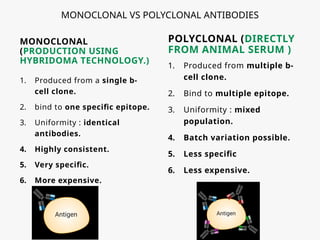
MONOCLONAL VS POLYCLONALANTIBODIES
MONOCLONAL
(PRODUCTION USING
HYBRIDOMA TECHNOLOGY.)
1. Produced from a single b-
cell clone.
2. bind to one specific epitope.
3. Uniformity : identical
antibodies.
4. Highly consistent.
5. Very specific.
6. More expensive.
POLYCLONAL (DIRECTLY
FROM ANIMAL SERUM )
1. Produced from multiple b-
cell clone.
2. Bind to multiple epitope.
3. Uniformity : mixed
population.
4. Batch variation possible.
5. Less specific
6. Less expensive.
8.
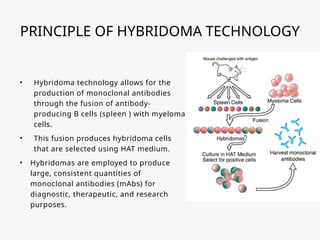
PRINCIPLE OF HYBRIDOMATECHNOLOGY
• Hybridoma technology allows for the
production of monoclonal antibodies
through the fusion of antibody-
producing B cells (spleen ) with myeloma
cells.
• This fusion produces hybridoma cells
that are selected using HAT medium.
• Hybridomas are employed to produce
large, consistent quantities of
monoclonal antibodies (mAbs) for
diagnostic, therapeutic, and research
purposes.
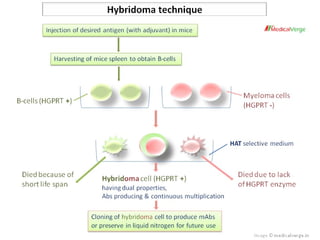
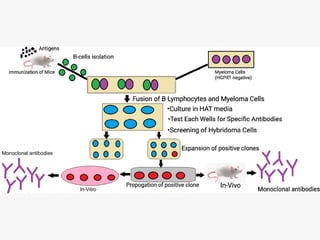
1. immunization :
•Inject antigen (protein/foreign substance ) into
mouse.
• Immune system stimulates B-cell production.
• B –cells produce antibodies against the antigen.
• Spleen is removed to collect B-cells.
2. Cell fusion :
• B -cells isolated from spleen.
• Myeloma cell ( cancer cells ) taken from culture.
• Myeloma cells can divide continuously but don’t
produce antibodies.
11.
• B-cells +myeloma cells fused using PEG medium.
(polyethylene glycol )
• Forms hybridoma cells.
• Hybridoma =
o Antibody – producing ability (from B cells.)
o Immortality (from myeloma cells.)
3. Selection (HAT MEDIUM ) { to select only hybrid cells.}
• Cells grown in HAT MEDIUM (hypoxanthine –aminopterin-
thymidine).
• Results : unfused B cells – die naturally.
unfused myeloma cells – cannot survive in
HAT.
Only hybridoma cells survive.
12.
• Before ,multiplication of antibody it has to synthesize
new copy of DNA and for that it require synthesis of
nucleotide.
• For nucleotide synthesis there are two main pathways;
1) De novo pathway
2) Salvage pathway (backup pathway )
• Aminopterin is added in HAT MEDIUM , it blocks DE
NOVO PATHWAY.
• Now, cells must depend on SALVAGE PATHWAY to
survive ; it requires a enzyme HGPRT ( Hypoxanthine –
guanine Phosphoribosyl transferase.
13.
• During myelomacell culture , some modifications
made and they do not contain HGPRT enzyme, so
they cannot use salvage pathway.
B cells (normal): have HGPRT , but they do not
live long not more than one week.
Myeloma cell (cancer ):they do not have
HGPRT ,but they also not survive as no dna
synthesis.
Hybridoma cell : get HGPRT from B Cells and
immortality from myeloma. So, they survive and
grow.
15.
4. Screening :identify hybridomas producing desired antibody .
• Methods – ELISA & Immunoassay
• Only specific-antibody producing cells selected.
5.Cloning :
• Single hybridoma cell is isolated .
• Allowed to multiply -> forms identical clones .
• Ensure monoclonal antibody production.
6. Mass production :
• Selected hybridoma cultured in :
o Bioreactors (in vitro)
o Mouse (in vivo ).
• Large quantities of antibody collected.
16.
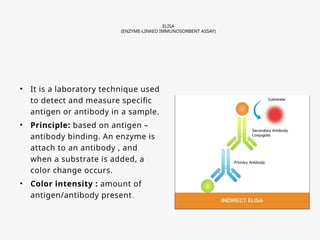
ELISA
(ENZYME-LINKED IMMUNOSORBENT ASSAY)
•It is a laboratory technique used
to detect and measure specific
antigen or antibody in a sample.
• Principle: based on antigen –
antibody binding. An enzyme is
attach to an antibody , and
when a substrate is added, a
color change occurs.
• Color intensity : amount of
antigen/antibody present..
17.
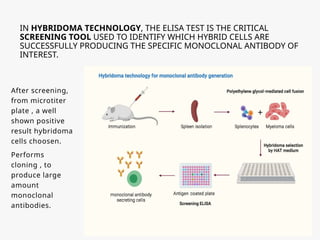
IN HYBRIDOMA TECHNOLOGY,THE ELISA TEST IS THE CRITICAL
SCREENING TOOL USED TO IDENTIFY WHICH HYBRID CELLS ARE
SUCCESSFULLY PRODUCING THE SPECIFIC MONOCLONAL ANTIBODY OF
INTEREST.
After screening,
from microtiter
plate , a well
shown positive
result hybridoma
cells choosen.
Performs
cloning , to
produce large
amount
monoclonal
antibodies.
19.
APPLICATION OF HYBRIDOMATECHNOLOGY
Clinical Testing: Used in kits to detect hormones (pregnancy
tests), viruses (COVID-19, HIV, Hepatitis), and bacteria.
Imaging: mAbs can be tagged with radioactive tracers to locate
tumors or blood clots inside the body using PET or MRI scans.
Cancer Therapy: Drugs like Rituximab or Herceptin target
specific proteins on cancer cells, marking them for destruction
by the immune system or delivering toxic drugs directly to them.
Protein Purification: mAbs are used in "affinity
chromatography" to pull a single specific protein out of a
complex mixture of thousands.
20.
GENETIC ENGINEERING
APPLICATIONS INHUMANS
Genetic engineering applications in humans range
from curing hereditary diseases to producing life-
saving medications.
Medical and Therapeutic Applications:
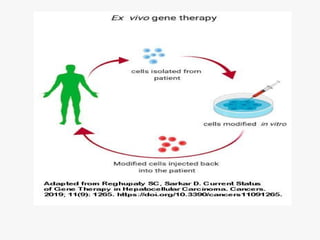
• Gene therapy : This involves inserting a functional
gene into a patient's cells to replace a defective one.
It is used to treat disorders like cystic fibrosis,
hemophilia, and certain types of inherited blindness.
22.
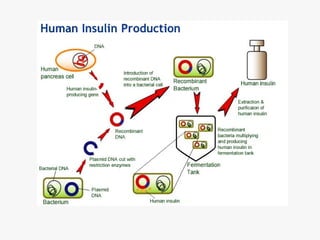
• Production ofPharmaceuticals: Genetic engineering
allows for the mass production of human proteins.
Insulin: Humulin was the first medication produced via
recombinant DNA technology for diabetes management.
Growth Hormones: Used to treat growth disorders in
children.
Clotting Factors: Essential for patients with hemophilia
to prevent life-threatening bleeding.
• Vaccine Development: Modern vaccines, such as
those for Hepatitis B and some COVID-19 vaccines, use
genetic engineering to trigger an immune response
without using the live virus.
24.
• Genetic Screeningand Diagnostics: Engineering
tools help identify genetic predispositions to
diseases like breast cancer (BRCA1/2 mutations),
allowing for proactive medical intervention.
• Personalized medicine : treatment based on
person’s genetic makeup.
doctor can choose the best drug and dose.
reduce side effects and increases effectiveness.
• Study of human genes(research ) : understand
gene function , study genetic disorder and devlop
new therapies.
25.
CONCLUSION : HYBRIDOMATECHNOLOGY AND GENETIC
ENGINEERING HAVE SIGNIFICANTLY ADVANCED
MODERN MEDICINE AND BIOTECHNOLOGY .
HYBRIDOMA TECHNOLOGY ENABLES THE PRODUCTION
OF HIGHLY SPECIFIC MONOCLONAL ANTIBODIES FOR
DIAGNOSIS AND THERAPY, WHILE GENETIC
ENGINEERING ALLOW GENE MANIPULATION FOR
DISEASES TREATMENT , DRUG PRODUCTION , AND
IMPROVE HEALTHCARE.
TOGETHER, THESE TECHNOLOGIES PLAY A VITAL ROLE
IN EARLY DIAGNOSIS , TARGETED TREATMENT , AND
THE DEVELOPMENT OF SAFER AND MORE EFFECTIVE
MEDICAL SOLUTIONS , SHAPING THE FUTURE OF
HUMAN HEALTH.
thankyou
 Most read
 Most read
 Most read